
The Amalfi Coast rewards early risers and punishes the sleep-deprived. By day, the SS163 clings to cliffs above a sea that shifts from sapphire to jade; by night, the same road carries the hum of late scooters, and Positano's bars send music uphill long after dinner. For travellers aged 50 to 70 who measure a holiday in restful nights rather than crowded piazzas, the choice of hotel matters more than the choice of town. This guide focuses on properties set back from the ferry-dock bustle and the nightlife, where gardens, sea outlooks and quiet rooms do the work that blackout curtains alone cannot.
Quiet on this coast is rarely absolute. It is a negotiated peace, won by choosing the right hamlet, the right hillside and the right room within a property. Praiano, Ravello, Conca dei Marini and the upper reaches of Positano deliver the most consistent sleep quality, while the waterfront cores of Positano and Amalfi demand more careful room selection. The properties below are documented for specific comfort details, and each comes with honest planning notes about what is not yet known.
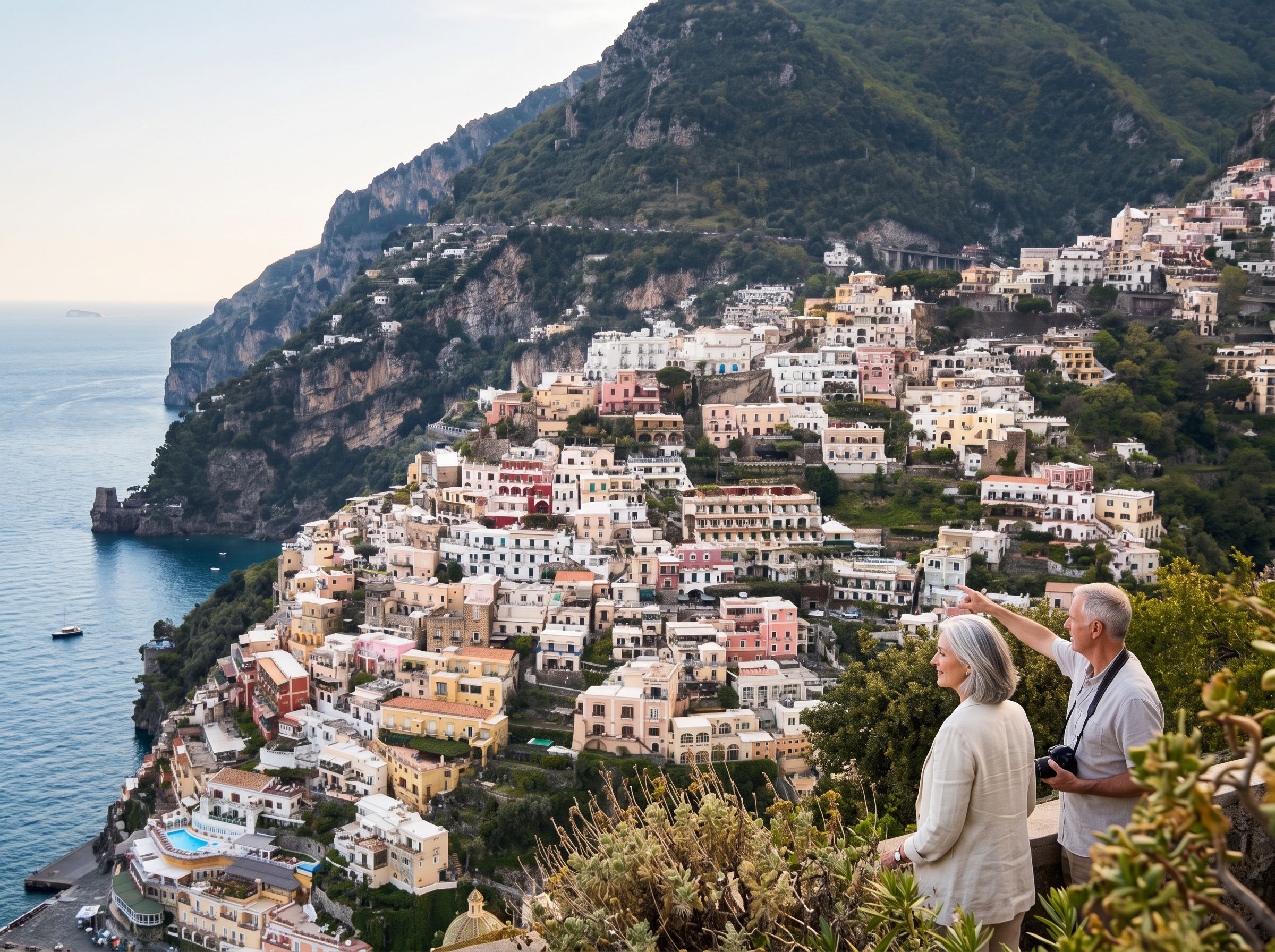 AI-edited
Which areas of the coast are quietest at night?
Praiano, Ravello, Conca dei Marini and the upper hamlets of Positano (Nocelle and Arienzo) are the most consistently documented quiet bases, while the waterfront cores of Positano and Amalfi carry the highest noise risk from bars, ferries and the coast road.
Traveller feedback across forums and review platforms repeatedly describes Praiano as "quieter than Amalfi or Positano" and "centrally located while avoiding large crowds." One forum contributor called a stay in Conca dei Marini "very quiet, non-touristy," while another said Furore was "nice and quiet" even if it meant taking a bus or paying for rides into town. Ravello draws the strongest language: a Fodors forum post called it "much quieter than Positano or Amalfi," better for "leisurely mornings, extended lunches, and peaceful evenings." The same post noted Ravello was "so quiet it was almost dead" in the first weekend of August, a detail worth weighing if you want some life around you.
Within Positano itself, a Fodors forum post names Nocelle and Arienzo as "truly quiet," with Nocelle reachable by local bus in about 12 minutes. These hamlets sit above the main town, which means nearly everything involves stairs and slopes; the town has no flat routes, as multiple sources confirm. For a broader comparison of which town suits your priorities, see our town-by-town guide to choosing your base.
Borgo Santandrea: cliffside calm between Amalfi and Conca dei Marini
Borgo Santandrea sits 79 to 50 metres above sea level on the cliff between Amalfi and Conca dei Marini, and its own materials describe the property as "a serene haven"; it documents the strongest accessibility package among the properties reviewed here.
The hotel's position, set into the rock rather than along a busy street, is its first defence against noise. The operator's own site describes it as "a serene haven in the heart of the Amalfi Coast," and for 2024 the property announced three new cliffside suites, a spa and wellness offer, a boutique and a "Borgo Fleet" of boats for transfers and excursions, designed specifically to avoid road traffic. That last detail matters for light sleepers: arriving by sea bypasses the SS163 altogether.
For guests with mobility considerations, the documented details are specific. The setting is steep, which is part of its quiet charm, but the operator does not publish step counts from road to reception. Ask when booking if you need that figure. The property does not document proximity to public transport or restaurants, so plan for that.
Hotel Il Nido, Amalfi: sea views above the town's hubbub
Hotel Il Nido sits above Amalfi with a documented 10 to 15 minute walk down to the town centre, a bus stop directly in front, and guest feedback consistently praising the sea views and quiet sleep; the walk involves a road with traffic and steps.
Guest reviews on Google, where the hotel holds a 4.7 out of 5 rating from 243 reviews as of September 2026, repeatedly describe the views from rooms, balconies and the breakfast room as stunning and postcard-like. Another, in September 2025, called it "one of the most beautiful and wonderful hotels I have stayed in."
The hotel's elevation is its quiet advantage. Being above the town means the ferry-dock bustle and evening bar noise stay below. The documented trade-off is the walk: about 10 to 15 minutes to the centre, partly along a road with traffic and involving steps. Staff are repeatedly described as helping with luggage, and the private parking on site is noted as a convenience for guests with cars. The property is named in the source set as one of four documented accessibility standouts, though the specific features are not published. Confirm lift access and step-free routes when booking.
"Really good location just a short walk into town; we had a gorgeous view from our balcony, it felt like a private villa it was so quaint and well decorated. The beds were so comfortable."
Guest review on Google, June 2026
Palazzo Suriano Heritage Hotel, Vietri sul Mare: quiet at the coast's eastern edge
Palazzo Suriano Heritage Hotel in Vietri sul Mare documents elevator access to upper floors and a walk-in shower, placing it at the quieter eastern end of the coast where the crowds thin out.
Vietri sul Mare sits at the eastern gateway of the Amalfi Coast, famous for its maiolica ceramics and noticeably less frenetic than Positano or central Amalfi. The property's documented accessibility details are specific: elevator access to upper floors and a walk-in shower in at least one room category. What the material does not state is room-by-room quietness or noise levels, so treat the town's calm as the primary asset and confirm specific room placement when booking.
For light sleepers, the eastern position has a practical benefit: it is the first town reached from Salerno, which means less time on the winding SS163 and easier access to the larger hospital and transport hub of Salerno if needed. The trade-off is distance from the iconic Positano views, which matters if you plan day trips. The UNESCO World Heritage status that protects the whole coast, inscribed in 1997 as a cultural landscape, applies as much to Vietri's ceramic traditions as to the cliffs further west, as the official UNESCO Amalfi Coast site describes.
Il Barilotto del Nonno, Positano: quiet at a documented distance
Il Barilotto del Nonno sits 1.2 miles from Positano centre at Via Laurito 13/15, with a documented elevator, upper floors accessible by elevator and a large walk-in shower; the distance from the centre is its quiet advantage.
This property answers the traveller who wants to be in Positano for the views but not in the middle of its nightlife. That distance, combined with the Laurito area's residential character, is what makes it viable for light sleepers. The documented accessibility details are solid: an elevator serves the upper floors, and at least one room has a large walk-in shower.
What is not documented is equally important. The material does not publish step counts, terrain details or noise levels for this exact property. Positano's hills are steep, and the town has no flat routes, so confirm the walk from the road to reception and the nature of the surrounding lanes when booking. The property's distance from the centre means you will rely on taxis, the local bus or your own willingness to climb for dinners and day trips.
Hotel Le Agavi, Positano: lift access to a private beach
Hotel Le Agavi in Positano documents a free private beach reachable by lift, a significant advantage for mobility on a coast where beach access usually means stairs; specific quiet-room details are not published.
Le Agavi sits above Positano, away from the main beach crowds, and its documented lift down to the private beach is the kind of detail that makes a stay feasible for travellers who find Positano's famous staircases daunting. The property has on-site restaurants, which reduces the need to venture into town in the evening.
Ask for a room facing the sea rather than the access road, and confirm whether the lift reaches your floor directly. Positano's energy is part of its appeal, but for a calmer base within the same town, the upper hamlets of Nocelle and Arienzo are documented as "truly quiet" options, reachable by local bus in about 12 minutes from the centre.
What about rooms above busy lanes and the coast road?
The most common noise complaints in guest feedback across the coast involve rooms facing busy streets, paper-thin walls between rooms, and evening music from nearby bars; the SS163 and ferry-related spillover onto roads are the documented sources of traffic noise.
Guest reviews across platforms describe hearing toilet flushes and conversations through "paper thin" doors, street noise from below, rubbish collection in the early hours and evening music from local bars. These complaints cluster in properties facing the main lanes of Positano and Amalfi, not in the hillside hotels above them. The practical guidance is consistent: ask for a room away from the bar, away from the street and on an upper floor. Where walls are thin, no location saves you; where the room faces the sea, the sound of water often masks the rest.
The coast road itself is a documented noise source. The SS163 Amalfitana carries buses, scooters and delivery vehicles through the night in high season, and ferry suspensions can push road traffic to a standstill, as happened on 14 April 2025 when the road-based public transport network ground to a halt. Properties set back from the road, like those on the upper cliffs, avoid this entirely. When a hotel sits directly on the SS163, ask whether the room has double glazing and whether the road is the main bus route.
When is the coast quietest for a restful stay?
May and September are documented as the calmest months for comfortable conditions on the Amalfi Coast, and the local tourism board reports that July and August have become quieter while September and October are now the new peak period.
The Amalfi Coast district itself reported that July and August arrivals were down 8 to 10 percent versus the previous year, and that September to October had become the new peak period. This inverts the old assumption that midsummer is the busiest time. For light sleepers, this cuts both ways: September and October bring the best weather and the most crowds, while July and August, though hotter, may actually offer fewer people on the streets at night.
Climate data for Amalfi municipality shows mild winters and hot, dry summers, with average highs around 27 to 30 degrees Celsius in July and August and rainfall lowest in summer. The shoulder periods of May and September combine manageable temperatures with thinner crowds, which translates to quieter evenings and easier restaurant bookings. For a full picture of what a comfortable trip costs across these seasons, see our guide to Amalfi Coast trip costs.
What should light sleepers check before booking?
Confirm four details with any property before booking: room orientation away from bars and the road, window glazing and shutters, whether the lift reaches your floor, and the nature of the walk from the nearest transport stop.
Guest feedback across the coast shows that the difference between a restful and a restless stay often comes down to details the booking portal does not show. Blackout shutters are specifically praised in some reviews, with guests noting they provide "full blackout of windows." Quiet air conditioning is another recurring theme, with guests praising both the silence and the cooling effect. Where air conditioning is weak, as some guests reported at Hotel Il Nido during hot weather despite staff attempts to fix it, sleep suffers regardless of location.
For travellers with mobility considerations, the accessibility picture is mixed and property-specific. Borgo Santandrea documents an accessible room and a universally accessible elevator to the beach. Il Barilotto del Nonno documents an elevator and a large walk-in shower. Palazzo Suriano documents elevator access and a walk-in shower. Hotel Le Agavi documents lift access to its private beach. the property does not publish lift details, step counts or walk-in shower availability. Ask directly when booking, and be aware that "accessible" in some Italian hotel descriptions can mean only that a lift exists.
The coast's emergency infrastructure is documented for Amalfi town specifically: emergency number 112, ambulance 118, police 112 or 113, fire 115, a pharmacy on Corso Italia 131 and a hospital on Corso Italia 1. The nearest hospital to the wider coast is the Presidio Ospedaliero Costa d'Amalfi on Via Civita 70 in Ravello, a first-response facility; serious cases transfer to Sorrento, Salerno or Naples. In summer, rescue teams often respond by sea or helicopter, which can be faster than a road ambulance on the congested SS163.
How should travellers 50 to 70 book these quiet hotels?
Book directly with the property or through a platform that offers free cancellation, state your quiet-room request in writing at the time of booking, and confirm accessibility details with the hotel itself rather than relying on booking-portal labels.
The practical advice is to treat any booking portal as a starting point, then contact the property directly with your specific requirements. Guest feedback shows that staff at the better-rated quiet properties are consistently described as "very helpful" and "attentive," and that they respond well to specific requests made in advance.
For guests who need mobility assistance, the operator Rome and Italy provides accessible accommodation matching via a disability questionnaire and, on request, offers private transfers with lift-equipped vehicles, wheelchair-designed tours and rental equipment including wheelchairs, mobility scooters, shower chairs and electric beds. These services are worth knowing about before you book, not after you arrive. The coast's terrain means that a hotel's quiet location and its accessibility are often in tension; the properties documented above represent the best current evidence for balancing both.
Which quiet hotel suits which traveller?
Choose Borgo Santandrea for documented beach lift access and cliffside serenity, Hotel Il Nido for sea views above Amalfi with a bus stop at the door, Il Barilotto del Nonno for Positano with an elevator and walk-in shower at a distance from the centre, and Palazzo Suriano for the quieter eastern end of the coast.
Borgo Santandrea offers the most clearly documented accessibility package, including an accessible room and lift access down to the beach, in a setting its own materials describe as serene. Hotel Il Nido delivers the postcard views and quiet sleep that guests consistently praise, with the documented caveat of a 10 to 15 minute walk involving traffic and steps. Il Barilotto del Nonno answers the traveller who wants Positano's setting without its nightlife, at a documented 1.2 miles from the centre. Palazzo Suriano suits those who value the eastern coast's calm and need documented elevator access and a walk-in shower.
Hotel Le Agavi offers the rare combination of lift access to a private beach and an elevated position above Positano, though its specific quiet-room details are not documented. For travellers who want to understand the full landscape of choices before committing, our accessibility guide for older travellers on the Amalfi Coast covers the terrain challenges in detail, and our food guide helps plan meals around the quietest hours.
Rates across these properties are indicative and vary by season and booking channel; no published rate sheet exists, so confirm current pricing directly with each hotel. The quietest nights on the Amalfi Coast are not found by accident. They are the product of choosing the right hamlet, the right hillside and the right room, then confirming the details that booking portals never show.


