
The Amalfi Coast rewards those who plan around its terrain. For travellers aged 50 to 70, the difference between a holiday spent climbing staircases and one spent strolling seafront promenades comes down to a single decision: which town you call home. This guide compares the main bases for atmosphere, transport links, steps and steepness, and ferry access, with a frank steer toward the flatter, easier options for those who tire on stairs.
The coast is a thirty-mile ribbon of cliffs, pastel towns and lemon terraces dropping into a deep blue sea, and it is, quite simply, one of the most beautiful places in the world, according to the Senior Traveling Guide. But beauty here is vertical. Positano is built into a near-sheer cliff, where almost every route is a staircase, and the towns are strung along a narrow, twisting road that the local SITA buses crawl along, slowly and often packed. The good news is that not every town is equally steep. Some bases are genuinely flat, and ferries let you see the rest without climbing a step.
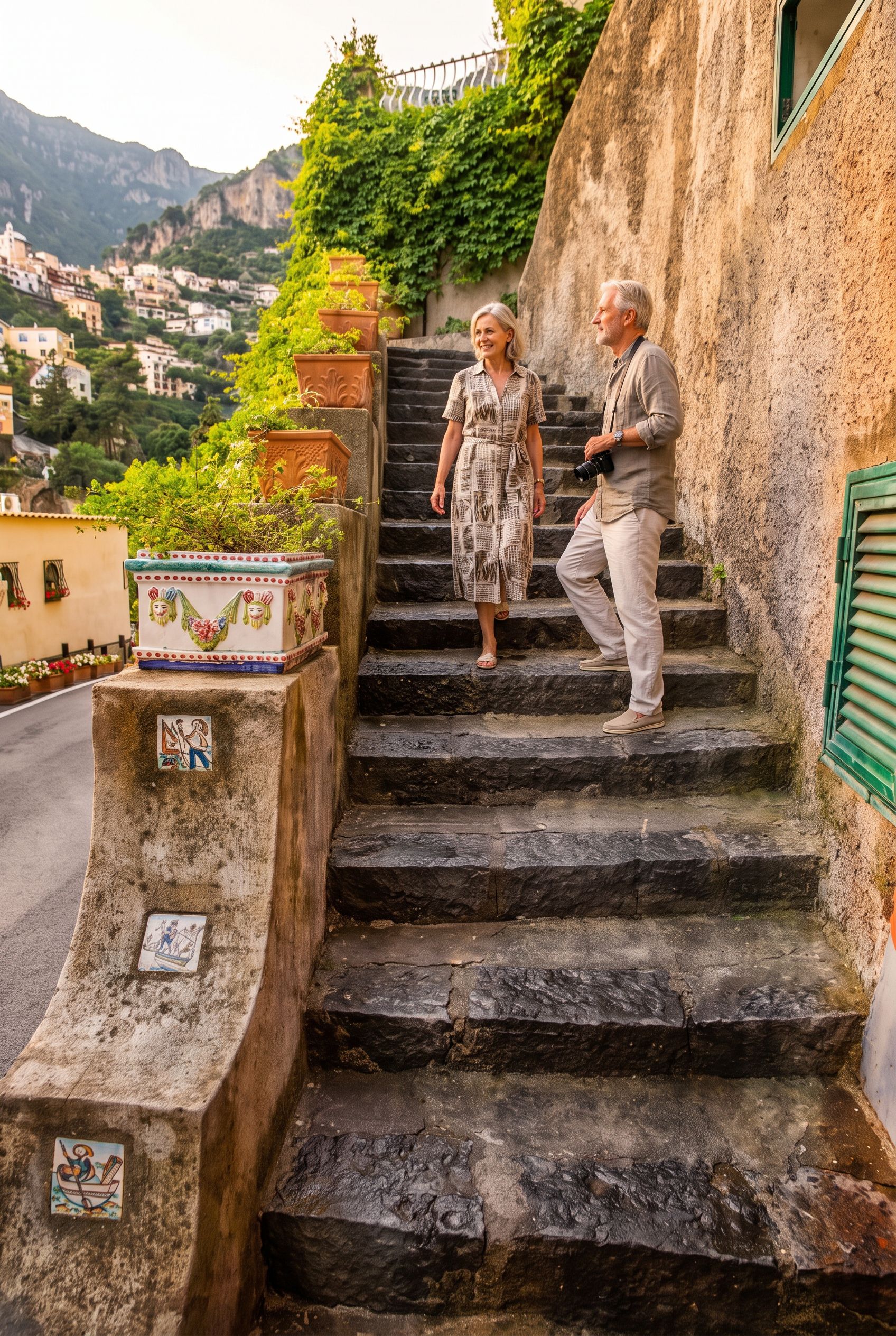 AI-edited
Which town is the flattest and easiest to walk?
Amalfi town has the most level centre of the main coast towns, with a flat seafront promenade and cathedral square, making it the clear choice for travellers who want to explore on foot without constant stairs.
Amalfi is repeatedly described as the flattest major base on the coast proper. The Senior Traveling Guide notes that the coast's namesake town has the most level centre of the lot, gathered around a pretty seafront piazza and the dramatic striped Cathedral of Saint Andrew. Disabled Accessible Travel states that Amalfi Town is one of the most accessible towns on the Amalfi Coast, located directly at sea level with reasonable access to the central part of the city, and that the pavement is mostly flat and easily rollable.
Maiori and Minori are also among the flattest towns on the coast, with gentler slopes and beach-friendly layouts. A guide for seniors from When They Get Older describes them as having accessible beachfronts and gentle slopes, offering a relaxing place to unwind with well-maintained facilities and easy entry to the sea. Sorrento, while not on the Amalfi Coast proper, is repeatedly described as the flattest and easiest overall base for older travellers doing day trips, with posters calling it flat, walkable and a hub for buses and ferries. Salerno is described as largely flat and therefore a strong mobility-friendly option, though one forum contributor reminds readers that it is a city, not a village.
How does Positano compare for steepness?
Positano is the steepest and most stair-dependent of the main towns, described by locals as the city of stairs, and is effectively inaccessible for wheelchair users in its upper reaches.
Positano is consistently described as steep, stair-based and challenging for limited mobility. Disabled Accessible Travel reports that Positano is by locals rightfully called the city of stairs, as many sights of this little village are only reachable by means of many stairs. The same source notes that the part of Positano that is most accessible to people is on and around the market square, which is cobbled but flat. A 2026 accessibility guide describes Positano as effectively inaccessible for wheelchair users.
Forum posts are blunt. A Rick Steves forum post warns Positano would be too challenging for an 85-year-old, and other contributors describe it as straight up or all stairs. If you arrive by bus, get off at the second stop to avoid some stairs; by ferry, you arrive at beach level but still face stairs if you want to see more than the waterfront. One Fodors poster suggested that if someone insists on Positano, the Best Western is on the road through town with a bus stop right at the door, presented as a more convenient location than many cliffside hotels.
Is Ravello practical for those with mobility concerns?
Ravello is quiet and upscale but sits high above the sea on a hilltop, and its terrain makes it the least practical of the main towns for reduced mobility.
Ravello is described as quiet, upscale and high above the sea, with fewer transport options than the coastal towns. When They Get Older notes that due to its hilltop location, it is wise to check accessibility in advance, particularly if stairs pose a concern. Disabled Accessible Travel reports that the main square slopes gently, has few cobbles and is easy to manoeuvre in a wheelchair or scooter, but the smaller side streets around the square and towards the gardens of Villa Cimbrone and Villa Rufolo are more complicated, filled with cobbles, stairs and quite steep sections.
An older accessibility thread reports that Ravello is not ideal if stairs are a concern. However, the famous gardens themselves are largely level once you arrive. The Senior Traveling Guide notes you can reach them by bus, taxi or private driver up from Amalfi, and once there the gardens are largely level, with benches and the finest panoramas on the coast. For those who want to see Ravello without staying there, a day trip from a flatter base works well. See our dedicated guide to the gardens and villas of Ravello for full details.
Which town has the best transport links?
Amalfi has the clearest combination of bus links, ferry access and a documented central transport hub, making it the most practical base for exploring the coast without a car.
Amalfi is the main transport hub on the coast, with its bus station at water level. The SITA bus system operates a terminal at Piazza Flavio Gioia, acting as the hub for local bus lines. A local sustainable-mobility consortium runs bookable routes linking Amalfi with Positano, Maiori and Ravello on the coast, according to Visit Amalfi's sustainable mobility page. The Green Line operates from Positano to Amalfi along State Road 163 Amalfitana, with five departures per day and intermediate stops at a cost of 10 euros each way.
Sorrento is also a strong transport hub, with train and ferry connections that make it ideal for day trips. The nearest railway station for Amalfi is Salerno, and Amalfi can be reached by bus, ferry, car, plane-linked transfers or private transport. Direct buses run from Rome's Tiburtina station to Amalfi. For full details on reaching the coast, see our guide to getting to the Amalfi Coast by air, rail and road.
| Destination | Distance by road | Driving time (clear roads) |
|---|---|---|
| Maiori | 20 km | About 40 minutes |
| Minori | 21 km | About 45 minutes |
| Amalfi | 25 km | About 50 minutes |
| Ravello | 45 km | About 50 minutes |
| Sorrento (station) | 51 km | About 55 minutes |
| Positano | 60 km | About 75 minutes |
What about ferries between the towns?
Passenger ferries link Sorrento, Positano, Amalfi and Salerno in season, offering a flat-water way to travel between towns with no steps until you arrive.
Ferries are repeatedly described as the easiest way to move between coast towns in season. The Senior Traveling Guide notes that in season, passenger ferries link Sorrento, Positano, Amalfi and Salerno, so you can travel between the towns on calm open water, with the cliffs unfolding in front of you and not a single step until you arrive. Ferries and hydrofoils also connect Salerno with Amalfi and Positano.
Many ferries have wheelchair ramps, though the exact boarding assistance and seasonal schedule vary by operator and sailing. A senior-travel guide advises travellers to base somewhere flat and see the coast by ferry, recommending Sorrento or Amalfi rather than climbing Positano. Summer weekends bring traffic that affects cars and buses but not boats, according to one forum contributor, making ferry travel the more reliable option on busy weekends.
Who should stay in each town?
Choose Amalfi for flat walking and transport links, Sorrento for the flattest terrain and day-trip hub, Maiori or Minori for quiet beaches, Positano for dramatic views if you can manage stairs, and Ravello only if you have a car and good mobility.
- Amalfi suits travellers who want the coast's most level centre, a seafront promenade, and the best bus and ferry connections. It is repeatedly described as far more accessible than Positano.
- Sorrento suits those who prioritise flat, walkable streets and easy day trips. It is not on the Amalfi Coast proper but is the easiest overall base for older travellers, with train and ferry links.
- Maiori and Minori suit travellers who want gentle slopes, beachfront layouts and a quieter pace than Amalfi or Positano.
- Positano suits travellers with good mobility who accept stairs in exchange for the coast's most dramatic setting. It is the least practical for those who tire on stairs.
- Ravello suits those who want quiet, upscale surroundings and are visiting the famous gardens. Its hilltop position makes it the least practical for reduced mobility.
- Praiano is quieter and more relaxed than Positano or Amalfi, and is the most consistently praised in reviews for peace at night.
Is Sorrento or Positano better for a base?
For travellers aged 50 to 70, Sorrento is the better base: it is flatter, more walkable and better connected, while Positano is steep and stair-based.
One Fodors post uses the phrase flatter terrain for Sorrento, and a long-running forum thread on seniors notes that both Sorrento and Amalfi have large flat areas. Sorrento is repeatedly described as the flattest and easiest overall base for older travellers doing day trips, with posters calling it flat, walkable and a hub for buses and ferries. Positano, by contrast, is described as effectively inaccessible for wheelchair users in a 2026 accessibility guide, and a Rick Steves forum post warns it would be too challenging for an 85-year-old.
By public transport, Salerno station to Sorrento station takes about 110 to 130 minutes with one change by train or coach, from the published weekday timetable for 15 September 2026. Timetables change, so check the operator before travelling. If you choose Positano anyway, one Fodors poster suggested the Best Western is on the road through town with a bus stop right at the door, a more convenient location than many cliffside hotels.
What about accessibility in specific hotels?
Several properties on the coast document specific accessibility features, including cliff elevators, walk-in showers and fully accessible rooms, but details vary and should be confirmed when booking.
Hotel Miramalfi in Amalfi is a boutique hotel where guests can reach the sun terraces and private beach by an elevator carved in the cliff, according to My Boutique Hotel. Broader accessibility details such as step-free entry and walk-in showers are not documented in the source; ask the property directly when booking.
Rome and Italy documents two wheelchair-accessible hotels in Amalfi. A five-star property about 600 metres from the centre of Amalfi has two entrances, one with steps and one fully accessible, with all public areas and rooms stated as 100% accessible, no architectural barriers, an accessible breakfast room, and a double room with roll-in shower, folding seat and grab bars.
Hotel le Rocce in Agerola, about 1.1 miles from the centre of Agerola, has disabled access, a lift, upper floors accessible by lift, and a walk-in shower in room facilities, according to Kayak. For the Amalfi Coast region generally, Rome and Italy states that accessible hotels have entrances without steps or with a gentle ramp, flat or ramp-served common areas, elevators sized for wheelchairs, and bathrooms with roll-in showers, grab bars and raised toilets. This applies to the region, not to every named property.
How do Minori and Maiori compare as quiet bases?
Minori and Maiori are among the flattest towns on the coast, with gentler slopes and beach-friendly layouts, making them strong choices for travellers who want easy walking and a quieter pace.
When They Get Older describes Minori and Maiori as having accessible beachfronts and gentle slopes, offering a relaxing place to unwind with well-maintained facilities and easy entry to the sea. They sit on the eastern stretch of the coast, closer to Salerno than to Positano, and are less crowded than the western towns.
For a quieter base generally, Praiano is the most consistently praised in reviews surfaced. A Tripadvisor roundup quotes guests describing Praiano as probably the best location because it is relatively quiet at night, and a review praises a Praiano room as a peaceful retreat with quiet surroundings and very comfortable beds. Praiano is quieter and more relaxed than Positano or Amalfi, though it is built on slopes like its neighbours, so check your accommodation's access when booking.
When is the best time to visit?
May, September and October are the shoulder-season months supported by climate and tourism data, and recent reports show September and October have become the new peak months.
A 2025 tourism update from the Costa d'Amalfi tourist district said July and August had become quiet months, while September and October were the new peak months, with July to August visits down 8 to 10 percent year on year. Climate data for Amalfi Town shows January at about 10°C high and 4°C low, and July to August at about 27°C high and 18°C low, with rainfall lowest in July and highest in November. June to September is the warmest stretch, with daytime highs around 24 to 27°C and sea temperatures around 22 to 26°C.
The best time to visit the Campania region with the Amalfi Coast, Herculaneum and Pompeii is from May to October, when you have warm temperatures and barely to little rainfall, according to Disabled Accessible Travel. The highest average temperature in Campania is 30°C in August, and the lowest is 12°C in January. For travellers who want to avoid the newest crowds, May offers warm weather before the September and October peak.
What about safety and health services?
The coast is described as a very safe place to visit, though standard Italian cautions about scams and pickpocketing apply, and the nearest hospital-type facility is in Ravello.
One travel FAQ describes Amalfi as a very safe place to visit, while the same page still cautions that scams and pickpocketing are common dangers in Italy generally. The emergency numbers used locally are 112 for police and 118 for ambulance. Marina Amalfi lists 112 for Carabinieri, 113 for ambulance and emergency response, 115 for fire, 116 for road rescue, 117 for Guardia di Finanza, 118 for first aid and 1530 for sea rescue, plus local numbers including Guardia Medica Amalfi at 089.871272 and Municipio Amalfi at 089.871205.
One published guide says the closest hospital is in Salerno, while another source names the local hospital facility as the Presidio Ospedaliero Costa d'Amalfi in Ravello, via Civita 70, as the nearest hospital-type facility serving the coast, with serious cases transferred onward. A recorded guide for the coast gives the pharmacy at Piazza dei Dogi in Amalfi, and a Frommers page says Amalfi's centre has two pharmacies without naming them both.
For beach access, the municipality of Amalfi and the Visit Amalfi tourism pages report a new inclusive beach project at Marina Spiaggia beginning in summer 2025, with access from June to October, support equipment including floating chairs and a Job chair, and free assistance by qualified operators. Visit Amalfi's announcement of the inclusive beach documents the project details.
Making your choice: a summary for travellers 50 to 70
Base yourself in Amalfi, Sorrento, Maiori or Minori for flat walking and easy transport, use ferries to see Positano and Ravello as day trips, and save Positano for a visit rather than a base unless you are comfortable with stairs.
The coast's highlights are best seen from a flat base. Amalfi offers the most level centre on the coast proper, with its seafront promenade and cathedral square, plus the main bus and ferry hub. Sorrento is flatter still and well connected, though it sits on the Sorrentine Peninsula rather than the Amalfi Coast. Maiori and Minori offer gentle slopes and quieter beaches on the eastern stretch.
Positano rewards visitors with its dramatic cliffside setting, but it is the city of stairs, and reviews repeatedly warn about uphill walking and noise. Ravello's famous gardens are worth the trip up from Amalfi, and once there the gardens are largely level with benches and superb panoramas. For those who want to explore the coast's highlights without climbing, see our guide to the Amalfi Coast's highlights chosen for the over-50s, and for a restorative break, consider a spa day on the Amalfi Coast.
Rates for accommodation across the coast are indicative and vary by season and booking channel. Where specific properties document accessibility features, those details are noted above; where they do not, ask the property directly when booking. The coast rewards planning, and the traveller who chooses a flat base and travels by ferry will see the best of it without exhausting themselves on stairs.


