
The Amalfi Coast is only partly suitable for travellers aged 50-70 with limited mobility. Amalfi town, Maiori and Minori offer the most workable terrain with flatter waterfronts, while Positano is steep, stair-heavy and effectively inaccessible for independent wheelchair users. The honest answer is that this is not an easy destination, but with the right base and transport choices, a rewarding visit remains possible.
The coast's dramatic beauty comes from its vertical architecture, a UNESCO World Heritage Site described as a "cultural landscape" because of how communities adapted to difficult topography. That same topography creates the access challenge. Stone steps, steep lanes, cobblestones and uneven surfaces dominate movement between and within towns. For travellers who can manage some stairs with care, the coast rewards with memorable views and helpful service. For those who cannot manage stairs at all, the strategy must be different: choose the flattest base, use boats rather than buses, and treat the steepest towns as sights to see from the water rather than on foot.
Which towns are flattest for walking?
Amalfi town, Maiori and Minori are the coast's most workable bases, each with relatively flat centres and continuous seafront promenades. Positano is the hardest, built on slopes where main routes function like staircases. Ravello sits high but is reached by road rather than cliff paths.
Amalfi town stands out in accessibility coverage as the coast's most navigable settlement. Its seafront, harbour promenade and Piazza del Duomo are relatively flat, with restaurants and shops at street level. The town becomes steep quickly once you leave the waterfront, so staying near the piazza matters. One forum traveller advised enjoying the flat core but not attempting to go farther uphill, where roads crowd with vehicles and pedestrians lack right-of-way.
Maiori receives consistent praise as the coast's most accessible base, with a flat centre and promenade that make independent exploration realistic. Minori is similarly described as flat and more wheelchair-friendly than the cliff villages. Both sit close to Amalfi: Maiori is 5.4 km by road, about 10 minutes with clear roads, and Minori is 4.2 km, also about 10 minutes without traffic.
How steep is Positano really?
Positano is the coast's most difficult town for limited mobility. Multiple guides describe it as effectively inaccessible for independent wheelchair users, with one source counting over 1,000 stairs down to the main beach. The practical approach is a boat visit to beach level or a waterfront meal.
Positano's famous pastel houses cascade down a cliff, and its "streets" are largely stepped alleyways. Travellers describe the town as "straight up and down," warning that once you leave beach level, stairs are unavoidable. One accessibility guide states plainly that Positano is not practical for independent wheelchair exploration. Another calls it "possible but exhausting" for those who can manage some stairs.
The sensible model for mobility-limited visitors is to arrive by boat, enjoy the beach-level waterfront and perhaps dine there, then depart without attempting the climb. Ferries drop passengers at the harbour, avoiding the road approach entirely. This allows you to absorb Positano's famous view without the physical toll of its vertical layout.
What about Ravello?
Ravello is reached by road rather than cliff stairways, making arrival easier than Positano. The central area offers some level walking, but the town sits high above the coast and its famous gardens involve uneven ground and steps. Villa Rufolo is partially accessible; Villa Cimbrone is more limited.
Ravello's position 6.9 km from Amalfi by road, about 10 minutes with clear roads, means visitors arrive by car or taxi rather than on foot. Forum travellers report "a decent amount of level walking" in the centre, with one calling the central area "very flat." The town's appeal lies in its clifftop gardens and panoramic terraces.
Villa Rufolo has a partially accessible route to its main terrace, though some areas involve steps. Villa Cimbrone's famous Terrace of Infinity requires a 700-metre walk on a flat but slightly uneven gravel path, and the garden is not fully accessible. Neither villa publishes complete step-free routes, so visitors should confirm current conditions before planning a visit.
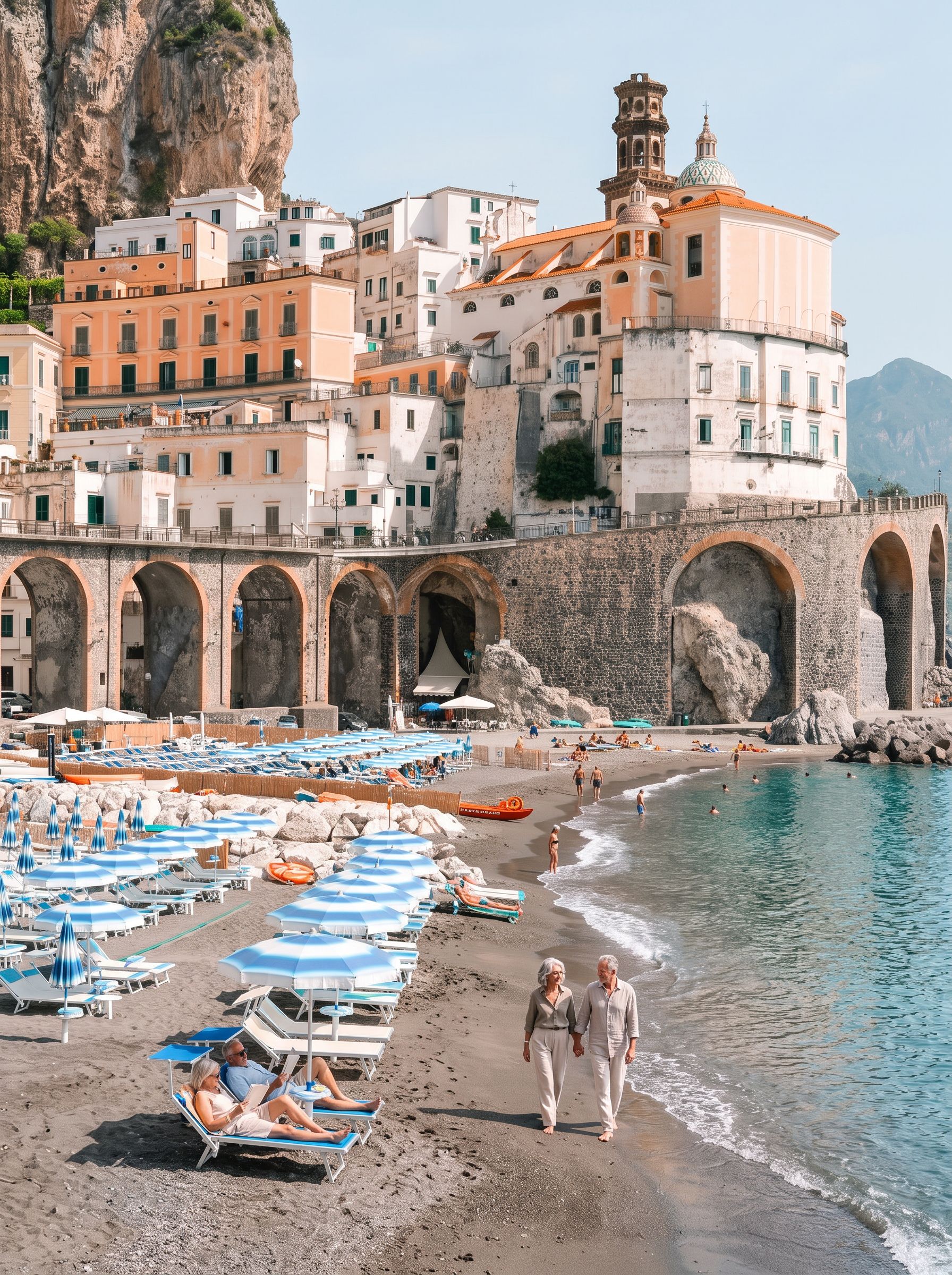 AI-edited
Are there lifts or funiculars?
Lifts and funiculars exist but are limited. Marina di Praia in Praiano is reached by an elevator from the main road with a short stair-free path. Sorrento, just outside the coast proper, has an elevator down to its seaside area. Most other beach access relies on stairs.
The coast's cliffside layout means elevators are rare and precious. Marina di Praia stands out as one of the more workable beach experiences because of its elevator access. In Sorrento, a practical base near the coast, an elevator connects the town centre to the marina below.
For beach access generally, most Amalfi Coast beaches involve stairs down from the road. The exceptions are Maiori and Minori, which have more direct access. Amalfi town has invested in inclusive beach infrastructure: from June to October, a portion of Marina Spiaggia beach is reserved and equipped for people with disabilities or motor difficulties, with floating chairs, a Job chair, a walkway to sunbeds and umbrellas, and free assistance from qualified operators.
How do you get between towns?
Ferries and private accessible transfers are the most reliable transport for limited mobility. Public buses are not step-free and are widely described as unsuitable for wheelchair users. The coastal road is narrow, winding and stressful, so avoiding self-drive removes both access and parking problems.
The Amalfi Coast sustainable mobility consortium operates local public transport with direct connections to main destinations. However, accessibility guides consistently report that SITA Sud buses are not reliably accessible, with narrow aisles and step-up boarding. Buses also run full in summer, particularly August.
Ferries and boats emerge as the practical alternative. They drop passengers at waterfront level, avoiding uphill walks and road stress. Accessible boat transfers exist, with some vessels using ramps and offering seats near the boarding point, but fleet-wide accessibility is not guaranteed. Private accessible vans with platform lifts are available from main airports and train stations, and taxis or car services are widely recommended despite the cost.
For those considering driving, note that some historic centres have ZTL limited-traffic zones, with exemptions for mobility-impaired drivers holding an official disability badge. In early 2024, disabled drivers in Amalfi and Positano were waived parking fees.
| Route | Distance | Driving time (clear roads) |
|---|---|---|
| Salerno Costa d'Amalfi Airport to Amalfi | 46 km | About 65 minutes |
| Amalfi to Positano | 19 km | About 35 minutes |
| Amalfi to Ravello | 6.9 km | About 10 minutes |
| Amalfi to Maiori | 5.4 km | About 10 minutes |
| Amalfi to Minori | 4.2 km | About 10 minutes |
These driving times assume free-flowing traffic with no stops. The coastal road itself has seen disruption from closures and safety work, so check current conditions before travelling.
What about public toilets?
Public toilet availability is not well documented for the Amalfi Coast. Forum travellers report that restrooms in cafes and restaurants often involve steep stairs, making advance planning important. The inclusive beach facilities at Amalfi's Marina Spiaggia include accessible bathrooms.
The reality of toilet access on this coast is that many cafe and restaurant facilities sit above or below street level, reached by stairs. One forum traveller travelling with an 80-year-old mother noted that "every restroom in a cafe or restaurant will be up or down a steep set of stairs." This makes planning rest stops essential, particularly for longer outings.
The documented exception is the inclusive beach area at Marina Spiaggia in Amalfi, which includes accessible bathrooms and changing rooms as part of its June-to-October equipped season. Elsewhere, travellers should ask about restroom access before committing to a venue, and consider basing days around the flatter waterfront areas where facilities are more likely to be at street level.
Is Sorrento a better base?
Sorrento, just outside the Amalfi Coast proper, is the most commonly recommended base for easier walking. Its pedestrian centre is mostly flat and walkable, with an elevator down to the seaside. Many travellers choose to stay there and day-trip to the coast by ferry.
Forum travellers repeatedly suggest Sorrento as the practical solution for limited mobility. One contributor said they chose it because it was "the easiest place to walk," while another described it as "relatively flat and walkable." The town offers the convenience of level streets combined with ferry connections to Amalfi, Positano and other coast towns.
The trade-off is that Sorrento sits outside the Amalfi Coast proper, so day trips involve boat travel rather than stepping out into the scenery. For travellers who want the coast experience without the coast's physical demands, this arrangement works well. Ferries from Sorrento reduce road stress and deliver passengers to waterfront level at each destination.
For those set on staying within the coast itself, Amalfi town remains the strongest choice for flatter ground, particularly near the seafront and piazza. The town-by-town base guide explores these trade-offs in more depth.
When is the best time to visit?
The tourist season runs from Easter or early April to late October. September offers lighter crowds as the season begins to ease, while August brings maximum crowds and fullest buses. April to June and September to October provide the most comfortable combination of weather and crowd levels.
The official Amalfi tourism site describes summer as peak season, with September marking the start of the slowdown. For older travellers, the shoulder seasons reduce two pressures simultaneously: crowd navigation and transport capacity. Buses are especially full in August, which adds stress for anyone who needs to use them.
Climate data shows warmest sea and air conditions from June to September, with July and August hottest. Rainfall is lower in late spring and summer, higher in autumn and winter. The sweet spot for comfort is late spring or early autumn, when temperatures are pleasant without the intensity of high summer.
Budget planning matters too. The comfortable trip cost guide breaks down what to expect for a stay that balances access needs with value.
What should you book in advance?
Accessible accommodation, transfers and inclusive beach equipment all require advance booking. Accessible villas and rooms are limited and should be reserved 4-6 months ahead. Accessible tours and transfers should be confirmed with the specific operator, as not all vehicles or boats in a fleet are accessible.
The coast's accessibility is property-by-property rather than coast-wide. Hotels and rentals often hide stair problems, so verifying the exact entrance, lift and step count before booking is essential. One Reddit advice thread recommends choosing a hotel "basically sea level, front of town" in Positano and asking directly about accessibility. Reviews of coastal properties describe elevators that still require stairs, approaches up steep flights, and step counts ranging from 25 to over 100. The property does not publish complete step details for every entrance; ask when booking.
For transport, confirm that the specific vehicle or boat in an operator's fleet is accessible, not merely that the company offers some accessible services. Accessible tours and private charters exist, but availability varies by season and vessel.
For the inclusive beach at Amalfi's Marina Spiaggia, reserve the day before during July and August. The service operates from June to October with free assistance from qualified operators.
What if you cannot manage stairs at all?
If wheelchair access is essential, the Amalfi Coast is not broadly accessible. The workable strategy is to stay in Amalfi town near the seafront, use private accessible transfers, and take ferries for sightseeing. Positano's upper town and most cliffside villages remain out of reach.
The honest assessment from accessibility guides is that the coast offers pockets of accessibility rather than continuous access. Amalfi town's flat waterfront, inclusive beach and harbour promenade create a viable base. Maiori and Minori add flatter alternatives. Marina di Praia's elevator provides one workable beach experience.
Beyond these pockets, the coast's defining feature is its stairs. Travellers who cannot manage steps should plan around the documented accessible elements: the Amalfi seafront, the inclusive beach, ferry-based sightseeing and private accessible transfers. The spa day guide offers one accessible leisure option, while the food guide highlights seafront dining with step-free entrances.
For those who can manage some stairs with assistance, the coast opens up considerably. Ravello's level central walking, Villa Rufolo's partial access and the many seafront restaurants become reachable. The key is knowing your own limits and planning around them rather than against the terrain.
One final consideration: the local emergency number in Italy is 112, applicable throughout the Amalfi Coast. The nearest pharmacy or hospital to Amalfi town is not named, so travellers should note medical facilities at their accommodation or ask locally on arrival.


