
Charleston rewards the traveller who hands over the logistics. The historic peninsula packs two centuries of architecture, churchyards and cobbled lanes into a few walkable blocks, and a licensed guide turns that density into a story rather than a navigation exercise. For travellers aged 50 to 70 who prefer organised travel, the city offers small-group walking tours capped at ten to twenty guests, private walks arranged by email, narrated harbour cruises of ninety minutes, carriage rides through the residential district and plantation excursions with transport included. The choice is wide; the differences that matter are pace, distance, surface and how honestly an operator answers questions before you pay.
What follows is a planning guide, not a ranking. It sets out what each documented operator actually publishes, what Charleston's streets demand of knees and ankles, and which questions to put in writing before a booking is confirmed. Prices are indicative and vary by season, group size and booking channel.
Why choose a guided tour in Charleston rather than exploring alone?
A guided tour solves the two hardest problems in historic Charleston: knowing which lanes and interiors are open to visitors, and pacing a day across uneven paving. Licensed guides lead groups through streets, cobbled lanes and gardens, including areas the Charleston Area Convention & Visitors Bureau describes as inaccessible to motorcoaches and carriages.
The Preservation Society of Charleston, which runs its own Fall Tours, states plainly that its tours typically require walking six or more blocks, often over uneven streets and sidewalks, and that many tour sites in Charleston are not handicapped accessible because of their historic nature (Preservation Society of Charleston Fall Tours). That is the honest baseline. A guide does not remove the cobblestones, but a good one knows where they are and how to route around the worst of them.
Group size is regulated. Bulldog Tours notes that Charleston law prohibits walking-tour groups larger than twenty participants, so larger parties must be divided. That cap is a quiet advantage for older travellers: even the biggest standard departure is a manageable cluster rather than a crowd.
 AI-edited
Which small-group walking tours suit older travellers?
Several operators publish two-hour walks with modest distances and frequent stops. Walk It Charleston caps its semi-private history walk at ten guests for $35 plus tax, meeting at 80 Broad Street in front of City Hall. Walks of Charleston runs small-group tours limited to thirteen guests, and JWalk Tours leads licensed two-hour walks at $34 per ticket.
Published group sizes range from a maximum of ten on the Walk It Charleston semi-private walk to twenty for certain Bulldog and private walking-tour arrangements, according to the published small-group history walking tour listing. Smaller is not automatically better, but it makes a slower pace and more questions easier to accommodate.
- Walk It Charleston: two hours, maximum ten guests, $35 plus tax, meeting at 80 Broad Street. The guide, Steve Bailey, is described in the listing as a licensed and registered guide and a native Charlestonian.
- Walks of Charleston: standard walks of roughly 1.5 to 2 miles over two hours at a comfortable pace, with stops for photographs. Small-group tours are limited to thirteen guests.
- JWalk Tours: three guided walks of historic Charleston, including the two-hour Chicora Walk at $34 per ticket, led on foot by a guide licensed by the City of Charleston. The operator describes an easy pace with frequent stops.
- Charleston Stroll: departs daily at 10 a.m. and 2 p.m., lasts two hours, meets at 115 Meeting Street, and costs $37 for adults aged 13 and over. The listing says tickets are refundable until 24 hours before departure.
- Bulldog Tours: guided walking tours including holiday, ghost and graveyard themes. The cited holiday tour lasts about 1.5 hours and covers approximately 0.75 mile with frequent stops.
Are private tours worth it for a couple or a small group?
Private tours cost more but buy control: a shorter route, more pauses, a meeting point near your hotel and a pace set by the slowest walker. Published private rates run from $350 for up to six people with Walks of Charleston to $640 plus tax for up to twenty with Bulldog Tours.
Walks of Charleston publishes a flat private-tour fee of $350 for up to six people or $450 for seven to twenty guests, per guide, and arranges private bookings by email with your preferred date, time and guide (Walks of Charleston private tour page). Pineapple Tour Group publishes $400 plus tax for 1½ hours, $500 plus tax for three hours and $750 plus tax for 4½ hours, and asks guests to arrive ten minutes before departure.
Bulldog Tours advertises private tours with advance notice required and a published buyout of $640 plus tax for up to twenty people. The Charleston Area Convention & Visitors Bureau notes that Bulldog offers customised private walks centred on architecture, gardens or culinary history, and that Experience Moore Tours advertises private and small-group walking, culinary and drinks tours.
How do carriage rides and harbour cruises compare for limited walking?
Both reduce distance on foot without eliminating it. A carriage ride lasts about an hour through the residential district; a narrated harbour cruise seats you for ninety minutes with a live guide. Neither operator publishes boarding-step heights, lift access or sheltered-seating details, so those points need a direct question.
Palmetto Carriage Works describes a one-hour Charleston carriage ride through the residential district, and the Charleston Area Convention & Visitors Bureau notes the company is described as the city's oldest carriage company, with licensed guides, and advises booking ahead to avoid long waits. Old South Carriage Company offers historic and haunted rides with certified guides and recommends advance reservations.
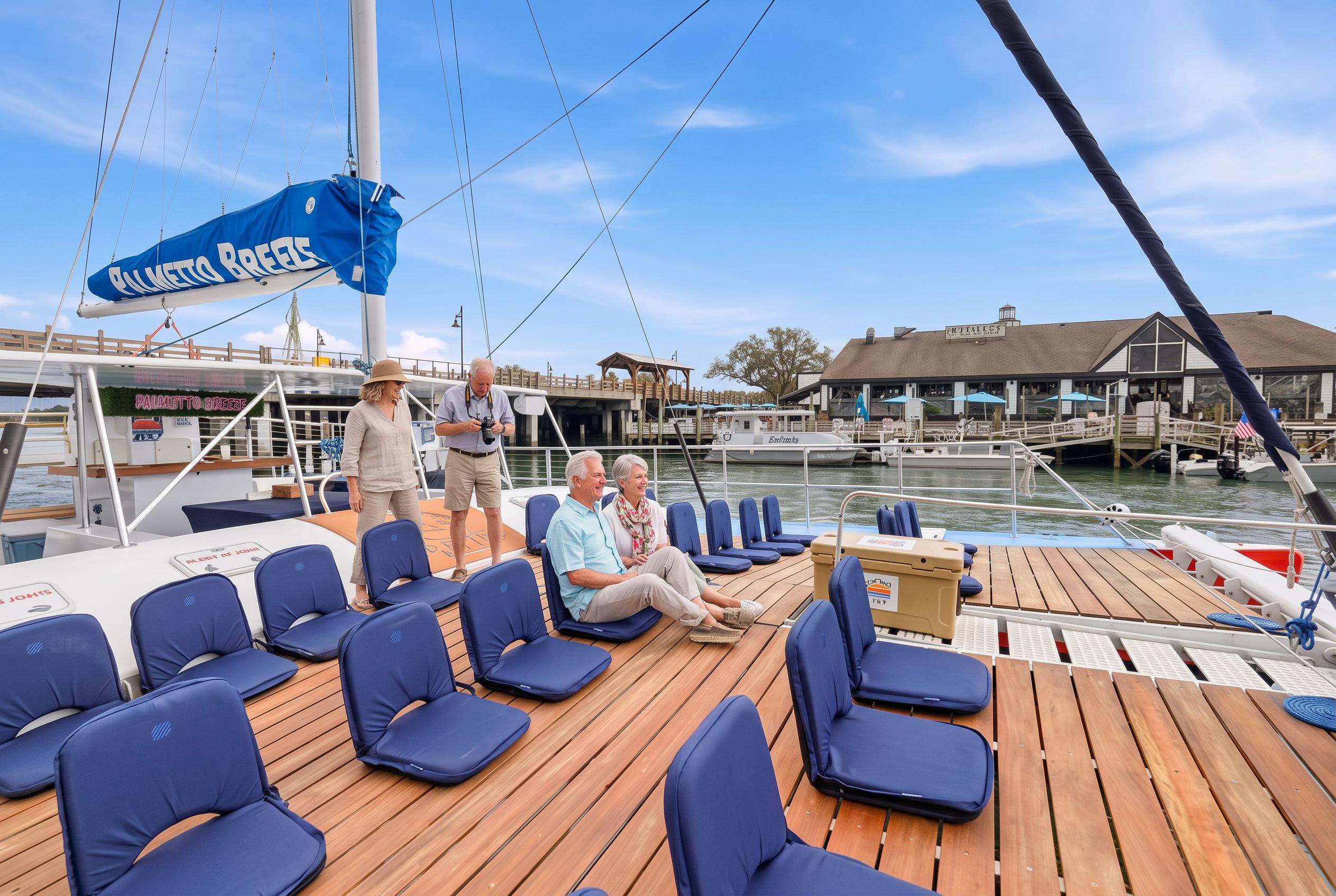
On the water, SpiritLine Cruises runs a ninety-minute narrated sightseeing cruise from Aquarium Wharf and Patriots Point, with a live guide certified by the City of Charleston and a published booking-platform fare of $50 for adults, children aged 11 and under free under the stated conditions. Charleston Harbor Tours lists the Carolina Belle as a ninety-minute cruise at a published $54, with departures at 11:30 a.m., 1:30 p.m., 3:30 p.m. and 5:30 p.m. plus a sunset sailing. The Charleston Area Convention & Visitors Bureau describes the live-narrated ninety-minute cruise as a relaxing way to learn the harbour's history and advises checking schedules and tickets for your chosen date.
For a group, a private charter is documented: a MANTA motoryacht for up to twelve people is published from $2,400 for three hours, rising to $6,400 for eight hours, with a two-hour price of $1,600 plus tax (the published harbour cruise listing for groups up to twelve).
Can you visit a plantation without driving yourself?
Yes. The Charleston Area Convention & Visitors Bureau lists public and private plantation tours designed to remove the need to drive, including Gray Line, Adventure Sightseeing and Chicora Tours. Boone Hall's general admission includes a covered wagon tour, a first-floor guided house tour and Gullah cultural presentations.
Boone Hall's listed hours are Monday to Saturday, 9:00 a.m. to 5:00 p.m., and Sunday, noon to 5:00 p.m., and it is closed on Thanksgiving Day and Christmas Day, according to the Charleston Area Convention & Visitors Bureau listing for Boone Hall. Its covered-wagon tours operate subject to weather and road conditions.
Magnolia Plantation & Gardens is listed by the tourism board with six miles of walking and biking trails, a Wildlife Center, Nature Train, Wildlife Boat, Audubon Swamp Garden, historic cabins and Magnolia House. Ask the operator directly.
Self-guided days on the peninsula are a separate subject with their own dedicated guide: see a four-day Charleston itinerary for the over-50s.
How should travellers with limited mobility prepare?
Ask each operator in writing whether the route is suitable for your mobility aid, because Charleston publishes no citywide standard for step-free access across tour operators. Walks of Charleston states its Alleys & Hidden Passages route is not recommended for wheelchair users. Bulldog identifies its Ghost and Graveyard tour as its most accessible option for wheelchairs and strollers.
JWalk Tours asks guests with mobility, stroller or hearing requirements to contact it before booking so it can assess whether the route is suitable. That is the model to expect: suitability is assessed per route, per guest, not promised in advance.
Historic Charleston Tours, a small-group and private driving history tour, is listed on its Tripadvisor product page as not wheelchair accessible, though stroller accessible and near public transportation. The same listing says the operator may drive guests who have difficulty walking or find the weather too hot, and that the tour is not recommended for people with back problems, heart problems or other serious medical conditions. The cited listing gives $125 per adult.
For getting around independently, CARTA buses are wheelchair accessible and ADA-compliant, with lifts, kneeling functions, priority seating and wheelchair securement, and the free DASH shuttle serves major visitor destinations across the peninsula. CARTA states that seniors aged 55 and over ride for $1 at all times, with proof of age possibly requested, and that riders with disabilities pay $0.75 all day with a valid CARTA Card. The regular metro fare is $2. Questions go to 843-724-7420, TTY/TTD to 843-747-1499.
What are the streets and paths actually like underfoot?
Uneven. Charleston's historic centre is walkable but not uniformly easy. Operators consistently describe cobblestones, uneven brick sidewalks, slate streets, curbs and occasional stairs. The Preservation Society notes restrooms are not readily available in the historic residential neighbourhoods, and that the nearest public restroom may be a substantial walking distance away.
Walks of Charleston warns that streets are uneven and narrow, and that its Alleys & Hidden Passages tour includes cobblestones and very uneven or unpaved surfaces. Bulldog Tours states that cobblestone and slate streets, graveyards and uneven floors can make wheelchair and stroller travel difficult, and that some locations have stairs. JWalk Tours describes cobblestones, uneven brick sidewalks and curbs but says its tours proceed at an easy pace with frequent stops.
No source documents a comprehensive inventory of rest benches, hill gradients or a citywide pedestrian-surface assessment, and no source establishes that Charleston has steep hills. The documented obstacles are paving, curbs, cobblestones, narrow streets and stairs. For a fuller packing and footwear briefing, see packing for Charleston: shoes, cobblestones and summer heat.
What should you ask before booking?
Ask for the distance, the surface, the number of stops, the toilet situation, the meeting point and the finishing point, and get the answers in writing. Ask too about the cancellation terms for heat, storms and mobility-related changes, since published policies differ between operators.
Weather policy is a good test of how forthcoming an operator is. Walks of Charleston says tours normally operate rain or shine but reserves the right to cancel in potentially dangerous weather. Bulldog and JWalk both state their cited tours run rain or shine, with Bulldog advising an umbrella or poncho. The Preservation Society of Charleston states its tours take place rain or shine and that tickets must be purchased in advance, with no walk-ins.
Cancellation terms for Bulldog Tours, JWalk Tours and Historic Charleston Tours are not documented. Ask before paying.
| Operator | Published format | Published price | Confirm before booking |
|---|---|---|---|
| Walk It Charleston | 2 hrs, max 10 guests | $35 plus tax | Route surface and stops |
| Walks of Charleston | 2 hrs, 1.5–2 miles, max 13 | From $32; private $350–$450 per guide | Wheelchair suitability by route |
| JWalk Tours | 2 hrs, easy pace | $34 per ticket | Mobility assessment before booking |
| Charleston Stroll | 2 hrs, daily 10 a.m. and 2 p.m. | $37 adults 13+ | Refundable until 24 hrs before |
| Bulldog Tours | 1.5 hrs, approx. 0.75 mile | Private buyout $640 plus tax, up to 20 | Cancellation terms not documented |
| Historic Charleston Tours | Private driving tour | $125 per adult | Not wheelchair accessible per listing |
When should you go, and what should you pack?
Morning departures make sense in summer, when heat and humidity build through the day, and the operators' rain-or-shine policies mean waterproof layers earn their place in any season. The available operator sources do not designate a formally calmest visiting period, so ask about group sizes on your intended date.
Pack supportive closed-toe shoes with grip for uneven sidewalks, cobblestones and slate; a lightweight rain jacket, compact umbrella or poncho; a water bottle and sun protection; light breathable clothing, a hat and sunglasses; prescribed medication and a small first-aid supply; and any mobility aid suited to uneven surfaces. The Preservation Society asks guests to wear flat, comfortable walking shoes, and notes that guests in high heels or shoes that could damage surfaces may be required to remove their shoes before entering a private property.
For seasonal context on crowds and festivals, see Charleston through the year: festivals and quiet seasons.
What else is worth knowing before you arrive?
Meeting points cluster around 80 Broad Street, 115 Meeting Street, 45 Pinckney Street and Aquarium Wharf, and some routes finish elsewhere, so confirm both the start and the end. Two downtown sites have had recent changes: The Charleston Place began demolishing its main entryway as part of a reported $150 million renovation, and The Powder Magazine reopened on a limited basis in late 2025 after an approximately eight-month closure.
Both items were reported by The Post and Courier in its editions of December 28, 2025 and January 3, 2026. Tour groups meeting near the hotel should confirm the current entrance and allow extra time for drop-offs; walking tours that include The Powder Magazine should verify opening hours before promising admission.
On health and safety, CARTA states that its buses serve most hospitals and medical-related service agencies in the Charleston area. The material does not identify the nearest pharmacy or clinic to each tour meeting point, nor document opening hours or walk-in availability for a specific Charleston pharmacy. For an immediate emergency in the United States, dial 911. Non-emergency police, medical and visitor-assistance numbers should be confirmed with your hotel or operator.
For a sense of how the city's historic inns handle quiet and comfort, see a closer look at The Wentworth Mansion.
How should an organised traveller structure a guided day?
Build the day around one walking tour of about two hours in the morning, add a seated experience such as a harbour cruise or carriage ride in the afternoon, and keep the two connected by the free DASH shuttle or a short taxi rather than a long walk. Book the walk first, then fit everything else around its meeting point.
The Charleston Area Convention & Visitors Bureau recommends looking for operators belonging to the Palmetto Guild Association, whose guides are certified. Published combination tickets exist, including carriage plus harbour cruise, a Fort Sumter trip plus a walking tour, and a three-part package combining a ninety-minute harbour cruise, carriage tour and Boone Hall. Ask whether a combination requires attractions on the same day, whether reservations are separate, and whether refunds apply for heat, storms or mobility-related cancellation.
Fort Sumter Tours publishes a ferry fare of $46 for adults, with lower fares for seniors, active military and children aged four to 11, and lists downtown departures at 9:30 a.m., noon and 2:45 p.m. in season, with two daily departures from Patriots Point at 10:45 a.m. and 1:30 p.m. Ask whether your tour runs on your intended date and what happens in rain, heat or rough water.
One final piece of planning advice, and it is the one that matters most: whatever the brochure says, put your three key questions to the operator in writing, keep the reply, and book the tour whose answers you actually like.


