
Charleston rewards a slower rhythm. The historic peninsula packs a dense collection of free waterfront sites, house museums and churchyards into a few walkable blocks, but the pavement and cobblestones can wear down even confident walkers. This four-day plan keeps you in one base in the historic district, uses cooler mornings for the outdoor work, and reserves afternoons for rest, air-conditioned museums or a seated meal. It is built for travellers aged 50-70 who want a full trip, not a forced march.
The structure follows a pattern recommended by The Senior Traveler in its 2026 Charleston guide: one major attraction per half-day, a seated lunch or indoor museum between outings, and an afternoon rest. The official Charleston visitor information lists the Battery, White Point Garden, Rainbow Row, Waterfront Park and City Market among the city's free experiences, so the outdoor days cost nothing beyond your own energy. This guide says so rather than guessing.
Why base yourself in the historic district for all four nights?
Staying in the historic district means you unpack once and walk or ride the free DASH shuttle to most sights, avoiding daily parking and driving. The peninsula's core puts the Battery, Rainbow Row, Waterfront Park and the City Market within reach, and a single base suits a rest-heavy schedule far better than moving hotels.
The city's fare-free DASH shuttle runs three routes covering most downtown historic and tourist attractions, according to The Senior Traveler's 2026 guide, which reduces the walking between sites. The source does not state whether every vehicle, stop or route segment is fully accessible, so travellers with mobility aids should confirm with the operator before relying on it.
Forum contributors on Fodor's have made the same case for a central base. A separate Fodor's discussion said the Francis Marion Hotel was walkable to attractions and restaurants "if you're in reasonably good condition."
Hotel selection has its own dedicated guide on this magazine, so this itinerary does not review properties. One planning note drawn from guest reviews: light sleepers should ask for a quiet-facing room, since Tripadvisor's 2026 quiet-hotel listing and reviews of the Francis Marion Hotel both flag uneven soundproofing in older buildings.
Day 1: How should you orient yourself without overdoing the walking?
Start with a horse-drawn carriage tour to see the historic district from a seat, then browse the City Market and take a short waterfront stroll before an early dinner. This orientation day keeps you off your feet for the longest stretches and gives you the layout before the walking days begin.
The Senior Traveler's 2026 guide recommends exactly this shape for older visitors: a carriage tour on arrival, followed by the City Market and an easy waterfront walk. A Fodor's discussion from April 4, 2025 likewise recommended beginning with a horse-drawn carriage ride and then revisiting the area on foot at a slower pace.
Ask the operator directly about step height and boarding help when you book.
 AI-edited
The City Market is listed among the city's free experiences by the official tourism material. One Reddit commenter in a November 2, 2026 itinerary discussion called the market "pretty typical for tourists" and suggested skipping it if pressed for time; that is one opinion, not a consensus.
Day 2: How do you cover the Battery, Rainbow Row and Waterfront Park comfortably?
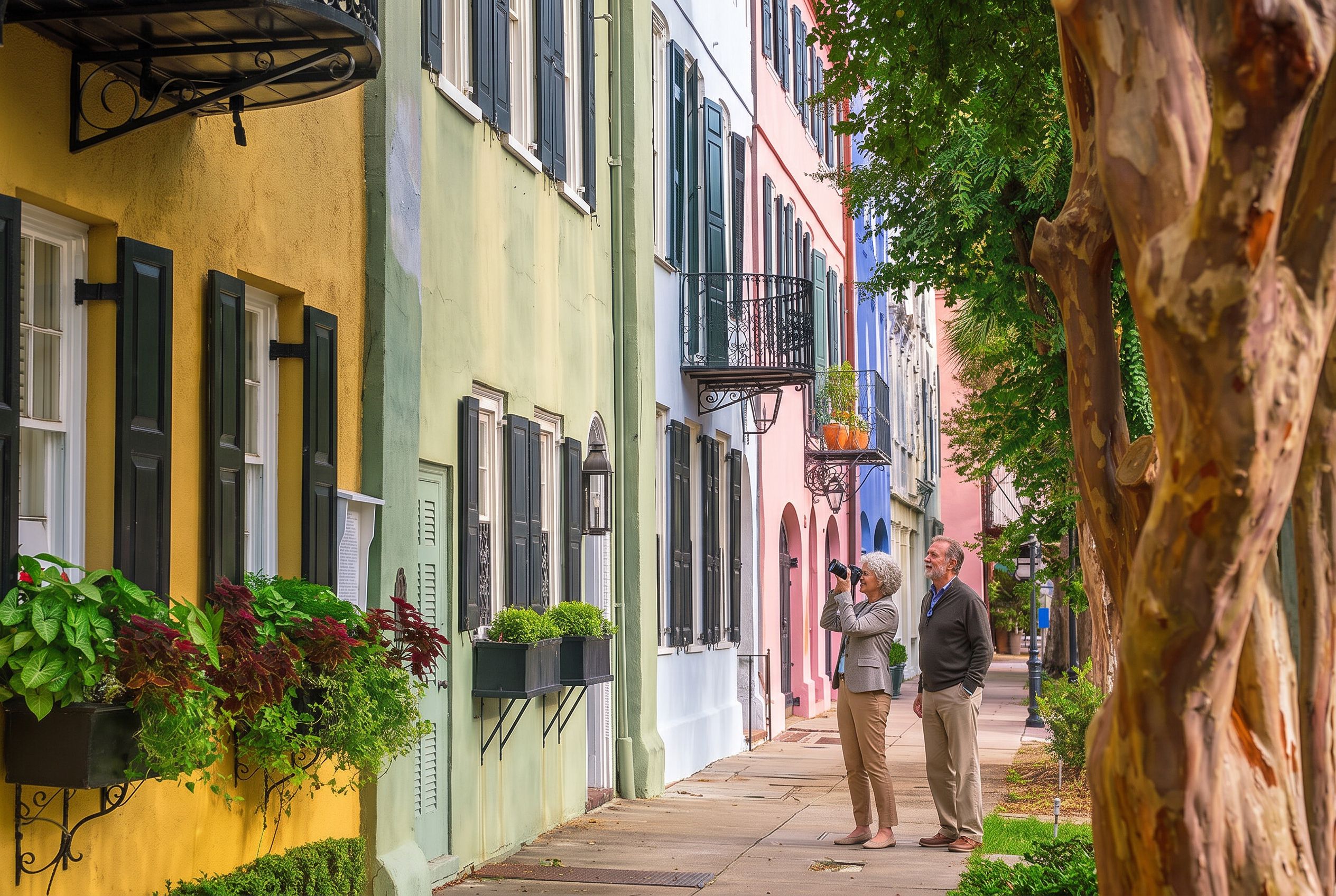
Walk the Battery and White Point Garden in stages during the cooler morning, using benches and shade for breaks, then continue to Rainbow Row and Waterfront Park. Break the route into separate outings rather than one continuous hike, and keep the afternoon free for rest or an air-conditioned museum.
The official Charleston visitor information lists the Battery, White Point Garden, Rainbow Row, Waterfront Park and the Pineapple Fountain among the city's free experiences. The Senior Traveler's 2026 guide recommends a short, self-guided route from the historic district toward Rainbow Row, Waterfront Park and the Battery, with frequent stops rather than treating it as one continuous walk.
Exact information on pavement quality, kerbs, gradients, shaded seating, public toilets and distances between each named site is not documented. Confirm conditions on the day, and carry water.
Walking can be more demanding than the map suggests. A Reddit trip report dated February 14, 2023 described walking roughly 4.5 miles each morning, including in rain. Treat that distance as a possible upper-end day, not a default target.
Cobblestones are a recurring comfort warning. A Fodor's forum post from October 15, 2005 recommended comfortable shoes for a walking tour lasting more than two hours, noting the route included both pavement and cobblestones. Fodor's current Charleston guide advises care on cobblestone streets and suggests a pedicab, horse-drawn carriage or bicycle if mobility is an issue. Our own guide to packing for Charleston's shoes, cobblestones and summer heat covers footwear in detail.
Day 3: Which indoor attractions suit a hot or rainy afternoon?
The Charleston Museum and the South Carolina Historical Society Museum are the two strongest indoor options for a slower-paced visit, according to The Senior Traveler's 2026 guide. Both document step-free features: the Charleston Museum has entrance ramps, second-floor elevators and free loan wheelchairs, while the Historical Society Museum has a wheelchair entrance on Meeting Street and elevators to both floors.
The Charleston Museum's official accessibility page says manual and electric wheelchairs are free, available first come first served, and permitted throughout the museum and historic houses. That makes it a reliable fallback when the heat or rain rules out the waterfront.
For the morning, a harbour cruise is identified as a suitable midday alternative in a paced itinerary. The source does not name an operator, vessel, boarding arrangements, fare, cancellation policy or accessibility specification. Ask about boarding steps and accessible seating when you book.
If you want a maritime afternoon, the South Carolina Aquarium documents two elevators and wheelchair-accessible exhibits, with free wheelchair checkout at Admissions and the Info Desk on a first-come, first-served basis. The Aquarium is closed Thanksgiving Day and December 25.
For evening dining, the French Quarter may feel calmer than North King Street. The February 2023 Reddit trip report described the French Quarter as attracting an older demographic, while North King Street felt busier and more college-oriented. That is a forum impression rather than a demographic statistic, but it may help when choosing a restaurant area. Our guide to Charleston's finest restaurants and historic taverns covers the dining side in depth.
Day 4 option A: Is a Middleton Place plantation visit worth a full day?
A plantation and garden visit deserves its own half or full day rather than being tacked onto a downtown morning, according to The Senior Traveler's 2026 guide, which recommends allocating a separate day to outlying attractions.
The material names Middleton Place or Magnolia Plantation for gardens and history, and McLeod Plantation for a history-focused visit, as the choices for a substantial excursion. It does not publish Middleton Place's opening times, ticket prices, terrain or mobility provision. Confirm all of these directly with the property before you commit a day to it.
If you would rather stay closer to the city, Charles Towne Landing State Historic Site is the best-documented outlying option. South Carolina Parks publishes its details directly.
- Park grounds: open daily, 9 a.m. to 5 p.m.
- Visitor centre and gift shop: open daily, 9 a.m. to 4 p.m., closed Christmas Day.
- Animal Forest: open daily, 10 a.m. to 4 p.m., closed Christmas Day.
- The Adventure ship: open 10 a.m. to 4 p.m., closed Tuesdays and Christmas Day.
- Admission: $12 per adult, $7.50 for a South Carolina senior, $7 for youth aged 6 to 15, free for children five and younger.
The park also notes that approximately half of the Animal Forest, starting at the puma and bear exhibits, will be temporarily closed Monday through Friday while construction continues, and that pets and service animals are not permitted in the Animal Forest.
Day 4 option B: Should you add a beach day instead?
A beach day works best as a separate excursion by car rather than a base for daily downtown sightseeing. Fodor's contributors estimated a 25 to 30 minute drive each way from Isle of Palms to downtown Charleston, and warned that staying downtown and paying to park every day is unnecessary when most activities are on the peninsula.
That same Fodor's discussion suggested driving to a beach for a separate day instead. For a four-day plan based in the historic district, this means choosing the beach on day four and treating the drive as part of the outing, not a daily commute.
Confirm conditions with the relevant town before you go.
For the more active traveller, the beach day is the natural place to spend energy, leaving the peninsula days deliberately gentle. For those who prefer gardens and history, the plantation option above fits the same slot.
Where should you eat a proper Lowcountry meal?
Specific restaurant recommendations belong in this magazine's dedicated dining guide.
The Senior Traveler's 2026 guide describes Shem Creek seafood in Mount Pleasant and atmospheric historic-district dining as part of a relaxed Charleston evening.
One practical note from guest reviews: breakfast is a major strength at several downtown hotels, and The Spectator's breakfast-card system lets guests choose both items and delivery time, which suits a slower morning before sightseeing. Reviews of The Spectator's breakfast itself receive some mixed reactions, so distinguish between the convenience of in-room delivery and the food. Our restaurant and tavern guide covers the evening table in detail.
When is the best time to visit for comfortable walking?
Spring and autumn are the most comfortable seasons for a walking-based Charleston itinerary. The official tourism material identifies March to May and October to November as especially favourable, while high summer is hotter and more humid and winter is quieter.
The Charleston climate summary gives 1991 to 2020 NOAA normals for Charleston International Airport, the official climate station used for the city. July is the hottest month in those figures, August the wettest, and November the driest.
| Month | Average high / low | Rainfall |
|---|---|---|
| March | 70.1°F / 47.3°F | About 3.35 inches |
| April | 77.1°F / 54.5°F | About 3.29 inches |
| May | 83.6°F / 63.0°F | About 3.32 inches |
| October | 77.9°F / 57.7°F | About 4.33 inches |
| November | 69.4°F / 47.1°F | About 2.66 inches |
The airport averages roughly 64 days annually at or above 90°F, with most occurring from June through August. Atlantic hurricane season runs from June 1 to November 30, with the climatological peak in September. A Fodor's contributor in the October 2024 thread called March a pleasant time to stroll, while noting that rain is possible. Our guide to when to visit Charleston for comfortable weather and thinner crowds goes further.
What practical details should you sort before you arrive?
Sort transport, parking and emergency contacts before you travel. Charleston's official visitor information identifies the city's waterfront and museums and notes accessible parking concessions for disability-placard holders, while Charleston County advises calling 911 for any emergency.
The City of Charleston states that vehicles displaying a disability placard or plate may park free at city-owned garages, lots and meters, as noted on the city's official visitor information page. That concession is worth confirming at each garage you use.
For public transport, CARTA publishes a discounted senior fare: riders aged 55 and over pay $1 during all hours of service, with a Medicare card or an ID card showing date of birth serving as identification. CARTA also offers one day per quarter when senior riders 55 and over ride all routes for free, including February 16 for Senior Independence Month. Day passes are $7, three-day passes $14 and weekly passes $15, and the Charleston Visitor Center at 375 Meeting Street is a ticketing point.
For any emergency in Charleston County, call 911; Charleston County EMS provides medical care and transportation to hospital emergency departments. Charleston County's emergency communications information also states that 911 can be contacted by text. Charleston County Emergency Management can be reached on 843-746-3800. Our guide to Charleston's health and pharmacy options covers the rest.
One recent change to plan around: Charleston International Airport's West Gate expansion is under construction and is expected to add four gates, about 15% more gate capacity, with a major parking-garage project due for substantial completion in summer 2027. Allow extra time for parking and terminal transfers on arrival and departure.
How do you keep four days from becoming an endurance test?
Spread the historic core across several mornings and reserve afternoons for museums, meals or rest rather than adding more sights. A Fodor's contributor reported that a tentative Charleston itinerary proved "overly leisurely" and that much of it could be completed in two very full days, which supports a gentler four-day spread.
Traffic and parking can disrupt ambitious plans. A Reddit Charleston report from January 29, 2025 described heavy traffic delaying the morning and forcing a change of café, and the group parked downtown so it could return to the car for hydration and breaks during an approximately 11-hour day, from 9:30 a.m. to 8:30 p.m. That schedule was productive but unusually long for a comfort-focused itinerary.
The same January 2025 report said the Battery was under construction during that visit, though the group still continued to Rainbow Row and Philadelphia Alley. Construction conditions change, so keep a flexible alternative such as Waterfront Park, a carriage tour or an indoor house museum in reserve.
For a shorter trip, the main highlights fit into three days: the historic peninsula, Fort Sumter and either Patriots Point or an Ashley River plantation, with a fourth day useful for beaches or a garden excursion. A practical two-day version covers the historic district, Battery, Rainbow Row, City Market and King Street on day one, followed by Fort Sumter or a harbour cruise and the aquarium on day two.
The strongest forum-supported strategy for reduced stamina is to stay south of or near the historic core, divide the Battery, Waterfront and Market area into separate outings, schedule a midday indoor break, and treat 4.5 miles of walking in a morning as a possible upper-end day rather than a default target.


