
Venice is a city built on water, and that single fact shapes every arrival. There are no cars in the historic centre, no taxis that can pull up at your hotel door, and no way to wheel a suitcase the last few hundred metres unless your hotel happens to sit beside a bridge-free route. The good news for travellers in their fifties and sixties is that the city has spent centuries moving people and goods by boat, and the arrival infrastructure reflects it. The key is choosing the right combination of plane, train and water transport before you leave home, because the decisions you make at the booking stage determine how much you lift, walk and sweat on the day.
This guide covers the three main gateways (Marco Polo Airport, Treviso Airport and Venezia Santa Lucia rail station), the water connections that link them to the city, and the practical realities of luggage in a city of bridges and stone steps. It does not cover the vaporetto network in detail; that has its own dedicated guide. What follows is strictly about getting in, getting onto the water, and getting to your hotel with as little strain as possible.
Which airport should you fly into for Venice?
Marco Polo Airport (VCE) is the main gateway, sitting on the mainland about 571 km by road from Piazzale Roma, though the lagoon crossing by boat is far shorter. Treviso Airport (TSF) serves some budget carriers and requires a bus connection to Venice. For most travellers aged 50-70, Marco Polo is the simpler choice because it has direct water links to the city.
Marco Polo Airport has no rail station. According to the official Venice tourism transfer page, every transfer from Marco Polo is either a bus to Piazzale Roma or a boat across the lagoon. That binary choice is the single most important decision you will make on arrival.
Treviso Airport, about 40 km inland, handles some low-cost flights. Travellers arriving there typically take a bus to Venice's Piazzale Roma or to Mestre station, then continue by vaporetto or on foot.
How do you get from Marco Polo Airport onto the water?
From Marco Polo, you reach the water by walking to the airport dock (a covered walk of about 7 to 10 minutes from arrivals) and boarding either an Alilaguna water bus or a private water taxi. The Alilaguna is the scheduled public boat service; the water taxi is the private, direct option.
The airport boat terminal is reached by a covered walk of about 7 to 10 minutes from arrivals, according to step-by-step arrival guidance. That walk is the first thing to plan for. It is covered, which helps in rain, but it is still a walk with luggage before you reach the boat.
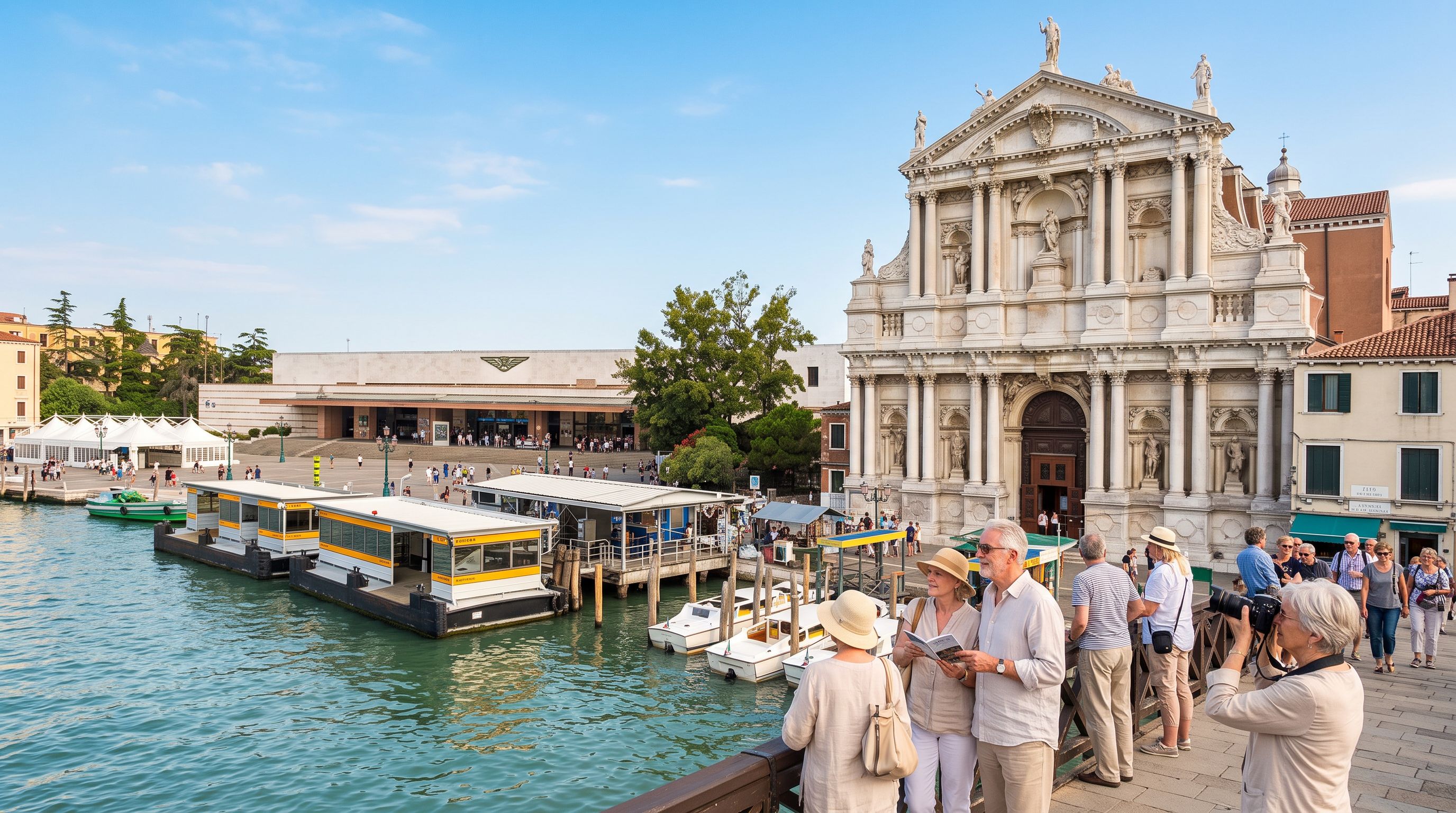
Alilaguna is the scheduled boat service between Marco Polo Airport and Venice. The airport transfer page states there are three lines serving the airport, including the Blue Line. Recent guidance says the airport boat serves Venice stops including Ferrovia, Rialto and San Marco, depending on the line. A private water taxi, by contrast, takes you directly to your hotel dock where one exists, and is described as a premium service.
 AI-edited
For pricing, Alilaguna's airport boat is €18 one way and €32 return in 2026, with the shorter airport-to-Murano leg at €10 single and €18 return. That ticket includes one hold bag and one item of hand luggage; extra bags cost €4 each. A private water taxi is quoted at roughly €125 to €140 per boat in multiple forum posts, though no published rate exists and you should confirm the fare before boarding. A shared water taxi from Marco Polo usually needs at least two people, should be booked in advance, and typically lands near a vaporetto stop rather than at the hotel door; shared prices run about €30 to €40 per person in several posts.
How do you arrive by train into Venice?
Trains from the mainland arrive at Venezia Santa Lucia, the station on the Grand Canal at the edge of the historic centre. Do not confuse it with Venezia Mestre, which is the mainland stop. Santa Lucia is the station you want for the historic centre, with vaporetto docks directly outside the main entrance.
Venezia Santa Lucia is the city's rail gateway on the water. The station sits on the Grand Canal, and the Ferrovia vaporetto stop is directly outside. For travellers with luggage, the most straightforward rail arrival is Santa Lucia because it is in the city rather than on the mainland.
The station has a side exit with a gently sloping stone path toward the Grand Canal, and a front ramp is also documented beside the stone steps at the main entrance. Sala Blu assistance for passengers with reduced mobility is documented at Santa Lucia station and is available daily. The station is documented as open daily from 04:17 to 01:00, with closure at night for cleaning and security.
Luggage storage is available on the platform level. The official left-luggage office at Santa Lucia's Deposito Bagagli is at the far end of platform 14, open 6am to 11pm daily, and designed for large suitcases as well as short stays. This is particularly useful for people arriving before hotel check-in or leaving after checkout. Vaporetto tickets and passes are sold at Venezia Unica offices inside the station and at machines outside.
What is the last leg by boat to your hotel actually like?
The last leg is by water, and it is where the journey becomes distinctly Venetian. From Santa Lucia or Piazzale Roma, you board a vaporetto or a water taxi. The vaporetto is cheaper and runs frequently; the water taxi is more expensive but takes you closer to your hotel door.
From Santa Lucia, Line 1 is widely described as the main "luggage boat" because it links the station to the hotel districts and has a central area for suitcases. A 2026 forum reply said Line 1 or Line 2 from Santa Lucia runs every 10 minutes, takes around 30 minutes across the Grand Canal, and after 9pm runs every 20 minutes. Santa Lucia to S. Angelo takes about 20 minutes on vaporetto Line 1.
The vaporetto is Venice's public water bus system. Many routes and pontoons are accessible, with staff assistance and ramps used where needed. Step-free access is documented on many stops, and ramps bridge the boat-dock gaps. Line 1 is highlighted as useful for wheelchairs and luggage. Wheelchair spaces and assistance by crew are documented; one source says no advance booking is required for standard individual travel.
But here is the reality that catches many travellers: you still have to lift bags on and off boats. A Rick Steves forum post noted that vaporetto rides require passengers to be "prepared to carry it up and down from pier to boat." Space on boats is limited and baggage should be kept close.
Why can you not wheel a case far in Venice?
Venice's historic centre is bridge-heavy, with stone steps at almost every canal crossing. Dragging a wheeled case over those steps is slow, physically demanding and hard on the case. This is why the water taxi or a hotel near a vaporetto stop matters so much.
Multiple Venice Q&A answers say travellers must cross bridges, walk from the station, or hire porters if bags are heavy. One recurring warning is that the walk is short but difficult "if you have bags." Consistent traveller-facing guidance is to avoid dragging luggage over bridges, to prefer accommodation near Piazzale Roma or a vaporetto stop, and to book accessible water transport in advance if needed.
The least frustrating approach, according to a recent luggage guide, is to arrive by water taxi or Alilaguna, choose a hotel near a vaporetto stop or with water access, and minimise the number of bridges between landing point and hotel. That last point is the one to act on when booking. A hotel two bridges from the vaporetto stop is a different proposition from one eight bridges away.
Porters are commonly found at Piazzale Roma and Santa Lucia Station, according to a 2025 luggage-storage article. Hotels also help arrange water taxis, porters or directions for station and airport transfers, according to several Venice hotel Q&A threads. If you are travelling with heavy luggage or limited mobility, asking your hotel in advance about porter service and the nearest boat landing is a sensible step.
What do the transfers cost, and how do you book?
Alilaguna airport boat: €18 one way, €32 return in 2026, including one hold bag and one hand item, with extra bags at €4 each. ACTV vaporetto single ticket: €9.50 for 75 minutes. Passes: €25 for 24 hours, €35 for 48 hours, €45 for 72 hours, €65 for 7 days. Private water taxi: roughly €125 to €140 per boat, though no published rate exists.
ACTV tickets must be validated at the start of each journey and when changing service, using validators at waterbus stops and People Mover stations. Tickets can be bought at ticket booths, machines or online before boarding. Validation is required before boarding.
For airport buses, the express coach to Mestre railway station is quoted at €12 single and €20 return in 2026. ATVO runs a coach on the Mestre corridor in about 20 minutes and luggage is included in the fare. ACTV buses allow three items free if their total dimensions stay within the stated limit, with an extra ticket needed for every three bags beyond that. The airport bus to Piazzale Roma is described as a low-floor bus and easy with luggage.
One source states reduced fares for people with reduced mobility, including a €1.50 single ticket and one free accompanying helper, but that is documented for disability-based access, not age. If you qualify on mobility grounds, ask at the ticket office; if you are simply over 65, do not expect an automatic discount.
| Service | Price | Notes |
|---|---|---|
| Alilaguna airport boat | €18 one way / €32 return | Includes one hold bag and one hand item; extra bags €4 each |
| Alilaguna airport to Murano | €10 single / €18 return | Shorter leg |
| ACTV vaporetto single | €9.50 | 75 minutes |
| ACTV 24-hour pass | €25 | Validate before boarding |
| ACTV 48-hour pass | €35 | Validate before boarding |
| ACTV 72-hour pass | €45 | Validate before boarding |
| ACTV 7-day pass | €65 | Validate before boarding |
| Private water taxi | About €125 to €140 per boat | No published rate; confirm before boarding |
| Shared water taxi | About €30 to €40 per person | Needs at least two people; book in advance |
| ATVO express coach to Mestre | €12 single / €20 return | About 20 minutes; luggage included |
What help is available if you tire easily or have mobility needs?
Sala Blu assistance for passengers with reduced mobility is documented at Santa Lucia station and is available daily. The airport has a mobile landing stage, reserved parking and a Sala Amica in the departures hall. Accessible boats and adapted airport transfers are available, though the airport transport page does not document reduced-mobility assistance in detail.
A source aimed at airport transfers says the water bus takes about 60 to 90 minutes plus waiting time, while bus or taxi plus vaporetto can be about 45 to 60 minutes total. The water bus is slower but involves less lifting and walking than the bus-plus-vaporetto combination.
From Santa Lucia, the side exit with its gently sloping stone path toward the Grand Canal is the gentler route. The front entrance has stone steps with a ramp beside them. If you are arriving by train and heading for a vaporetto, the side exit is the one to look for.
Reduced-mobility assistance is not documented in the official Alilaguna pages surfaced. The airport transport page does not document reduced-mobility assistance either. If you need assistance boarding an Alilaguna boat, contact the operator directly before you travel rather than assuming it will be available on the day.
What should you pack, and where are the pharmacies?
Pack comfortable walking shoes, a light rolling bag or manageable carry-on, a small day bag and any medication you need. Venice is a city of bridges and stone surfaces. Pharmacies in Venice include Farmacia Morelli in San Marco 5310 and Farmacia Internazionale on Riva degli Schiavoni 2.
Comfortable walking shoes matter because Venice is documented as a city of bridges and stone surfaces. A light rolling bag or manageable carry-on is easier to lift on and off boats than a heavy case. Space on boats is limited and baggage should be kept close. A small day bag is needed for ticketing, water, pharmacy items and documents.
Many pharmacies close in mid-afternoon and reopen later, according to one source. Opening hours for Farmacia Morelli are not documented. Emergency numbers are 112 for general emergencies and 118 for medical emergencies in Italy.
If you need medical help, calling 118 is the documented route. The nearest hospital for the Municipality of Venezia is not documented.
On climate, Venice has hot, muggy summers with highs around 27 to 30°C and cool, damp winters with highs around 6 to 8°C. April to May and September to October are described as the most comfortable periods to visit, with thinner crowds than in peak summer. Late autumn and winter bring the risk of acqua alta, seasonal high-tide flooding, especially common in the fall and winter months and occurring almost daily in November.
What are the easiest door-to-door routes for those who tire?
The easiest route from Marco Polo is a private water taxi direct to your hotel dock where one exists. The next easiest is the Alilaguna water bus to a stop near your hotel, followed by a short walk. From Santa Lucia, a water taxi from outside the station to the nearest dock is the least physically demanding option.
water transport from the airport or station is easier than dragging bags through bridges and alleys. A private water taxi takes you directly to your hotel dock where one exists, and is described as the most direct option when luggage is heavy. It is also the most expensive.
Alilaguna is the common middle ground for airport arrivals. It is the most luggage-friendly direct water arrival in the material gathered, because the airport dock is reached by a covered walk and the boat can take you directly to Venice landing stages. It can be crowded and makes lots of stops, according to a Rick Steves forum post, but it avoids the bus-to-Piazzale-Roma-then-vaporetto combination.
From Santa Lucia, the train-station water taxi option is repeatedly portrayed as the least physically demanding choice, especially for older travellers or anyone wanting to avoid bridges and steps. A prebooked water taxi from Santa Lucia to any hotel in Venice proper cost about €87 in one forum post, with taxis "parked outside the station." No published rate exists for this service, so confirm the fare before boarding.
If your hotel is near a vaporetto stop, the public water bus is far cheaper and can be a better choice. A forum contributor advised that if your hotel is near a stop, "use the public water bus," calling it "easier and cheaper." The key is knowing how far your hotel is from the stop and how many bridges lie between.
What should you confirm before you travel?
Confirm your hotel's nearest vaporetto stop and the number of bridges between it and the entrance. Confirm whether the hotel has a water door for taxi drop-off. Book any water taxi or accessible transfer in advance. Check Alilaguna ticket office hours at the airport, as some offices are listed as temporarily closed.
The Red Line operates on a seasonal schedule and mainly operates in the spring to autumn seasons, according to one source; another says April to October only. The People Mover between Piazzale Roma and the cruise terminal operates Monday to Saturday in the cited schedule, and Sunday and holiday service should be checked separately.
For the wider city once you have arrived, the vaporetto network has its own dedicated guide. For the cultural side of the trip, the palaces, basilicas and museums of Venice at an unrushed pace covers how to see the major sites without exhausting yourself. And for a broader overview of travelling in the city at this stage of life, Venice for travellers over 50 gathers the practical threads in one place.
the evidence does not document UK-specific air or rail itineraries, only that Marco Polo is the main airport gateway and Venice is also reached by rail. If you are travelling from the UK, your airline or rail operator will have the route details. What matters for the Venice end is the choice between boat and bus, and the walk from the boat to your hotel door.


