
Venice rewards the traveller who plans two or three cultural set pieces rather than ten. The city's great monuments sit close together in the San Marco and Dorsoduro districts, and the difference between a tiring day and a satisfying one is rarely the distance. It is the timing, the ticket, and knowing which door to use. The four names that matter most for a culture-focused visit are St Mark's Basilica, the Doge's Palace, the Gallerie dell'Accademia and the Peggy Guggenheim Collection. Each has its own rhythm, its own bottlenecks and its own published rules. This guide works through them one at a time, with the practical detail that older travellers ask for: where the lifts are, where the seating is, how long to allow, and how to book so that the day does not become a queue.
What makes Venice's cultural sights manageable for travellers 50-70?
The four main cultural sites cluster within a manageable area, and each publishes at least some accessibility provision. St Mark's Basilica has a ramp at the Porta dei Fiori, the Doge's Palace has a lift with staff guidance, and the Gallerie dell'Accademia has a barrier-free entrance in Calle della Carità with lifts to the first floor. The variable is not the buildings but the route between them.
The structural challenge in Venice is the city itself. Many routes rely on bridges and uneven paving, and the historic centre has about 110 accessible routes with 41 bridges modified with ramps, according to the Senior's Travel Club city guide. That figure applies to the historic centre as a whole, not to every named site, and it does not remove the need to check a specific route on the day.
For anyone building a cultural visit around comfort rather than endurance, the sensible approach is one major site per half-day, booked in advance, with a known accessible entrance and a known place to sit. The complete guide to Venice for travellers over 50 covers the wider logistics of getting around the city. This article stays with the four cultural set pieces and how to see them without exhaustion.
Can you just walk into St Mark's Basilica?
No. Tickets must be bought online in advance, and reviewers report that same-day slots sell out and that tickets are not sold at the entrance. The official ticketing site sells timed entry for individual visitors through the Porta San Pietro. Book before you travel, not on the morning.
The official price page lists a standard basilica admission at €10, the basilica plus Pala d'Oro at €20, the basilica plus Museum and Loggia dei Cavalli at €20, and a complete ticket covering all four elements at €30, according to the basilica's official ticket prices. The same page states that over-65s receive an additional 50% discount on the price for private individuals, and that private visitors automatically receive a standard 20% discount on the ticket price. Children under 11, and people with disabilities together with one accompanying person who shows the relevant certificate, receive free admission. Free entry does not apply to the Bell Tower, which is priced separately at €15.
Opening hours are Monday to Saturday 9:30 to 17:15, with last admission at 16:45. On Sundays and national holy days, tourist access begins at 14:00 and the same last-admission time applies. The official FAQ states that visitors must arrive at the booked time, with a 5-minute tolerance, and the ticketing page allows arrival up to 15 minutes early or late relative to the scheduled start.
 AI-edited
What should I expect inside St Mark's Basilica?
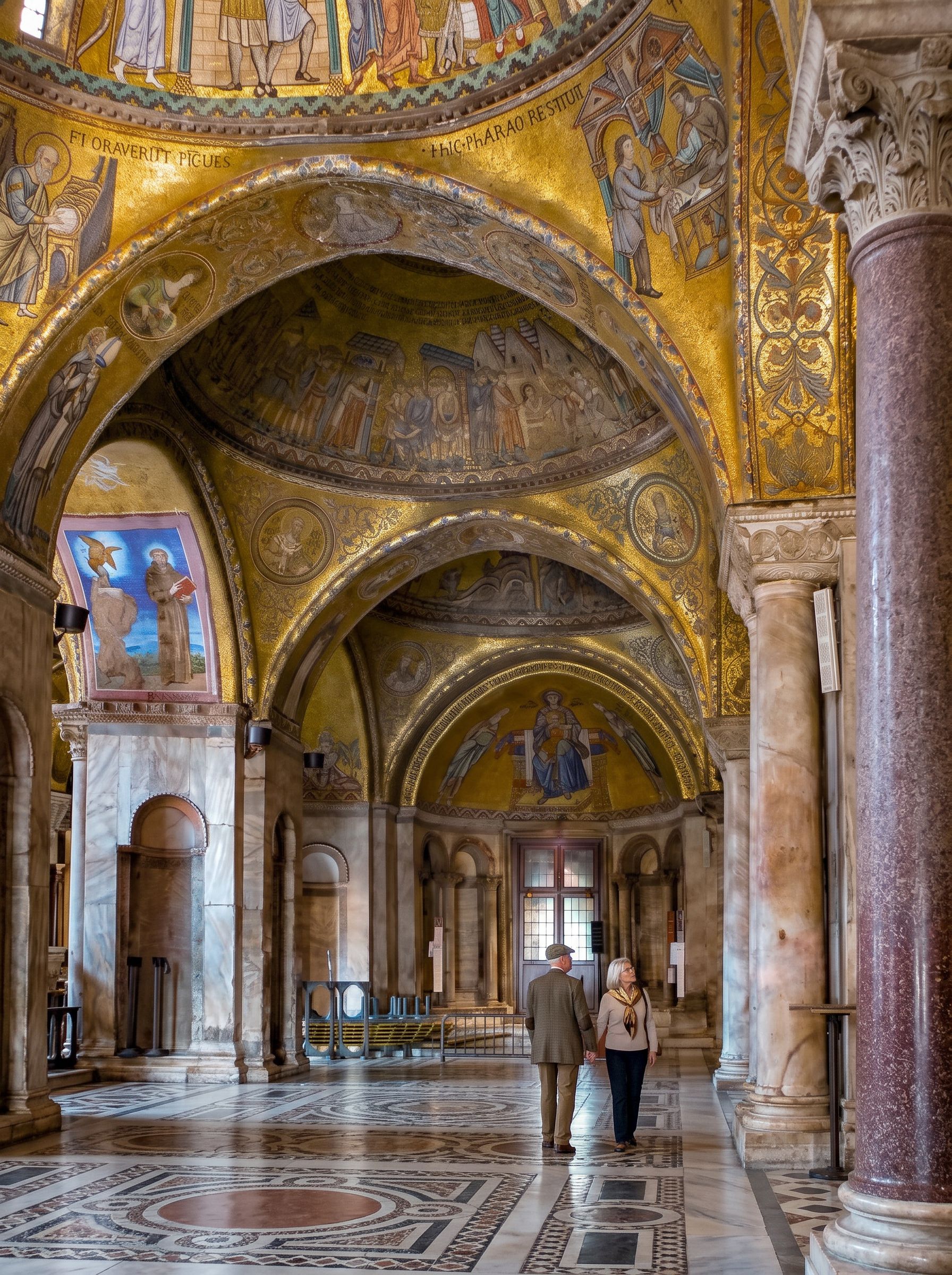
The interior is a working place of worship with a medieval mosaic floor that is highly uneven, and the route to the upper museum involves steep, worn stairs. The mosaics, the Pala d'Oro and the bronze Horses of Saint Mark are the elements guests single out most. Allow an hour for the ground floor and more if you climb.
Accessibility information for the basilica is not consistent across published sources. Operator guidance states that people with physical disabilities and wheelchair users can enter through the Porta dei Fiori, which has a ramp, and that the Museum on the upper floor is served by a lift and stair lifts. Other published guidance says the Pala d'Oro and Museum involve steps, so the accessible route is partial rather than fully step-free. Sources differ on how far the lift reaches; confirm with staff on arrival.
Dress is enforced at the door: shoulders and knees covered for both men and women, and men are asked to remove hats. Rucksacks and luggage larger than 40 cm by 30 cm by 20 cm are not permitted, and trolley bags are not permitted under any circumstances. A free cloakroom operates nearby in Calle San Basso. Audio guides can be hired at the counter immediately after the entrance turnstile.
Guest feedback on Google, where the basilica holds 4.7 out of 5 from 30,228 reviews as of September 2026, repeatedly notes that the stairs to the upper floor and museum are steep and uneven, and that the descent is difficult for anyone with mobility concerns. Reviews also recommend an early time slot to reduce queueing.
"The basilica is nothing short of breathtaking! The mosaics are so intricate that you stand in awe of the craftsmanship." — a guest wrote on Google in July 2026
What happens at St Mark's on Sunday mornings?
On Sunday mornings until 14:00, and during religious services, the only area open to visitors is the Museum and the Loggia dei Cavalli. The Museum and Loggia ticket is priced at €14 for that Sunday morning window. Plan a Sunday visit around the afternoon, or accept the museum-only route.
This is the clearest example of local religious custom shaping a visit. The basilica's own ticketing page states that on Sunday mornings until 14:00, and during religious services in the Basilica, the only area open to visitors is the Museum and Horses Loggia. The official visitor information notes that tourist access is later on Sundays because worship takes priority.
Opening conditions can also change for major holidays, liturgical events, bad weather or maintenance. Acqua alta can force temporary closure, with the narthex flooding first. The basilica's official FAQ is the best current source for opening-state changes, and access rules have been expanding gradually through 2026, so expect some fluidity.
For anyone whose trip includes a Sunday, the practical sequence is to book the afternoon slot and treat the morning as a slow start. The wider Venice guide for over-50s covers how to build a day around the city's quieter hours.
How accessible is the Doge's Palace?
The main tour route is described as fully accessible, with staff able to guide visitors to a lift. The ticket office has steps, and the Secret Itineraries, the Armoury and the Bridge of Sighs are not wheelchair accessible. Admission is free for disabled visitors and one accompanying person.
The palace is open daily. Summer season, from 1 April to 31 October, runs 09:00 to 19:00 with last admission at 18:00. Winter season, from 1 November to 31 March, runs 09:00 to 18:00 with last admission at 17:00. Friday and Saturday evening openings run from 1 May to 26 September 2026 until 23:00, with last admission at 22:00. The palace is closed on 25 December and 1 January.
Secret Itineraries tours operate on scheduled time slots and must be booked in advance. They cover upper or restricted areas not otherwise open to the public, so they are a special add-on rather than a general-access solution. A normal palace ticket includes access to the Bridge of Sighs; it is not a separate feature.
One frequently repeated tip is to buy a combined ticket with the Correr Museum, which can let you avoid the ticket-buying line at the palace. The palace's own pages do not document an over-65 fare, and no senior tariff was found in the official material reviewed. The official visitor information page includes disabled people with a helper among the admission categories.
Is the Gallerie dell'Accademia the easiest of the four?
On published access, yes. The museum's official accessibility page states there is barrier-free access from the right-hand side entrance in Calle della Carità, with lifts to the first floor and lifting platforms between halls. Accessible toilets are on the ground floor, and wheelchairs are available free of charge. It is also the quietest of the four in guest reports.
The gallery is open Tuesday to Sunday from 09:00 to 19:00, with ticket sales ending at 18:00, and it is closed on Mondays. Guest feedback consistently reports the gallery is quiet and uncrowded compared with other major Venice sites, including during peak season, and that seating is available in most rooms. The collection is overwhelmingly Venetian painting from the 14th to the 18th centuries, with multiple works by Bellini, Titian, Tintoretto, Veronese and Giorgione, plus three paintings by Hieronymus Bosch.
Two practical points from guest feedback. Entry is free on the first Sunday of each month, and a reduced early-morning rate applies before 10:00. The audio guide costs extra and is described as worthwhile but complicated to operate. The gallery is large, spread over two floors and roughly 37 to 40 rooms, and reviewers recommend allowing two to three hours.
Leonardo's Vitruvian Man is displayed only in occasional limited showings. When shown, it is revealed for about 20 minutes and then covered for about 20 minutes to protect it. One guest wrote on Google in August 2026: "And it's displayed for 20 mins, then it's covered for 20 mins. The wall is blank when it was resting from the lights and I didn't know it was there. Only when I heard the commotion when it went on display again that I saw it too."
The museum's official accessibility page notes that Halls XVIII to XXIII are currently closed because of an accessibility project, that some parts of the route are interrupted by missing platforms between specific halls, and that one elevator is temporarily out of service. The Gallerie dell'Accademia accessibility page is the place to check before travelling. The museum does not publish an over-65 tariff in the material reviewed.
What about the Peggy Guggenheim Collection?
The venue-specific details are not documented. No official Peggy Guggenheim Collection page surfaced with published facts on timed tickets, lifts, cloakrooms or step-by-step accessibility for the Venice location. Treat this as a site to confirm directly with the museum before you build a day around it.
The collection is mentioned in Venice museum-pass references only in combination with other museums, which does not provide the venue-specific access facts a traveller with mobility concerns would need. The museum does not publish, in the material reviewed, its current ticketing, mobility or seasonal rules for this answer.
The practical advice is straightforward. Contact the museum directly, ask about timed entry, lift access, seating and cloakroom facilities, and confirm whether any part of the route involves stairs. Do not assume that because the Accademia and the Doge's Palace publish access detail, every Dorsoduro museum does the same.
When is the calmest time to see these sights?
Guest reports point to the Piazza San Marco area being busiest around 10:00 and quieter later in the day. Pair an early basilica slot with a later museum visit, because queues and movement inside ease once the first wave has passed. For the Accademia, aim for a weekday morning or early afternoon.
Several travellers over 50 report that the smartest way to do St Mark's Basilica is with a timed entry bought in advance, because it mainly saves the ticket-buying queue rather than the security line. The remaining security wait is usually short, described in one 2023 report as "maybe 5 minutes." The phrase "skip the line" is misleading: it generally means skipping the ticket line, not bypassing security.
One Rick Steves forum post noted that the basilica queue was short but the museum line was "fairly significant" because the stairway is narrow and everyone is funnelled together. That matches the wider pattern: the basilica itself can be easier than expected if booked properly, while the museum may be the slowest part of the visit.
For the Doge's Palace, the official Friday and Saturday evening openings from 1 May to 26 September 2026 until 23:00 are a documented option for pacing. The Accademia's reduced early-morning rate before 10:00 is another. Neither guarantees an empty room, but both shift the visit away from the middle of the day.
What practical arrangements should I make before I go?
Book every timed ticket online before you travel, carry your identity document for free or reduced admission, and know the nearest medical help. The Piazza San Marco first-aid point is the best-documented tourist medical service in the centre, and the city emergency number is 118.
The first-aid point sits in Piazza San Marco near Caffè Florian. One source says it is open 08:00 to 20:00, and another gives a tourist-doctor phone number there, 041 296 0784. The city-wide health care emergency toll-free number is 800 186 010, and the Venice historic-centre doctors-on-call number is 041 2385648. Pharmacies in Venice are numerous, with one source saying there are about 40, though exact pharmacy names near the named attractions are not documented. The Venice tourism travel tips page carries the emergency-medical contacts for the city.
On tickets, all basilica tickets are nominative from the time of booking and purchase, each registered account can buy a maximum of five tickets, and purchased tickets cannot be changed. To gain free entry, show your identity document to the staff checking at the entrance gates.
For accommodation, guest reviews of Venice hotels repeatedly praise quiet rooms, calm breakfast service and attentive staff, while the most common complaints are stairs, absent or undersized lifts, and occasional noise from breakfast areas or nearby venues. The magazine's guide to where to stay in Venice when comfort comes first covers those trade-offs in detail.
What should I leave for another day?
The islands, the wider sightseeing circuit and the food markets each have their own dedicated guides. This article stays with the four cultural set pieces. If your energy allows only one thing beyond them, the Accademia is the calmest and the best documented for access.
Venice's outer islands involve a crowded vaporetto and stepping on and off at each stop, which one source explicitly contrasts with adapted, low-mobility approaches. That subject has its own dedicated guide and is not covered here.
For anyone who wants to add a wellness element to a culture-focused trip, the magazine's guide to spa hotels in Venice and on the Lido covers the options. The Lido also hosts the Venice International Film Festival, which ran 2 to 12 September 2026, concentrated on the Lido rather than the historic centre.
The Biennale di Venezia 2026 runs 9 May to 22 November 2026 at the Giardini, Arsenale and other locations, with Monday closures except on 11 May, 1 June, 7 September and 16 November. Summer hours are 11:00 to 19:00, and the Arsenale extends to 20:00 on Fridays and Saturdays until late September. That is a separate itinerary in its own right.
How do I see the treasures without exhaustion?
One site per half-day, booked in advance, with a known entrance and a known place to sit. The Accademia has the strongest published mobility support, the Doge's Palace provides a lift but excludes some historic areas, and St Mark's Basilica's timed ticket reduces queuing. Build in a rest between each.
The pattern that works is a morning basilica visit with a booked slot, a long lunch, and an afternoon at the Accademia or the palace. The basilica's lit evening visits, the palace's summer Friday and Saturday openings, and the Accademia's early-morning rate all offer ways to shift a visit away from the busiest hours.
Treat it as a question to ask. The basilica does not clearly publish the exact locations of cloakrooms, lifts or seating for the museum route. The Doge's Palace does not publish step counts or cloakroom locations on its own pages. The Accademia does not publish the exact internal sequence of steps, seating points or cloakroom location for the whole route. The Peggy Guggenheim Collection does not publish venue-specific access detail in the material reviewed. Ask each site directly when booking, and confirm the day before you travel.
Venice rewards patience more than stamina. Two well-planned visits will leave you with more than six rushed ones, and the city's greatest treasures are best met when you are not counting the steps.


