
Venice is not one city but a hundred small ones, stitched together across a lagoon by some four hundred bridges. For visitors in their fifties, sixties and seventies, that single fact decides everything: how you choose a neighbourhood, how you move, how much you see in a day, and how tired you are by dinner. The good news, documented across the city's own accessibility material and confirmed by decades of traveller reports, is that Venice rewards planning more than almost any destination in Europe. Plan around the water, not the pavement, and the city opens up.
The historic centre divides into six sestieri, the traditional districts that still shape how addresses, vaporetto stops and walking routes make sense. San Marco holds the great square and basilica. San Polo holds the Rialto market and bridge. Santa Croce and Cannaregio sit either side of the station and the northern canal. Dorsoduro, across the Grand Canal, holds the Accademia and the Peggy Guggenheim. Castello stretches east towards the Arsenale. Each is walkable in itself; crossing between them is where the bridges accumulate.
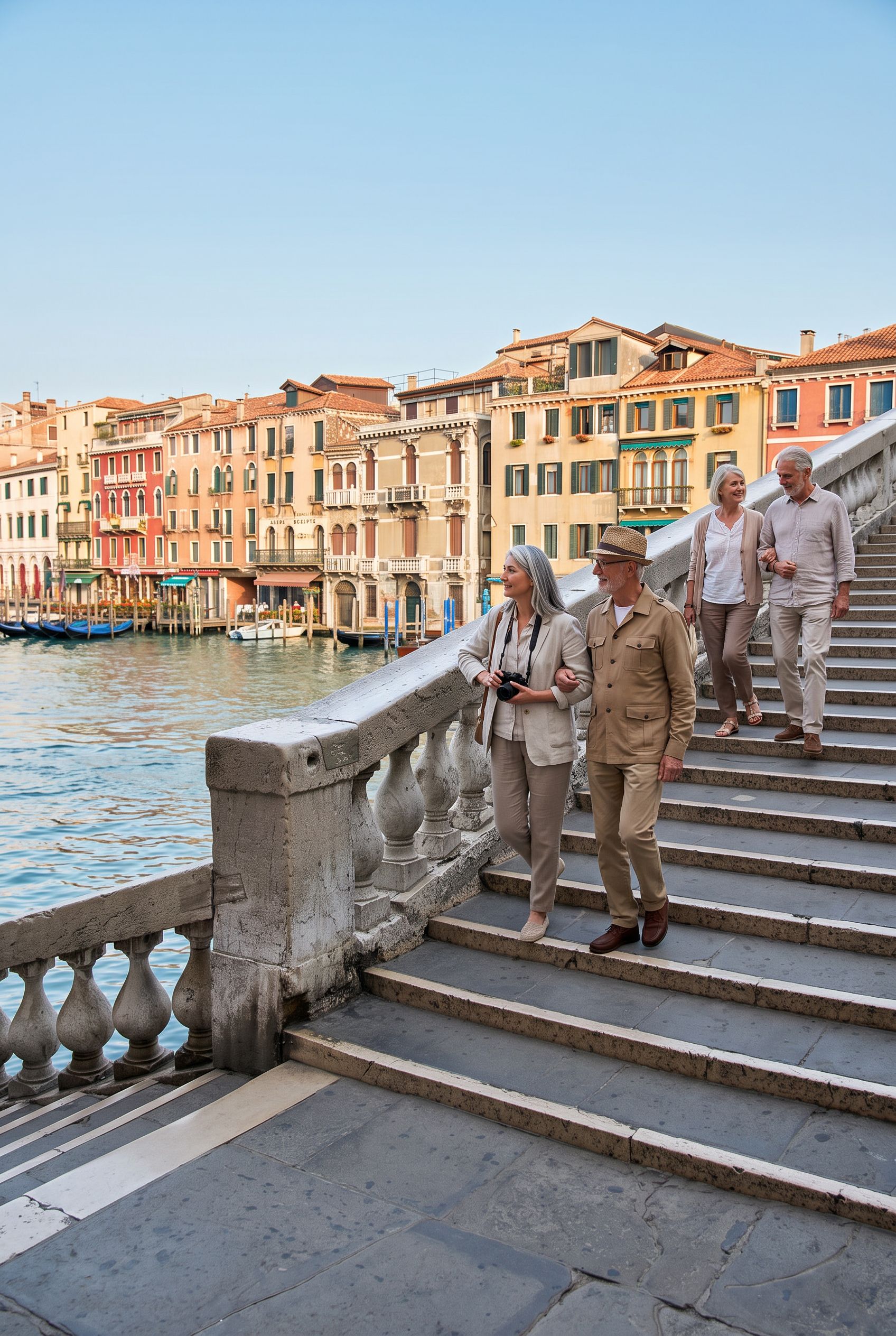 AI-edited
How is Venice laid out, and why does it matter for older visitors?
Venice is an archipelago of small islands joined by bridges, built over roughly a thousand years, and the Grand Canal splits the historic centre into two halves connected by just four bridges (plus the gondola traghetto ferries). Understanding this geography before you book is the single most useful preparation for a comfortable trip.
The city's layout is medieval, not planned. Streets end at water; a route that looks short on a map can involve three stepped bridges, while a longer-looking route along a fondamenta (canal-side walkway) may be almost level. The city's own accessibility map classifies the centre and islands by access level, distinguishing areas completely accessible by vaporetto, areas reachable by motoscafo or a facilitated bridge, and areas not accessible by public transport (the municipality's Accessible Venice map).
That classification is the best mental model a visitor can carry. Think in three layers: the water network, which does the heavy lifting; the canal-side walkways, which are the gentlest walking; and the interior lanes, which are where the steps live. The city reports that almost 70% of its area is accessible to people with motor disabilities, and that it has developed 14 barrier-free itineraries for visitors with reduced mobility (Comune di Venezia, mobilità ridotta).
Where should you base yourself?
Base yourself in San Marco, Castello or the Dorsoduro edge if stamina is a consideration, because the major sights cluster there and fewer bridges are required between them. Cannaregio and Santa Croce suit arrivals by train and travellers who prefer quieter evenings, though both add bridge crossings to the classic sightseeing circuit.
Traveller reports collected from senior-focused forums repeatedly recommend the San Marco area for visitors with limited stamina, precisely because so much is concentrated within a short radius. The same reports warn that two addresses the same distance from a landmark can differ enormously in effort depending on how many bridges lie between them, so a map check before booking is worth more than a star rating.
For arrivals, geography matters. Venice Santa Lucia Station connects to Marco Polo Airport by the Alilaguna water bus, and the Piazzale Roma bus station is reachable from the station on foot in about ten minutes via the Ponte della Costituzione, according to the airport operator's transport pages. A new rail link to Marco Polo Airport has been under construction, with completion projected for December 2025 when the Veneto Region announced it.
Guest feedback across Venice hotels points in a consistent direction for this age group: prioritise properties that explicitly state they have a lift, and ask for a room away from breakfast areas, courtyards and housekeeping zones. Reviews of individual hotels are covered in our dedicated hotel dossiers, which have their own guides.
How bad are the bridges and steps, really?
Venice has around 400 bridges with steps, uneven paving, and boarding gaps at boat stops that vary with the tide. One senior-focused source rates wheelchair accessibility at 2.5 out of 5 and describes the city as best suited to slow walkers or travellers with a companion. For most visitors in their fifties to seventies, the bridges are manageable if broken up, not avoided.
The honest picture is that Venice is not a flat walking city in any practical sense, even though the terrain itself has no hills. Forum contributors who have visited describe the stairways as usually very short, which is why the city works for many older travellers when walking is interspersed with boat rides and sit-down breaks. The recurring regret in those same reports is not using the vaporetto enough, or not building in rest.
Practical measures that appear repeatedly in traveller accounts include a collapsible cane, a cane with a seat, or a lightweight folding chair for rest stops. Cafes and restaurants are plentiful along the main routes, and returning to the hotel midday for a rest is a pattern several visitors recommend rather than a sign of weakness.
The city does not publish step counts for individual bridges or routes, and no source gathered here documents the exact gradient or step number of any named bridge. Ask at your hotel, or check the municipality's accessible route maps before committing to a long interior walk.
How do you get around Venice without exhausting yourself?
The vaporetto, Venice's water bus network, is the key mobility solution, and Lines 1 and 2 along the Grand Canal are the backbone of accessible sightseeing. Boarding ramps can be steep and gaps uneven depending on tide and crowding, so timing your journeys matters as much as choosing your route.
One source recommends travelling off-peak, roughly 10am to 12pm or 3pm to 5pm, when boats are less crowded and boarding is easier. Staff assistance at boarding is mentioned in more than one account, and some stops have ramps. Seats on vaporetti can be limited, with one mobility-focused report noting that most passengers end up standing, so standing tolerance is worth an honest self-assessment before a long canal run.
The traghetto gondola ferries, which cross the Grand Canal at seven key points, are described in one city travel source as wheelchair-friendly and costing €2. They are a short crossing rather than a sightseeing trip, but they can save a long detour to the nearest bridge.
| Element | What the evidence states |
|---|---|
| Vaporetto lines | Lines 1 and 2 along the Grand Canal are the documented accessible sightseeing spine |
| Quieter boarding windows | Roughly 10am–12pm or 3pm–5pm, per one source |
| Traghetto ferries | Seven key crossing points; €2 per crossing, per one city travel source |
| Boarding conditions | Ramps may be steep and gaps uneven, depending on tide and crowding |
| Rialto A/B boarding | Wheelchair users can ask crew to assist; the municipality advises phoning 800845065 about 20 minutes before boarding |
For visitors with reduced mobility, the municipality states that waterborne and land AVM/Actv services are accessible to wheelchair users, and that special lagoon transport units, including hydro-ambulances, operate for non-ambulatory and injured passengers. The city's official material also notes that water bus tickets for people with reduced mobility are less expensive, and that people with disabilities can use free washrooms, with civic museums free for a disabled visitor and a companion.
Which major sights work best for older visitors?
Piazza San Marco, the Basilica, the Doge's Palace, the Accademia, the Peggy Guggenheim Collection and the Campanile form the most practical cluster, all reachable by vaporetto with documented access provisions. The Grand Canal itself, seen from a vaporetto seat, is the single most comfortable major sight in the city.
Piazza San Marco is described in one senior itinerary source as flat, with bench seating and sheltered arcades; another source says much of the area around the square is wheelchair-accessible, apart from occasional steps. The Basilica di San Marco has a ramped entrance via the Porta dei Fiori and a lift to the upper museum, according to one accessibility guide, which also notes it can be reached without crossing a stepped bridge if the approach is planned by vaporetto.
The Doge's Palace is described in one guide as partially wheelchair-accessible with a lift, though some areas still have steps; another says the visit is fully accessible and includes an accessible toilet on the ground floor. Sources differ on the extent of step-free access inside the palace; confirm with the ticket office when booking.
The Campanile di San Marco has a lift to the belfry, installed in the 1960s. The Gallerie dell'Accademia has a barrier-free entrance on the right and lifts to the first floor, per one accessibility guide.
What should you know about the Peggy Guggenheim Collection?
The Peggy Guggenheim Collection, in the Palazzo Venier dei Leoni in Dorsoduro, is reachable from the Accademia, Salute and Zattere vaporetto stops, has platform lifts inside, provides free wheelchairs and staff assistance, and offers free admission to visitors with limited mobility and their care partners. It is closed on Tuesdays and on 25 December.
The museum's own accessibility page states it is open daily from 10am to 6pm, closed Tuesdays and 25 December, and that it is not possible to access the museum directly from the Grand Canal. That last point matters for planning: approach from the land side, via the Dorsoduro vaporetto stops, not by water taxi to the frontage.
Guided tours are offered for the permanent collection, the Schulhof Collection and the temporary exhibition, and the museum states that booking is required. The museum's own pages do not state cancellation terms, so confirm those directly when you book.
When should you go?
The best balance of weather and crowds falls in April to May or September to early October. December through February is the quietest stretch, with January the coldest month and the lowest visitor numbers. July and August are the hottest and busiest, with average highs around 28°C and the year's peak arrivals.
Recorded tourist-arrival data for the historic centre in 2023 show January at 175,070 arrivals against July at 423,252, confirming both the summer peak and the winter trough. The same source notes Venice is much quieter from December through February.
Temperature patterns are well documented. January averages highs around 6.6°C in one climate table, with lows near freezing. April brings average highs of roughly 16 to 18°C. May sits comfortably at 21 to 23°C before crowds build. September cools into the low twenties and remains a favoured shoulder month. October falls to the mid-teens with wetter conditions. November cools to roughly 10 to 13°C and turns quieter.
| Period | Typical conditions | Crowd level |
|---|---|---|
| January | Coldest month; highs near 6.6°C | Quietest; 175,070 arrivals in 2023 |
| April–May | Mild to warm; 16–23°C highs | Shoulder season; crowds rising in May |
| July–August | Hottest; highs around 28°C | Busiest; 423,252 arrivals in July 2023 |
| September–early October | Low twenties cooling to mid-teens | Favoured shoulder window |
| December | Cool; highs near 5–9°C | Quiet, with short daylight |
For visitors sensitive to heat, the summer months deserve particular caution: Venice's stone squares and canal-side walkways offer limited shade, and the vaporetto boarding areas can be exposed. Spring and autumn remove that concern almost entirely.
What does it cost, and what discounts exist?
Venice's access fee is not currently in effect: the trial period for 2026 ended on 27 July 2026, and the city states it is possible to visit Venice without any payment or exemption request. Senior discounts exist at some state museums and on Trenitalia rail travel, but they are not universal and vary by site.
The city's official access-fee page states that the authority to approve further measures for possible application of the fee in years following 2026 lies with the governing bodies of the City of Venice. When it applied, the fee was €5 or €10 depending on booking timing, with no reductions, and it did not apply to the minor islands in 2026. Exemptions included people with disabilities and their companions.
On museum entry, the Museo di Palazzo Mocenigo explicitly lists visitors over 65 in its reduced-ticket categories, and online booking is available for reduced-price tickets for over-65s, children aged 6 to 14 and students aged 15 to 25 (Museo di Palazzo Mocenigo visitor information). Other reduced and free tickets are issued on presentation of documents at the ticket office. The Murano Glass Museum lists a reduced tariff for seniors aged 65 and over.
One senior travel source notes that some state museums offer reduced entry for those over 65, with proof of age possibly required, and that Trenitalia's Carta d'Argento offers train discounts for over-60s, though some discounts are limited to EU citizens. No citywide senior vaporetto fare for visitors is documented: AVM/Actv's published over-75 concession applies to residents of the Comune di Venezia, not to tourists. Wheelchair users and EU Disability Card holders pay €1.50 for 75 minutes, with companions travelling free under the stated rules.
What accessibility support does the city provide?
The municipality publishes an Accessible Venice map classifying areas by access level, maintains a network of pedestrian paths for people with limited mobility covering about 14 kilometres, and states that more than half of its 66 islands are now accessible for tourists with limited mobility, including 46 reachable by public transport and 20 more made accessible with ramps on bridges.
The tourist office can provide the map and a key for bridge stairlifts, according to one source. The map's three-way classification (fully accessible by vaporetto, accessible by motoscafo or facilitated bridge, and not accessible by public transport) is the most useful single document for planning a visit with mobility limitations.
Where a requested vaporetto stop is less commonly served, one source advises using the nearest accessible alternative, and staff may help route passengers to a nearby accessible stop. For wheelchair users boarding at Rialto A/B, the municipality advises phoning 800845065 about 20 minutes before boarding so crew can assist.
One source lists local pharmacy examples including Farmacia Morelli in San Marco and other medical-supply shops, but does not state the nearest pharmacy to each attraction, and no on-site medical service is documented for the named sights. The standard emergency number used locally in Italy is 112; no Venice-specific municipal emergency listing was documented in the material gathered here.
What about crowds, events and construction?
Venice runs a heavy calendar of events and public works that can disrupt walking routes, vaporetto landings and transfers. The municipality reported around €1.5 billion of public works under way in the city in 2025, including hydraulic safety works and major works in Piazza San Marco, so checking your dates against the works calendar is worthwhile.
The 2024 Venicemarathon caused major temporary transport and landing-point changes in Venice and nearby municipalities, including suspended or altered waterbus stops and road closures in Marghera, Mestre and the city itself. A temporary bridge and related waterborne-service changes were used around Punta della Dogana and San Marco during the marathon period, showing that even central sightseeing routes can be temporarily disrupted by major events.
Work in Rio di Cannaregio finished in February 2025, restoring normal navigation and public-transport service after the interruption, with lines 3, 4.1/4.2 and 5.1/5.2 among those restored or rescheduled. The city also reported work on Piazza San Marco in late 2024, with works running almost around the clock.
Two further developments are worth knowing. The Fusina cruise terminal in Marghera opened in August 2024, with space for up to two ships in home-port mode and capacity quoted at 400 passengers per hour, shifting some cruise handling to the lagoon edge rather than the historic core. An 18,500-seat Venice Stadium was unveiled in April 2025 for the Bosco dello Sport area north of the city, intended for football, rugby and concerts, which may affect event-day traffic in the municipality.
What else should you plan for?
Plan around four things: mobility, health, safety and booking ease.
On mobility, the pattern is consistent: use boats strategically, accept slower sightseeing, and choose accommodation that minimises bridge crossings. On booking, the documented channels are the museum ticket offices and call centres, with MUVE providing accessibility contacts including phone numbers for the ticket office and call centre. The Museo di Palazzo Mocenigo call centre can be reached on 848082000 from Italy or +39 041 42730892 from abroad.
Travellers with specific medical needs should ask their accommodation directly and carry any necessary documentation, since reduced and free museum tickets are issued on presentation of documents.
On safety, no dedicated municipal safety note for Venice was documented in the material gathered here. The closest documented practical fact is that the municipality operates special transport for disabled or non-ambulatory users and maintains formal accessibility support channels, which matters for older travellers moving around the city.
For readers extending a wider Italian trip, our guides to Rome's prettiest piazzas and easy strolls and to senior-friendly day trips from Rome follow the same pacing principles, and families travelling with grandchildren may find our Rome family guide useful for comparison.
How many days do you need, and how should you pace them?
Three to four nights suits most visitors in this age group, allowing one major sight or district per half-day with a rest in between. Attempting more than that tends to produce the fatigue that traveller reports consistently warn about, and the city rewards depth over coverage.
The documented pattern from traveller accounts is that Venice works best when days are built around one vaporetto journey, one major destination, and a sit-down pause. The Grand Canal by vaporetto is treated across multiple sources as the key accessible sightseeing experience, and it can be done seated, which makes it an ideal anchor for a tiring day.
Distances in Venice are deceptive. A route of similar length to another can differ greatly in effort depending on how many bridges must be crossed, and checking maps carefully before setting out is advice that appears repeatedly in senior-focused forum reports. Building in a midday return to the hotel is a pattern several visitors recommend, and the city's density of cafes and restaurants makes spontaneous pauses easy.
For visitors with limited stamina, concentrating on the San Marco, Accademia and Zattere cluster, with the Peggy Guggenheim and the Accademia galleries as the museum anchors, gives a full and satisfying visit without ever crossing the city end to end.


