
A packing list for the Dolomites is not a holiday wardrobe. It is a small, carefully chosen kit built around three realities: ground that is rocky, steep and often loose underfoot; weather that can shift from hot sun to cold rain within a single afternoon; and a valley-to-summit temperature gap that surprises almost everyone on a first visit. The Dolomites span Trentino-South Tyrol, Veneto and Friuli across five provinces, and no single set of conditions applies to all of it. What does apply everywhere is the logic of layering, the case for proper boots, and the value of travelling light through hotels that were often built long before anyone thought about lifts.
Travellers aged 50 to 70 who report back from the region tend to say the same thing: they packed more warmth and more rain protection than they expected to need, and they were glad of it. The advice below is drawn from operator pages, official packing guidance and the accumulated experience of walkers who have been there in June, July, August, September and October. It is practical rather than exhaustive, and it starts with the single item that matters most.
What footwear do you actually need in the Dolomites?
Lightweight or mid-weight waterproof hiking boots with ankle support are the standard recommendation for Dolomites walking. Trainers and road-running shoes are not considered appropriate for hiking, climbing, trail running or via ferrata trips, according to the Dolomite Mountains packing guidance. Grip and support matter more than appearance on this terrain.
The reasoning is straightforward. The range is mountainous, summer hiking is strongest from mid-July through September, and the surfaces underfoot include scree, loose stones, wet grass and, after rain, paths that turn slippery even when they are technically easy. One walker who spent ten days in South Tyrol in July reported that waterproof boots were the right call. Another advised sturdy walking boots specifically because loose stones and scree make footing tricky.
There is genuine disagreement among experienced visitors about how much boot you need. Some argue waterproof footwear is unnecessary in August because rain tends to be brief; others counter that rain, wet grass and occasional snow can make feet miserable regardless of the month. A middle position, voiced on the Rick Steves forum, is that athletic shoes are fine if the tread is good and the routes are not technical, with the caveat that trails can be very slippery after rain. For anyone who plans to walk regularly, or who values ankle stability on descents, boots remain the safer default.
For village time, the same principle applies in a gentler form. Cobblestones and mountain paths both reward thick soles, firm support and a shoe that bends where the toes bend. Heels and thin soles are the two things experienced walkers consistently warn against.
How should you layer for fast-changing mountain weather?
Three layers is the documented formula: a moisture-wicking base layer, an insulating fleece or light down mid-layer, and a waterproof shell. Official Dolomites safety guidance recommends warm layers and a waterproof jacket, and packing guides specify synthetic or wool fabrics rather than cotton, which holds moisture against the skin.
The reason layering works here is the temperature gap. Valley towns can feel genuinely warm while the air at around 2,000 metres is markedly cooler, and above 2,500 metres summer snow is possible. A single heavy coat cannot handle that range; three thin layers can be added and removed as the day demands.
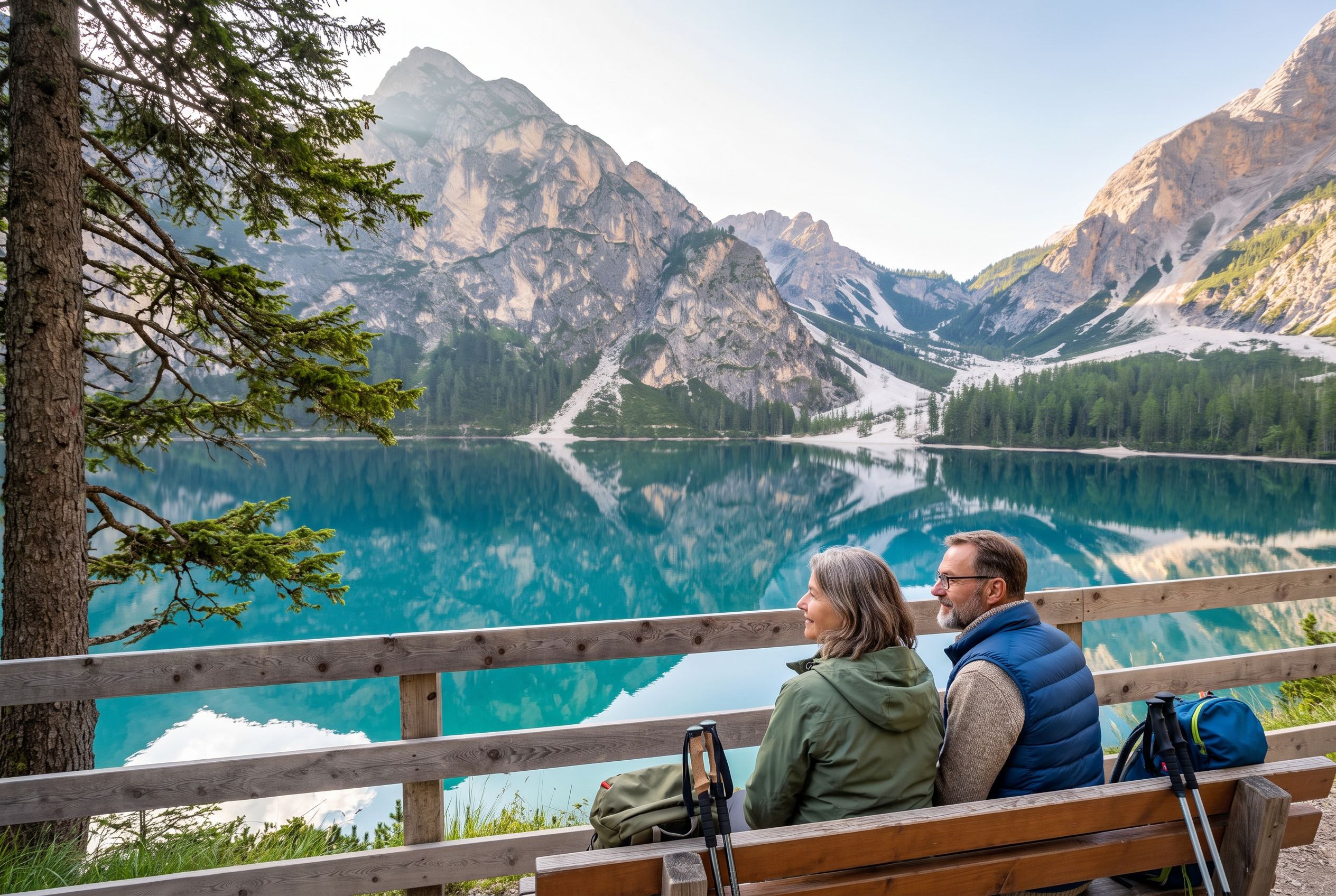
Cotton is the one fabric to avoid against the skin. Several experienced travellers say it holds moisture and chills the wearer, and they prefer merino or wool for cold, wet conditions. A wicking base layer, a fleece or light down middle, and a Gore-Tex-style rain and wind jacket with over-trousers form the core of the kit. Quick-drying trousers and both short- and long-sleeved tops round it out.
- Base layer: merino or synthetic, not cotton
- Mid layer: fleece or light down
- Outer layer: waterproof and windproof jacket, plus over-trousers
- Extras: warm hat, light gloves, waterproof backpack cover, blister protection
- Sun: hat, sunglasses and sunscreen, because altitude intensifies exposure
 AI-edited
Gloves and a warm hat earn their place even in midsummer. Travellers who visit in fall or the shoulder season repeatedly mention carrying light gloves, a rain-and-sun hat and long underwear even when the forecast looks mild. The pattern across reports is that mornings are cool, afternoons can turn stormy, and higher elevations feel much colder than the valley below.
When does the weather turn, and how should that shape your day?
Afternoon storms are common in summer, especially in July and August, so early starts are safer and more comfortable. Mountain forecasts are only reliable a few days out, which means packing should assume rain, wind and cold even when the outlook looks good. Check the forecast again on the morning of a walk.
The Dolomiti Bellunesi guidance recommends checking the ARPAV Veneto forecast for the area you intend to visit, both a couple of days before and on the day of the hike. Official advice stresses using the relevant provincial service rather than a generic weather app, because conditions vary sharply between valleys and elevations.
Cortina d'Ampezzo, a commonly cited valley-floor reference point, shows how wide the swing can be across a year. Average highs run from about 6°C in January to 29°C in July, while lows range from about -5°C in January to 15°C in July. April through October brings a regular rainfall pattern, with roughly six to ten rainy days per month in the warmer season. Those figures describe the valley floor, not the summits, and the difference between the two is the whole argument for layering.
| Month | High | Low | Rainy days |
|---|---|---|---|
| May | 23°C | 9°C | 10 |
| June | 27°C | 13°C | 9 |
| July | 29°C | 15°C | 9 |
| August | 28°C | 15°C | 9 |
| September | 25°C | 11°C | 6 |
| October | 19°C | 6°C | 6 |
Snow normally accumulates from December through March and can last into April, which is why the winter months are the least favourable for hiking-focused trips. For anyone weighing dates, our guide to when to visit the Dolomites for fine weather and fewer crowds covers the seasonal trade-offs in more detail.
Are walking poles and a daypack worth carrying?
Trekking poles are recommended for descents and longer walks, with one trekking guide specifically citing them as a way to save the knees. For longer hikes, a 20 to 25 litre daypack is the documented recommendation, carrying water, snacks, a small first-aid kit and a map or GPS.
Poles earn their place on exactly the terrain the Dolomites provide: loose scree, wet grass and long descents that load the joints. For walkers in their fifties and sixties, the case is practical rather than technical. They also help on uneven ground where a momentary loss of balance is the real risk.
The daypack should hold more than a sandwich. Official safety guidance for the region recommends carrying a map or GPS, a headtorch, a first-aid kit and a charged phone alongside the layers and waterproofs. A waterproof backpack cover protects the contents when the afternoon storm arrives. For via ferrata routes, dedicated via ferrata gear is recommended by packing guides covering the Dolomites; that is a separate kit from ordinary walking equipment.
What size pack should you bring, and can you backpack through the Dolomites?
No exact official pack size is published for the Dolomites, so there is no single figure to quote. What is documented is a 20 to 25 litre daypack for longer hikes. For a multi-day trip, the sensible approach is a daypack plus a wheeled case rather than one large rucksack.
The region is marketed for hiking and multi-day active travel, but no exact route statement on backpacking through the Dolomites appears.
For most travellers in this age bracket, the more useful question is how to move luggage between valleys. Several Dolomites highlights now depend on timed access, cable cars, buses or reservations rather than simply driving up and parking. A wheeled case that fits a cable car cabin and a car boot, plus a small daypack for the trail, is the combination that keeps a multi-base trip manageable. The Seiser Alm cable car, for instance, transports pushchairs and is described as fully accessible, with cabins holding up to 16 passengers.
How do you handle luggage in hotels with steps and lifts?
Lightweight luggage matters because many Dolomites hotels are older buildings where rooms may involve stairs or higher-floor placements. Reviews of several properties mention lift access as a valued convenience, and where stairs come up it is usually in the context of room location rather than a formal accessibility feature.
The practical translation is simple. Ask about lift access and room location when booking, and ask specifically whether the room is reached by stairs. A soft-sided case that can be carried up a short flight is easier to manage than a hard shell, and packing light in the first place removes most of the problem.
Where the material is silent on step counts, lift dimensions and assistance services for a specific property, that detail is not documented and should be confirmed directly with the hotel. This is the kind of question worth asking in writing before you book, particularly if mobility is a consideration. Our guide to altitude, health and peace of mind in the Dolomites covers the wider planning picture.
Guest feedback across the region is more positive than negative on access, but the recurring friction points are worth knowing: some rooms involve stairs or higher-floor placements, and a few guests have reported rooms running too warm, requiring a window or balcony door open at night. Neither is a reason to avoid a property; both are reasons to ask a question before booking.
What health and emergency information should you carry?
Emergency number 112 is documented for the Dolomites generally and for Val Gardena specifically. In the Veneto Dolomites, 118 is also used for medical emergencies, with a 24/7 operations centre. In Val Gardena, healthcare services are documented in Ortisei, Santa Cristina and Selva di Val Gardena.
For the Dolomites as a whole, the nearest pharmacy and nearest hospital are not documented, because both depend on the exact municipality or valley. That is not an oversight; it reflects the fact that the Dolomites are not a single administrative area. The practical approach is to identify the services in whichever valley you are basing yourself.
- Val Gardena: doctors, pediatricians, dentists and pharmacies in Ortisei, Santa Cristina and Selva di Val Gardena
- Selva di Val Gardena: Pharmacy Dolomiti Dr. Berdou is listed, along with an outpatient clinic on Nivesstr.
- Sciliar / Alpe di Siusi area: pharmacies in Castelrotto, Siusi, Fiè and Alpe di Siusi; nearest hospitals in Bressanone and Bolzano
- Veneto / Belluno side: hospitals listed in Belluno, Feltre, Agordo, Pieve di Cadore, Lamon and Cortina, with 76 affiliated pharmacies providing 24-hour assistance on a shift system
The doctor-on-call service in Selva di Val Gardena is listed seasonally by the Val Gardena tourism site, running from July to September and from December to April. Outside those windows, confirm locally what is available. Carrying a written list of your medications, and knowing the Italian names where they differ, saves time in a pharmacy.
Why does sun protection matter more at altitude?
Sun protection is a documented packing requirement for the Dolomites, including sunscreen, sunglasses and a hat. Altitude intensifies exposure, and the same conditions that produce a hot morning can produce a cold, windy afternoon, so sun protection and warm layers are carried together rather than as alternatives.
The practical kit is a brimmed hat, high-factor sunscreen and sunglasses with proper UV filtering. A rain-and-sun hat, mentioned by travellers who visit in shoulder season, does double duty. Lips and the backs of hands are the areas most often forgotten.
Altitude also affects how the body performs, which is a separate consideration from what you pack. Our guide to altitude, health and peace of mind in the Dolomites covers that side of the trip. For packing purposes, the point is simply that a sunny morning at 2,000 metres is not the same as a sunny morning in a valley town.
What should you know about accessible trails and viewpoints?
Accessible trails and viewpoints exist across the wider Dolomites, but they are distributed rather than concentrated in one place, according to the official accessibility resources. The UNESCO-linked accessibility pages record 36 trails open to everybody and 13 accessible viewpoints, spread across the broader region rather than tied to a single municipality.
That distribution matters for planning. It means you cannot assume that a given valley will have an accessible route simply because the region as a whole does. It also means the sensible approach is to identify the specific trail or viewpoint you want and confirm its conditions before travelling.
Public transport in Val Gardena is documented as barrier-free, with many regional trains offering low-floor access, stations with lifts, and public buses that are barrier-free with ramps. A barrier-free Südtirol Transfer shuttle is also mentioned on request. The Seiser Alm cable car is described as fully accessible, with wheelchair users receiving priority boarding and free travel for blind passengers, people with 100% disability and wheelchair users, while accompanying persons pay the regular price.
For the Dolomites as a whole, pedestrian-path quality is not documented comprehensively, and no full place-by-place inventory of cobblestones, benches or gradients exists for the region. Some areas are documented as steep, rocky and exposed, which affects both footing and comfort. Where a specific path's surface is not documented, that detail should be confirmed locally rather than assumed in either direction.
What should you not forget to pack?
The items most often forgotten are the ones that handle change: a waterproof shell, a warm mid-layer, blister protection, a headtorch, and a spare pair of shoes. No Dolomites-specific source was found on what not to forget for Italy generally, so this list is drawn from the regional packing guidance and traveller reports.
Beyond the core kit, the smaller items earn their place disproportionately. Blister protection turns a good walk into a comfortable one. A waterproof backpack cover protects electronics when the rain arrives. A charged phone and a power bank matter more here than in a city, because the phone is the map, the camera and the emergency line.
One final consideration is booking and timing. Several Dolomites highlights now depend on timed access, cable cars, buses or reservations rather than driving up and parking, which makes a flexible daily plan more useful than a fixed itinerary. The Seiser Alm road, for example, is closed to cars from 9:00 am to 5:00 pm during the season, with the cable car or buses required during those hours. Where booking methods and cancellation terms for a specific service are not documented, confirm them directly with the operator before you travel.


