
The Dolomites reward timing more than almost any mountain range in Europe. The same valley that feels serene in the second week of September can be a slow-moving queue of cars and walking poles in the first week of August. For travellers aged 50 to 70, the question is rarely whether to go, but when the weather, the lift network and the crowds line up in your favour. The answer, drawn from operator calendars, tourism boards and traveller reports, points to two windows: early to mid-June, and September through early October.
This guide works through the year month by month, covering when the summer hiking season opens, when lifts and mountain huts close, how autumn colour shifts the landscape, what the winter ski months involve, and where the quieter shoulder windows sit. It also treats two factors that shape any Dolomites trip: the afternoon thunderstorm pattern of high summer, and the way altitude changes the temperature even on a warm day.
What is the best time to visit the Dolomites?
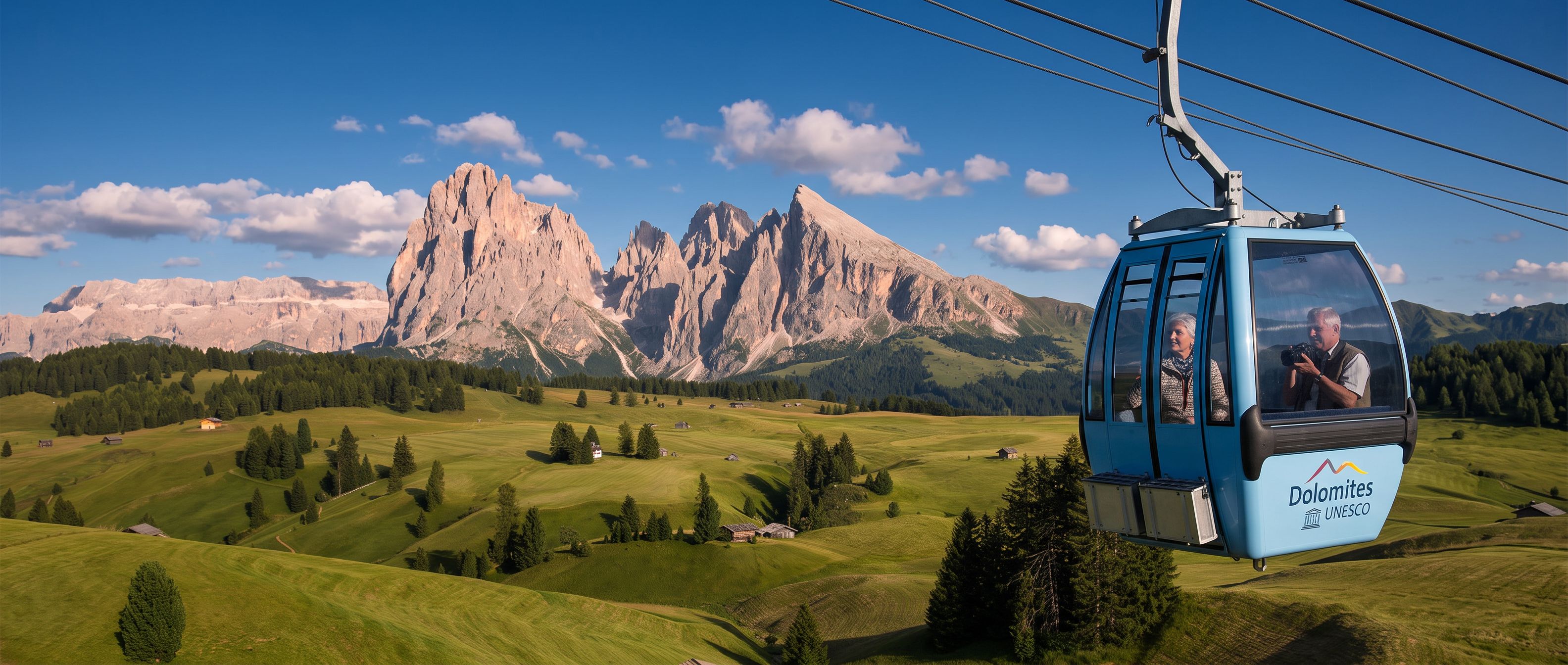
September is the most consistently recommended month, with early October close behind. June, especially early to mid-June, is the strongest summer alternative. These windows combine stable weather, open infrastructure and noticeably fewer visitors than July and August, which are the busiest months across the range.
Multiple travel guides and field-based planning articles independently point to September as the month where weather stays good while crowds fall noticeably. One month-by-month hiking guide states that crowds halve in early September and calls it the best window for hikers. The-senior-traveler.com recommends aiming for September or early October if quiet conditions matter, and suggests basing yourself in one valley rather than trying to cover the whole range.
The same source notes that September and early October suit older walkers best, because of golden larches and fewer afternoon storms than midsummer. That combination, stable skies plus a thinner trail, is what makes the shoulder season worth planning around.
For those who prefer a summer trip with long days, early to mid-June is the other strong option. Lifts begin operating from mid-June in many areas, and the crowds have not yet arrived in force. The trade-off is that higher routes may still be snowbound or muddy, and some lifts only open by mid-June.
 AI-edited
What is the weather like in the Dolomites by month?
The Dolomites run from warm summer highs near 27 to 29°C in June to August down to cold winter conditions from December to March. Rain days occur even in summer, with Cortina d'Ampezzo recording nine rainy days in June, July and August, and six in September. Daylight falls from 15 hours 42 minutes in June to 12 hours 37 minutes in September.
Published monthly averages for Cortina d'Ampezzo, a key valley-floor reference, show June highs of 27°C, July 29°C, August 28°C and September 25°C. Rain days are not absent in summer: June, July and August each record nine rainy days, and September six, according to the same published table. Winter highs are much cooler, and snow typically accumulates from December through March, sometimes into April.
The dolomites.it seasonal guide frames each month with a short character note and a caution. December brings a festive atmosphere and early winter, but snow and terrain can be uneven early in the month. January is quieter skiing with cold conditions and short days. February offers full winter operation and family holidays, with peak prices and school-holiday crowds. March brings longer ski days and terraces, though lower slopes can soften. April allows late skiing in selected areas, with rapid closures and inconsistent valley conditions.
May and November, the guide states, are beautiful but structurally limited. June brings fresh summer and opening lifts, though snow can remain on higher routes. July offers broad summer access alongside crowds and afternoon storms. August delivers full operation and events, with the highest pressure on roads, trails and hotels. September brings a clearer rhythm and early autumn, with shorter days and some closures. October offers colour and quiet, but lift and hotel closures accelerate. November is near-total calm, with limited hospitality and mountain infrastructure.
When does the summer hiking season start and end?
The hiking season generally runs from mid-June to September. Many major lifts begin operating in mid-June, and most mountain huts open between mid and late May, with high alpine refuges starting from mid-June after snowmelt. Most huts remain open until early October or early November, depending on weather and snowfall.
Published 2026 lift dates from Dolomiti SuperSummer show the pattern clearly. In Cortina d'Ampezzo, summer lifts run from 6 June to 18 October 2026. Alta Badia operates from 13 June to 4 October 2026, and Val di Fiemme from 13 June to 27 September 2026. In Val Gardena, Dantercepies I and II run from 12 June to 4 October 2026, which is typical of the late-spring-to-early-autumn access pattern.
In Val di Fassa, published autumn lift information shows some lifts staying open into early November while others close earlier in October. Nova Levante to Malga Frommer, for example, is listed as open until 1 November. Val Gardena lists some closures as early as 4 October 2026 and others as late as 2 November 2026.
Hut closing dates vary widely too. A hut-and-lift listing for the wider Dolomites shows closing dates from 10 October to 6 January, confirming that autumn and early winter closures depend heavily on the individual site. No general, all-Dolomites maintenance calendar is documented; exact dates are published by operators and vary by route.
For readers planning around mobility, the UNESCO Dolomites accessibility programme publishes 36 accessible trails across all nine Dolomites systems, plus 13 panoramic viewpoints reached by fully accessible lift systems. Each route has detailed maps, GPS coordinates and technical information sheets in English, German and Italian. The UNESCO Dolomites accessibility programme is the authoritative starting point for anyone who needs to check a specific trail before travelling. Our own guide to how accessible the Dolomites are for older travellers covers this ground in more detail.
When are the quieter shoulder windows?
Late September to early October is repeatedly described as the quietest period with good conditions. April and May are quieter still, but with more closures. November is near-total calm with minimal infrastructure. Early June is the other practical shoulder window, offering fresh conditions and opening lifts before the summer rush.
Late September to early October appears most often, followed by April and May, early September, and mid-September onwards. One source describes November as near-total calm but with minimal infrastructure, which is a fair summary of the trade-off: the villages empty, but so do the lifts and many of the hotels.
Early September is described as a safer weather-and-crowds compromise than mid-September, because later in the month some lifts and restaurants start closing while the towns stay fairly quiet. Travellers report that Ortisei is pretty quiet by September, and that Val Gardena still has plenty open even when some lifts begin closing. A tourism staffer in San Cassiano said they love October because the tourists are gone and the mountains turn fall colours.
When does the autumn colour arrive?
Autumn colour peaks from late September into October, when the larches turn gold and the rock faces catch a pink-orange glow in the evening. October offers strong colour with much lighter tourism, but days are shorter and higher huts may already be shut. Some lifts remain open into early or mid-October in selected areas.
The larch turn is the signature of a Dolomites autumn, and it is the reason late September and early October appear so often in recommendations for older walkers. The-senior-traveler.com specifically cites golden larches and fewer afternoon storms than midsummer as the reasons this window suits walkers in their 50s and 60s.
October is quiet and scenic, but closures accelerate and convenience drops. Some lifts remain open into early or mid-October in selected areas, while operations become limited and weather turns more changeable. Higher trails can be affected by early snow. If autumn colour is the goal, the practical approach is to book for the last week of September or the first week of October, then check individual lift closing dates before committing to a particular valley.
For dining during this window, note that some restaurants close mid-to-late September. Our guide to the Dolomites' finest restaurants and mountain rifugi covers what stays open and how the hut season works.
What are the winter ski months like?
The core winter ski season runs from December to March, with most cable cars operating from early December to the end of March or early April. January is quieter with cold conditions and short days. February brings full operation, peak prices and school-holiday crowds. March offers longer ski days, though lower slopes can soften.
The dolomites.it seasonal guide notes that early December should not be marketed as guaranteed complete skiing across every sector, and that snow and terrain can be uneven early in the month. April allows late skiing in selected areas, but with rapid closures and inconsistent valley conditions.
Winter travel requires extra caution because some roads, hikes and viewpoints are not accessible, and snow can make terrain uneven. Wind can close high links even when the village is calm. Dolomiti Superski offers a 10% reduction on some ski passes for those born in 1960 or earlier, which is worth asking about at the ticket office.
Industry press reported more than €95 million invested across the Dolomiti Superski area for the 2024–25 winter season, with multiple lift and snowmaking upgrades. The Milan-Cortina 2026 Winter Olympics have also brought increased pressure for winter-tourism infrastructure, with new ski tracks and lifts already ongoing in the Dolomites.
How do thunderstorms and altitude affect planning?
Summer from mid-June to September brings the most regular afternoon thunderstorms, a real factor for hikers. Altitude compounds the effect: temperatures drop by roughly 6°C for every 1,000 metres of elevation gain, so even a warm valley day can feel cold on a high ridge. Early starts reduce thunderstorm exposure.
A published mountain-weather guide for the Dolomites describes summer as the season of trails, via ferratas and open huts, but also notes the most regular afternoon thunderstorms. The provincial weather service publishes separate high-mountain data for the Dolomites area, and at 3,000 metres the forecast temperatures are much cooler than at 1,500 metres.
One Dolomites guide states that you lose about 6°C for every 1,000 metres of elevation gain, which reinforces that even summer can feel cold at higher altitude. The provincial mountain weather service is the authority to check before a high-level walk.
The practical rule is simple: in summer, early starts reduce thunderstorm exposure. A Rick Steves forum post reported that hitting the trail at 6 or 7 a.m. in August meant encountering few people, and concluded that getting up early makes August manageable. For readers aged 50 to 70, the altitude and health dimension deserves its own planning: our guide to altitude, health and peace of mind in the Dolomites covers the medical and comfort side.
What about accessibility and senior fares?
The UNESCO Dolomites programme publishes 36 accessible trails and 13 panoramic viewpoints reached by fully accessible lifts. Senior reductions exist on some services: the Seiser Alm cable car offers a senior rate for those born in 1960 or earlier, and Dolomiti Superski offers a 10% reduction on some ski passes for the same age group.
On the Seiser Alm cable car, the senior fare for those born in 1960 or earlier is €18 one-way and €26 return in summer 2026. The source does not document step counts, platform distance or terrain details for the exact station, so those details should be confirmed with the operator. Wheelchair users, blind passengers and people with 100% disability travel free, and people with a valid disability certificate pay the same senior fare.
Other reductions documented for the 1960-or-earlier age group include a €4 reduced ticket for over-65s at the Geological Museum of the Dolomites, €12 for seniors aged 60+ at the DoloMythos Museum (against €14 for adults), and €10 for people with disabilities at MMM Dolomites. No region-wide senior pass for the Dolomites as a whole is documented, and no general over-65 fare for public transport across the range is documented either.
In South Tyrol and the Seiser Alm area, the tourism board says public transport is designed with accessibility in mind, with low-floor entry and marked spaces for wheelchairs and pushchairs on modern buses and trains. Blind and visually impaired travellers can use public transport free of charge subject to valid documentation, and travellers with disabilities need a valid disability card to obtain reductions or free travel.
How should a trip be planned around the seasons?
Base yourself in one valley rather than trying to cover the whole range. Ortisei and the Seiser Alm are specifically recommended as practical bases. Bolzano, Trento and Belluno are the practical rail gateways. Book around open-lift and open-property periods, and check individual closing dates before committing.
The-senior-traveler.com recommends basing yourself in one valley and aiming for September or early October if quiet conditions matter. Ortisei and the Seiser Alm are named as practical bases. Val Gardena is supported as a valley-level base with hiking-safety information, emergency guidance, and local pharmacy and clinic details in Selva di Val Gardena, including Pharmacy Dolomiti and an outpatient clinic at Nivesstr. 2, plus additional pharmacies in Santa Cristina and Ortisei.
Emergency numbers are documented: 112 is the single European emergency number used for mountain rescue across the Dolomites, and 118 is the health emergency number in the Veneto Dolomites, operating 24/7. The Where Are U app may be used for emergencies.
No single regional entry permit is documented for the Dolomites as a whole. Access is seasonal, and shoulder months often have limited lift operations, closed hotels and reduced mountain infrastructure. Winter travel requires extra caution because some roads, hikes and viewpoints are not accessible. The Tre Cime di Lavaredo toll road reopened on 25 May 2025 with reservation required, so access rules matter if that is on the itinerary.
For accommodation, quiet nights tend to come from shoulder-season timing and from rooms set away from roads, kitchens, lifts or cable cars. Reviews repeatedly praise restful nights at properties with soundproofing and blackout curtains, and repeatedly flag noise when a room is exposed to mechanical or traffic noise. Our guide to the quietest hotels in the Dolomites covers this in detail. Rates are indicative and vary by season and booking channel.
What should travellers 50 to 70 expect on the ground?
Expect a mountain range where access depends heavily on the month. June and September offer the best balance of conditions and lower crowd pressure for most hikers. July and August are fully open but busy. Late September and October bring colour and quiet, with progressive closures. November is calm but structurally limited.
The Dolomites are consistently described as a shoulder-season and summer walking destination, with lift operations and hospitality limited in May, October and November.
The period most likely to disappoint an unprepared first visitor, according to the dolomites.it guide, is May or November. That is not a verdict on those months, but a note that the infrastructure is thin and the weather unsettled. For anyone whose priority is fine weather with fewer crowds, the strongest first-hand consensus is September, especially early September. For maximum quiet, early October can be excellent, but with more seasonal closures and shorter days.
Exact season dates vary by valley, altitude and year. The most reliable approach is to choose a window, then confirm the specific lift and hut dates for your chosen valley before booking.


