
Lake Garda rewards those who let someone else do the driving. For travellers aged 50 to 70 who prefer organised travel, the lake's best experiences—the ferry rides across deep blue water, the hilltop villages, the vineyards that tumble toward the shore—come wrapped in small-group tours and private guides who know exactly where to stop and when to pause. This guide cuts through the options to show you what to look for, what to ask before booking, and how to match a tour to your pace.
The lake stretches 51 kilometres from north to south, and its character changes dramatically along the way. The northern shore near Riva del Garda feels alpine and dramatic, while the southern towns of Sirmione and Desenzano bask in a Mediterranean microclimate. That variety is precisely why organised tours make sense: they compress the logistics so you can simply watch the scenery change.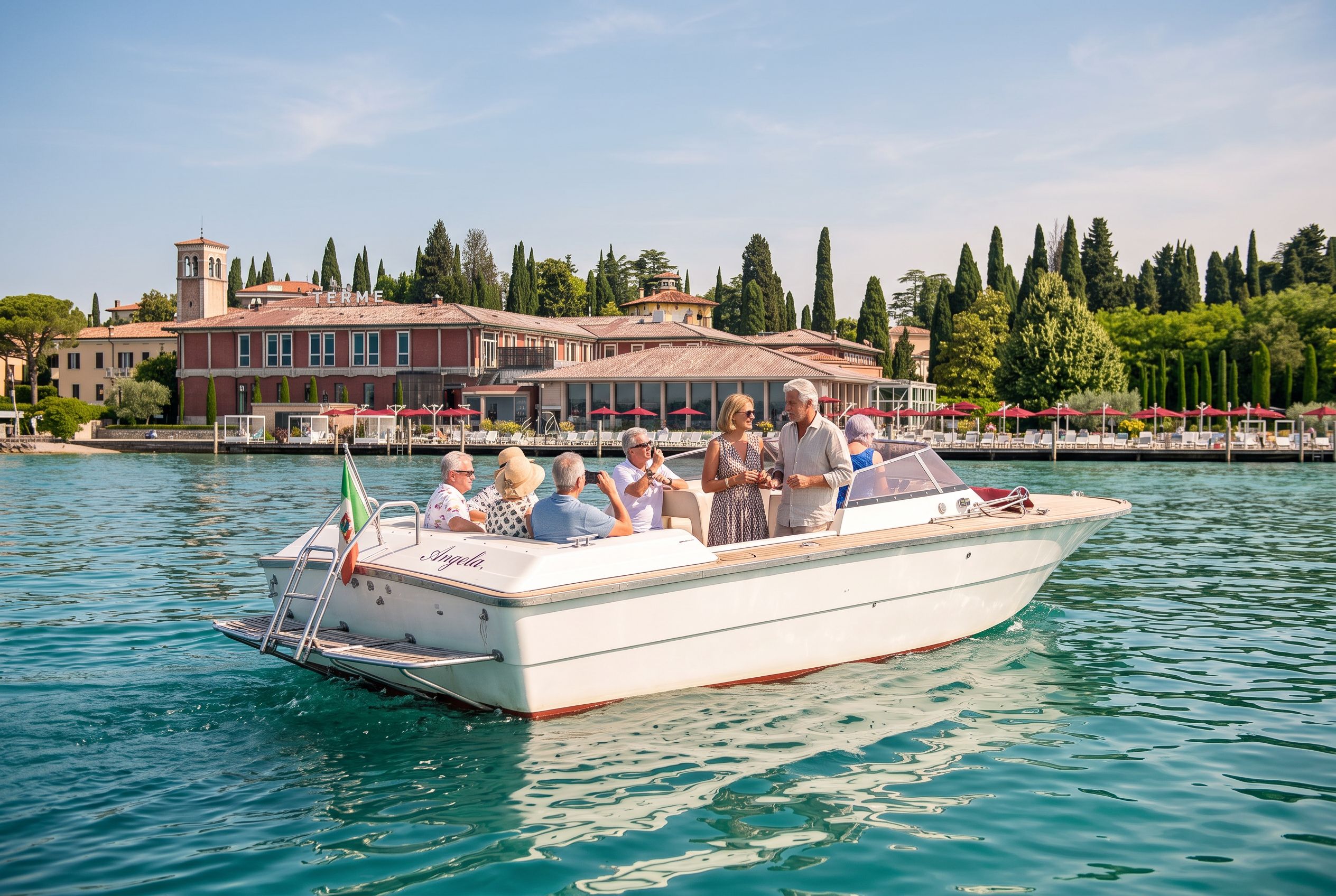 AI-edited
Why choose a small-group or private tour?
A well-run small-group tour removes the three biggest stresses of Lake Garda travel: navigating winding roads, finding parking in crowded lakeside towns, and managing ferry timetables. You trade a little spontaneity for a great deal of comfort, and the best operators build in rest stops and gentle pacing.
The practical case for organised travel here is strong. The lake's roads are narrow and busy in summer, and many hilltop villages involve steep climbs from the waterfront. A private guide or small-group minibus handles the driving while you watch the scenery. As of August 2026, ferry operator Navigazione Laghi continues to run the main routes across the lake, and its vessels are the backbone of most organised itineraries—but not every boat is equally accessible, so checking specific vessels matters. The pattern that works best is straightforward. The lake is easiest to enjoy with one base town, a private driver or guide for inland sights, and a boat or ferry for the lake itself. Where mobility is limited, a private arrangement buys the one thing a scheduled departure cannot: the freedom to stop, sit down and change the plan without holding up a group."It was a beautiful and interesting tour around the peninsula. The boat driver was very friendly and knowledgeable about the area." — a guest wrote on Google in June 2026 about the Sirmione peninsula cruise
What types of organised tours are available?
You will find four main formats: scheduled ferry rides you can join independently, scheduled small-group boat cruises, full-day minibus tours combining lake and inland sights, and private guided experiences tailored entirely to your pace. Each suits a different travel style.
The most popular organised options cluster around a few formats:- Scheduled boat cruises — From a 25-minute run around the Sirmione peninsula to half-day trips that add a wine tasting. They focus on the lake itself and usually involve no walking beyond the dock.
- Full-day minibus tours — Usually 8–10 hours, combining a lake cruise with visits to towns like Sirmione and Salò. Many depart from Verona or Milan and include hotel pickup.
- Private guided day trips — A guide, and often a driver or skipper, for your group alone. Licensed guides charge per tour rather than per person: the Guide Center Verona tariff for 2026 is €150 for about two hours and €300 for about four, for groups of up to thirty.
- Wine-focused outings — Small-group visits to the Bardolino or Lugana vineyards, often paired with a lakeside lunch.
How do I choose a reliable operator?
Look for three things: group size limits stated clearly (ideally 15 or fewer), a guide who speaks your language well, and a cancellation policy that gives you flexibility. Then read recent reviews for mentions of pacing, comfort, and how the operator handles less mobile guests.
As of August 2026, Garda Tours — the Consorzio Motoscafisti Sirmione, which boards at Piazzale Porto — holds 4.7 out of 5 on Google from 758 reviews, with guests repeatedly mentioning knowledgeable skippers and an unhurried pace. Navigazione Laghi is a different proposition: the Google listing for its Desenzano terminal holds 3.7 out of 5 from 202 reviews, which is a scheduled public service rather than a guided experience and is rated as one. When comparing operators, ask these questions:- What is the maximum group size on this specific tour?
- Is the boat or minibus step-free, and is there assistance for boarding?
- How many stops involve significant walking or stairs?
- Are restroom breaks scheduled, and how frequent are they?
- What happens if the weather cancels the sailing?
What should I expect from a boat tour?
Scheduled boat tours here are shorter than most people expect: the Sirmione peninsula cruise runs 25 minutes, a castles-and-wine trip four hours. Most boats have covered seating, and a private charter is the way to set your own length and stops. Landings are at village centres, so walking is short.
The lake's ferry system is the most comfortable way to see multiple towns without repeated walking. Boats land near the centre of each village, where lakefront streets are relatively flat and easier to manage. Regional accessibility guidance confirms this: ferry-linked towns are generally easier for reduced-mobility travellers than inland hikes or cliffside villages. However, accessibility varies by vessel. Some smaller tourist boats are explicitly not wheelchair accessible, and even the main ferry fleet has older and newer vessels with different boarding arrangements. Always check the specific boat before booking, especially if you use a walking aid. The public boats fill up in high summer, and Navigazione Laghi is explicit that boarding may be limited or refused at the captain's discretion for safety reasons; if you cannot board because there is no space, the fare is refundable in full. For organised travellers this matters less, because small-group tours use private boats or hold space in advance. If you plan to combine a tour with independent ferry travel, the quieter months either side of July and August make the connections easier to rely on.How much do organised tours cost?
Published 2026 rates give firmer anchors than averages do. Garda Tours in Sirmione charges €12 for its 25-minute peninsula cruise and €100 for a four-hour castles-and-wine boat tour, while a private boat with skipper starts at €720 for half a day. A licensed guide in Verona costs €150 for two hours, per group.
Here is what named operators and the ferry company actually publish for 2026:| Tour Type | Duration | Price Range | Group Size |
|---|---|---|---|
| Peninsula cruise, Garda Tours (Sirmione) | 25 minutes | €12 adult, €6 child 5–12 | Scheduled departure |
| Castles and Bardolino wine tour by boat, Garda Tours | 4 hours | €100 adult, €50 child 5–12 | Scheduled departure |
| Private boat with skipper, Garda Tours | 4 hours / 8 hours | from €720 / from €1,300 per boat | Your party only |
| Licensed guide on land, Guide Center Verona tariff | about 2 hours / 4 hours | €150 / €300 per group | Up to 30 people |
| Ferry day pass, whole lake (Navigazione Laghi) | Full day | €39.50 adult, €31.60 reduced | Public service |
What questions should I ask before booking?
Ask about walking distances at each stop, whether the vehicle or boat has step-free access, how many passengers are confirmed, and whether the guide will accompany you at every stop or only at some. These four answers will tell you most of what you need to know.
Travellers aged 50–70 who prefer organised travel consistently report that the details matter more than the itinerary. A tour that looks perfect on paper can be exhausting if it involves long walks between stops or frequent transfers.- How many metres of walking are involved at each stop? (Ask for approximate distances.)
- Is there a step-free route from the dock to the village centre?
- Are restrooms available on the boat or vehicle?
- Do you offer a slower-paced version of this tour?
- What is your policy if I need to cancel due to health reasons?
"We had such a lovely time on the boat tour. The 25 minutes flew by — it was the perfect mix of fun and relaxing." — one Google reviewer wrote in August 2025 after the Sirmione cruise
When is the best time for organised tours?
Late May through June and September offer the best combination of warm weather, manageable crowds, and full tour schedules. July and August are hot, busy, and can see ferry services stretched to capacity.
Climate data for Lake Garda shows July and August as the hottest months, with average temperatures of 24°C and 23°C and daily highs around 29°C and 28°C, while May and June average 17°C and 21°C with highs in the low to mid twenties — which is why they, along with September, are commonly described as the best all-round months for warm weather with fewer crowds. According to The Italy Travel Guide's climate overview, the shoulder seasons offer the most comfortable conditions for extended sightseeing. For organised travellers, the shoulder season has another advantage: smaller group sizes. Tour operators run fewer departures but with more space per guest, and the pace tends to be more relaxed when the operator isn't juggling multiple full groups. If you are flexible with timing, consider late September. It still falls inside the summer boat timetable, which runs to 4 October 2026, so the northern towns of Riva del Garda, Limone and Malcesine remain fully connected by water after the August crowds have gone. You can read more about seasonal patterns in our guide to Lake Garda through the year: festivals and quiet seasons.Which base towns work best for organised tours?
For organised travel, choose a base with direct ferry access, a flat lakeside promenade, and tour operators who depart locally. Sirmione, Desenzano, Malcesine, and Riva del Garda all fit this description well.
Your base town matters more than the specific tours you book, because it determines how much energy you spend just getting to the starting point. The most useful shortlist is the one the ferry operator has certified: Desenzano, Sirmione, Peschiera, Garda, Malcesine and Riva del Garda are the six Lake Garda piers that hold the Bandiera Lilla accessibility certificate, alongside nine of the ships that serve them. The northern towns—particularly Riva del Garda, Limone, and Malcesine—are often recommended for scenery and lake access. Malcesine has the additional advantage of the Monte Baldo cable car, which is a popular organised excursion and describes itself as barrier-free: the ticket office is on the ground floor, wheelchair users reach the station by lift from the underground car park, and staff assist at every boarding point. It runs from 4 April to 1 November, with departures at least every half hour from 8:30, and a return ticket costs €30, or €28 booked online. The top station sits at 1,760 metres, so the mountain can be cold even when the lake below is warm; dress in layers. If you prefer a more refined base with excellent hotel options, consider Gardone Riviera, home to the Grand Hotel Fasano, or Sirmione, where the Villa Cortine Palace Hotel offers easy access to tour departures.How do tours combine with ferries and trains?
Most organised tours handle their own transport, but you can extend your reach by combining a tour with the public ferry system or a train connection. The key is to avoid over-scheduling—one organised activity per day is usually enough.
Rail access to Lake Garda is limited to the southern shore, with Desenzano del Garda and Peschiera del Garda as the main gateways. From there, ferries and buses connect to the rest of the lake. A practical pattern used by many older travellers: train to Peschiera, take Bus 483 north, use ferries between towns, and book a small-group tour for inland sights. The public ferry network run by Navigazione Laghi connects the major lakeside towns directly along the waterfront, reducing the need for long uphill walks. As of August 2026 the summer timetable runs from 16 May to 4 October and lists more than twenty sailings a day between Limone and Malcesine; the spring timetable, from 1 April to 15 May, is noticeably thinner. For a fuller picture of how to structure your days, see our five-day Lake Garda itinerary for the over-50s, which combines ferry times with gentle days and two bases.What should I pack for organised tours?
Comfortable walking shoes with grip, light layers, sun protection, a compact rain jacket, and a small day pack for medications and documents. If you use a walking aid, bring a foldable cane or trekking pole—many tour operators can store it on board.
The practical packing list for Lake Garda tours reflects the mix of boat time and short walks:- Comfortable walking shoes with grip for cobbles and uneven lakeside paving
- Light layers for warm days and cooler evenings near the water
- Sun hat, sunglasses, and sunscreen for boat trips
- Light waterproof jacket or compact umbrella for showers and ferry spray
- Small day pack for medications, water, tickets, and documents
- Foldable cane or trekking pole if needed for steep sections
- Copies of prescriptions and your insurance card
- Swimwear only if your tour includes a swim stop—most sightseeing cruises do not
What healthcare options exist near tour routes?
Pharmacies are common around the lake, identified by a green cross and the word "Farmacia." Most are open daytime hours with rotating Sunday and holiday duty. For non-emergencies in summer, some resorts offer a Guardia Medica Turistica, but availability varies by town and staffing.
If you need a pharmacy during a tour, the main towns are well covered. Limone sul Garda has a pharmacy on Via IV Novembre 29/e, Garda town lists one at Corso Italia 78 near the bus station, and Bardolino, Lazise, Riva del Garda, and Arco also have listed pharmacies. For medical emergencies, the general emergency number is 112 and the medical emergency number is 118. The nearest hospital depends on your location—Peschiera del Garda has the Clinica Pederzoli emergency room, while the northern lake area is served by hospitals in Arco, Tione, Trento, and Rovereto. On the western shore the service is documented rather than rumoured. ASST Garda ran its summer medical service for visitors in July and August 2026, with surgeries at Desenzano and Bedizzole, Gargnano, Manerba, Salò with Portese and San Felice, Sirmione, Toscolano Maderno, Tremosine, and Bagolino with Ponte Caffaro. It is meant for people who are not registered with a local doctor, and it is chargeable: the Gargnano notice lists €20 for a surgery visit and €35 for a home visit. Opening hours differ from town to town, so check the current notice for your base.How accessible are the tours really?
Accessibility is uneven across Lake Garda tours. The public ferry system has improved significantly since 2016, with step-free ramps on many vessels and main ports, but smaller private boats and some minibus tours are less accessible. Always verify before booking.
The operator's own accessibility and PRM page is the document to read before booking. It states that ships and the main ports of call have been fitted with stepless ramps since 2016, that boarding is always assisted by staff over a gangway at least 80 centimetres wide with a non-slip surface, and that since 2018 the timetables carry symbols marking which sailings suit wheelchair users best. It is equally candid that not every pier is easy to reach and that a captain may limit boarding on safety grounds. Lombardy's S.T.A.I. accessible-tourism programme covered Bergamo and Brescia — and so the western shore — in its 2022–2024 edition; the current 2025–2026 edition has moved to the provinces of Pavia and Sondrio. On the Trentino shore, Visit Trentino describes a boat run by the Archè social cooperative at Porto San Nicolò in Riva del Garda, equipped for people with sensory, cognitive or motor disabilities; it is a sailing boat rather than a sightseeing cruise. However, not all private or boat tours are wheelchair accessible, and where operators say so they usually say it in the small print of the booking page rather than in the description. If you have specific mobility needs, ask for written confirmation before you pay — and ask about the step down into the cabin as well as the step onto the boat.What is the smartest way to book?
Book your accommodation first, then choose one or two organised tours that depart from your base town. Leave at least one full day unplanned for ferry exploration or rest. This balance gives you structure without exhaustion.
The travellers who enjoy Lake Garda most are those who resist the urge to pack in too much. Fewer day trips and more time in one place is the pattern that holds up, because constant transfers are what exhaust people. It is also worth asking at your hotel or the local tourist office about a private driver or boat operator before committing to a prebooked package excursion. For those who prefer a completely organised experience, escorted multi-day tours that include accommodation, some meals and a tour leader are sold by international operators and tour marketplaces. These work well for travellers who want the logistics handled entirely.

