
Lake Garda is not a single destination but a calendar of shifting moods, and for travellers aged 50 to 70, knowing which month matches your appetite for crowds, music, wine, and quiet mornings can transform a pleasant trip into a memorable one. The lake's cultural rhythm runs from spring garden openings through summer opera and lakeside festivals, into autumn harvests and winter Christmas markets. Each season offers a different Garda, and the trick is matching your interests to the right weeks.
This guide walks you through the year month by month, with honest notes on crowds, accessibility, and what makes each period special. You will find practical details on ferry access, walking surfaces, and where to sit with a coffee while the world goes by. For a broader planning framework, our five-day Lake Garda itinerary for the over-50s covers bases and gentle days in depth.
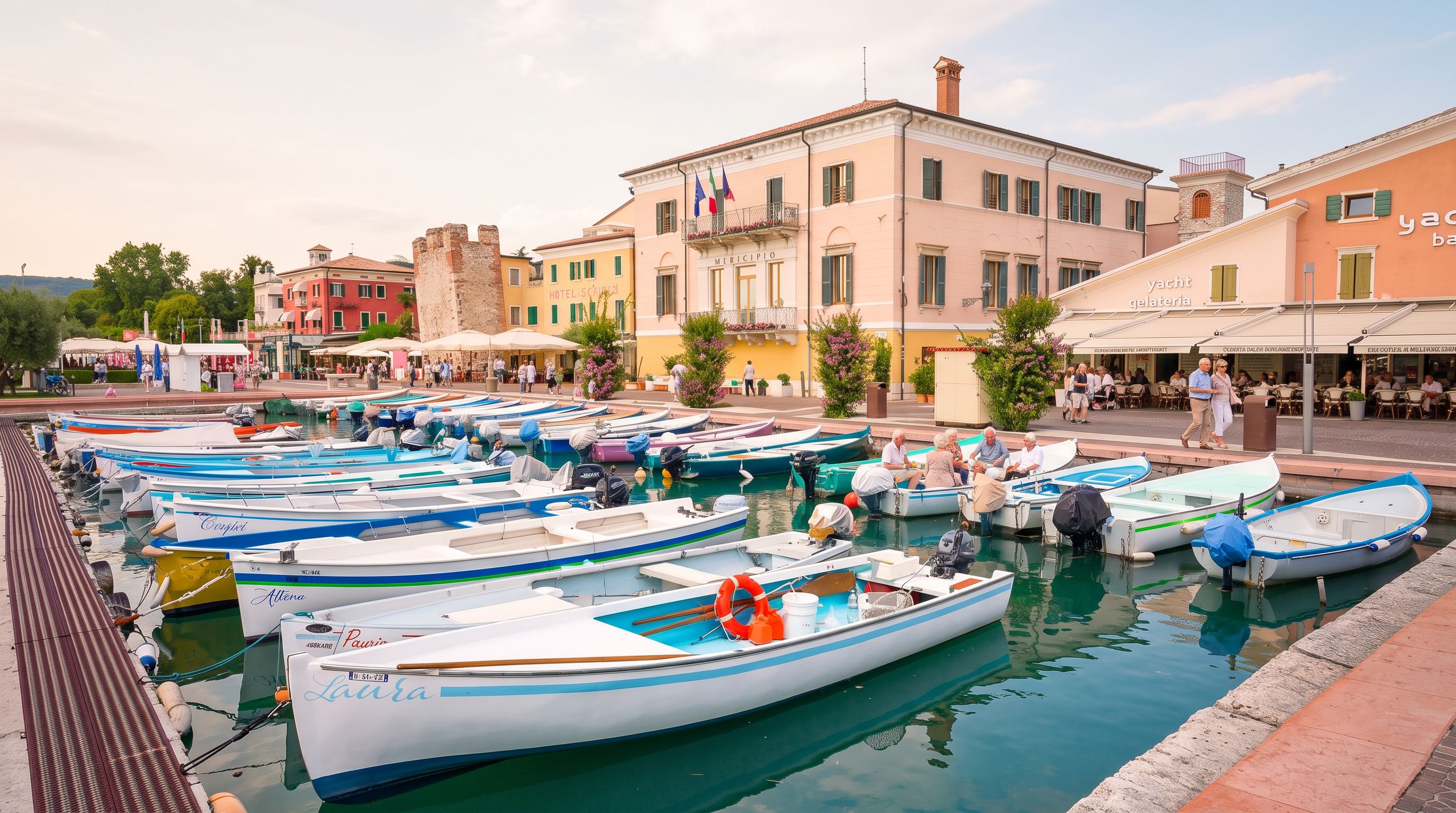 AI-edited
What opens in spring and how busy is it?
Spring, from late March through May, brings garden openings, asparagus festivals, and mild crowds on flat promenades. It is the most comfortable season for culture-focused seniors, with daytime temperatures in the high teens and low twenties, and the famous summer crush still weeks away.
The signature spring events cluster around local produce. Asparagus from the moraine hills of the hinterland is the season's staple: the Lake Garda Veneto tourist board names risotto con gli asparagi as the typical spring dish of the area, and the vegetable turns up in the weekly markets and at village sagre (food festivals) through April and May. The asparagus sagre themselves are inland affairs, at Rivoli Veronese and Cavaion Veronese, rather than on the shore. These are daytime events, mostly outdoors, with seating and easy walking.
Garden openings are quieter affairs, and the two big ones in Gardone Riviera do not share a calendar. The Giardino Botanico Fondazione André Heller opens daily from 9am to 7pm and closes for the winter from 1 November 2026 to 1 March 2027; it warns that steps and narrow pathways make it unsuitable for wheelchairs and pushchairs. The Vittoriale degli Italiani, Gabriele D'Annunzio's sprawling estate, sells a park ticket valid all day with unlimited re-entry, which suits a slow pace. Its foundation is candid that the historic character of the site prevents the complete removal of architectural barriers, so the visitor route is only partly accessible: the Prioria, the poet's house, cannot be visited by anyone with a mobility impairment, but the rose garden, the Giardino delle Vittorie, the Pilo del Piave, the loggias and several park museums are reachable without steps, and the Auditorium screens a film of the house and grounds. Gardone Riviera itself holds the Bandiera Lilla accessibility award, which cites the historic centre and the lakefront as wheelchair-accessible, and spring is when locals reclaim them after winter.
Which summer festivals are worth the crowds?
Summer, from June through August, is the busiest and most festive season. The Garda Jazz Festival across Garda Trentino, the Palio del Chiaretto in Bardolino and Lazise, and the Verona opera season all run in these months, and crowds peak in July and August. Weekday mornings are your friend.
The Garda Jazz Festival ran from 27 July to 9 August in 2026 and draws international musicians to Garda Trentino. Its organisers sit in Riva del Garda, but the concerts are spread across the whole northern basin — Torbole sul Garda, Arco, Dro, Nago, Tenno and Riva — and the venues are a mix of open-air stages, halls such as the Palacongressi and the Auditorium SMAG, and hotel and cellar rooms, so check where each night actually happens rather than packing for an outdoor seat. Getting between them without a car is realistic: Garda Trentino's tourist board states that public transport in the area is entirely barrier-free. The Palio del Chiaretto, the rosé festival, falls in early June — the 21st edition ran from 5 to 7 June 2026 — and it is now held in Lazise as well as Bardolino, with tastings along the lakefront. Both events are popular, so arrive early and expect foot traffic.
Verona's Arena Opera Festival ran from 12 June to 12 September in 2026, its 103rd edition, and Lake Garda towns are a popular base for attending. Regional trains reach Verona Porta Nuova in about a quarter of an hour from Peschiera and about twenty minutes from Desenzano, so a lakeside dinner before the performance is easy; the journey home is the part that needs planning, and the FAQ below sets out why. The unnumbered tiers really are the original Roman stone steps, but the Arena is clear that no architectural barriers prevent wheelchair users from reaching the stalls, with level access from gates 1, 4 and 8 and a metal ramp from Piazza Bra. Those places are limited and have to be requested when you book. Our wine tasting guide covers Bardolino's offerings in more detail.
Ferragosto, mid-August, brings the largest celebrations. Garda runs the Palio delle Contrade on 15 August, the patronal feast: the town council's programme lists a parade of crews and flag-throwers at 19:30, a rowing race in the water in front of the town hall from 21:15, and fireworks from 23:00. Other lakeside towns mark the night with fireworks over the water: at Desenzano the display goes up over the gulf at 22:00 on 15 August, preceded by a free open-air concert in Piazza Cappelletti. These are lively, crowded events—wonderful to watch, but plan for dense crowds and limited seating.
"Free wine museum. Free wine tasting," one Google reviewer wrote of the Zeni wine museum above Bardolino in July 2025. "It's a gorgeous site to cycle to, with views overlooking the vineyards in front of the lake. You get to taste 6 wines each for free — there is a selection of white, red and rosé… All of the staff were lovely and happy to describe the wines or give recommendations."
How do the autumn wine and olive harvests compare?
Autumn, from mid-September through October, is the harvest season, with the Festa dell'Uva e del Vino in Bardolino as the headline event. Crowds are thinner than summer, temperatures are pleasant, and the lake's food culture takes centre stage.
The Festa dell'Uva e del Vino straddles the turn of the month rather than sitting squarely in September: the 2026 edition runs from 1 to 5 October. It was founded in 1929 to celebrate the grape harvest, so it is approaching its centenary. The town of Bardolino fills with wine stands, food stalls, and live music along the lakeside, and the tourist board calls it the most important event in Bardolino's year. It draws large crowds, but the festival layout along the promenade means you can move at your own pace. Many visitors come for the day and leave by evening, so late afternoons are quieter.
Olive harvest follows in late October and November. The oil carries the Garda protected designation of origin, whose eastern zone, Garda Orientale, takes in Garda and Torri del Benaco, and the production rules require the olives to be picked by 15 January each year. Several estates offer tastings and mill visits. These are smaller, more intimate experiences than the wine festivals, often requiring advance booking. The Garda Trentino events calendar lists many of these harvest activities with dates and booking details.
Autumn above the lake is chestnut season first of all: San Zeno di Montagna celebrates its Marrone di San Zeno, protected since 2003, over the weekends of 17–18 and 24–25 October and again on 31 October and 1 November in 2026. Truffles are a shore-by-shore matter. On the Veronese side the black truffle of Monte Baldo is a late-summer affair — the seventeenth Festa del Tartufo Nero at Caprino Veronese fell on 28–31 August 2026 — while on the western shore Tignale runs its own Sagra del Tartufo, now in its twenty-eighth edition, around the turn of September into October; the tourist office publishes the dates late, so check before you plan around it. These are day trips from lakeside bases, and the hill towns are steeper, so consider your mobility before committing to the climb.
What happens in winter and are the Christmas markets worth it?
Winter, from November through February, is the quietest season. Christmas markets run in Arco, Riva del Garda, and Garda from mid-November to Epiphany, with smaller crowds and a genuinely local atmosphere. Many lakeside hotels close, so check availability carefully.
The Christmas markets at Lake Garda are smaller and more intimate than those in Austria or Germany. Arco's runs from 13 November 2026 to 6 January 2027 in the medieval town centre beneath the castle, with wooden stalls selling local crafts, mulled wine, and roasted chestnuts. Riva del Garda's is set out along the lakeside, and Garda town's, which it calls Natale tra gli olivi, fills the lakeside centre with wooden huts allocated by the council. Moving between the northern two is easier than it looks: Garda Trentino's tourist board describes public transport across Arco, Riva and Torbole as entirely barrier-free, by bus, train and Bus&Go alike.
Winter is also the season for local food traditions. At Varone, just above Riva del Garda, the free distribution of polenta and mortadella closes the carnival period on the first Sunday of Lent — a custom the Garda Trentino tourist board traces to 1463 — and the region's hearty cuisine comes into its own. Many restaurants close for a week or two in January, so check opening hours if you plan a winter visit.
The quiet season has real advantages: parking is easy and you can have the lakeside promenades almost to yourself. The tradeoff is shorter days and a shrinking timetable. As of August 2026, Navigazione Laghi had published Lake Garda schedules only for 1 April to 15 May and 16 May to 4 October 2026, so a winter crossing has to be confirmed with the operator rather than assumed — the queues do not so much vanish as become moot. Plan indoor afternoons instead: the Museo Alto Garda in the Rocca at Riva del Garda lists opening hours of 10am to 6pm, Monday to Sunday, and in Sirmione the Grottoes of Catullus and their museum are, in the town council's words, accessible, while the Scaligero Castle is not accessible inside.
How accessible are the festivals and events for seniors?
Accessibility varies significantly by town and event, and not in the way you would guess from the contours. Four Lake Garda municipalities hold the Bandiera Lilla accessibility award: Sirmione, Gardone Riviera and, despite their hillsides, Malcesine and Limone sul Garda. Six ferry piers are certified accessible — Desenzano, Sirmione, Peschiera, Garda, Malcesine and Riva del Garda.
The Navigazione Laghi ferry network is the backbone of lake travel, and the operator is unusually precise about what it can and cannot promise. Its ships and main ports of call carry light, easily handled stepless ramps that remove the step between jetty and gangway, and the Bandiera Lilla certification covers nine vessels as well as those six piers. For the remaining landing stages the company says plainly that not all wharfs are easily accessible and that its survey of them is still being compiled, so a smaller pier such as Bardolino is worth checking before you build a day around it. The ferries remain the most scenic way to travel, and they spare you the parking and the narrow roads.
For walking, the Lombardy region's S.T.A.I. project mapped four accessible routes on the Brescia shore: Desenzano del Garda, Rivoltella del Garda, Sirmione, and Bedizzole–Calvagese della Riviera. The Desenzano stretch takes in a new lakeside promenade the survey describes as completely on the level, with no barriers or obstacles and no climbs or descents, running as far as Rivoltella. Sirmione needs no such caveat at all: the town council states that all its pedestrian routes are suitable for wheelchairs, and that the Grottoes of Catullus and their museum are accessible, even though the Scaligero Castle is not accessible inside.
One caveat from guest reviews: night-time noise in lakeside hotels can be an issue during festival periods. If you are a light sleeper, request a room away from the main square or event stage, and check whether the hotel has double-glazed windows. Check the calendar as well as the room: the Grand Hotel Gardone in Gardone Riviera still carried a 4.5/5 rating on Google from 780 reviews in August 2026, but the house itself is closed for a full renovation and is due to reopen in 2027 as an LXR Hotels & Resorts property. A familiar name high in a search result is no guarantee that the doors are open.
What is the month-by-month cultural calendar?
This calendar condenses the year into practical planning blocks. Use it to match your interests to the right weeks, and always check official event listings before booking, as dates shift slightly each year.
| Month | Key Events | Crowd Level | Senior Comfort |
|---|---|---|---|
| March–April | Garden openings, asparagus festivals | Low | Excellent |
| May–June | Palio del Chiaretto (early June), opera season opens | Moderate | Excellent |
| July–August | Garda Jazz Festival, Ferragosto, opera season | High | Moderate |
| September–October | Festa dell'Uva (1–5 Oct 2026), olive harvest, chestnut festivals | Moderate | Good |
| November–December | Christmas markets, winter food festivals | Low | Good |
| January–February | Carnival, quiet season | Very low | Variable |
June is the most balanced month: summer has begun, but the full crowds have not arrived. The turn of September into October offers similar conditions with the added draw of the harvest festivals. If you want the quietest possible experience, November and January are the months to choose, though you will need to check that your preferred hotels and restaurants are open.
Where should you base yourself for cultural visits?
For cultural travellers aged 50–70, the best bases are Riva del Garda for its flat, walkable centre and museum, Desenzano for ferry connections and the lakefront promenade, and Bardolino for festival access. Each offers different strengths depending on the season.
Riva del Garda is the standout choice for seniors. Its historic centre is flat, and the Museo Alto Garda, housed in the Rocca, traces the history of the lower Sarca valley from prehistory to the events of the Second World War. The lakefront is a pleasure to walk. The town is also a ferry hub and one of the six certified accessible piers, and Garda Trentino describes local public transport as entirely barrier-free, whether you are heading along the northern shore or taking the bus to the train at Rovereto.
Desenzano, at the southern end, is the transport gateway. The train from Milan stops here, the ferry terminal is central, and the promenade is flat and easy. It is less picturesque than the northern towns but more practical, and the lakefront cafés are excellent for people-watching. For a detailed look at one of Sirmione's grand hotels, see our Villa Cortine Palace Hotel dossier.
Bardolino is the festival town. If you are planning around the wine harvest or the Chiaretto festival, staying here puts you in the heart of the action. The promenade is flat and the town is compact, but it fills up during events, so book early.
What should you eat and where are the best markets?
Lake Garda's food culture is event-driven, so the best tastings happen at sagre, wine festivals, and weekly markets rather than only in restaurants. Signature dishes include bigoli con le sarde, tench risotto, and local olive oil, with historic cafés in Garda, Bardolino, and Desenzano offering the classic coffee break.
The weekly markets are a cultural experience in themselves. Most towns hold a market morning, and the days are easy to get wrong: Bardolino's is Thursday on the lakefront, Garda's is Friday, Lazise's is Wednesday, and Desenzano's is Tuesday from 8am to 1pm. Bardolino also runs a separate evening market on Tuesdays in summer, which is where much of the confusion starts. Local producers sell cheese, cold cuts, olive oil, and seasonal produce. These markets are flat, walkable, and best visited in the morning before the heat builds.
For heritage café stops, choose historic town-centre cafés in Garda, Bardolino, Sirmione, and Desenzano. The pattern is consistent: find the main square, look for the café with the oldest interior, and order a coffee and a pastry. These are the places where locals gather, and they offer a genuine glimpse of lakeside life.
The signature products to look for are extra virgin olive oil, Bardolino and Lugana wines, Trentino carne salada, lemons from Limone and Tignale, and cheeses such as Formaggella di Tremosine and Bagòss. The official Lake Garda Veneto events page lists many food festivals with dates and locations.
What practical tips matter for festival visits?
Plan around weekday mornings, book accommodation early for festival weekends, and use ferries rather than driving into town centres. Parking is difficult in lakeside towns during events, and several towns have ZTL (limited traffic) zones that restrict vehicle access.
Guest reviews consistently highlight the importance of checking noise insulation and air conditioning in hotels before booking, particularly for summer festival visits. As of August 2026, the Strada della Forra in Tremosine is open: the SP38 reopened at 16:30 on 13 March 2026 after the second phase of rockfall protection, and the Province of Brescia has announced that it will close again in the autumn for further consolidation work, without naming dates yet. Since August 2025 it has been one-way uphill at all hours for every category of traffic, from Porto di Tremosine to the Forra, with no overtaking and a 30 km/h limit, which makes the drive less stressful, though it stays narrow with tight bends. Walking it is not an option: pedestrians are banned between kilometre 0.95 and kilometre 2.7.
For packing advice specific to the lake's cobblestones and summer heat, see our packing guide for Lake Garda. The key items are sturdy walking shoes, layers for evening breezes, and a small daypack for festival purchases.
Driving into Bardolino on a festival day is the one avoidable mistake. Arriving by ferry from Garda instead puts you on the promenade a few steps from the stands, with no parking to find at either end — while the timetable lasts, which in 2026 means up to 4 October, one day before the wine festival ends.
The ferry network is the single best tool for festival travel while it is running, and the lake crossing itself is part of the experience. Check the Navigazione Laghi schedule against your dates rather than the other way round.


