
Lake Garda rewards those who resist the urge to see it all. The best Italian lake trips are built on a simple arithmetic: one main outing per day, a ferry timetable in your pocket, and a long lunch with a view. This five-day plan for travellers aged 50 to 70 uses just two bases—Sirmione in the south and Malcesine in the north—so you unpack twice, never rush, and still capture the lake's three distinct personalities: the Roman south, the wine-growing east, and the dramatic alpine north.
The itinerary follows the natural rhythm of the lake's ferry network, which becomes your scenic transport and your sightseeing platform in one. Each day pairs a morning excursion with an afternoon of deliberate rest—a promenade, a café terrace, or simply a nap with the windows open to the water. For the more energetic among you, two optional add-ons follow: a flat lakeside cycle and a cable-car ride up Monte Baldo. Both are genuinely optional; the plan works beautifully without them.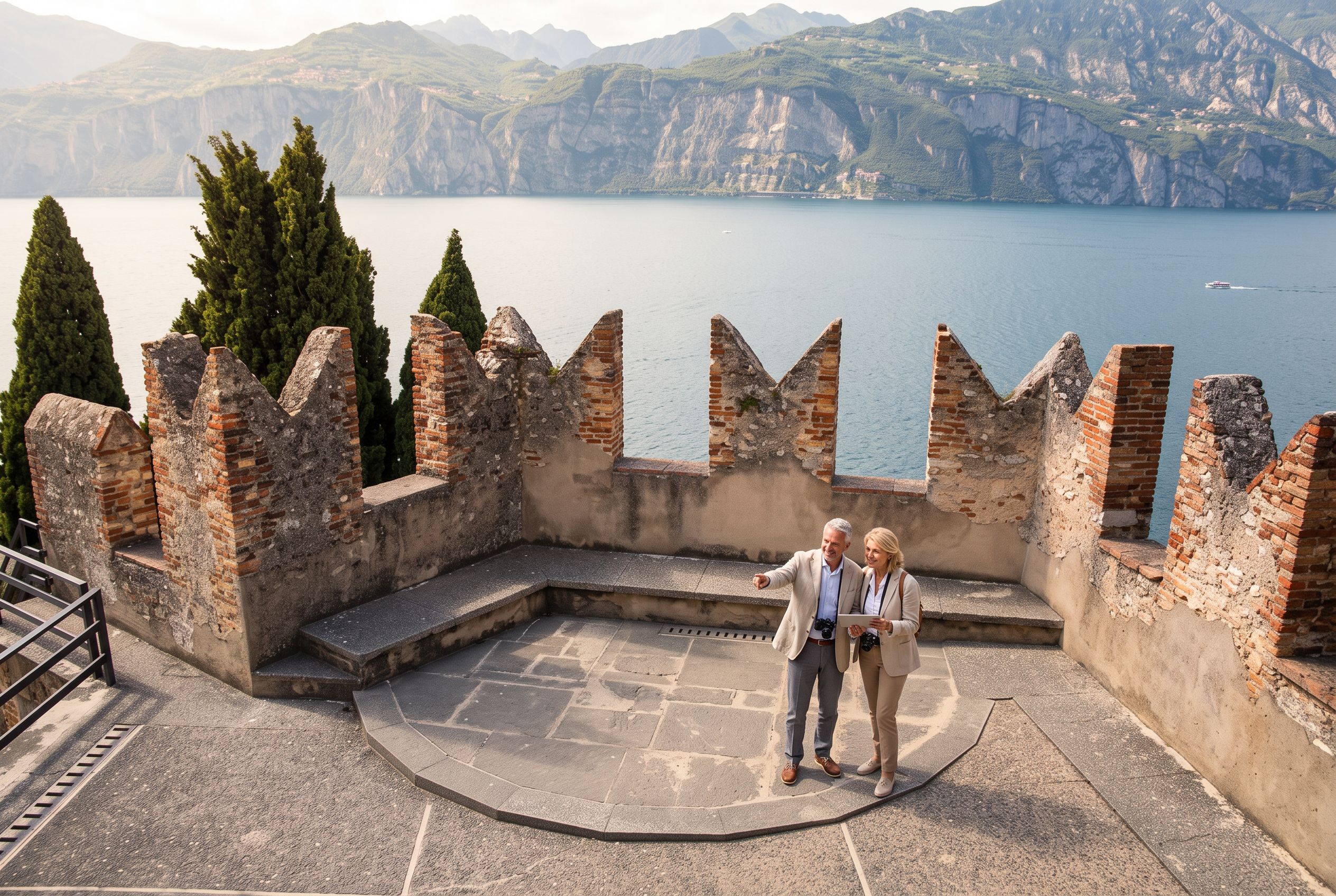 AI-edited
Why settle for two bases instead of moving daily?
Two bases—Sirmione for the south and Malcesine for the north—eliminate the packing-and-unpacking cycle that drains energy from any holiday. You trade a little ferry time for the comfort of returning to the same bed, the same breakfast corner, and the same view each evening.
The timetable makes the case on its own. The geography is deceptive: Garda stretches 51 kilometres from north to south, and under the 2026 summer timetable of Navigazione Laghi the crossing from Sirmione to Malcesine takes an hour and a half to two hours on the fast service and more than three on an ordinary boat. Travel between the ends of the lake and back in a day and you have spent the day on the water. By basing yourself twice, you also gain a practical advantage—each base gives you a different ferry route to explore without backtracking. Sirmione works as your southern hub because it sits on a peninsula jutting into the lake, with ferries calling directly at its small port. Malcesine, in the north, offers the castle, the cable car, and easy ferry connections to the western shore. Between them, you cover the lake's essential character without a single stressful transfer.Day 1: Arrival and Sirmione's old town at a gentle pace
Your first afternoon belongs to Sirmione's historic centre: a compact peninsula of narrow lanes, the moated Scaliger Castle, and the Roman villa ruins at the tip. The entire old town is walkable in two unhurried hours, with plenty of benches and gelato stops along the way.
Arrive by train to Desenzano del Garda or Peschiera, then take a short taxi or bus to your Sirmione hotel. Check in, unpack, and resist the urge to plan. The afternoon is for orientation: walk the main street, Corso Vittorio Emanuele, to the water's edge, and let the castle's crenellated silhouette draw you forward. The Scaliger Castle (Castello Scaligero) is Sirmione's medieval signature, its 13th-century walls rising directly from the lake. Climb the tower if you feel steady on stairs—the view over the peninsula and the ferry routes is worth the effort. The town council notes that the castle is not accessible inside, so wheelchair users are better served by the Grotte di Catullo, which are accessible including their museum. Check the day, too: the castle is normally shut on Sundays and public holidays, though a sponsorship funds 30 extra openings in 2026, mostly on Sunday and holiday afternoons from 1.30 pm to 7.30 pm, with free entry on the first Sunday of the month. The Grotte di Catullo, at the peninsula's tip, is the lake's most important archaeological site. Despite the name suggesting caves, these are the extensive remains of a vast Roman villa, with olive groves and panoramic terraces. The town council lists the site and its museum as accessible, though the approach includes a gentle incline. Allow 90 minutes. For more on what to bring for these cobbled streets, see our packing guide for Lake Garda's steps and summer heat."This is a lovely place to visit, very quiet and peaceful. Large area to walk around and discover, very well preserved." — a review left on Google in June 2026
Day 2: Desenzano's flat promenade and a ferry afternoon
Desenzano del Garda offers the flattest, easiest walking on the southern shore, making it an ideal low-effort morning outing. Take the morning ferry from Sirmione (about 20 minutes), stroll the lakeside, then return by boat for a long afternoon rest.
Desenzano is the practical southern hub—a working town with a railway station and a broad, level lakefront promenade. Unlike Sirmione's medieval lanes, Desenzano's waterfront is wide, paved, and forgiving underfoot. The morning plan is simple: ferry across, walk the promenade from the harbour to the port, browse the morning market if it is on—the town holds it every Tuesday along the lakefront between Via Cesare Battisti and Via Anelli—and settle into a café with a view of the castle-topped hill of Sirmione across the water. The town's Roman villa, with its remarkably preserved mosaics, is a short, level walk from the waterfront and rarely crowded. It offers a quieter counterpoint to Sirmione's more famous ruins. After lunch, take the ferry back—the afternoon is deliberately unstructured. This is your first rest afternoon, and it sets the pattern for the week: mornings for exploring, afternoons for the lake itself. For a sense of the region's wine traditions before you reach Bardolino tomorrow, glance at our guide to Lake Garda's wine country—it will make tomorrow's stops more meaningful.Day 3: Bardolino and Lazise—gentle wine-country walking
The eastern shore's twin towns of Bardolino and Lazise offer the lake's most comfortable walking: flat promenades, small harbours, and wine bars every few steps. A morning ferry from Sirmione reaches Bardolino in 40 minutes to an hour; the two towns are linked by a completely level lakeside path of about six kilometres.
This is the day for slow movement. Bardolino's waterfront promenade runs along the lake with barely a gradient, past the small harbour and the church of San Severo, built between the late 11th and early 12th centuries and considered a masterpiece of local Romanesque architecture. The town is famous for its namesake red wine, and the shops along the main street offer tastings that make a pleasant mid-morning pause. The walk from Bardolino to Lazise runs about six kilometres along a dedicated lakeside path that the regional tourist board calls completely level and suitable for everyone; allow roughly an hour and a half at a gentle pace, or take the 17-minute ferry between the two. Lazise is smaller and quieter, with a medieval harbour and a castle that remains privately owned—it belongs to the Bernini family, is still lived in and cannot be visited, though the well-preserved crenellated walls around it can be walked in about an hour. The village's charm lies in its unhurried rhythm—fishermen, café tables, and the gentle lap of water against stone."A beautiful village. We keep coming back year after year to wander the streets and enjoy meals and ice creams on the harbour." — one Google reviewer wrote in August 2019Return to Sirmione by ferry in the late afternoon. The boat journey itself, with the lake widening as you head south, is part of the day's pleasure. This evening, consider a simple dinner near your hotel—the southern shore's restaurants are strongest on lake fish and grilled meats.
Day 4: Move north to Malcesine and the Monte Baldo cable car
Today you transfer bases by ferry—a scenic hour-and-three-quarter crossing that swings from Sirmione across to the western shore before doubling back to Malcesine. Malcesine's medieval castle and the Monte Baldo cable car await, but the afternoon is reserved for settling in and resting after the journey.
The morning ferry from Sirmione to Malcesine is one of the lake's great experiences. In the 2026 summer timetable there is exactly one such departure: the 9.10 servizio rapido, which calls first at Garda and Torri del Benaco, then crosses to Salò, Gardone Riviera and Gargnano on the western shore before doubling back to Malcesine's picture-perfect harbour beneath the castle at 10.55. Check into your second base, have lunch, and take the afternoon as a rest period—the transfer day earns its keep through the journey itself. If you feel energetic, a short evening stroll through Malcesine's old town introduces you to its steep, narrow lanes and the lakeside promenade. The medieval core is more demanding underfoot than the southern bases, and cobbles and gradients are unavoidable there—but Malcesine holds the Bandiera Lilla accessible-tourism award, and the lakeside path running the length of the municipality from north to south is free of architectural barriers. The municipal library, the Palazzo dei Capitani, the church of Santo Stefano and the sailing club are all listed as accessible, as is the cable car.Day 5: Monte Baldo by cable car, or a gentle castle morning
The Monte Baldo cable car lifts you from Malcesine to Tratto Spino at 1,760 metres in about 20 minutes, changing at the San Michele mid-station at roughly 562 metres, and it delivers alpine views without a single step of climbing. For those who prefer to stay by the water, Malcesine's castle and harbour offer a full, satisfying morning.
The cable car is the day's centrepiece for the more active. On the second section, from the San Michele mid-station up to Monte Baldo, the cabin turns a full circle as it rises, offering panoramic views that shift from lake to mountain. At the top the terrain is high-alpine: rocky and exposed. Dress warmly even in summer—the operator itself warns that mountain weather can change suddenly and advises proper clothing, walking shoes, a hat, water and a snack. The top station stands in the Tratto Spino locality, not on the summit itself—Cima Valdritta, the highest point of Monte Baldo, is a long ridge walk away—but marked paths of varying difficulty start right there, and even a short, level stroll rewards with views over the lake's northern basin. For those who prefer to stay low, Malcesine's Castello Scaligero is the town's medieval heart. Its halls hold the Monte Baldo and Garda natural history museum, on the basement and ground floors, together with the Venetian galleys room and the Goethe room in the former Austrian powder magazine, which shows drawings the poet made on his Italian Journey. The climb to the top of the tower is steep but short, and the view over the harbour is among the lake's finest. The castle opens daily at 9.30, until 19.30 from 23 May to 27 September 2026 and until 18.30 either side of those dates. The lakeside promenade north of the castle is flat and pleasant, with benches facing the cliffs of the western shore.Optional additions: a lakeside cycle or a second northern day
Two optional additions fit this itinerary without breaking its gentle rhythm: a flat cycle along the southern shore from Desenzano, or an extra day in the north to visit Riva del Garda by ferry.
For cyclists, the southern shore offers the lake's easiest riding. The Ciclabile Sud-Ovest links Peschiera with Desenzano by way of the Sirmione peninsula: about seven kilometres of cycle path alongside the Gardesana road as far as Colombare, then roughly six more into Desenzano, so a morning ride of 10 to 15 kilometres with café stops fits naturally into Day 2 or 3. Two things to know before setting off: the final approach to Sirmione's old town along Via XXV Aprile has no cycle lane, and in summer bicycles are not allowed into the historic centre at all. E-bikes are widely available and remove any concern about headwinds or gradients. For those who want to extend the northern section, a day trip to Riva del Garda by ferry (45 minutes to an hour and a quarter by ordinary boat, about 40 minutes on the fast service) adds the lake's most dramatic scenery. Riva's waterfront is livelier and more alpine in character, with the MAG museum, whose history section traces Upper Garda from prehistory to the events of the First and Second World Wars, alongside an archaeological collection. Public transport in Garda Trentino is documented as entirely barrier-free, including the panoramic lift up to the Bastione above the town, though the surrounding cliffs make the setting more dramatic than the southern shore. If you have a sixth day, this is where to spend it.How do ferry times shape this itinerary?
Navigazione Laghi operates the lake's ferry network, with timetables that vary by season. Under the summer timetable valid from 16 May to 4 October 2026, boats call at Sirmione roughly every 30 to 60 minutes in each direction, with gaps of up to about 75 minutes in the middle of the day, and only the servizio rapido, which carries a supplement, links Sirmione with Malcesine.
The ferry network is the itinerary's backbone, and its rhythms dictate your daily structure. Morning departures are typically less crowded; afternoon services fill with day-trippers. The key practical points:- Sirmione to Desenzano: about 20 minutes, frequent service
- Sirmione to Bardolino: 40 minutes to an hour, depending on the run
- Sirmione to Malcesine: 1 hour 30 to 2 hours on the servizio rapido (supplement payable); the single ordinary boat takes over three hours
- Malcesine to Riva del Garda: 45 minutes to 1 hour 20 by ordinary boat, about 40 minutes on the servizio rapido
When should you go for the best balance of weather and crowds?
May, June, and September offer the best combination of warm days, manageable crowds, and comfortable walking conditions. July and August bring heat and congestion; the shoulder seasons reward those who can travel outside school holidays.
As of 2026, local guides consistently recommend the shoulder seasons for travellers over 50. Our detailed seasonal guide to Lake Garda breaks down the trade-offs month by month. In summary: May brings spring flowers and moderate temperatures; June offers the first reliable swimming weather; September delivers warm days and the grape harvest; October is cooler but beautifully quiet. Sirmione's pedestrianisation calendar is worth checking: the town runs a summer limited-traffic scheme from 23 March to 13 October 2026 and closes its historic centre to all vehicles on 31 planned days, each time from 2 pm to 7 pm. This is generally good news for walkers, but it can affect taxi access to hotels—confirm your arrival logistics with your accommodation if you travel on a pedestrianised day.What should you know about walking and mobility?
Sirmione, Desenzano, Bardolino, and Lazise offer the easiest walking, with level promenades and compact centres. Malcesine's medieval core is more demanding, with cobbles and gradients, but the town holds the Bandiera Lilla award and its lakeside path is barrier-free along the whole municipality.
The southern and eastern shores are the lake's most forgiving terrain. Sirmione's old town is walkable but can feel crowded; the town council states that all of its pedestrian routes are suitable for wheelchairs, and Regione Lombardia describes several streets as level, well paved and free of obstacles. Desenzano's waterfront is the flattest option. Bardolino and Lazise connect via a level lakeside path that is a genuine pleasure to walk. Malcesine requires more care in its medieval core, which has tighter streets and elevation changes, and the castle involves stairs. Away from it, though, the barrier-free lakeside path runs the length of the municipality, and the cable car station on Via Navene Vecchia is reached step-free by lift from level -1 of its own underground car park; the castle is a five-minute walk from that station. None of this is prohibitive, but it rewards a slower pace and well-broken-in shoes—our packing guide covers footwear in detail. For those with limited mobility, the ferry network itself is the great equaliser: you see the lake's drama from the water, avoiding the steepest terrain entirely. The southern bases are the right choice if you want to minimise walking challenges.What practical details should you confirm before departure?
Confirm your ferry timetable, check the pedestrianisation calendar for your base towns, and verify that your hotel has a lift and step-free access. These three checks prevent most common frustrations for travellers over 50.
The ferry timetable is the itinerary's skeleton—check it the evening before each travel day, as seasonal variations are common. The pedestrianisation calendar affects taxi access and parking. And hotel accessibility varies widely even within the same category; a lift and step-free entry are worth confirming directly with the property rather than assuming from photos. For dining, the southern shore's tourist-heavy areas can produce uneven service. Lido 84, the celebrated restaurant at Gardone Riviera, served its last meal on 22 March 2026, and its own website now says simply that it is closed. Such changes are normal in a living destination—ask your hotel for current recommendations rather than relying on older guides. ---

