
Venice rewards the traveller who books ahead. The city's historic centre is made up of 121 islets linked by 435 bridges, according to the city's own accessibility pages, and that figure explains why so many visitors aged 50 to 70 choose a guided format rather than assembling a visit piece by piece. A guide solves three problems at once: the queue at St Mark's Basilica, the one-way route through the Doge's Palace, and the question of how far anyone actually has to walk. What follows is a practical guide to the small-group, private and skip-the-line options that suit organised travel, with the questions worth asking before paying.
The formats divide cleanly. There are guided visits to the two great monuments of Piazza San Marco, private water-taxi and gondola tours that use the canals instead of the calli, and full or half-day boat trips to the lagoon islands. Each has a different walking profile, and the walking profile is the thing to interrogate. Prices and inclusions vary by operator and season, so treat every figure below as indicative and confirm at the point of booking.
What tour formats suit older travellers in Venice?
The published options fall into three groups: guided small-group visits to St Mark's Basilica and the Doge's Palace, private water-taxi and gondola tours on the canals, and boat days to the lagoon islands. The boat formats involve the least walking, because they replace bridge crossings with water transport.
For the two monuments, the published products differ more than the marketing suggests. Italy Museum sells a small-group morning tour with fast-track entry, an English-speaking guide and a duration of about two and a half hours, which includes exclusive entrance to the Doge's Palace before it opens to the public and free admission to St Mark's Basilica and its terraces. Viator publishes a small-group tour with pre-reserved tickets, an expert local guide, a three-hour walking tour described as being at a relaxed pace, and a maximum of 16 travellers. GetYourGuide lists a skip-the-line guided tour offered as either private or small group, with a stated duration of three hours and live guides in English, French, Italian and Spanish.
Those three descriptions are not interchangeable. A two-and-a-half-hour visit with an early palace entry is a different day from a three-hour walking tour at a relaxed pace, even though both are sold as small group.
 AI-edited
How do guided visits to St Mark's Basilica and the Doge's Palace work?
The Doge's Palace opens daily, 09:00 to 19:00 from 1 April to 31 October and 09:00 to 18:00 from 1 November to 31 March, with last admission an hour before closing. Guided tours enter at Porta del Frumento, Piazzetta San Marco, and late arrivals can be refused.
The palace's official visitor information sets out the terms clearly. Summer season runs 1 April to 31 October, 09:00 to 19:00, with last admission at 18:00. Winter season runs 1 November to 31 March, 09:00 to 18:00, with last admission at 17:00. Museum closing procedures begin 30 minutes before the stated closing time. The public entrance is Porta del Frumento, Piazzetta San Marco, and the official page warns that showing up more than 15 minutes after the tour departure time will result in exclusion from the guided tour. Arriving early is not a suggestion.
Two further rules matter for anyone carrying a bag. Suitcases, trolleys and bulky bags whose three dimensions total more than one linear metre may not be taken into the museum area, though storage is free of charge. Since 1 April 2022, unorganised groups of more than 10 people must use whisper audio equipment, hired at one euro per person and paid at the whisper cash desk. Organised tours handle this themselves, which is one quiet advantage of booking rather than improvising.
What are the Doge's Palace special itineraries, and do they suit limited mobility?
The palace's special itineraries are available by reservation only, limited in number, and accompanied by a specialised guide. The regular visit is fully accessible and the ground-floor toilets are fully accessible, but the Secret Itineraries, Prisons and Armoury are not accessible.
That split is the single most useful accessibility fact in this guide, and it comes from the palace's own accessibility page. A traveller who wants the standard route through the Doge's Palace can take it. A traveller who wants the Secret Itineraries, the Prisons or the Armoury cannot, on the palace's own statement. The ticket for the Secret Itineraries includes the guided tour of those spaces and grants access, without a guide, to the Doge's Palace, the Museum Correr, the National Archaeological Museum of Venice and the Monumental Rooms of the Marciana National Library. It is valid for six months and allows one admission to each museum, with no reservation required for those additional entries.
Forum contributors on the Rick Steves Travel Forum have reported that the Secret Itineraries Tour has only 10 to 15 places and often sells out, so advance booking is wise in busy periods. That is forum reporting rather than an operator figure, and the palace does not publish a place count on the pages reviewed here. Ask the operator for the current group size when booking.
How much walking and how many bridges should you expect?
Venice's official accessibility pages state that the city is made up of 121 islets linked by 435 bridges, and that almost 70% of the historic city centre is accessible to people with impaired mobility. The bridges, not hills, are the obstacle.
There is no elevation gain to plan for in Venice. The terrain issue is bridges, steps and uneven paving. The city's own tourism pages describe the bridge network as making the city difficult to move about in not only for people with reduced mobility but also for the elderly carrying shopping, parents pushing a pram and visitors with luggage. That is the city describing itself, and it is worth taking at face value.
The same source notes that almost 70% of the historic city centre is accessible to people with impaired mobility, and that Venice's official accessibility pages state that wheelchair users can travel on ACTV waterbuses, buses and trams, and that the city publishes accessible itineraries and support contacts. Those official accessible Venice pages are the right starting point for anyone planning around mobility, and the city also publishes accessible itineraries for the historic centre.
For a tour, the practical question is not the city average but the specific route. Published products differ between short guided visits and three-hour walking tours, which is why the walking distance between the meeting point, the basilica and the palace belongs in your first email to the operator. The Italy Museum small-group palace and basilica tour is one published example where the meeting point is under the St Mark's Column in St Mark's Square and arrival 15 minutes before the start is recommended.
Do private water-taxi tours avoid the bridges?
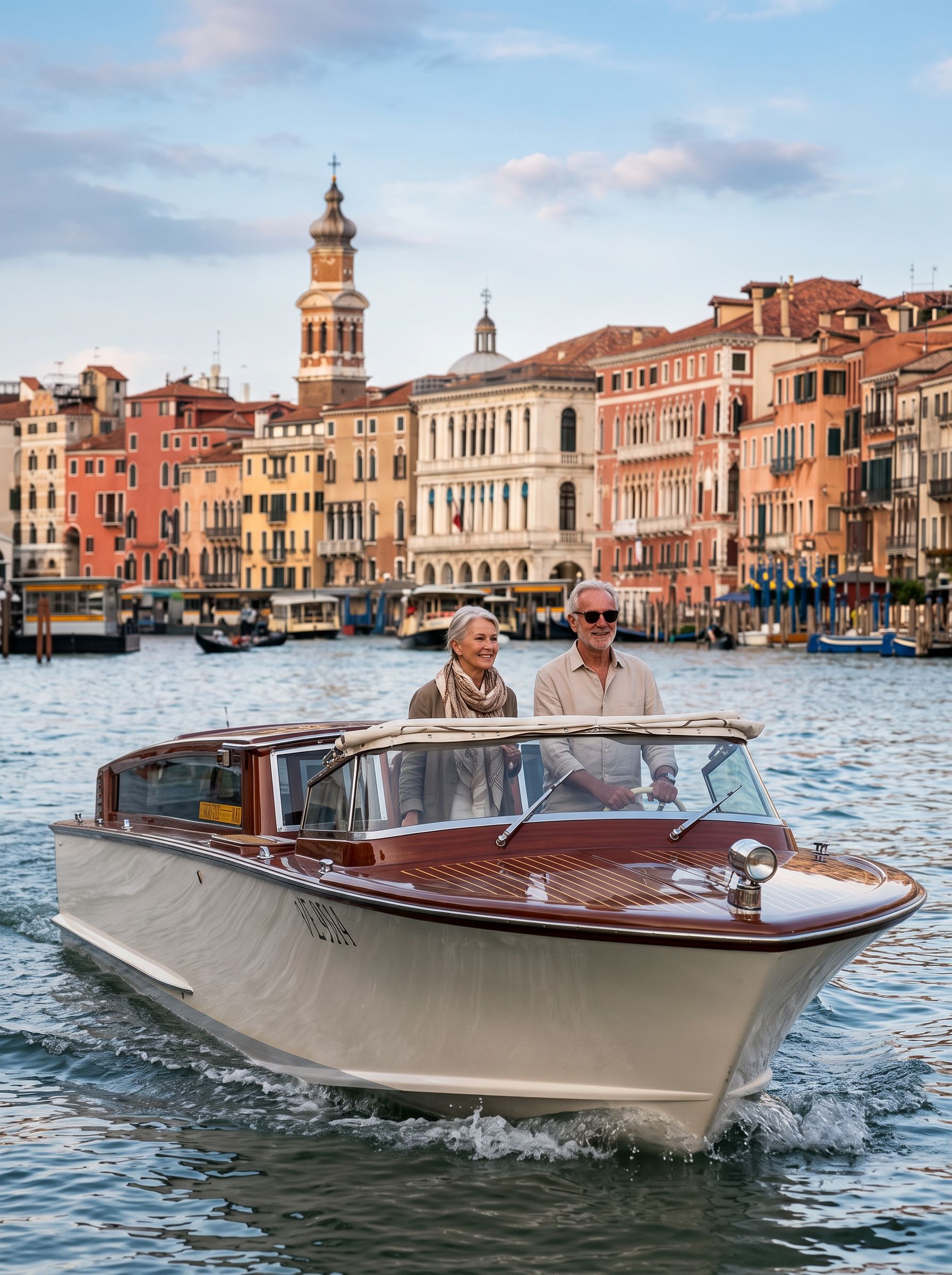
Private boat tours replace bridge crossings with water transport, and operators publish routes along the Grand Canal past the Rialto Bridge and in front of St Mark's Square, with excursions to Murano, Burano, Torcello and the Lido. Whether a specific itinerary is step-free is not documented and must be confirmed.
Venice Water Taxi states that its tours can include travelling along the Grand Canal and excursions to the lagoon islands of Murano, Burano and Torcello, and that its boats pass the Rialto Bridge and St Mark's Square and serve the Lido di Venezia as well. Venice Luxury Boat publishes a two-hour private boat tour in Venice with capacity for one to nine people and a listed price of €380. Venice Taxi Boat publishes an island tour of Murano and Burano with a minimum duration of four hours and one to ten passengers, and says a classic itinerary can combine the Grand Canal with the surrounding islands.
For a longer day, a Marriott activity page describes a private full-day lagoon tour to Murano, Burano and Torcello with a private water taxi, hotel pick-up and drop-off in central Venice, and six hours on the lagoon. GetYourGuide lists a Private Water Taxi Tour of Venice's Inner Canals and a Grand Canal Private Gondola Tour, both marketed as private or small-group experiences.
What none of those listings documents is step access, boarding assistance or cancellation terms for the exact products. The detail is not published, so ask before paying.
What does a lagoon-islands boat day involve?
A lagoon day by private boat typically covers Murano and Burano, with Torcello on longer itineraries. Published durations run from four hours to a full six-hour day. Operators state that tours may be cancelled or rescheduled in very bad weather or very high tides.
The weather clause is the practical heart of this section. One booking page for a Murano and Burano tour states that the tour can still run in rain because the boats are covered, but will not operate in exceptionally bad weather, in which case it may be postponed or refunded. A similar lagoon booking page states that the tour will not run in very bad weather or very high tides and may be rescheduled or refunded. Venice's acqua alta is a real scheduling factor, and a refund policy is worth reading before you commit a full day.
Once ashore, the walking profile changes. A Venice guide aimed at limited-mobility visitors notes that Murano, Burano and Torcello are reachable by boat with mostly flat walking once ashore. That is a guide's description rather than an operator guarantee, and it applies to the islands rather than to every route on them.
For anyone weighing a lagoon day against a monument day, the trade is straightforward: the boat removes the bridges, and the islands remove the crowds of Piazza San Marco. The three-day Venice itinerary for the over-50s sets out how the two fit together across a short stay.
What do guests say about Venice's guided tours?
Guest feedback on the major platforms is consistently positive about small-group formats, knowledgeable guides and skip-the-line access. As of September 2026, the Doge's Palace holds a Google rating of 4.7 out of 5 from 40,012 reviews, and St Mark's Basilica holds 4.7 out of 5 from 30,271 reviews.
The pattern in the review material is that guides are repeatedly described as knowledgeable, kind, flexible and attentive. A small-group walking tour of the Jewish Ghetto in Venice, rated 5.0 out of 5 from 73 reviews on Tripadvisor, drew descriptions of a guide who was helpful, kind and extremely knowledgeable, flexible regarding the group's needs and interests, and generous with her time. Reviewers described the format as the perfect mix of history and storytelling, with two hours passing quickly.
Skip-the-line access draws particular praise. A fully guided Doge's Palace and St Mark's Basilica tour was noted for being able to skip the lines. A Saint Mark's VIP Night Tour, with 63 reviews on Tripadvisor, drew repeated praise for seeing the basilica without the crowd and viewing the mosaics and ceiling lit up in evening light.
"Very worthwhile tour. The history is deep and one could spend a lifetime. The 2hr tour was perfect, providing insight to many key facets of the buildings and their purpose." (Google, July 2026)
On the monument side, the practical caveats in guest feedback are worth carrying into your planning. Reviewers report quite a few stairs throughout the palace, a basement prison area that requires hunching, and museum stairs at St Mark's that are described as steep and uneven. Only one restroom location is available inside the palace, with limited women's cubicles and long queues reported. Many rooms have no air conditioning and become very hot later in the day, which is why morning visits are recommended. Booking timed-entry tickets in advance is repeatedly advised, and same-day slots at the basilica frequently sell out.
What should you ask before booking a Venice tour?
Ask about walking distance, stairs and bridges, whether the guide is inside the monuments or the ticket covers entry only, whether the pace allows frequent stops, and where the departure point is. Published products differ on every one of these points, and the answers decide whether a tour suits you.
The questions below come directly from the gaps in what operators publish. None of them is a complaint; they are the details that decide whether a good tour is a good tour for you.
- Is the itinerary fully step-free, or does it only reduce walking?
- How many bridges, stairs or uneven surfaces are involved at the museum or sight level?
- Is boarding from a floating landing stage or from a quay with steps?
- Is there a toilet stop, and is it accessible?
- Does the tour use a water taxi, a vaporetto, or mixed transport?
- If weather or high tide disrupts the trip, is there a postponement or refund policy?
- Is the guide inside the basilica and palace, or does the ticket cover timed entry only?
- Can the tour accommodate slower walking or frequent stops?
One cancellation term deserves attention. The Italy Museum small-group tour states that the reservation cannot be modified, cancelled or refunded under any circumstances. That is one operator's term, not an industry standard, but it shows why the cancellation policy belongs in the same email as the accessibility questions. A tour that cannot be refunded is a different commitment from one that can.
What practical matters should organised travellers plan for?
Medical emergency numbers in Venice are 118 for medical emergencies and 112 as the Italy-wide number. Two tourist first-aid points operate at Piazza San Marco and Piazzale Roma, both open 08:00 to 20:00 daily including holidays. Pharmacies are common in the historic centre and marked by a green cross.
The main emergency hospital is Ospedale SS. Giovanni e Paolo, at Campo SS. Giovanni, Castello 6777, reachable on foot or by waterbus. Waiting times, lift availability and visitor-assistance arrangements at that hospital are not documented here, so ask on arrival rather than assuming. Night and Sunday duty pharmacies are published on rotation, but the nearest one depends on your hotel and is not documented for a single fixed point.
On fares, the documented senior offer from the city is a Venezia Unica Senior City Pass for the over-65s, priced at €34.90. For reduced-mobility transport, a Venice water-bus page states that the ACTV water bus reduced fare for a wheelchair user is €1.50 per person per journey, valid for 75 minutes, with the accompanying person travelling free. Broader senior discounts on sights or tours are not documented in the official material reviewed here.
On footwear and weather, the city's bridge network and uneven paving make supportive low-slip shoes the most clearly documented need. The packing guide for Venice shoes, bridges and acqua alta covers that ground in detail. For timing, no official source in the material reviewed here documents a best month for senior travellers; the guide to Venice through the year covers Carnival, the Biennale and the quieter seasons.
One note on the access fee. The official Venice access-fee page states that the 2026 trial period ended on 27 July 2026, and from that date the fee does not apply. Persons with disabilities and any accompanying person are exempt, with documentation requirements depending on whether the visitor holds a European Disability Card or equivalent certification. For further information on exemptions, the city's page gives the number (+39) 041041.
How should you choose between a small group and a private tour?
Forum reporting from the Rick Steves Travel Forum suggests group size varies more than the label implies. Context Venice was described in one post as using groups of six or smaller.
That range is the reason to ask for a number rather than a category. Small group can mean six, and it can mean 25. A private tour removes the question entirely, at a price. For travellers who prefer organised travel and want the pace to hold, the published clue to look for is a tour that states its maximum group size and describes the pace, as the Viator product does with a maximum of 16 travellers and a three-hour walking tour at a relaxed pace.
Forum contributors also report that the best small-group experiences tend to be flexible rather than rigid, with guides opening by asking what the group wants to see, what they have already seen and why they are taking the tour. One post recommended a private boat-based half-day to Murano and Burano specifically for older travellers who want to reduce walking and use water transport instead. Another recommended checking the local Tourist Information Centre and Venice Facebook groups for walking tours, which suggests locally run options exist outside the large commercial brands.
For a first visit, a small-group orientation walk followed by a boat day covers the city without exhausting anyone. For a return visit, the private formats and the palace's special itineraries reward the extra planning. The review of the Belmond Hotel Cipriani on Giudecca is useful for anyone building a stay around boat-based touring, since the property sits across the water from the historic centre.
Venice is a city where the difference between a good day and a long one is decided before you arrive. The monuments are manageable with the right ticket and the right hour, the water is the great equaliser for anyone who would rather not count bridges, and the operators who publish their group sizes, durations and cancellation terms are the ones worth your booking. Ask the questions, get the answers in writing, and the city does the rest.


