
Venice rewards a slow hand. For travellers in their fifties and sixties, the trick is not to see more but to cross fewer bridges, ride more vaporetti, and let the city come to you from the water. This three-day plan keeps you in one base, groups each day by sestiere so you are not zig-zagging across the Grand Canal, and builds in the rest breaks that make the difference between a memorable trip and an exhausting one.
The city's own accessible-venice programme exists precisely because mobility barriers are a real feature of the historic centre, not a niche concern. A senior-travel guide rates Venice's wheelchair accessibility at 2.5 out of 5, noting that many main paths are flat but the city's 400-plus stepped bridges are the major challenge. That single fact shapes everything below: plan in short sector-based days with vaporetto transfers rather than long cross-city walks, a pattern reflected in several published three-day itineraries.
Why does a single base matter so much in Venice?
Staying put removes the single biggest drain on a three-day visit: hauling luggage over stepped bridges and repacking. A central base near San Marco or the Rialto means less walking and fewer bridges, and lets you return to the room for a couple of hours before heading out again in the evening.
Forum advice from travellers who took elderly parents is unusually consistent on this point. One widely read thread recommends San Marco as the best base because "less walking and fewer bridges would be required," and suggests three days in Venice, or four if mobility is not a problem. A detailed itinerary for the city makes the same structural argument: do your sights in the morning, return to the hotel for a couple of hours, then go back out in the evening.
That rhythm is not laziness. It is the difference between finishing the trip upright and finishing it on the sofa. If you are still deciding what to pack for the terrain, our guide to packing for Venice, shoes, bridges and acqua alta covers the footwear question properly.
How should over-50s get around Venice?
By water, wherever possible. A vaporetto day pass lets you ride the Grand Canal end to end, sit down, and see the city without walking it. Line 1 and Line 2 on the Grand Canal accept up to four wheelchairs at a time, and all vaporetto landing stages are accessible, though high tides can make ramps too steep.
The municipality's public-transport page states that all vaporetto landing stages are accessible, with the tide caveat above. For route and timetable questions, the city directs visitors to the Hello Venice service on (+39) 041 2424. Road and water public transport in Venice is managed by ACTV.
Travellers consistently praise the open-air front seats on the vaporetti for Grand Canal views, and a Rick Steves forum post calls a Grand Canal ride one of the best low-effort ways to see the city. One forum contributor recommends buying an all-day vaporetto ticket and getting on a boat that is not too busy to do the whole loop.
On fares, be aware of a gap. The official ACTV categories page documents reduced fares for disabled passengers and for residents aged 75 and over with income conditions, and states that EU Disability Card holders and wheelchair users pay €1.50 for a 75-minute ticket, with wheelchair users travelling with one companion free. It does not document a general tourist over-65 discount. The gathered official material documents no senior or over-65 fare, reduced tariff or senior pass for Venice's major sights. Ask at the ticket office rather than assuming.
Day One: San Marco and the monumental core
Arrival day should be lighter than it looks on paper. One published three-day outline ends Day One with the words "crash from exhaustion," which is a useful warning. Drop your bags, take a slow vaporetto down the Grand Canal, then keep the first evening to St Mark's Square and dinner nearby.
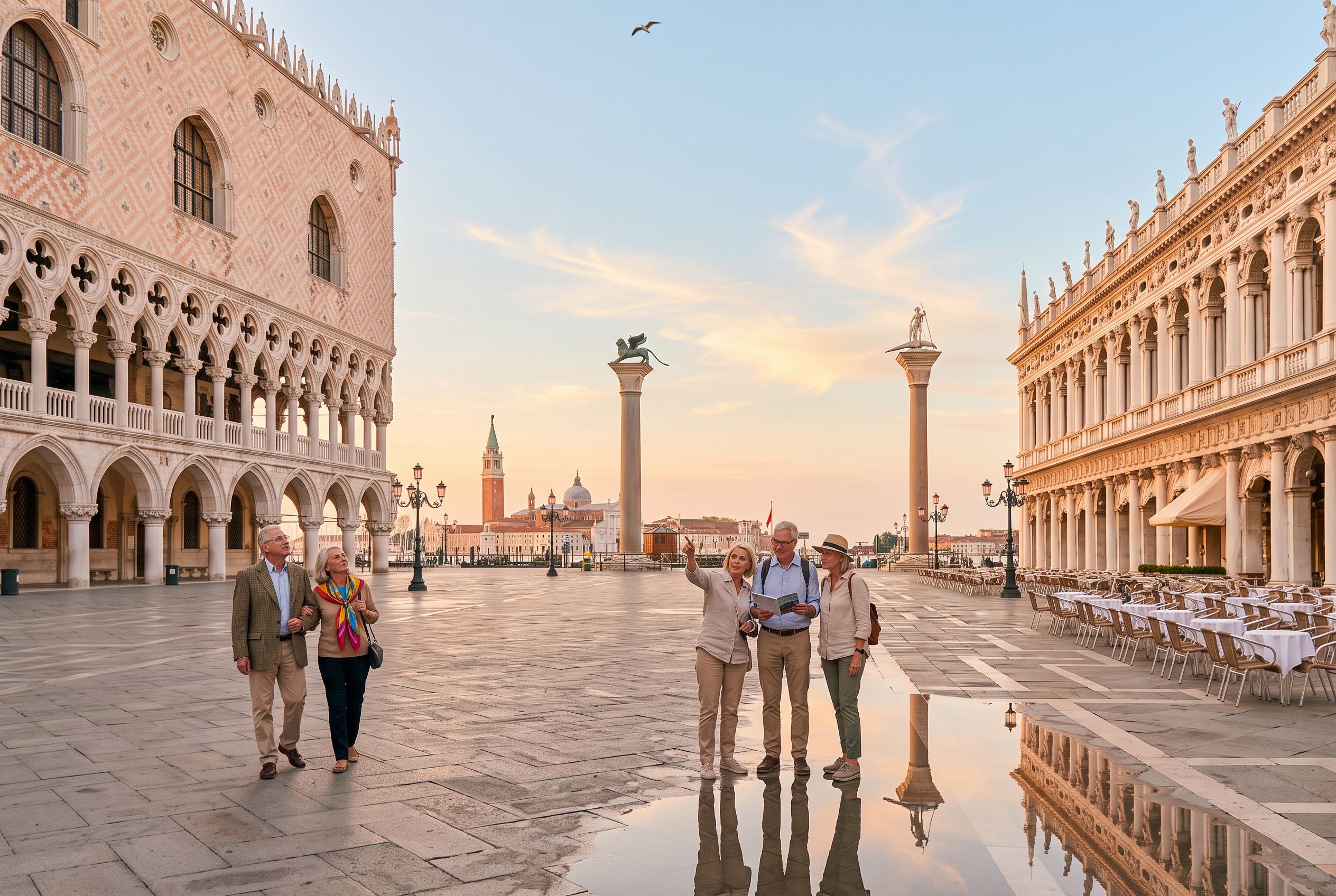
Piazza San Marco is supported as a core first-stop area across multiple Venice itineraries, with the basilica and campanile repeatedly grouped here as the city's central monumental cluster. St Mark's Basilica is listed in itineraries as a key daytime visit and is known for its Byzantine gold mosaics. Timed entry is specifically mentioned in itinerary sources, and one forum post advises getting timed tickets ahead of time and simply showing up to queue at your slot.
Piazza San Marco is described as best before 9 a.m. to beat crowds, and a senior-travel guide recommends visiting St Mark's Square at dusk when daytime crowds have thinned. A forum post advises returning to the basilica after 3.30 p.m. when day-trippers have eased off.
Doge's Palace is repeatedly included in Day One plans as a principal historic sight, usually paired with St Mark's Square and the Bridge of Sighs. Pre-booking is recommended in a senior-travel guide and in itinerary sources. The palace's Secret Itineraries guided tour runs about four hours, and children under six are not admitted to it; a shorter tour option runs about one hour.
 AI-edited
Day Two: Dorsoduro and the Accademia
Dorsoduro gives you two major museums, a calm waterfront and gelato, all within a compact area. The Gallerie dell'Accademia and the Peggy Guggenheim Collection are both repeatedly included in published plans as major art stops, and the Zattere promenade is supported as a calmer waterfront walk with lagoon views.
Grouping these together is the whole point of a sestiere-based plan. Rather than crossing the city twice, you cross the Accademia bridge once and work through the neighbourhood on foot at your own pace.
That is not a warning about any of them; it simply means the detail is not published in the material available. Contact the individual museum before you go if you need to know.
One practical alert worth checking before you travel: Alilaguna announced temporary service interruptions at Zattere for maintenance in late August 2026, so if your trip falls near that window, confirm the stop is running. Alilaguna also published new timetables from 29 April 2026 for its Blue, Orange and Red lines.
Day Three: Rialto, then the islands
Split the day. Do the Rialto Market early, when it is at its best, then take a vaporetto to Murano and Burano. One itinerary source says Line 4.1 or 4.2 reaches Murano in about 20 minutes and that the trip can be covered by a day pass.
The Rialto Bridge and Rialto Market area is supported as a major must-see, with the market noted as a morning stop and the bridge as a central crossing point. One itinerary source says the Rialto Fish Market is closed Sunday and Monday and open in the morning only. No booking requirement is documented for the market or the bridge.
Murano is supported as the island for glassblowing workshops and the Museo del Vetro, described in one itinerary source as covering 2,000 years of glassmaking history. Glass demonstrations are described as sometimes free and with no obligation to buy. The Murano Glass Museum is open every day of the year, with summer and winter hours listed, and reduced admission for visitors aged 65 and over at €7.50. The museum is described as partially accessible, with internal level changes; visitors needing assistance are advised to contact the museum or MUVE in advance, and disabled visitors plus one helper enter free.
Burano is consistently presented as a place for colourful houses and lace traditions. Early is better: the advice to go early for Murano and Burano is tied to the comment that you will not be alone, and one senior guide suggests a late start around 10 a.m. to avoid the morning tour rush.
Can you spare your legs with a water taxi?
Yes, and it is the single most effective mobility measure available. A water taxi removes the bridge crossings and the walk to a landing stage entirely, dropping you at a private pontoon close to your destination.
in a city where 400-plus stepped bridges are the main obstacle, a leg that involves no bridges at all is worth considering for at least one journey, typically arrival or the island day.
For the airport, official sources indicate options include bus links to Piazzale Roma and Venezia Mestre, plus water-bus and water-taxi transfers. The airport bus stop is documented as about 50 metres from the terminal exit, and airport buses are described as accessible to people with reduced mobility with luggage space. By road, Marco Polo Airport to Piazzale Roma measures 571 km on the road network, about 320 minutes with clear roads; the airport to Venezia Mestre measures 12 km, about 15 minutes with clear roads. Those road figures reflect the mainland routing and are not the water transfer.
What is the best month to go to Venice?
April to June and September to October are the most practical months for older travellers, sitting outside the summer peak with milder temperatures. July is the busiest month and the least comfortable choice for anyone wanting smaller crowds and easier pacing.
The visitor numbers back this up. Venice's historic centre recorded 2023 monthly visitor counts ranging from 168,941 in January to 426,112 in July. A traveller-focused summary of Venice tourism data says the city is busiest from June to August, peaking in July, and quieter from December through February.
On climate, the average temperature is about 4°C in January, rising to about 24°C in July and August. Rainfall is fairly even through the year, with slightly wetter months from late spring to autumn; June is around 80 mm and October around 75 mm in the cited climate series. January has the fewest visitors but is also the coldest period. Venice does not close seasonally; the seasonality is visitor-volume based, not closure-based. Our guide to when to visit Venice for warm days and small crowds goes further into the trade-offs.
What do you need to book, and what will it cost?
Book timed entry for St Mark's Basilica, the campanile and Doge's Palace in advance, and check the Venice Access Fee dates before you travel. The fee applies on selected peak days in the historic centre, generally between 8.30 a.m. and 4 p.m., for visitors aged 14 and over on active days.
The Access Fee is €5 if booked by the fourth-last day and €10 later, with no reductions. The Venezia Unica page states the fee is due on specific access days and is not due for people who only pass through certain transport areas without entering the historic city. Disabled visitors are exempt, and the accessible-Venice pages identify dedicated accessibility information for water transport and city access.
On the museums, the Murano Glass Museum is the clearest documented case of a senior tariff in the official pages, with reduced admission for visitors aged 65 and over at €7.50. The Correr Museum lists visitors over 65 and disabled people with a helper among its reduced categories. Its ticket is valid for six months and allows one admission to each museum, with no reservation required. Opening hours run 10.00 to 18.00 from 1 April to 31 October (last admission 17.00) and 10.00 to 17.00 from 1 November to 31 March (last admission 16.00), with closing procedures beginning 30 minutes before closing time.
Expect site-by-site maintenance. Even marquee attractions such as St Mark's Basilica, the Correr Museum and the Biennale Giardini have had staggered works or operating changes. The Correr's Room III in the Canova collection has been closed for maintenance since 29 October 2025, and the Correr and Doge's Palace stayed open late on Fridays and Saturdays from 1 May to 26 September 2026. Venezia Unica explicitly advises checking each museum website for opening days, times and access conditions.
Rates and fees are indicative and vary by season and booking channel. No published senior pass covers Venice's major sights, so plan on full-price tickets plus the documented reductions above. For the wider picture of what is on when, see Venice through the year, Carnival, the Biennale and quiet seasons.
Practical questions before you go
Plan around four things: mobility, health, safety and booking. The municipality publishes 14 barrier-free itineraries with downloadable maps, and its accessible map colour-codes the city by whether areas can be reached by vaporetto, by motoscafo or a facilitated bridge, or not by public transport at all.
That map, produced by the Città per tutti Service with the EBA Department for the Elimination of Architectural Barriers, also marks bridges with facilities such as platform lifts, lifts or low steps, waterborne public transport stops, public toilets and tourist terminals. It is the most useful single planning document for anyone with reduced mobility, and it is free. You can consult the municipality's accessible Venice map directly.
The nearest pharmacy or hospital to any specific sight is not documented in the gathered official sources. A municipal PDF on hospital transport documents L'Ospedale SS. Giovanni e Paolo at Castello 6777, reachable by ACTV vaporetto at the Ospedale stop and by Alilaguna Blu. The documented emergency numbers for Venice are 112 for the unified European emergency number and 118 for medical emergencies.
On safety, no citywide safety rating for Venice is documented in the official material gathered. The municipal transport pages do document practical measures: accessible stops, specially equipped vehicles and route mapping for areas that can or cannot be crossed by public transport.
For booking assistance, the municipality and Venezia Unica direct people seeking disability-related facilities to the City of Venice tourist information offices or call centre, contactable through an online form or call centre. The 14 barrier-free itineraries can be consulted online or downloaded.
One more thing worth knowing: Cannaregio, the northernmost sestiere, is described in itinerary sources as a less tourist-heavy area, and one itinerary source explicitly recommends it as far from tourist crowds. A forum post said the first morning wandering Cannaregio among local markets and sidewalk cafés was when the traveller fell in love with Venice. It is a good place to end a day when you want quiet.
Caveats belong here rather than in the introduction. They do not document cancellation terms for the Venice attractions named here. Where you need one of those details, contact the site directly before booking. If your plans run to a longer stay and a hotel decision, that is a separate subject with its own dedicated guide, including our closer look at the Gritti Palace in Venice.


