
Lake Garda has drawn wellness seekers to its shores for centuries, but the modern traveller over 50 wants more than pretty views—they want warm water that actually heals, easy access, and a quiet night's sleep. This guide cuts through the glossy marketing to focus on where the thermal waters genuinely flow, which spa hotels deliver on comfort and accessibility, and how to plan your visit without the crowds.
Sirmione remains the undisputed thermal heart of the lake, thanks to the sulphurous, bromine-iodine springs of the Fonte Boiola that bubble up at the tip of the peninsula. But the lake's wellness scene now extends well beyond this historic town, with luxury retreats in Gargnano and modern thermal centres that cater specifically to those seeking rest, rehabilitation, and recovery.
For the traveller aged 50–70, the key questions are practical ones: Can I get in and out of the pools easily? Will I sleep well? Is the treatment range gentle enough for my needs? We've assessed each option against these criteria, using operator documentation, the accessibility information published by Sirmione's tourism office, and patterns across recent guest reviews. For a broader overview of the region, see our complete guide to Lake Garda for travellers over 50.
 AI-edited
Which thermal baths are actually worth visiting?
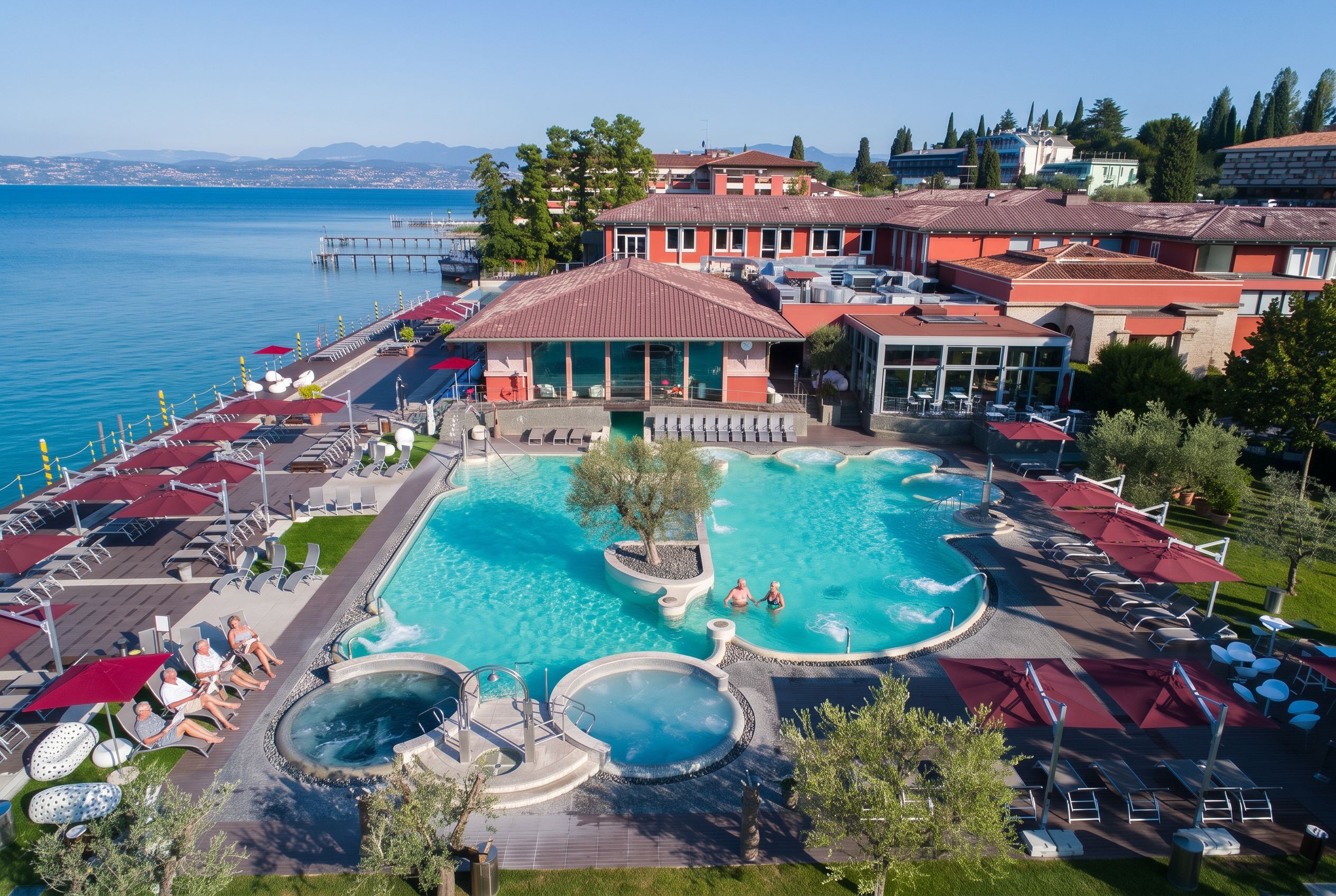
Terme di Sirmione's SPA & Thermal Garden (Aquaria) is the standout choice for genuine thermal bathing, offering lake-view pools, saunas, and steam baths in the historic centre. The separate Therapy District at Colombare handles medical treatments. Both require advance booking, and weekday mornings are significantly calmer than weekend evenings.
The SPA & Thermal Garden was renamed from Aquaria and is still signposted under the old name in places; the operator says the logo change on signs and information materials is being made gradually. It sits in the historic centre at Piazza Don A. Piatti 1, a few minutes' walk from Scaligero Castle, and opens daily from 9:00 to 22:00 Sunday through Thursday and until midnight on Fridays and Saturdays. Terme di Sirmione advises checking its calendar, because hours vary on public holidays. As of August 2026, booking is always necessary. The operator publishes no accessibility statement for the site, so travellers who need step-free routes, a lift or help getting into the pools should ask the spa what is available before booking.
The thermal water itself is the star. Rich in sulphur, bromine, and iodine from the Fonte Boiola spring, it has been used for over a century to treat respiratory conditions, rheumatic complaints, skin disorders, and circulatory issues. Children are welcome too: those aged two and a half to sixteen are admitted when accompanied by an adult, and a dedicated five-hour Junior admission covers ages thirty months to eleven years. Travellers who want the quietest atmosphere should plan around weekends and school holidays.
The Therapy District at Colombare di Sirmione, about 3 kilometres south of the historic centre, takes a more medical approach. Here you'll find specialist consultations, inhalation therapies, fango mud packs, and rehabilitation programmes, some of which are covered by Italy's National Health Service. This is the place to come if you have a specific condition you want addressed, rather than a general desire to soak in warm water.
"The thermal waters were warm and soothing, and the atmosphere was calm, clean, and very well organized. The outdoor thermal pools were the highlight, especially with the stunning lake views and the peaceful surroundings." — a guest wrote on Google in March 2026
One note on natural thermal sites: Lake Garda has no free, open-air hot springs of its own. The Cascate del Mulino, the open-air thermal cascades often mentioned in the same breath as Italian spa travel, lie at Saturnia in the municipality of Manciano, province of Grosseto, in Tuscany — roughly 340 kilometres south of the lake, and not on Garda's eastern shore. On Lake Garda the thermal water reaches visitors only through the Terme di Sirmione facilities, which draw on the Boiola spring below the lake surface.
Which spa hotels deliver on comfort and accessibility?
Lefay Resort & SPA Lago di Garda in Gargnano leads the luxury field with panoramic lake views, multiple saunas, indoor and outdoor pools, and consistently praised service. Guests report exceptional breakfasts and spacious, modern rooms, but the hillside location requires a 15–20 minute drive up a winding road from the lakeside town.
Lefay has built a reputation as one of the finest wellness resorts on the lake, and the guest feedback supports it. As of August 2026, the resort holds a Google rating of 4.7 out of 5 from more than 1,396 reviews. Recent guests consistently praise the attentive staff and the evening turndown service. "They were incredibly considerate and accommodating of my medical needs, ensuring our stay was completely comfortable and stress-free," a guest wrote on Google in April 2026.
The spa facilities are extensive: a 25-metre indoor and outdoor heated pool, the "La Luna nel Lago" salt-water pool, which the resort lists with a separate entrance fee, several saunas and relaxation areas, and a gym open around the clock. The outdoor infinity pool and the Fonte Roccolino whirlpool run from April to October only. The breakfast buffet draws particular acclaim, with made-to-order eggs, fresh juices, and plant-based milk options. For travellers who want a genuine wellness immersion rather than a quick soak, this is the destination.
However, the location demands planning. The resort sits on the hillside above Gargnano, about 9.6 kilometres and a twenty-minute drive from the village. Lefay runs a free electric shuttle to Gargnano from 10:00 to 19:00, subject to availability, and the reception arranges taxis, private transfers and car hire outside those hours. There are few taxis waiting in the area, so guests who plan to eat in the village in the evening should agree the return journey in advance.
For those who prefer to stay in the heart of Sirmione itself, the Grand Hotel Terme Sirmione and Hotel Sirmione Terme offer direct access to thermal facilities without the need to walk far. Guest reviews across these properties consistently highlight quiet rooms, comfortable beds, and good breakfast quality. The operator lists rooms with either a bath or a shower rather than one standard layout, so travellers who need a low step into the shower should say so when booking.
How do the price bands compare?
Expect to pay €€€€ for Lefay's luxury experience, €€€ for the better Sirmione spa hotels like the Grand Hotel Terme Sirmione, and €€ for a day visit to Aquaria's thermal garden. Half-board is worth considering at Lefay, where the dining quality justifies the upgrade, but less so at mid-range properties where you'll want to explore local restaurants.
| Property / Facility | Price Band | Half-Board Worth It? | Best For |
|---|---|---|---|
| Lefay Resort & SPA | €€€€ | Yes—dining is exceptional | Full wellness immersion |
| Grand Hotel Terme Sirmione | €€€ | Optional—good but not essential | Thermal access + historic charm |
| Hotel Sirmione Terme | €€€ | No—explore Sirmione's restaurants | Mid-range thermal stay |
| SPA & Thermal Garden (day visit) | €€ | N/A | Thermal bathing without overnight stay |
The price difference between a day visit and a full resort stay is substantial, but so is the experience. A day at Aquaria gives you the thermal pools, saunas, and steam baths—everything you need for a restorative afternoon. A stay at Lefay wraps that in a complete wellness programme with spa treatments, guided relaxation, and dining that rivals the best restaurants in the region.
For the traveller who wants both thermal bathing and a comfortable base, the Sirmione hotels offer the best of both worlds. The Grand Hotel Terme Sirmione, a five-star house on Viale Marconi, has a long history of thermal hospitality and stands close enough to the SPA & Thermal Garden to walk there in minutes. Its in-house thermal treatments are open only to guests staying overnight and require an initial consultation, which can be carried out at the hotel. Recent guests note the service is courteous and attentive.
When is the calmest time to visit?
Weekday mornings, ideally Monday through Thursday, are the quietest times at Aquaria and the Sirmione thermal centres. Friday and Saturday evenings draw the biggest crowds, with hours extending to midnight. For the lake as a whole, shoulder seasons of May–June and September–October offer the best balance of pleasant weather and manageable crowds.
The thermal facilities in Sirmione follow a predictable rhythm. Weekday mornings right after the 9:00 a.m. opening are notably calm, and the pools fill noticeably by late morning. Evenings are the other quiet window, and the spa sells separate evening admissions that run until closing time: "It's a lot less busy in the evenings so we enjoyed ourselves a lot more," a guest wrote on Google in June 2026.
Seasonally, Lake Garda's mild microclimate makes spring and autumn the sweet spots. July and August bring the hottest temperatures and the largest crowds, which can make the walk through Sirmione's historic centre feel like a chore rather than a pleasure. April–May and September offer comfortable temperatures for both soaking in thermal pools and strolling the lakeside promenades.
If you're planning a broader trip, consider how the thermal visits fit into your overall itinerary. The Lake Garda guide for travellers over 50 covers transport options and walking considerations in more detail, but the key principle is simple: base yourself near the thermal facilities you plan to use most, and save the longer excursions for days when you're not planning a spa visit.
What should you pack and prepare?
At the SPA & Thermal Garden your admission already includes a welcome kit with a bathing cap and towel, so what you actually need to pack is a swimming costume and slippers — both compulsory from the changing rooms onwards. Arrive with a reservation, and allow extra time for the walk from parking or the shuttle stop.
Travellers consistently report that small preparations make thermal visits far smoother. Pack a swimsuit that's comfortable for extended wear and non-slip slippers for poolside walking; the bathing cap and towel come with the admission. Leave valuables at your accommodation rather than bringing them along: the operator warns that they oxidise in contact with the thermal water and that there are no safes on site.
At the SPA & Thermal Garden the changing rooms are equipped with showers, hairdryers and lockers, and are split between the ground floor and the first floor. Terme di Sirmione publishes nothing about lifts, step-free routes or pool access aids, so none of that can be treated as given. The historic centre of Sirmione is far better documented: the town's tourism office states that all pedestrian routes are suitable for wheelchairs, with accessible parking bays in Piazzale Porto, reserved spaces in Piazza Porto Valentino, and public toilets with disabled facilities in Piazzale Monte Baldo, Viale Marconi and at Lido Galeazzi beach.
For those considering the Therapy District at Colombare, note that medical treatments require advance booking and often a consultation first. If you're coming specifically for respiratory or rheumatic treatment, contact them directly to understand what documentation you might need and whether your condition qualifies for NHS-covered services.
How accessible is Sirmione itself?
Sirmione's historic centre is remarkably accessible for a medieval Italian town. The official tourism materials confirm that all pedestrian routes are suitable for wheelchairs, with accessible parking bays and, in summer, a dedicated shuttle bus from the Colombare car parks. The main challenge is distance: the peninsula is narrow and long, so staying close to the thermal facilities reduces walking significantly.
Parking in Sirmione requires planning. Vehicle access to the historic centre around the Scaligero Castle is restricted rather than closed outright, and drivers who need to enter the controlled zone — guests staying at a hotel and disabled drivers among them — can be accredited for it. The main car park serving the old town is Piazzale Monte Baldo, roughly 500 metres from the centre. A shuttle bus runs from the car parks in Colombare to the Scaligero Castle during the summer; outside that season, plan on walking or arranging a taxi.
The lakefront promenades are level and well-maintained, making them pleasant for evening strolls. On accessibility the official picture runs the opposite way to what most visitors assume: Sirmione's tourism office states that the Scaligero Castle is not accessible inside, while the Grottoes of Catullus at the peninsula's tip, including the museum, are. There is also a winch at Piazzale Porto that helps passengers with reduced mobility board the boats.
For a more detailed breakdown of walking distances and transport options across the lake, the Fodor's guide to Sirmione hotels offers practical neighbourhood-by-neighbourhood advice. The key takeaway is simple: choose accommodation within a 10-minute walk of your primary thermal destination, and you'll eliminate most of the day's logistical stress.
What treatments should you consider?
The thermal waters of Sirmione are particularly effective for respiratory conditions, rheumatic complaints, and skin disorders. Inhalation therapies, fango mud packs, and thermal baths form the core of the treatment menu, ranging from gentle to invigorating depending on your needs and tolerance.
For respiratory issues, the inhalation rooms at the Therapy District use the sulphurous water in aerosol form—a treatment with over a century of documented use. For joint and muscle complaints, fango therapy combines thermal mud with warm baths, typically in a 15–20 minute session followed by rest. The thermal pools themselves provide gentle hydrotherapy, with hydromassage jets available in designated areas.
If you're new to thermal treatments, start with a simple soak in the thermal pools, which the operator holds at 34°C in summer and 36°C in winter, and gradually add sauna sessions. The suggested time in each pool is about twenty minutes, and the Infinity Pool alongside them is a freshwater basin at 30°C rather than a thermal one. The staff at both Aquaria and the Therapy District are experienced with older visitors and can recommend appropriate durations. Listen to your body—the combination of heat and mineral water can be more draining than expected, especially on the first day.
Recent guests at Lefay consistently note the spa's range, from gentle relaxation massages to more invigorating deep-tissue work. The resort's wellness philosophy emphasises prevention and recovery, making it well-suited to travellers who want to address specific concerns rather than simply relax. "The pools were amazing, and the indoor/outdoor pool was awesome for a rainy day spot," a guest wrote on Google in October 2025.
Where should you stay?
Choose Sirmione for direct thermal access and historic charm, Gargnano for Lefay's luxury wellness immersion, or the eastern shore towns of Lazise and Bardolino for a quieter, more residential base with good spa hotels nearby. Your choice should hinge on whether you want thermal bathing as the centrepiece or simply a relaxing hotel spa.
Sirmione remains the obvious choice for thermal enthusiasts. The concentration of thermal facilities, combined with the pedestrian-friendly centre, makes it easy to build a wellness-focused itinerary without constant transfers. The trade-off is crowds, particularly in summer and on weekends—the reason weekday visits are so strongly recommended.
Gargnano offers a completely different experience. The town itself is quiet and residential, and Lefay's hillside position provides panoramic views that no Sirmione hotel can match. The winding access road is the main drawback, but the resort's shuttle and the quality of the on-site experience compensate for the isolation. If you want to switch off completely, this is the place.
The eastern shore towns of Lazise, Bardolino, and Garda offer a middle ground. These towns have their own spa hotels—many renovated in recent years—and are less frenetic than Sirmione. The lakeside promenades are flat and pleasant, and the towns are well-connected by ferry for day trips to Sirmione's thermal baths. For travellers who want flexibility, this is a strong option.
For those considering the broader lake, the Hotel Guru's ranking of Lake Garda spa hotels provides a useful overview of the top properties across all price bands. The list includes several options we haven't covered here, from the lakeside Lido Palace in Riva del Garda to the adults-only EALA – My Lakeside Dream in Limone sul Garda—both worth considering if you're exploring beyond Sirmione and Gargnano.
How do you plan the perfect wellness itinerary?
A five-to-seven-day stay allows for a proper wellness rhythm: two or three thermal sessions, one or two spa treatments, and plenty of time for gentle exploration. Build in rest days between intensive treatments, and don't try to see the entire lake in a single trip—pick a base and explore outward.
For a Sirmione-based itinerary, we suggest arriving on a Sunday or Monday to take advantage of the quietest thermal days. Spend your first day acclimatising with a gentle soak at Aquaria, your second day on a treatment at the Therapy District if you have specific concerns, and your third day exploring the town and castle. Add a ferry trip to another lakeside town if you want variety—the boats run regularly and offer a restful way to see the lake.
For a Lefay-based itinerary, the resort's facilities are extensive enough to fill several days without leaving the property. The 24-hour gym, multiple pools, and extensive spa menu mean you can alternate active and restorative days. The shuttle into Gargnano allows for a pleasant afternoon exploring the town's shops and waterfront restaurants, and the winding road to the resort is worth the journey for the views alone.
Whichever base you choose, remember that wellness travel is about pacing. The travellers who report the most positive experiences are those who plan one significant activity per day and leave room for spontaneity. A late-afternoon soak in a thermal pool followed by a quiet dinner is often more restorative than a packed schedule of sightseeing.
For those who want to extend their Italian wellness journey, our guide to Lake Como with grandchildren offers a different perspective on the neighbouring lake, while the half-day hikes above Lake Como provide gentle outdoor options for active travellers. Each region has its own character, and many travellers find that combining both lakes makes for a richer Italian holiday.
The thermal waters of Lake Garda have been drawing visitors for over a century, and the modern facilities honour that legacy with genuine therapeutic offerings rather than superficial spa experiences. Whether you choose the historic thermal baths of Sirmione or the hillside luxury of Lefay, the lake delivers on its promise of rest, recovery, and renewal.


