
Lake Garda stretches 52 kilometres from the flat, olive-dotted southern shore to the sheer limestone cliffs of the north, and for travellers aged 50 to 70 it offers one of Italy's most rewarding combinations of easy walking, reliable ferry connections, and genuinely spectacular scenery. The trick lies in choosing the right base and pacing yourself according to your fitness level. This guide breaks down the lake's three distinct personalities — the mild south, the resort-lined west, and the mountainous north — so you can match your mobility, energy, and travel style to the right stretch of shore.
Travellers in their 60s fall in love with Garda, and just as many struggle because they try to do too much from a single base. The lake rewards those who understand its geography. The southern shore offers flat, easy promenades and practical transport links. The western shore delivers classic resort charm with gentle gradients. The northern reaches provide dramatic mountain scenery but demand more of your knees and lungs. None of this is complicated, but knowing it before you book makes all the difference between a holiday that energises you and one that exhausts you.
 AI-edited
How does the lake divide for different fitness levels?
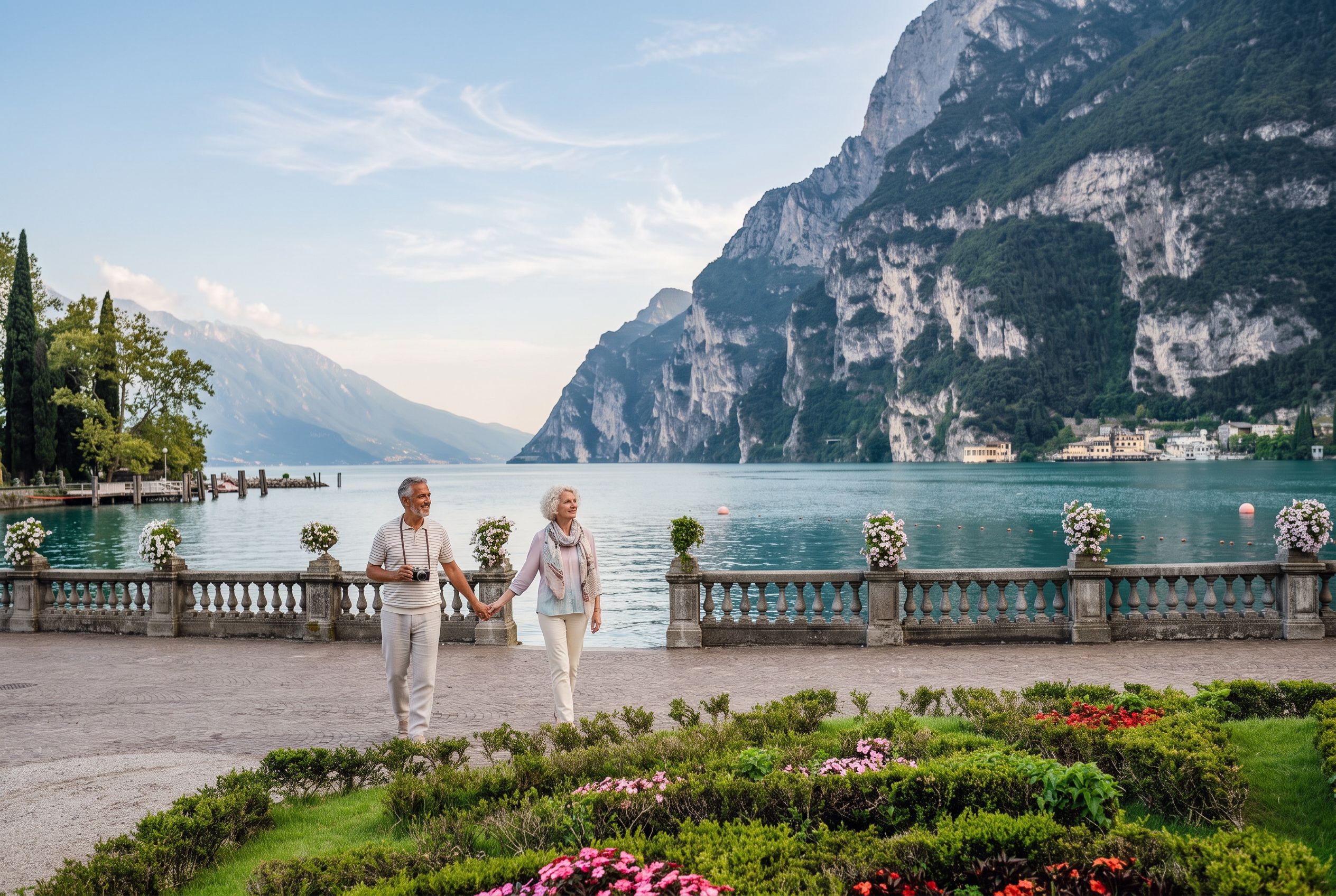
Lake Garda splits into three distinct zones: the flat, mild south around Desenzano and Peschiera; the resort-lined western shore with gentle slopes from Garda to Salò; and the mountainous northern basin near Riva and Malcesine, where dramatic scenery comes with steeper terrain. Choose your base according to your walking comfort rather than trying to cover everything.
The southern shore, roughly from Peschiera del Garda through Desenzano and west to Salò, is where you will find the flattest walking. Towns like Desenzano and Bardolino have broad, level lakeside promenades that are genuinely easy for anyone with moderate mobility. The terrain here is gentle, the climate is milder in spring and autumn, and the transport connections are excellent — Peschiera sits just 16 minutes by train from Verona, making it a practical hub for car-free travellers.
The western shore, running north from Salò through Gardone Riviera and Gargnano toward Limone, offers a middle ground. The lakefront areas are mostly flat, but the towns climb the hillsides behind them, so you can choose how much incline you want to tackle. This is classic resort territory, with grand hotels, botanical gardens, and the sort of unhurried pace that suits a longer stay.
The northern basin, centred on Riva del Garda and Malcesine, is the most dramatically beautiful and the most physically demanding. The town centres themselves have flat sections — Riva's waterfront is surprisingly level — but the surrounding streets climb quickly, and the famous sights like Malcesine's castle involve steps and uneven surfaces. If you are a keen walker or cyclist, this is your part of the lake. If you prefer flat ground, treat the north as a day-trip destination reached by ferry rather than as your base.
Which towns are best for easy walking?
For genuinely flat, easy walking, choose Desenzano del Garda, Sirmione, Bardolino, Garda, Lazise, or Salò. These towns have broad, level lakeside promenades and mostly walkable historic centres. Malcesine and Limone sul Garda do climb steeply behind the waterfront, but both keep a level lakeside route: Malcesine is a Bandiera Lilla town whose barrier-free path runs the length of its shore, and Limone's Ciclopedonale leads from the town centre to the Trentino border.
Desenzano del Garda is the town the regional accessibility surveys keep returning to, and it is one of the easiest on the lake. Its lakeside path is wide, flat, and well-maintained, and the town centre offers everyday amenities — supermarkets, pharmacies, banks, and a good range of restaurants. The ferry terminal sits right on the waterfront, so you can step off the boat and onto level ground without breaking stride.
Sirmione deserves special mention. It is the lake's most iconic destination, with the Scaliger Castle and the Roman ruins of the Grotte di Catullo drawing visitors from across Europe. The old town is mostly flat and walkable, though the town council is precise about which is which: the Scaligero Castle is not accessible inside, while the Grottoes of Catullus, including the museum, are. Arrive early — Sirmione fills up by mid-morning, and the experience is far more pleasant before the day-trip crowds arrive.
Bardolino and its neighbour Garda are quieter alternatives with the same flat-lakefront formula. Both towns have long, level lungolago promenades perfect for a morning stroll or an evening passeggiata. The shore path further south is less forgiving: an Italian wheelchair association that surveyed the 20-kilometre route from Peschiera to Garda in May 2025 found a steep descent and at least three sandy stretches between Peschiera and Lazise that need a helping hand, and suggests starting at Lazise instead. Both towns also offer easy ferry access to other lakeside towns, making them practical bases for a slow-travel holiday.
"This is a wonderful walking path along the lake with excellent views," one Google reviewer wrote of the Rivalunga promenade between Bardolino and Garda in May 2024. "The path brings you past some beach camping, small villages, and the consistent view of the lake. The path is very easily traversed with some paved area, some sandy, and the occasional boardwalk."
How accessible is the ferry network?
The ferry network run by Navigazione Laghi is the single most mobility-friendly way to explore Lake Garda. Since 2016, the company has equipped its ships and main ports of call with stepless ramps for wheelchair boarding, and six Garda piers — Desenzano, Sirmione, Peschiera, Garda, Malcesine and Riva — now hold the Bandiera Lilla Approved certificate, along with nine of its boats. For travellers over 50, ferries eliminate the stress of parking, narrow roads, and steep hill climbs.
The network connects all the major towns around the lake, with frequent services in summer and reduced schedules in the shoulder seasons. As of August 2026, the service includes passenger boats around the whole lake plus a single car ferry, which shuttles between Toscolano Maderno and Torri del Benaco in about thirty minutes, so you can plan day trips without ever getting behind the wheel. The boats are comfortable, with both indoor seating and open decks for enjoying the views, and journey times are longer than the map suggests — the fast service covers Garda to Malcesine in about an hour, while the stopping service along the eastern shore takes closer to an hour and three quarters.
For travellers who want to avoid driving entirely, the ferry network combined with the train connections at Peschiera and Desenzano creates a genuinely car-free holiday. In high summer the boats run often enough to leave the car parked for the whole week. This approach works particularly well if you choose a base with a ferry pier and plan your day trips around the boat schedule.
If you are considering a similar lake-hopping holiday elsewhere in Italy, our guide to two weeks across the Italian lakes offers a practical framework for combining Garda with Como, Lugano, and Maggiore.
What are the best bases without a car?
Peschiera del Garda is the best car-free base for travellers over 50, with a train station just 16 minutes from Verona and direct ferry connections to the rest of the lake. Malcesine and Sirmione are strong alternatives if you prefer a more scenic setting, while Desenzano offers a good balance of transport links and flat walking.
Peschiera del Garda is the transport hub of the southern lake. The train station connects to Verona in 14 to 16 minutes, and direct trains run from the same platforms to Milano Centrale and to Venezia Santa Lucia, making it ideal for travellers arriving by rail. The town itself is compact, with a historic centre enclosed by Venetian walls and a pleasant lakeside promenade. Ferry services depart from the harbour, giving you direct access to the rest of the lake without needing a car.
Malcesine is the best car-free base for the northern lake, though it comes with a caveat about terrain. The town centre and waterfront are flat and attractive, but the streets climb quickly once you move away from the lake. The Monte Baldo cable car departs from the edge of town, and the municipality lists it among the barrier-free facilities that earned Malcesine its Bandiera Lilla accreditation for accessible tourism — a popular choice for travellers who want the mountain experience without the physical effort.
For a detailed comparison of car-free bases, the table below summarises the key factors for each town.
| Town | Train Station | Walking Ease | Ferry Access | Best For |
|---|---|---|---|---|
| Peschiera del Garda | Yes, 16 min to Verona | Easy, flat centre | Excellent | Rail travellers |
| Desenzano del Garda | Yes, direct to Milan | Very easy, flat lakefront | Excellent | Mobility-conscious |
| Bardolino | No, bus required | Easy, flat lungolago | Good | Quiet, relaxed stays |
| Sirmione | No, bus to Desenzano | Mostly easy, some steps | Good | Sightseeing |
| Malcesine | No, bus to Verona | Moderate, hills behind centre | Excellent | Northern scenery |
What pace should you plan for?
Plan for a slow-travel pace: one or two bases, one main activity per day, and plenty of time for coffee stops, promenade walks, and ferry rides. Travellers over 50 consistently report that trying to see the whole lake from a single base leads to exhaustion and frustration. The lake rewards those who stay put and explore deeply.
A realistic pace for a week-long stay involves choosing one base and making two or three ferry-based day trips to nearby towns. For example, from Bardolino you could spend one day exploring Garda on foot, another taking the ferry to Malcesine for the cable car, and a third visiting Sirmione early in the morning before the crowds arrive. This leaves plenty of time for leisurely meals, afternoon rests, and the simple pleasure of watching the lake change colour as the sun moves across the water.
The slower approach matters most in the smaller places. Moniga del Garda, for example, is peaceful and has local shops and restaurants, but the 2026 summer timetable stops there only six times a day in total, so a day trip has to be planned around the schedule rather than the other way round. The ferry is almost always the better option.
For those who want to combine Garda with other Italian lakes, our guide to Lake Como with grandchildren offers a useful comparison of how the two lakes differ in pace and accessibility.
How does the north differ from the south?
The northern lake around Riva del Garda and Malcesine is dramatically more mountainous, with cliffs rising directly from the water and a cooler climate even in summer. The southern shore is flat, mild, and agricultural, with olive groves and vineyards. For travellers over 50, the choice is between dramatic scenery with more challenging terrain and gentle comfort with easier walking.
The northern basin is where Lake Garda reveals its alpine character. The mountains here are serious — the Monte Baldo range rises to over 2,200 metres — and the scenery is correspondingly spectacular. Riva del Garda, at the lake's northern tip, has a surprisingly flat and walkable centre, making it a good base for travellers who want the mountain views without constant climbing. The town's waterfront promenade is level and attractive, and the Museo Alto Garda (MAG) traces the story of the Upper Garda from prehistory through to the two world wars.
Malcesine, on the eastern shore of the northern basin, is more challenging. The medieval castle requires climbing steps, and the streets behind the waterfront climb steeply. However, the Monte Baldo cable car carries you from the edge of town to the mountain station at Tratto Spino, 1,760 metres up, with panoramic views that rival anything in the Alps; the true summit, Cima Valdritta at 2,218 metres, is reached only on foot. As of August 2026, the cable car runs all year except in March and from November until shortly before Christmas, when it closes for maintenance, and it makes a comfortable half-day outing, especially on hot summer days when the mountain air provides welcome relief.
The southern shore could hardly be more different. Here the lake is wide and gentle, the terrain is flat, and the climate is noticeably warmer. This is the Garda of olive groves, lemon houses, and vineyard-covered hillsides. The towns are more spread out, the pace is slower, and the walking is easier. For travellers who want a relaxing holiday with the option of gentle exploration, the south is the obvious choice.
When is the best time to visit?
The best times to visit Lake Garda for travellers over 50 are May, June, September, and October. These shoulder-season months offer warm but not oppressive weather, smaller crowds, and lower prices than July and August. Tourism figures for the Veneto side of the lake show a strong summer peak — over 3 million arrivals and 13.7 million overnight stays in 2019 — making the shoulder seasons a practical choice for a more relaxed experience.
According to the Veneto tourism observatory's report on the Lake Garda destination, tourism there is highly seasonal, with the largest number of visitor nights falling between June and September; the figures cover the Veronese shore and its hinterland rather than the whole lake. For older travellers who prefer fewer crowds, this supports planning your visit for late spring or early autumn. May is particularly pleasant — the 1991–2020 normals give Torbole an average daily maximum of 24°C — with wildflowers in bloom and the lake's famous breezes keeping the air fresh.
September is arguably the best month of all. The water is still warm from the summer sun, the crowds have thinned, and the light has a golden quality that photographers love. The vineyards along the southern shore are beginning their harvest, and the local festivals celebrate the season's produce. October brings cooler temperatures and the possibility of rain, but also the lowest prices of the year and a genuine sense of local life.
July and August are best avoided if you value comfort and calm. The lake becomes crowded, parking is difficult, and it is genuinely hot: at Torbole, at the northern end, the 1991–2020 climate normals put the average daily maximum at 30°C for both months. That combination leaves most days fit for little beyond indoor breaks and short bursts of sightseeing. If your schedule is flexible, the shoulder seasons offer a superior experience.
For a broader perspective on timing your Italian lakes holiday, the Fodor's Lake Garda guide provides additional seasonal context and practical planning advice.
What comfort and mobility realities should you expect?
Expect cobblestones, some slopes, and occasional steps in historic centres, but also expect excellent ferry access and flat lakeside promenades in most towns. The ferry operator's own accessibility notes are the most reliable guide to what is actually provided, and they are candid that the standard varies sharply from pier to pier, just as individual hotels and attractions vary in their mobility provisions.
The reality of Lake Garda is that accessibility is good but not universal. The ferry network has been equipped with stepless ramps at its main ports of call since 2016, and six Garda piers — Desenzano, Sirmione, Peschiera, Garda, Malcesine and Riva — carry the Bandiera Lilla Approved certificate. The operator is candid that not every landing stage is easy to use and that its survey of the remaining piers is still unpublished, so boarding is always assisted by crew across a non-slip gangway at least 80 centimetres wide. Since 2018 the timetables also carry symbols marking the sailings best suited to wheelchair passengers, and they are worth checking before you commit to a return leg: a wheelchair association that rode the eastern shore in May 2025 noted that the Garda–Peschiera boats, roughly an hour and a half, do not all take wheelchairs and bicycles. The regional S.T.A.I. project has mapped four accessible routes on the Brescia side of the lake: Desenzano del Garda, Rivoltella del Garda, Sirmione, and a Bedizzole–Calvagese della Riviera route inland.
However, a headline score tells you less than the details underneath it. As of August 2026, Enjoy Garda Hotel in Peschiera del Garda holds 4.8 out of 5 on Google from 1,577 reviews, and it lists rooms for guests with disabilities among its facilities. It also lets holiday apartments in a separate building about 100 metres from the hotel, which share the pool, restaurant and parking. Neither fact shows up in a star rating, and that is the point: across the lake, what decides a stay is which building your key opens and which way the room faces.
For travellers who want to avoid these problems, the key is to ask specific questions before booking. Does the hotel have a lift? Are there steps between the reception and the rooms? Is the bathroom a walk-in shower or a bath? What is the room's orientation relative to traffic and nightlife? These questions matter more than star ratings when you are planning for comfort.
How do you choose a hotel for comfort?
Choose a hotel with strong recent reviews for quiet rooms, lift access, walk-in showers, and lakefront convenience. Guest reviews across Lake Garda consistently show that the best properties for travellers over 50 combine attentive service, good breakfast quality, and easy access to the promenade and ferry pier.
The guest review data from Lake Garda hotels reveals a clear pattern. The strongest recurring positives are warm, attentive service, high-quality breakfasts, and clean, comfortable rooms. The main recurring negatives are night-time noise from roads, boats, and entertainment; thin acoustics between rooms; and occasional accessibility limitations such as steps or awkward bathroom layouts.
For travellers in their 60s, this means prioritising quiet rooms, lift access, and walk-in showers over other amenities. A hotel with a pool and spa is lovely, but not if it means climbing three flights of stairs to reach your room. Similarly, a lakeside location is desirable, but not if the room faces a busy road with traffic noise throughout the night.
One practical approach is to book a hotel that offers a cycling package, as these properties tend to be well-equipped for active guests with secure bike storage and laundry services. Enjoy Garda Hotel in Peschiera, for example, is an official Pinarello rental centre with more than 40 bikes and runs daily guided group tours at three levels of difficulty, alongside a self-guided e-bike package that includes a laundry service — a good indicator that the hotel understands the needs of active older travellers.
If you are considering an e-bike holiday, our guide to cycling Lake Como by e-bike offers transferable advice on what to look for in a cycling-friendly hotel.
What are the must-see sights for seniors?
The five must-see sights for travellers over 50 are Sirmione's old town and Roman ruins, Desenzano's flat lakefront, Bardolino's easy promenade, Malcesine's castle and Monte Baldo cable car, and Riva del Garda's waterfront and museum. All are accessible by ferry, and all offer a rewarding experience without requiring strenuous hiking.
Sirmione is the lake's crown jewel. The Scaliger Castle, with its distinctive crenellated towers, guards the entrance to the old town, and the Grotte di Catullo — the ruins of a vast Roman villa — sit on the peninsula's tip. The old town is mostly flat and walkable, though the castle is not accessible inside, while the Grottoes of Catullus and their museum are. Arrive early to avoid the crowds, and allow at least half a day to explore properly.
Desenzano del Garda offers a different kind of appeal. Its wide, flat lakefront is one of the easiest walks on the lake, and the town centre has a lively, everyday atmosphere that makes it a pleasure to explore. The ferry terminal connects to the rest of the lake, making Desenzano an excellent base for day trips.
Bardolino is the quiet gem of the eastern shore. Its long, flat lungolago is perfect for a morning stroll, and the town's wine shops and cafés invite leisurely stops. The ferry service connects Bardolino to Garda, Malcesine, and the western shore, making it a practical base for slow travel.
Malcesine's castle and the Monte Baldo cable car are the highlights of the northern lake. The cable car rises from the edge of town to over 1,700 metres, offering panoramic views without any hiking. As of August 2026, cabins leave at least every 30 minutes from 8.30 and the ride takes about 20 minutes in two sections; the line runs all year except in March and from November until shortly before Christmas, when it closes for maintenance.
Riva del Garda, at the lake's northern tip, offers a flat, walkable centre and the excellent Museo Alto Garda, whose history section runs from prehistory to the events of the First and Second World Wars. The town's waterfront promenade is level and attractive, and the mountain scenery provides a dramatic backdrop. Garda Trentino is also the one stretch of shore whose tourist board states plainly that public transport is entirely barrier-free — bus, train and the scenic lift up to the Bastione above the town included.
What about cycling and active pursuits?
Lake Garda is excellent for active travellers over 50, with flat lakeside cycling paths in the south and challenging mountain routes in the north. E-bikes have transformed the experience, making hills accessible to riders of all fitness levels. The lake also offers sailing, windsurfing, and gentle hiking opportunities.
The southern shore has a network of flat, well-maintained cycling paths that are perfect for a relaxed morning ride. The route from Peschiera to Garda along the eastern shore is particularly popular — about 20 kilometres one way, passing through Lazise and Bardolino with plenty of cafés and viewpoints, and easy to shorten by taking the boat back from Garda. For those who want to explore further, e-bikes are widely available for rental, and several hotels offer cycling packages with guided rides tailored to different abilities.
The northern lake offers more challenging terrain for experienced cyclists. The route around the northern basin climbs into the foothills of the Alps, with serious gradients and spectacular views. This is not for everyone, but for keen cyclists in their 50s and 60s, it is some of the best riding in Italy. The Monte Baldo cable car also carries bikes, allowing you to descend the mountain on a purpose-built downhill trail if you are confident on two wheels.
Sailing and windsurfing are popular on the lake, particularly in the north where the famous Ora and Pelèr winds create ideal conditions. Several sailing schools offer courses for adults, and day charters with a skipper are available for those who prefer a more relaxed experience. For hikers, the lake offers a range of options from easy lakeside paths to challenging mountain trails — our guide to half-day hikes above Lake Como offers a useful comparison of what to expect at similar altitudes.
What should you know about dining and evenings?
Dining on Lake Garda is a highlight, with fresh lake fish, local wines, and generous hospitality. However, travellers over 50 should note that the boats stop early — on the 2026 summer timetable the last southbound sailing reaches Desenzano at 20.15 and the last northbound arrival in Riva is 20.30 — so plan your evenings around your base rather than expecting to travel after dinner.
The lake's cuisine reflects its position between the Veneto and Lombardy regions. Lake fish — particularly trout, perch, and lavarello — feature prominently on menus, along with olive oil from the southern shore's groves and wines from the Bardolino and Lugana vineyards. Most restaurants offer a fixed-price menu at lunch, which is excellent value, and the evening meals are unhurried affairs that can easily last two hours.
One practical consideration for travellers over 50 is the limited evening transport. Shop hours are not the constraint: both Veneto and Lombardy leave opening and closing times to the shopkeeper in the municipalities classed as tourist localities, and lakeside shops routinely trade late into a summer evening. The boats are the constraint: the last sailings of the 2026 summer timetable dock shortly after eight in the evening, and there is nothing after them. This means you should plan to be back at your base by mid-evening unless you have a car or are prepared for a taxi ride. It also means that evening entertainment is centred on your hotel and the immediate surroundings, so choosing a base with good restaurants within walking distance is important.
For those who enjoy a glass of wine with dinner, the local Bardolino and Valpolicella wines are excellent and remarkably affordable. House wine is more often ordered by the carafe than by the bottle: a lakefront restaurant in Garda lists a half-litre carafe of house Lugana at €12.00 on its published menu as of August 2026, and the quality is consistently high. The lake's lemon houses, once a major industry, have left a culinary legacy in the form of lemon-based desserts and liqueurs that are well worth trying.
How do you plan a realistic itinerary?
Plan for one or two bases and two or three ferry-based day trips per week. A realistic itinerary might involve four nights in Bardolino or Desenzano, followed by three nights in Riva del Garda for the northern scenery. This approach minimises packing and unpacking while allowing you to experience both the gentle south and the dramatic north.
A week-long itinerary for travellers over 50 might look something like this: arrive at Verona airport or station, take the train to Peschiera or Desenzano, and transfer to your first base on the southern or eastern shore. Spend the first two days exploring your base town on foot, with a ferry day trip to Sirmione on day three. On day four, take the ferry north to Malcesine for the Monte Baldo cable car, returning to your base in the evening. On day five, move to your second base in Riva del Garda, and spend the final two days exploring the northern lake at a relaxed pace.
This itinerary works well because it balances easy walking with scenic highlights, and it avoids the exhaustion of trying to see everything from a single base. It also allows for rest days — days when you simply sit by the lake, read a book, and enjoy the view. For travellers who prefer a single base, the southern shore offers the easiest option, with ferry day trips to the north providing the dramatic scenery without the challenging terrain.
For a more detailed multi-lake itinerary, our guide to two weeks across the Italian lakes offers a practical framework that includes Garda alongside Como, Lugano, and Maggiore.
What should you pack and prepare?
Pack comfortable walking shoes with good grip for cobblestones, layers for changing temperatures, and a light rain jacket for sudden showers. Bring sunscreen and a hat for summer, and consider a small daypack for ferry trips. If you have mobility concerns, book hotels with lifts and walk-in showers, and confirm ferry accessibility in advance.
The practicalities of packing for Lake Garda are straightforward. Comfortable walking shoes are essential — the cobblestones in historic centres are charming but unforgiving on tired feet. Layers are important because the temperature can vary significantly between the lakeside and the mountains, and between morning and afternoon. A light rain jacket is wise even in summer, as afternoon thunderstorms are common in the mountains.
For ferry trips, a small daypack is useful for carrying water, sunscreen, and a light jacket. The ferries are comfortable, but the open decks can be windy, and the sun is stronger on the water than it feels on land. If you are planning to visit the Monte Baldo cable car, note that the temperature at the summit can be 10 degrees Celsius cooler than at the lake, so bring a warm layer.
For travellers with mobility concerns, preparation is key. Book hotels with lifts and walk-in showers, confirm ferry accessibility in advance, and consider hiring a taxi for the journey from the station to your hotel if you have heavy luggage. The lake's accessibility infrastructure is good, but it is not universal, and a little planning goes a long way.
The most useful single document for planning is the operator's own accessibility page for the Lake Garda ferries: it names the certified piers and ships, describes how boarding is assisted, and states plainly that not all wharfs are easily accessible to disabled or reduced-mobility passengers. That candour is more helpful than a general assurance, because it tells you which questions still need asking.
What are the practical details?
No special entry permit is required to visit Lake Garda, but normal Italian travel rules apply based on your nationality. The lake spans three provinces and three regions — Brescia in Lombardy, Verona in Veneto and Trento in Trentino — so the nearest hospital or pharmacy depends on your base town. Plan for cobblestones and slopes in historic centres, and use the ferry network for the most accessible travel.
Lake Garda sits between Brescia and Verona, roughly 30 kilometres from each city, with easy access from the Milan-Venice corridor. The nearest international airports are Verona Villafranca (about 30 minutes from the southern shore), Milan Bergamo (about an hour), and Milan Malpensa (about an hour and 50 minutes by road). From any of these, you can reach the lake by train and bus, or by pre-booked transfer.
For medical needs, the lake's towns are well served by pharmacies. The emergency departments are in Desenzano del Garda for the southern and south-western shore, Gavardo and Salò for the western shore, the Ospedale P. Pederzoli in Peschiera del Garda for the eastern shore, and Arco — about six kilometres from Riva del Garda — for the northern end. Riva itself has no hospital, which is worth knowing before you assume help is next door. If you have specific medical needs, it is worth identifying the nearest pharmacy and hospital to your base before you travel.
Pedestrianisation is worth noting for drivers, but it is set town by town rather than lake-wide. Sirmione runs its summer limited-traffic scheme from 23 March to 13 October 2026 and closes the historic centre to all vehicles on 31 pedestrianisation days between April and September, each time from 14:00 to 19:00. Other towns publish their own calendars, so if you are self-driving, check the dates that affect your base town and plan accordingly.
How does Garda compare to other Italian lakes?
Lake Garda is the largest and most accessible of the Italian lakes, with the flattest walking, the most extensive ferry network, and the widest range of accommodation options. Lake Como is more dramatic but more challenging, while Lake Maggiore offers a middle ground. For travellers over 50, Garda is often the easiest and most rewarding choice.
Compared to Lake Como, Garda is larger, warmer, and more varied. Como's western shore is steep and mountainous, with fewer flat walking options, while Garda's southern shore offers genuinely easy terrain. The ferry network on Garda is also more extensive, with more frequent services and better accessibility. For travellers who want a relaxed holiday with the option of gentle exploration, Garda is the superior choice.
Lake Maggiore, to the west, offers a similar combination of gentle walking and scenic beauty, but on a smaller scale. The Borromean Islands are a highlight, and the lake's mild climate supports subtropical gardens that are a delight to explore. However, the transport connections are less convenient than Garda's, and the range of accommodation is more limited.
For travellers who want to experience multiple lakes, our guide to two weeks across the Italian lakes offers a practical itinerary that combines Garda with Como, Lugano, and Maggiore, with realistic daily distances and mobility considerations.


