
Located in the heart of the Austrian Alps, the Zillertal valley has a compact wellness scene that repays a little planning if you are between 50 and 70. While many know it for skiing and hiking, this guide focuses entirely on the region's thermal baths, spa hotels, and gentle relaxation options—with practical details on accessibility, quiet times, and what a spa day actually involves.
 AI-edited
Which thermal baths and spas are best for seniors?
The standout choice for public thermal bathing is the Therme Zillertal in Fügen, the house the valley long knew as the Erlebnistherme, while hotel spas such as the MalisGarten Green Spa Hotel in Zell am Ziller and the Alpin Spa Hotel Tuxerhof in Tux offer quieter, adults-only wellness hours on their own terms.
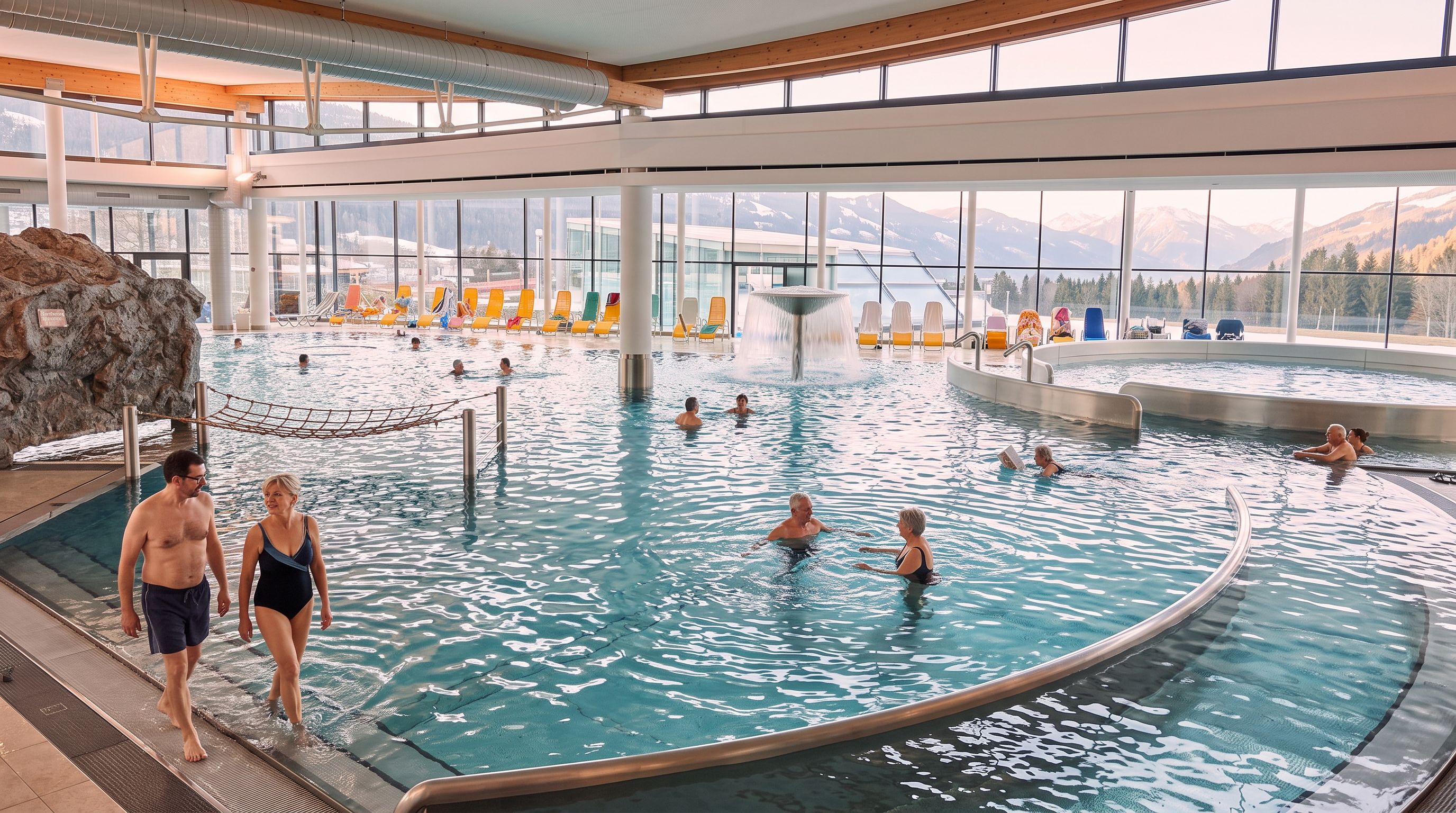
The Therme Zillertal — renamed from Erlebnistherme Zillertal, the same house at Badweg 1 in Fügen under the same operator — is the valley's main public thermal spa. The operator describes a 1,000 m² water park with indoor and outdoor pools, a wave pool, a lazy river, water features and massage beds, and upstairs seven indoor saunas and steam rooms plus a garden sauna and relaxation rooms with daybeds. As of August 2026 it holds a Google rating of 4.4/5 from 4,747 reviews, with guests consistently praising its cleanliness and well-run facilities. It opens Monday to Sunday from 10:00 to 22:00; the sauna and spa floor runs from 13:00 to 22:00 and is adults-only. The house closes for its annual overhaul, next from 7 to 20 June 2027.
For those seeking a more intimate experience, the MalisGarten Green Spa Hotel in Zell am Ziller is a five-star superior green spa hotel that welcomes adult guests only, from the age of twelve; its Herbarium Spa can also be booked as a day spa, 09:00 to 21:00, on request. The Alpin Spa Hotel Tuxerhof in Vorderlanersbach, Tux, is a five-star house whose 2,200 m² wellness area is spread over three floors with five pools, seven themed saunas, steam baths, an infrared sky lounge and panoramic relaxation rooms. Its sauna and relaxation zones are adults-only from fifteen, the Late Night Spa runs on Wednesdays until 22:30, and the hotel lists around fifty treatments, physiotherapy among them — useful for mobility-friendly recovery.
What therapeutic benefits do the local springs offer?
The wellness benefits in Zillertal come from thermal bathing, saltwater pools, sauna therapy, and massage-based treatments rather than a single historic healing spring.
The thermal water and sauna programme at the Therme Zillertal is presented as relaxation-focused. The operator writes that its seven indoor saunas and steam rooms and the garden sauna help relax the muscles and promote deep mental relaxation, and that the plunge pools, cold or warm, indoors or outdoors, boost the immune system. The brine pool is the one to head for if you want gentle floating: 96 m² of water at 32-34°C with a two per cent salt content, which the house calls gently effervescent and good for the circulation in muscles and joints.
Hotel wellness menus across the valley emphasize massages, infrared saunas, steam baths, physiotherapy, and relaxation rooms. While the Zillertal does not have a single medically certified spring source like some other Austrian thermal regions, the combination of thermal bathing, saltwater, sauna therapy, and massage-based treatment programs provides genuine wellness benefits.
"An amazing water park, especially cold outside and the water is warm, excellent service, lots of pools with games, a pool with salt water, slides, water jets, a restaurant, a must visit place." — a review of the Erlebnistherme Zillertal in Fügen left on Google in April 2024
How accessible are the main facilities?
The Therme Zillertal advertises barrier-free access and comfortable pool entrances, and lists a wheelchair-accessible entrance at its Adventure Pool and an accessible shower. That is the whole of what the operator documents: no pool lift, no wheelchair-accessible changing cubicle and no lift between the building’s two levels are named anywhere on its site.
The thermal spa in Fügen is located at Badweg 1, 6263 Fügen, right off the B169 road through the valley. The sentence about barrier-free access comes from the operator’s own website rather than from a tourism authority: Tirol’s official register of barrier-free excursion destinations does not list the house at all. The building spans two levels, the AQUA world on one and the adults-only SPA floor on the other. If you need a step-free route upstairs, or a changing cubicle you can turn a wheelchair in, ring the spa on +43 5288 63240 before you travel rather than after you arrive.
For hotel spas the picture is thinner than the brochures suggest. Tirol’s quality-checked register of barrier-free hotels names more than thirty houses across the province, and exactly one of them lies in the Zillertal: the Hotel Neuwirt in Finkenberg. Its entry is unusually candid — a barrier-free room for up to six people, a sturdy folding shower seat that also works in the sauna shower, a relaxation room that can be entered without a barrier, and the plain warning that the sauna door is only 58 cm wide. The descriptions of lifts to wellness floors and pools reachable from reception level that circulate for Tyrol belong to houses in the Kaunertal and the Tyrolean Oberland, not to this valley.
Public transport reaches the spa, but not on a blanket promise. There is no valley-wide guarantee for the Zillertalbahn: the Verkehrsverbund Tirol states for each individual connection in its timetable enquiry whether the service is a low-floor train and whether a wheelchair space and a wheelchair-accessible WC are on board, and a wheelchair space has to be reserved by telephone on +43 5 17 17 5. For the regional buses the VVT says plainly that no low-floor information is available online at present and asks passengers with reduced mobility to contact the operating company in advance. From Fügen-Hart station, Zillertalbahn bus line 8330 serves the stop Fügen Erlebnistherme-Zillertal at the door. For a broader overview of the region, see The Zillertal for Travellers Over 50: The Complete Guide.
When are the calmest times to visit?
Weekday mornings right at opening (10:00–12:00) from Tuesday to Thursday are the quietest times, avoiding after-work and weekend crowds.
The Therme Zillertal opens daily at 10:00, making early entry the best way to avoid the after-work and evening rush. Midweek visits are generally calmer than weekends for spa tourism in alpine resort areas. The spa is likely to be busiest on rainy days, school holidays, and winter ski weeks—this is an inference based on the venue's family-and-tourist profile rather than a directly quoted crowd study.
The sauna and spa floor only opens at 13:00, and it fills as the day goes on: the published infusion schedule runs from an Alps-Style Welcome at 14:30 through to Alpine Goodnight at 21:00, with the strongest sessions in the evening. If you want the adults-only zone at its calmest, go when it opens rather than after work. Hotel spas such as MalisGarten and the Tuxerhof are typically calmer than a public thermal bath because they are guest-limited or adults-only in parts.
The Land Tirol tourism statistics show why: across the valley’s four tourism boards the 2023/24 winter season recorded about 4.41 million overnight stays against about 3.26 million in the summer of 2024, so the strongest hotel demand falls in the cold months. Shoulder-season visits in late spring or early autumn offer lighter crowds.
| Time Slot | Crowd Level | Best For |
|---|---|---|
| 10:00–12:00 (Tue–Thu) | Low | Quietest experience |
| 13:00–16:00 (Weekdays) | Moderate | Sauna zone after opening |
| Weekends & Holidays | High | Avoid if possible |
| School Holidays | Very High | Avoid entirely |
What does a typical spa day involve?
Tickets at the Therme Zillertal are sold by time rather than by the day: an adult pays €14.70 for two hours, €19.00 for three and €34.20 for a full day in the thermal baths, with €3.00 for every further half hour and a ten per cent surcharge at weekends and on public holidays. The sauna floor costs extra again.
Because the tariff is timed, it pays to decide in advance how long you want to stay; three hours is enough for most people to swim, rest and eat something, and every further half hour is charged at €3.00. On arrival you are given a personal wristband that doubles as your locker key. The water is kept at 32–34°C and includes the 600 m² Adventure Pool, whose indoor and outdoor halves run seamlessly into one another, a 172 m² wave pool, the brine pool and two indoor slides of 134 and 133 metres.
The sauna floor needs a separate, dearer ticket: €22.10 for two hours, €27.10 for three and €45.50 for a day, or €34.00 for a three-hour spa-and-sauna combination and €61.80 for a full day in both. Children under fifteen are not admitted there, and parts of it, such as the outdoor relax pool, are textile-free. Seven infusions are held daily. The self-service restaurant runs from burgers and tarte flambée to schnitzel, salads and desserts — but the clock keeps running while you eat, so build the meal into the pass you buy.
Practical comfort advice is worth taking seriously: bring cheap flip-flops, and expect changing areas that are not always separated by gender. At the Therme Zillertal the clothing divide runs along the two levels: the AQUA world downstairs is a swimwear area open to every age, the SPA floor upstairs is not. The house publishes no further clothing rules on its website, so if you have a preference, ask at reception rather than assume.
What gentle wellness alternatives exist beyond thermal baths?
For a quieter, more private experience, consider hotel spa day passes, gentle riverside walks, or accessible excursions that combine low-strain sightseeing with relaxation.
If the public thermal bath feels too busy, several hotels in the valley sell day spa passes to non-guests, and they publish what those cost. The HELD Hotel & SPA in Fügen, a little over a kilometre from the thermal spa, has opened an adults-only Garden SPA with three relaxation rooms, a bio sauna, a panorama sauna, a steam bath, a plunge pool, a saltwater relax pool and a 25-metre sports pool; a full day from 08:00 to 19:30 costs €86.00 per person from Monday to Thursday and €96.00 from Friday to Sunday, a half day €59.00 or €69.00, and the Garden SPA is open from the age of fifteen. The Neuhaus Zillertal Resort in Mayrhofen sells an afternoon in its 5,800 m² Badehaus, 14:00 to 20:00, from €65.00.
For gentle outdoor activity the valley’s flattest option is the Zillerpromenade, the path along the Ziller. The Zillertal Arena describes a 3.5-kilometre stretch of it as suitable for families with prams, and from the Ziller bridge in Zell am Ziller you can walk either bank towards Hippach, four kilometres away, and on to Mayrhofen at eight. Zillertal Tourismus promotes barrier-free excursion destinations and the accessible mountain worlds of the four cable-car companies, but it makes no wheelchair claim for the walking paths. Its leaflet of barrier-free excursions names no thermal bath at all; the entry most likely to interest a wheelchair user is the panorama terrace at the Hintertux glacier, where the region states that the ascent is barrier-free and that Austria’s highest passenger lift carries wheelchair users and prams to the top. The terrace itself is free; the cable car costs €42.50 for an adult from 08:00 and €35.50 from 11:45. These options work well when combined with a spa morning—lunch at a mountain hut, then an afternoon at the thermal baths.
If hiking interests you, note that it has its own dedicated guide: Half-Day Mountain Walks Around Hallstatt for Active Over-50s covers a different region but similar gentle walking principles apply.
What practical tips should seniors know before visiting?
Book ahead during peak seasons, check spa rules about clothing and nudity, and confirm accessibility details directly with each facility before your visit.
Three points are worth planning around. First, winter is the valley’s main season, as the overnight figures above show, and the Therme’s summer lido is a separate ticket that only runs from 1 May to about the start of September, daily from 09:00 to 19:00. Second, do not rely on "spa town" branding alone—several Zillertal villages have hotel spas but no public thermal bath. Third, book ahead at wellness hotels, especially for the popular properties.
Fügen has two public pharmacies, both listed by the municipality: the St. Pankraz-Apotheke at Karl-Mauracher-Weg 36, roughly a kilometre from the spa on foot, and the Dorf Apotheke Fügen at Hauptstraße 65, about half a kilometre further. For advice outside opening hours, Austria’s nationwide health line is 1450.
Recent guests at the Hotel Landhaus Zillertal (Google 4.7/5 from 226 reviews as of August 2026) consistently praise the exceptionally friendly, attentive staff and the warm, welcoming atmosphere. The family-run house lists a wellness oasis with a steam sauna, an infrared health cabin with light therapy and a relaxation room with generous loungers; it advertises no pool of its own. It stands at Sonnenweg 2, about a kilometre on foot from the Therme Zillertal, which makes it a practical base for combining hotel wellness with visits to the thermal baths.
Before you set off, check the current tariff and opening times yourself: the operator publishes both on the Therme Zillertal hours and prices page, including the weekend surcharge and the dates of the annual overhaul.
For accommodation, the province keeps a quality-checked register rather than a marketing list. Check Tirol's barrier-free hotel listings, and read the entry itself: each one names door widths, shower seats and the rooms that have been adapted.


