
The Amalfi Coast's most famous export is not a view or a beach. It is a lemon. The Sfusato Amalfitano, a knobbly, intensely perfumed fruit, grows on terraces cut into cliffs above the sea, and the coast has built a small industry around letting visitors walk among the trees, taste the products made from them, and buy a bottle of limoncello that was actually made here. For food-minded travellers aged 50-70, the good news is that several of these experiences are short, seated at the tasting stage, and based in Amalfi town itself, which means no long hikes and no car.
What follows covers where to find the groves, what a visit involves, how to arrange one, how much walking and how many steps are involved, and how to tell genuine Amalfi lemon products from the souvenirs. General dining on the coast is a separate subject with its own dedicated guide, The Amalfi Coast's Finest Restaurants and Seaside Cafes.
Why are Amalfi lemons different?
The Sfusato Amalfitano is the coast's signature citrus, grown on hand-built terraces and protected as Limone Costa d'Amalfi IGP. The protected fruit can be grown only in a designated list of coastal municipalities, and the flavour comes from the combination of sea air, steep terraces and a long ripening season.
The protected Limone Costa d'Amalfi IGP can be grown only in the designated coastal municipalities of Amalfi, Atrani, Cetara, Conca dei Marini, Furore, Maiori, Minori, Positano, Praiano, Ravello, Scala, Tramonti and Vietri sul Mare. Tramonti, often called the green lung of the Amalfi Coast, is where the majority of official IGP lemons are grown.
The Amalfi Historical Garden, which runs a lemon tour in Amalfi on the way up to Pontone, states that it grows different varieties of lemons, two of which are more widespread: Costa and Sfusato. Its own lemons are 100% organic and grown without chemicals, and it describes authentic Amalfitan limoncello as made from alcohol, lemons, water and sugar, with each organic lemon hand-peeled.
One detail worth knowing before you taste: the Amalfi Historical Garden says its limoncello is made with the peels of not-yet-ripe lemons called Verdello, has an alcohol content of 25%, and is described as having excellent digestive properties. That is a different drink from the syrupy, high-sugar versions sold in many shops.
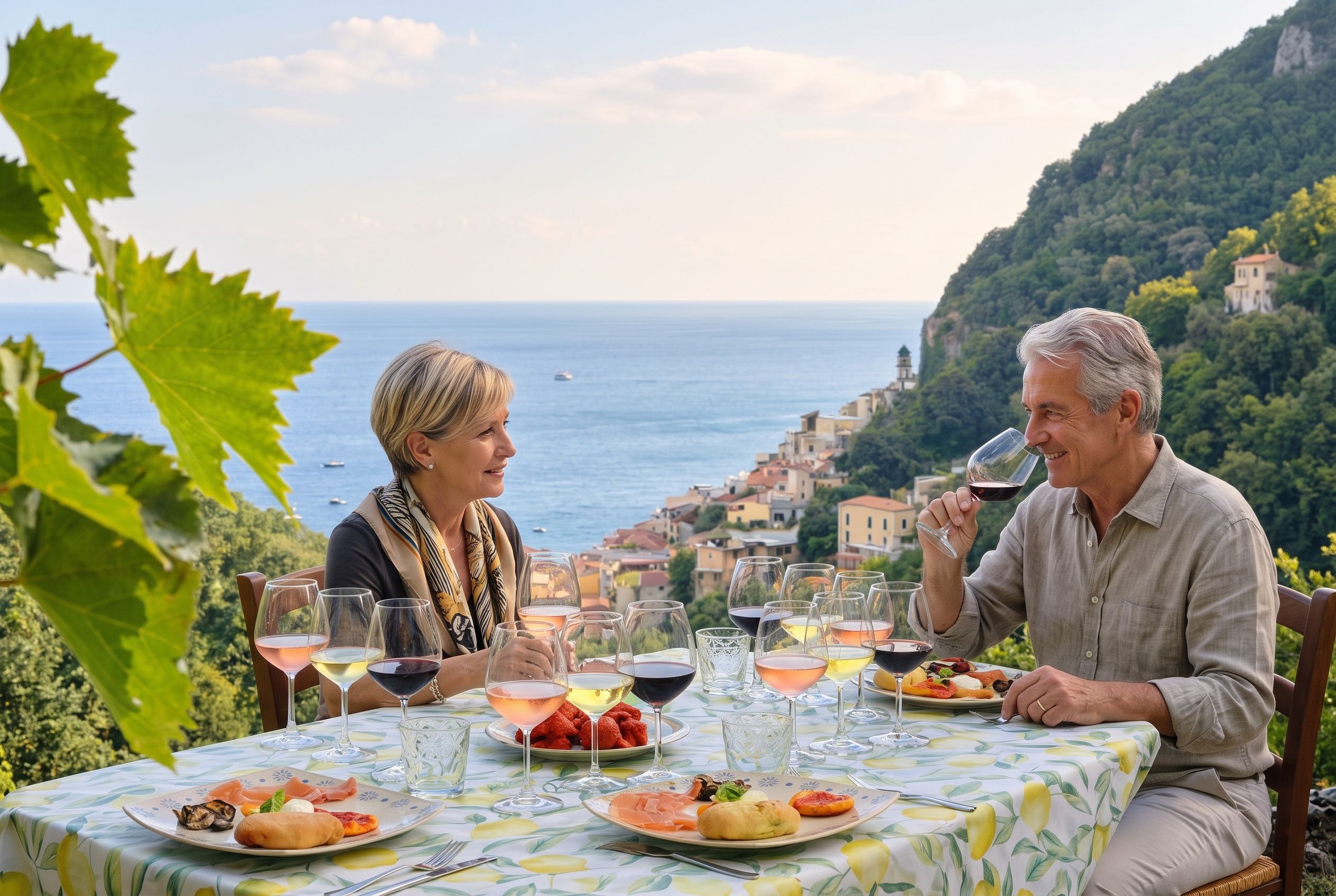 AI-edited
Where can you visit a lemon grove and taste limoncello?
Amalfi town has two well-documented options: the Amalfi Historical Garden, reached by a short climb up stone steps, and the Amalfi Lemon Experience at Via delle Cartiere 59. Both combine a grove visit with a tasting, and both run about an hour and a half.
The Amalfi Historical Garden publishes its lemon tour as a visit to the historical lemon groves and a limoncello lab, with time to relax on the panoramic terrace, lasting one hour and 30 minutes. Guests aged 18 or over can have a small tasting of its limoncello free of charge. At the Belvedere Terrace, the tasting includes a 100% organic lemonade and an Amalfitan lemon cake, and the garden also hosts a small Museum of the Peasant Civilization.
The Amalfi Lemon Experience runs a classic lemon tour starting directly from its farm at Via Delle Cartiere 59 in Amalfi, lasting about an hour and a half, priced at €30 per guest. Children from 2 to 10 pay €15, and children up to 2 are free. The tour includes a walk among the lemon groves, a break with typical products such as lemonade and lemon pie, a visit to the farm, and a visit to the Museum of rural culture, arts and crafts. Products and fresh lemons can be bought in the factory, with the possibility of having them delivered to your home.
How much walking and how many steps are involved?
This is the section to read carefully. The groves are terraced and steep by nature, and the operators say so plainly. The Amalfi Historical Garden is reached by a short and scenic climb up traditional stone steps from town. The Amalfi Lemon Experience states that its tours are not suitable for those with health or mobility problems as some of the tour is uphill.
The Amalfi Historical Garden notes that there are no concrete roads or platforms into its gardens and under its lemon trees, which tells you the terrain is agricultural rather than paved. It also states that it is reachable on foot from the main ferry dock and bus station.
The Amalfi Lemon Experience publishes a materially easier arrangement for reaching the groves: the meeting point in central Amalfi is on the main street, in the small clearing between Via Cardinale Marino del Giudice and Salita dei Patroni, about a 5-minute walk from Amalfi Cathedral, and from there guests are taken by electric cart to Salita Chiarito 1. That reduces the climbing considerably compared with walking up. The operator also states there is no parking on site, so arriving on foot or by arranged transport is the practical option.
A third operator, the Amalfi Monumental Garden, states that its tour is not suitable for people with mobility or heart problems due to the difficulty of the route, which it gives as approximately 200 steps. A fourth listing, the Lemon Trail tour, states that the path includes real steps, is not suitable for people with mobility impairments, and is not suitable for people over 95. One traveller quoted on that listing described about 600 steps from the drop-off point to the farm area, and noted an option to take a small shuttle from near the big church area for about €1 and then walk the last stretch of roughly 200 metres.
Which option works as a relaxed, largely seated outing?
The most seated-friendly format is a scheduled tour that uses a vehicle transfer to the grove and places the tasting at the end. The Amalfi Lemon Experience publishes an electric cart from central Amalfi to the grove, and both Amalfi town operators finish with a tasting on a terrace or in the garden.
Guest feedback gathered across the review platforms supports this pattern. Reviews of the Amalfi Lemon Experience repeatedly describe the guides as knowledgeable and passionate, covering the history of the family farm, organic growing methods and the regional lemon industry, and the tour ending with a tasting of house-made lemonade, lemon cake and limoncello. The same review set notes that the walk through the groves is mostly uphill with many stairs and steep sections, and that several reviewers consider it difficult for those with mobility limitations. That is planning information, not a verdict: the tasting is the seated part, the grove walk is the moving part, and the two can be separated by asking.
"I thoroughly enjoyed learning about the science of growing lemons, the techniques that go into it, and different uses of all parts of the lemon. You get a snack in the middle of the tour which is just stunning surrounded by lemon trees." (Google, June 2026)
For a lower-effort version, the Amalfi Historical Garden publishes bookable experiences on its own site, including the Lemon Tour, a Lemon Tour & Light Lunch, and sensory experiences. The tasting element there is seated on the Belvedere Terrace.
What is the Path of the Lemons, and is it for you?
The Path of the Lemons is a rural walking route linking Ravello, Minori and Maiori through the terraces above the coast. It is a genuine walk, not a garden visit, and one operator describes it as about three hours, exposed with minimal shade.
One Amalfi Coast operator says the Path of the Lemons walk reveals coastal farm life and local farming technique above Minori and Maiori. The same operator states the hike is about three hours, is exposed with minimal shade, and recommends sunscreen, a sunhat, plenty of water and hiking shoes. It also says private hotel pick-up and drop-off is available on request for a surcharge and subject to availability. The route involves steps and ancient streets.
Costiera Amalfitana lists a guided tour to the Path of the Lemons with tastings as a 2.5-hour excursion through the Sentiero dei Limoni between Maiori and Minori, with a starting point in Maiori reachable by Travelmar ferries or SITA SUD buses. Another source describes the Sentiero dei Limoni between Maiori and Minori as an easy 1.5-hour walk showing the landscape of the lemon terraces. Sources differ on the duration and difficulty of this route; confirm the exact itinerary with the operator when booking.
For food-minded travellers who would rather taste than hike, this route is best treated as an alternative rather than a substitute. The Amalfi town garden visits deliver the same lemons, the same terraces and the same limoncello with far less exposure to sun and steps.
How do you arrange a lemon grove visit?
Book direct with the operator where possible. The Amalfi Lemon Experience requires booking in advance on its official website, and a Tripadvisor listing for the Authentic Amalfi Lemon Tour & Tasting in the Historical Garden notes that it is booked 62 days in advance on average, so book ahead.
Departure times are published rather than flexible. The Amalfi Lemon Experience publishes a scheduled classic lemon tour at 10:15am, with departure no later than 10:15. The Amalfi Monumental Garden publishes a start time of 11:00, with small groups of a maximum of 10 people and limited availability. The Amalfi Historical Garden does not publish a fixed departure time in its tour description.
Cancellation terms vary by operator and are worth checking before you commit. The Amalfi Lemon Experience listing states free cancellation up to 24 hours in advance. The Tripadvisor-listed Authentic Amalfi Lemon Tour & Tasting states that cancellation is possible with a full refund if cancelled in time, and that if the minimum group size is not met, a different date or experience or a full refund is offered. The Amalfi Historical Garden does not document cancellation terms on its tour page.
On access to Amalfi itself: the town centre has a car and scooter ban inside the city centre, and one operator strongly recommends avoiding arriving in Amalfi by car, especially during the high season. Salerno Costa d'Amalfi Airport is 46 km from Amalfi by road, about 65 minutes with clear roads and no stops. Amalfi to Maiori is 5.4 km by road, about 10 minutes with clear roads, and Amalfi to Minori is 4.2 km, also about 10 minutes with clear roads.
When is the best time to go?
Amalfi lemons are at their best from February to August, when the harvest period runs, according to the Amalfi Lemon Experience. A separate source gives the Limone Costa d'Amalfi IGP harvest as November to July, with a peak from February to May.
Living Amalfi sells the Amalfi Lemon Tour and the Limoncello production and states that the tour can be arranged every day all year round, lasting about 1 hour and 30 minutes.
For a food-minded traveller, the peak harvest months of February to May are the most interesting window: the groves are working, the fruit is being picked, and the tasting rooms are running at full pace. If you are planning around warm weather and smaller crowds, our guide to when to visit the Amalfi Coast for warm days and small crowds covers the wider seasonal picture.
One documented event worth noting: the event calendar reported an August 2026 lemon festival in Minori, with tastings, workshops and markets celebrating the coast's IGP lemon. Minori is 4.2 km from Amalfi by road, about 10 minutes with clear roads.
How do you buy the real thing?
Limoncello itself has no protected designation. What is protected is the fruit, so the question to ask is whether the bottle was made with IGP sfusato lemons. Check the label for Limone Costa d'Amalfi IGP or sfusato amalfitano.
A source on buying limoncello from the coast says one consortium regulates the sfusato amalfitano and that around 56,000 certified bottles of limoncello with sfusato amalfitano are produced each year. The clearest official buying lead in the material gathered is the Consorzio di Tutela Limone Costa d'Amalfi I.G.P. in Maiori, which regulates cultivation of the sfusato amalfitano. Packaged lemons, jams and limoncello should be checked for the blue-and-yellow Limone Costa d'Amalfi IGP logo to confirm authenticity.
Named places to look for local lemon products include Antichi Sapori d'Amalfi at Piazza Duomo 39 in Amalfi, which presents itself as a limoncello factory in the heart of Amalfi and offers a guided production visit with a tasting and snacks, and Amalfi Lemon at Via delle Cartiere 55-57.
One practical note from guest feedback on the Lemon Tour + Classic Cooking Class: a review context mentions that the downstairs shop had better prices than the tasting area for limoncello. That is a single review observation, not a published rate, and prices in Amalfi shops change with the season and the shop. Compare before you buy, and remember that the Amalfi Historical Garden offers its limoncello for private use with a small free tasting rather than a retail bottle programme on site.
What should travellers 50-70 know before booking?
Book ahead, ask about the transfer, wear proper shoes, and treat the grove walk and the tasting as two separate things. The operators publish their terrain honestly, and the information is there to be used.
On mobility: no retrieved official or operator page states full step-free access for the lemon groves themselves in Amalfi. The grove terrain remains terraced and steep in the standard-tour descriptions. One separate recorded offering describes an accessible limoncello tasting for the Amalfi Coast and Naples area, explicitly designed for wheelchair users and offering an accessible transfer with a vehicle equipped with a lift, described as a half-day private experience from 75 euros. That is a different product from the grove tours, and it is the only clearly documented accessible option in the material.
the nearest pharmacy, medical help and formal safety staffing are not documented for these exact places in the sources. Our guide to health, pharmacies and peace of mind on the Amalfi Coast covers the wider picture. The Path of the Lemons operator recommends sunscreen, a sunhat, plenty of water and hiking shoes for its exposed route.
On senior fares: no senior or over-65 fares are documented on the official pages surfaced for these Amalfi Coast lemon and limoncello experiences. A private Path of the Lemons product page on a reseller site mentions discounted rates for seniors aged 65 and above and for students with valid ID, but that appears on a reseller page rather than an operator site, so treat it as unconfirmed and ask when booking.
On closures: no retrieved source documents closure days or maintenance shutdowns for the exact Amalfi lemon grove or limoncello experiences. One operator page, amalfilemontour.com, states every day except Sunday, but that is a single page and does not cover the other operators.
On the wider coast: the SS163 Amalfitana had temporary closures and bus-route adjustments for bridge repairs in Cetara, and a metro-style bus network was reported as starting on 11 April 2026 for the Amalfi Coast. Both affect how you reach Amalfi, not what happens once you are in the grove.


