
Ubud's sacred sites sit close together, and that is their great advantage for older travellers. The Ubud Palace, Pura Taman Saraswati and the Sacred Monkey Forest Sanctuary form a central cluster that can be visited on foot across a single unhurried day. Goa Gajah and Tirta Empul lie outside town and need a vehicle, but both reward the journey with living ritual rather than museum display. What follows is a practical guide to what each site offers, what to wear, what it costs, and which are easiest underfoot.
The town works best in the morning. Published guidance for the palace recommends arriving between 08:00 and 10:00, when temperatures are cooler and mid-day crowds have not yet gathered (https://ubud-palace.com/travel-guide). That same rhythm suits the whole town: sightseeing early, rest through the afternoon heat, and go out again later in the day.
Which temples and palaces are within reach of Ubud?
Three sacred sites stand in central Ubud within roughly 1 km of one another: the Ubud Palace, Pura Taman Saraswati and the Sacred Monkey Forest Sanctuary. Two more, Goa Gajah and Tirta Empul, lie outside town and require transport. Goa Gajah is about 4 km south-east in Bedulu; Tirta Empul is about 20 km north-east in Tampaksiring.
The central three are the practical core. Ubud Palace stands at the junction of Jalan Raya Ubud and Jalan Monkey Forest, and the walk from the palace to the Monkey Forest is approximately 1.5 km, or about 20 minutes along Jalan Monkey Forest. Saraswati Temple is reached from Jalan Kajeng, just off Jalan Raya Ubud.
For the two outlying sites, plan on a car. Published access guidance recommends a vehicle for Goa Gajah rather than treating it as a central walking link (https://www.baligenie.com/places/ubud/walking-and-access/). Indonesia's tourism portal puts Tirta Empul about 30 minutes from Ubud by car or tour. Travellers' reports vary widely on the Tirta Empul drive, from roughly 45 minutes each way to an hour or more in traffic, so build slack into the day.
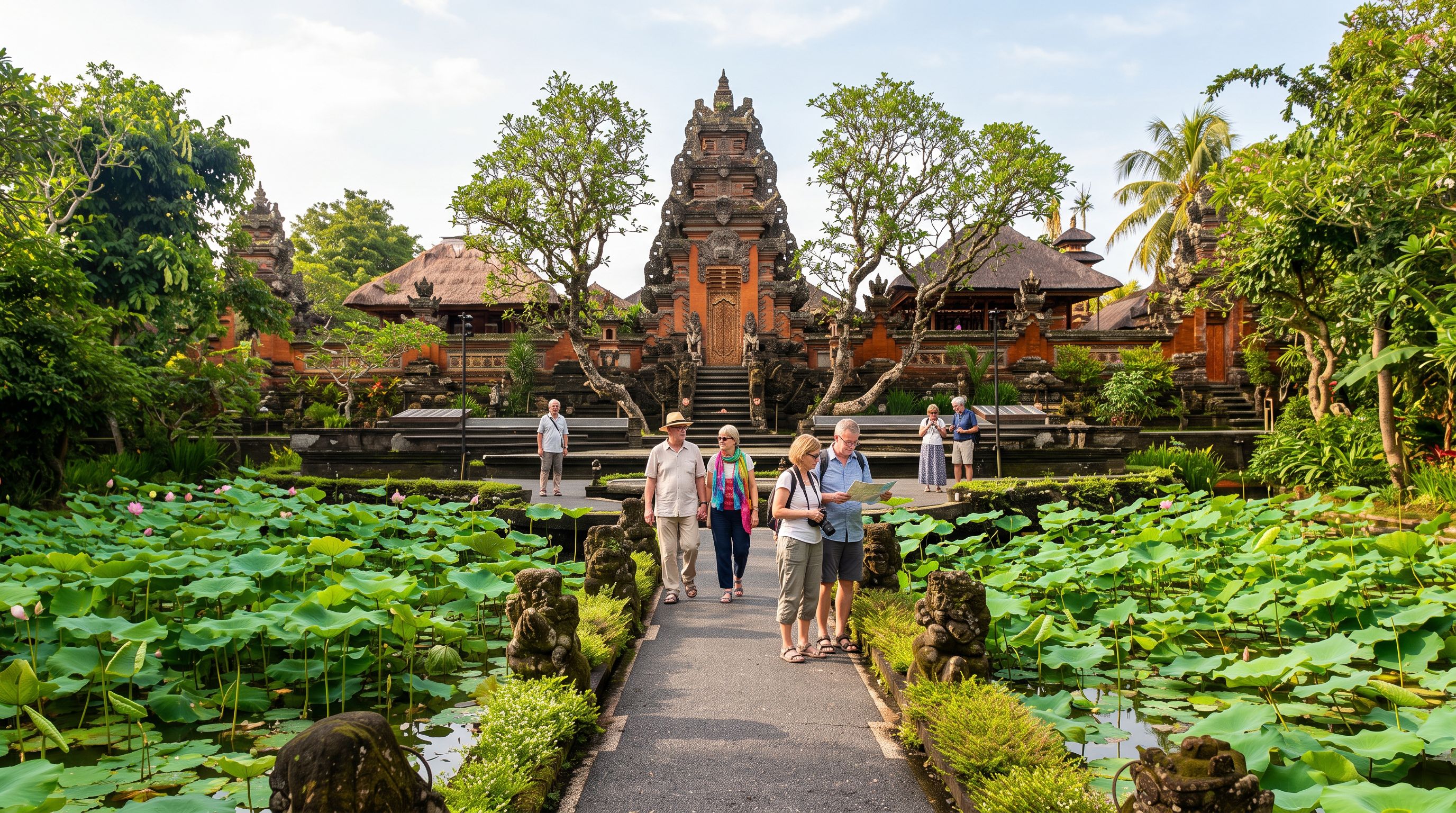 AI-edited
What can you see at Ubud Palace, and is entry really free?
Yes. Daytime entry to the outer courtyards of Ubud Palace is free, and the grounds are open daily from 08:00 to 18:00. The palace is a working royal compound, so only part of it is open. Evening dance performances are ticketed separately, at around IDR 100,000.
The open section is compact. The palace's own travel guide describes the grounds as occupying less than half a hectare, with a perimeter walk of about twelve minutes and a typical visit of 30 to 60 minutes. Red brick walls rise to open-air pavilions with carved wooden columns and gilt detailing. The operator notes that pre-war Balinese craftsmanship here is rarely seen outside museum collections.
Guest feedback collected on Google is consistent on one point: the grounds feel calm despite the busy location, and the site is clean and well maintained. The same reviews note that signage explaining the buildings is limited, and that daytime crowds can be heavy. As of October 2026, Ubud Palace holds a Google rating of 4.3/5 from 20,830 reviews.
"Beautiful place, here you can explore old Ubud, free entrance. There is a restaurant inside and some shows in the evening." (Google, 5/5, August 2026)
For the evening Legong dance, the operator lists a 1 hour 30 minute performance at IDR 100,000. Seating is limited, and reviewers advise arriving 30 to 60 minutes early. The operator's dress-code page says audiences sit on wooden benches for around two hours in the open air, so breathable fabrics that still meet the coverage rules are the sensible choice.
What are the sarong and dress rules at each site?
Cover your shoulders and knees at every temple ground, and expect a sarong and sash at the major temples. Saraswati lends both free at the entrance. Tirta Empul requires a sarong. Ubud Palace does not supply sarongs for casual daytime courtyard visits, so dress modestly before you arrive.
The rules differ by site, and it is worth knowing them before you set out.
- Ubud Palace: The operator states that sarongs are not mandatory for the outer courtyards during daytime visits, but modest attire is enforced. The palace does not supply sarongs at the entrance for casual daytime visits, so arriving in appropriate clothing is essential. Footwear is permitted throughout the courtyards; shoes come off only at covered pavilions marked by stone thresholds.
- Pura Taman Saraswati: Published guidance requires a sarong and sash, and the entrance is reported to lend them free of charge.
- Tirta Empul: A sarong is required, and published guidance says clothing should cover the shoulders and knees (https://www.ubudcenter.com/).
- Sacred Monkey Forest: Visitors normally see the three working temples from the paths and do not enter their courtyards, so the sanctuary is less demanding on temple clothing.
Published Ubud guidance also says that women who are menstruating should not enter inner temple areas, a restriction specifically noted for Tirta Empul and Saraswati (https://www.ubudcenter.com/saraswati-temple-ubud/). Inner sanctums are generally reserved for worshippers, and sites can restrict tourist access during ceremonies. Follow the notice at the individual entrance rather than assuming every courtyard carries identical rules.
Is Saraswati Temple the temple on the water, and how long does it take?
Saraswati is the Ubud temple on the water: a lotus pond leads toward red-brick entrance gates, and the forecourt hosts dance performances. The grounds are small. Visitors typically spend 10 to 30 minutes, and published visitor information gives daily hours of 7:00 to 17:00, except when ceremonies restrict access.
The site is dedicated to Saraswati, the goddess of learning, and the lotus pond is the principal visual feature. Seating areas overlook the ponds, and a neighbouring café does too, which makes this the easiest of the central sites for a rest between stops.
Entry fees need checking at the gate. One published listing gives no entrance fee while welcoming donations. Another gives IDR 65,000 for international adults and IDR 50,000 for international children. A third tariff page records IDR 35,000 for foreign adults and IDR 20,000 for foreign children, with a sarong and sash loan noted. Because that tariff was not found on the temple's own official site, confirm the price when you arrive.
Guest feedback on Google describes entry including loaned traditional attire, sometimes with a free welcome drink or a small chocolate. The same reviews note that the loaned attire is shared between visitors, can be damp or unwashed, and comes in limited sizing. As of October 2026, Saraswati Temple holds a Google rating of 4.2/5 from 5,497 reviews. Visitors cannot enter the inner temple itself; only the front garden and lotus pond area are open.
"This place is beautiful! The entrance fee also included the traditional dress and they provided free juice (orange&watermelon) as well. This pura did not big you can walk+taking picture and end this trip in 15 minutes." (Google, 5/5, April 2026)
Is the Sacred Monkey Forest easy to walk, and what does it cost?
The main circuit is the easiest substantial walk of the group: paved, wide and mostly level, with plentiful shade and benches. The sanctuary's own visitor page lists adult admission at IDR 130,000 and child admission at IDR 100,000, with daily opening from 09:00 to 18:00 and last admission at 17:00.
The sanctuary holds three working temples rather than theatrical replicas: the Main Temple, the Holy Spring Temple (also called Beji Temple) and the Cremation Temple. Visitors normally see them from the paths.
One route needs a warning. The ravine route descends a long, steep, mossy staircase and can be slippery, and the ravine, dragon bridge and Pura Beji area involve steeper, damp steps. The sanctuary's published description calls this route beautiful but optional. For anyone who wants shade, regular stopping places and a manageable surface, the main circuit is the better choice.
The official visitor information does not publish a step-free circuit, route distances, benches by route, wheelchair hire or an escort service. Ask at the entrance if you need to know more. Keep to the paths, do not feed the monkeys, and avoid staring directly at macaques.
What is at Goa Gajah, and how do you get there?
Goa Gajah is an archaeological and religious site about 4 km from central Ubud in Bedulu, combining a cave entrance carved with a demonic face, a cave associated with a Shiva lingam, and ancient bathing pools with carved water spouts. Published Ubud information lists admission at IDR 50,000, and another account gives hours of 8:00 to 18:00.
Indonesia's tourism portal lists adult foreign admission at IDR 50,000 and children at IDR 25,000, with Indonesian rates of IDR 30,000 for adults and IDR 15,000 for children (https://www.indonesia.travel/de/de/travel-ideas/heritage/6-must-visit-temples-in-bali-to-experience-bliss). Sarongs are handed out at the gate.
Underfoot, the carved cave entrance, bathing pools and surrounding archaeological area require walking on uneven ground. The available published information does not document a reliable number of seats or a continuous shaded path. This is the site to visit with a driver waiting, and with shoes that grip.
How does the purification ritual at Tirta Empul work for visitors?
Tirta Empul is a holy-spring temple in the Pakerisan watershed, about 20 km north-east of Ubud in Tampaksiring. Its spring feeds 30 ritual bathing fountains used for melukat, the Balinese purification ceremony. Visitors may watch the ritual from dry ground without entering the pools.
Entry costs IDR 75,000 for adults and IDR 50,000 for children aged 5 to 12, free for children under 5, following a fee update on 1 January 2025. Visitors pay on arrival, and the temple is open daily from 7 AM to 6 PM (https://tirtaempul.com/). Some published information still lists IDR 50,000, so carry a little extra.
The courtyards are described as sufficiently level for viewing, but the purification pools require steps down into the water, which is described as algae-slicked. The pools, changing arrangements and movement between water spouts require additional walking and standing. A fully step-free route, lifts, seating provision and an assistance service are not documented.
Timing matters more here than anywhere else on this list. One source recommends weekday morning visits and reports that waits can exceed 90 minutes by 10 a.m. in high season, with weekend waits doubling in the peak dry season. The formal bathing routine is intended for pilgrims and devotees, not casual sightseeing. If you take part, bring a change of clothes, wear appropriate traditional attire beneath the required covering, and note that soap and shampoo are not permitted in the pools.
Which sacred sites are easiest underfoot for older visitors?
The Sacred Monkey Forest's main circuit is the easiest substantial walk, followed by the compact Ubud Palace courtyards and the short, central approach to Saraswati Temple. Goa Gajah and Tirta Empul are the least suitable for anyone seeking a consistently level route, and neither publishes step counts.
Central Ubud has its own obstacle, and it is not inside the temples. The town pavements can include missing slabs, open drains, sudden steps and parked scooters. A Fodor's forum discussion warns of considerable uphill and downhill walking, with narrow or badly maintained pavements outside the centre and hazardous conditions after dark. The palace is central but not necessarily easy underfoot: the surrounding pavements, rather than the palace itself, are the main reported obstacle.
Published information does not provide a reliable, exact step count for Ubud Palace, Saraswati Temple, Goa Gajah or Tirta Empul. For Saraswati, one guide records about 10 steps. For the Monkey Forest, the ravine is specifically described as a steep staircase, but no official number of steps is published.
If mobility is limited, ask your driver in advance about the final drop-off point. Temple approaches may involve steps, narrow paths, or a walk from a road where vehicles cannot stop directly. A practical itinerary should also allow for wet or slippery surfaces during rain, especially at the forest, cave and spring sites.
For a wider look at pacing a stay around these sites, see our complete guide to Ubud for travellers over 50, and for somewhere quiet to return to afterwards, our selection of Ubud hotels where comfort comes first.
What does a temple visit cost, and what should you carry?
Central entry is cheap or free: Ubud Palace and Saraswati cost nothing or a modest gate fee depending on the listing, the Monkey Forest is IDR 130,000 for adults, and both outlying sites sit around IDR 50,000 to IDR 75,000. No senior concession or combined pass is documented for any of the five.
Prices can change, and some local temple charges or parking fees may be collected separately. Carry small rupiah notes, particularly outside the main commercial attractions (https://boardinggate.io/bali-temples/).
International visitors also pay a separate Bali-wide visitor levy of IDR 150,000 through the provincial Love Bali system. That is not an admission ticket to any one temple.
No verified senior or over-65 concession, combined pass covering these five sites, or reduced-mobility tariff was documented in the retrieved sources. No regular closing day was documented for Ubud Palace, Saraswati Temple, Goa Gajah or Tirta Empul.
For emergency numbers, Bali visitor guidance lists 112 for police, ambulance or fire, 110 for police specifically, and a Bali Tourist Police hotline of +62 361 224 111. No cited source identifies a nearest pharmacy or clinic for any of these exact sites.
How should you plan a day around Ubud's sacred sites?
Start early, group the central three on foot, and give the outlying two their own half-day with a car. Morning visits are preferable for heat and crowd management, though no formal seasonal timetable for Ubud's temples is documented.
A workable shape: Ubud Palace at opening, Saraswati Temple next while the light is still low, then the Monkey Forest main circuit before the heat peaks. The palace, Saraswati and the upper Monkey Forest Road lie within roughly 1 km of one another. A 2025 trip report describes combining a walk through the Monkey Forest with the palace, the water temple and the market on the same day.
Keep the outlying sites separate. Goa Gajah and Tirta Empul each need a vehicle and a driver who knows where to drop you. Tirta Empul's weekday morning window is the strongest documented recommendation; the period after 10 a.m. in high season is the one to avoid.
If you want to build wellness into the trip, our guide to wellness and yoga retreats in Ubud covers the options. And if your travels take you further afield in Southeast Asia, our piece on riverside dining in Hoi An makes a useful companion read.
One last piece of context. Recent reporting identifies a proposed underground rapid-transit system for Bali, with Ubud included only in a later planned phase. For now, the car and the pavement remain how these sites are reached, and neither is documented as step-free.


