
Chiang Mai eats differently from the rest of Thailand. The northern kitchen leans on ginger, turmeric and fermented soybean rather than the coconut-heavy curries of the south, and the signature dishes are served with sticky rice rather than steamed jasmine. For food-minded travellers aged 50-70, the city rewards a slow, curious approach: a bowl of khao soi before noon, a market wander in the afternoon, and a willingness to ask how hot the nam prik really is. This guide covers the dishes worth seeking out, the markets and kitchens where locals eat them, and the practical rhythm of eating well here without a long walk or a late night.
What food is Chiang Mai famous for?
Chiang Mai is best known for khao soi, a coconut-curry noodle soup topped with crispy egg noodles, and for a northern repertoire that includes sai ua sausage, nam prik ong and gaeng hang lay. Michelin describes the city as a place for authentic Northern Thai classics such as khao soi and nam prik ong.
Khao soi is the dish most consistently named in coverage of the city, and it is the one most travellers are told to try first. A bowl arrives with chicken or beef, a tangle of soft and crispy noodles, and a small plate of lime, pickled mustard greens, shallots and chili paste to adjust at the table. National Geographic notes that the Muslim quarter is home to what it calls the city's most famous dish, and points to long-running vendors in the Fa Ham area that have served bowls for decades.
Sai ua, the northern herb sausage, is the market staple most often listed alongside khao soi. It is coarsely textured, scented with lemongrass and kaffir lime, and sold grilled by the length at markets across the city. Nam prik ong, a tomato-and-pork chili dip, and nam prik noom, its green chili cousin, are the two dips most frequently cited as northern essentials, both eaten with sticky rice and raw or blanched vegetables.
Gaeng hang lay, a Burmese-influenced pork belly curry with ginger and tamarind, appears repeatedly in Chiang Mai food guides. Food writing about the city is consistent that this northern menu is milder and more aromatic than southern Thai cooking, though "milder" is a relative term, and the chili dips are where the heat actually lives.
 AI-edited
Where should you try khao soi?
Several long-established khao soi shops are named repeatedly across food guides and traveller forums, including Khao Soi Khun Yai, Khao Soi Mae Sai, Khao Soi Lung Prakit, Khao Soi Mae Manee and Khao Soi Samerjai. Most are lunch-only, and the best-known sell out well before mid-afternoon.
Khao Soi Khun Yai, in the Old City area, is repeatedly singled out as a standout stop. As of October 2026, it holds a Google rating of 4.6 out of 5 from 2,949 reviews. Guest feedback gathered across those reviews describes the broth as rich, fragrant and coconut-forward, with tender chicken, beef and pork, and staff who are friendly and quick, often bringing food within a couple of minutes of ordering. Ordering is done at the counter with payment upfront. The shop serves from 10am to 2pm and frequently sells out of items, sometimes before 1pm, so arriving early is the practical move. Seating is limited and shared, with queues forming before opening, and the outdoor area has fans, shade and pigeons that walk between the tables.
"This place feels less like a restaurant and more like someone's backyard kitchen that accidentally became really good at feeding people. You order at the counter, pay upfront, grab a seat, and when you're done, you simply leave." (Google, June 2026)
Khao Soi Mae Sai is described as Michelin-listed and, in traveller accounts, priced under 100 baht, with the chicken leg praised as tender enough to fall off the bone. Khao Soi Lung Prakit is presented as the old-school choice, using a traditional recipe that some locals grew up with. Khao Soi Mae Manee is noted for a richer flavour profile, with the beef version specifically recommended. Khao Soi Samerjai has drawn regulars since the 1980s, according to one traveller account, and also serves pork satay.
Each shop has its own twist, and tasting several versions before settling on a favourite is part of the pleasure. The Michelin Guide's Chiang Mai entries show that well-known khao soi addresses are spread across Mueang Chiang Mai District, not just the compact core of the municipality, so a short taxi ride may be part of the plan. For an overview of which neighbourhoods suit a longer stay, see our guide to choosing your base in Chiang Mai.
How much does food in Chiang Mai cost?
Travellers report local khao soi at roughly 50 to 80 baht a bowl, while tourist-area versions can run 100 to 200 baht or more. These are forum and review figures rather than published menu rates, so treat them as indicative and expect variation by season and venue.
The gap matters. Several travellers say the best versions come from breakfast and lunch places where locals queue, and that bowls in heavily touristed areas cost more and can be hit-or-miss. Khao Soi Mae Sai is described in traveller accounts as Michelin-listed and under 100 baht. No published rate card exists for most of these shops, so the figures above are what diners report paying rather than what the kitchens advertise.
Markets and food courts are repeatedly named as the best-value route. A bowl at a market stall or a mall food court costs less than a sit-down restaurant version, and the portions are sized for a quick meal rather than a long one. At Central Airport Mall, one traveller notes there are a couple of stalls offering khao soi, and advises choosing carefully and looking for the Michelin guide sign.
Rates across the city are indicative and vary by season and booking channel, and food is no different. The cool season, roughly November to February, is peak season with higher prices and larger crowds. The rainy months, roughly June to October, are generally cheaper and quieter. No source provides a verified cost comparison between Chiang Mai and Bangkok, or a reliable answer to whether 10,000 Thai baht covers five days, so those questions are best answered by checking current prices close to travel dates.
Where do local Thai people eat?
Warorot Market, Chiang Mai Gate Market and the student strip near Chiang Mai University's back entrance are the areas most often named for everyday northern eating. Warorot, known locally as Kad Luang, sells sour pork, northern spicy sausage and chili paste from morning to evening.
Warorot Market is documented by the Thailand Tourism Directory as selling local foods including sour pork, Northern Thai spicy sausage, Vietnamese-style sausage and chili paste, and it opens from morning to evening. It is repeatedly identified as a strong place to sample northern Thai snacks and regional foods. For travellers who want to see the ingredients before they eat them, this is the market to walk first.
Chiang Mai Gate Market, on the south side of the Old City, is described as a major shopping venue for fruit, vegetables, meat and fish, with numerous food stalls nearby. One traveller account calls it really good and notes that, despite being touristy, the food is legit, with khao soi and soy-braised pork leg specifically mentioned.
The Suthep Road area near the back entrance of Chiang Mai University, known as Lang Mor, is described by travellers as a cheap, student-price street-food strip with plenty of choices, including northern dishes. The official provincial tourism page also points to the Saturday and Sunday markets and names market foods such as kanom jeen nam ngeaw and kanom jeen namya, both fermented rice noodle dishes served with fish-based broth.
For a fuller sense of how the city pairs its temples with its tables, the official Chiang Mai tourism material presents the Old City as a showcase of both cuisine and culture, and the Tourism Authority of Thailand's Chiang Mai pages are a useful starting point for planning a day that combines the two.
What should you know about the Sunday Walking Street?
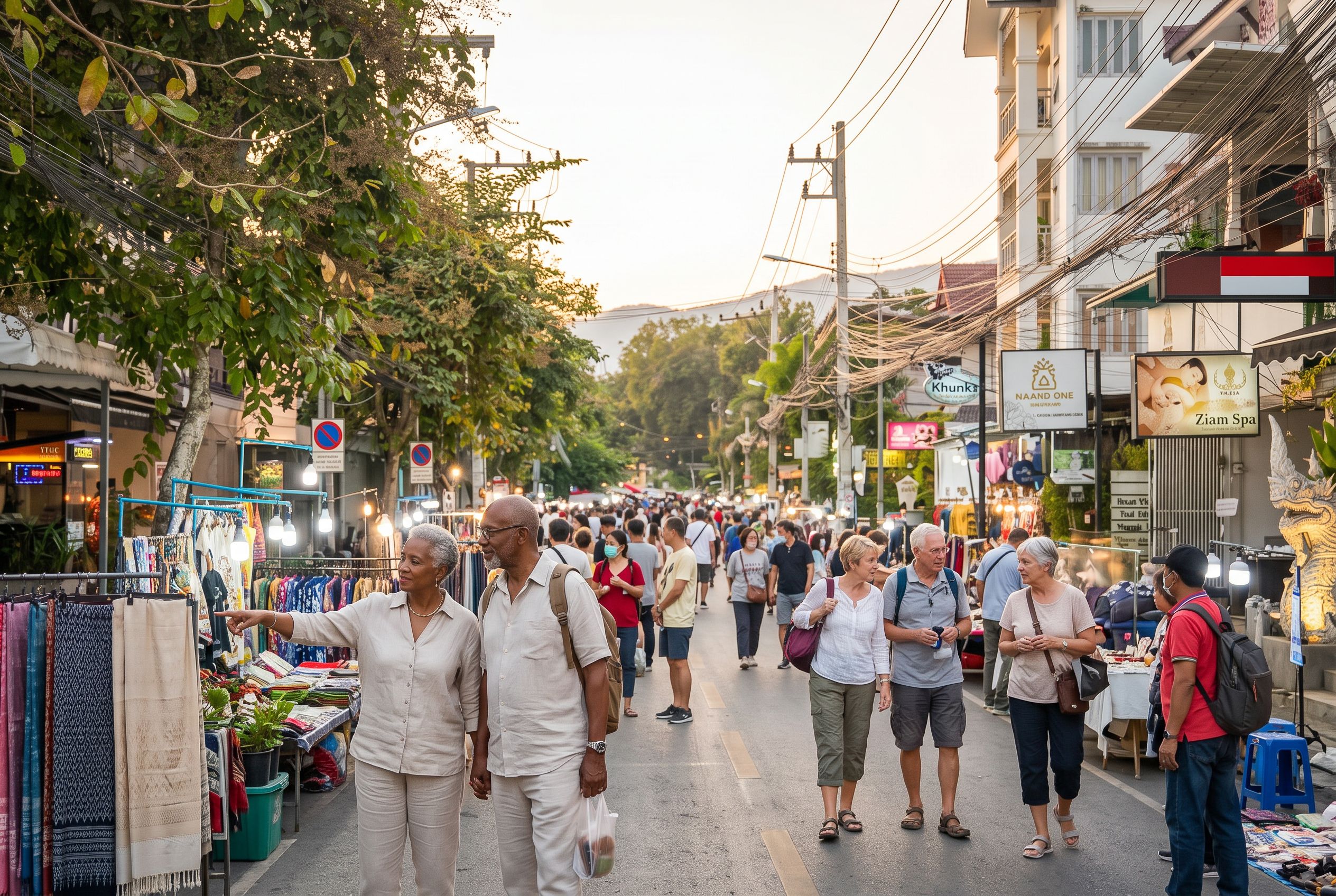
The Sunday Walking Street on Ratchadamnoen Road runs Sundays from 16:00 to midnight and is free to enter. It stretches from Tha Pae Gate through the Old City centre to Wat Phra Singh, with side streets and temple courtyards also used by vendors.
The market is described as a weekly pedestrian event with cultural performances, artisan demonstrations and temple blessings alongside the food stalls. Vendors sell northern Thai market foods, and coconut pancakes and other local snacks appear in coverage of the area. It is the clearest documented high-density zone in the city: a kilometre-long pedestrian market with hundreds of stalls and performances.
For travellers 50-70 who want the food without the crush, the practical approach is to arrive close to the 16:00 opening, before the evening peak, and to eat early rather than late. The market is free to enter and requires no booking.
If a quieter evening is preferred, the same northern dishes are available at the city's permanent markets and at food courts in malls such as Maya Mall and Central Airport Mall, where khao soi can be found without a long walk through crowds. Guests at several Old City hotels have noted that Sunday market music carries into nearby rooms, so a room away from Ratchadamnoen is worth requesting if you are staying in the centre over a weekend. Our curated guide to Chiang Mai for the over-50s covers the wider cultural circuit.
How do you gauge the spice?
Northern Thai cooking is generally milder and more aromatic than southern Thai food, but the heat sits in the chili dips rather than the noodles. Nam prik ong and nam prik noom are the two dips to approach cautiously, and khao soi arrives with its chili paste on the side.
This is the single most useful thing to understand about eating in Chiang Mai. Khao soi is served with a small plate of condiments, including chili paste, so the diner controls the heat. The broth itself is rich and coconut-forward rather than fiery. The nam prik dips are a different matter: they are the chili-forward element of the northern table, eaten in small spoonfuls with sticky rice and vegetables rather than in quantity.
Sai ua is herbaceous rather than hot, though some versions carry a background warmth. Gaeng hang lay is aromatic and gently spiced, built on ginger and tamarind rather than chili. Larb, the minced meat salad, can be ordered mild or hot depending on the kitchen, and it is worth asking.
The practical phrase to learn is "mai phet" (not spicy), though in a northern kitchen this usually means less chili rather than none. At market stalls, pointing and asking is entirely normal, and vendors are accustomed to adjusting. For travellers who want to taste broadly without overwhelming the palate, ordering sticky rice alongside the dips lets you control each bite.
What practical details should you plan around?
Chiang Mai is a year-round city, but the cool season from November to February is the most comfortable for market eating, with December and January the driest and coolest months. The rainy season runs roughly June to October, and April is typically the hottest month.
Daytime temperatures in the cool season are often around 28 to 32°C, with city nighttime lows around 13 to 16°C, so a light layer is useful for early morning khao soi runs. April can see daytime highs above 35 to 38°C, which makes a midday market walk less appealing. The burning season overlaps late winter into spring and can affect air quality in the valley; the Chiang Mai safety guide covers this alongside emergency numbers.
Emergency numbers documented for Chiang Mai are 191 for police, 1669 for ambulance and medical emergencies, 199 for fire, and 1155 for the Tourist Police. The 1155 line is staffed with English-speaking operators around the clock and can coordinate the right service. Private hospitals cited for the city include Bangkok Hospital Chiang Mai and Chiang Mai Ram Hospital, and one guide notes that a taxi to a private hospital may be faster than waiting for an ambulance in some situations.
On mobility, a senior travel guide describes the Old City as flat but notes that sidewalks are uneven and sometimes obstructed, and that major temples are mostly step-free at ground level, with some upper terraces involving stairs. For a gentler introduction to the city's wellness side, see our guide to Thai massage in Chiang Mai for the over-50s.
What has changed on the Chiang Mai food scene recently?
A 2025 Chiang Mai restaurant guide reports that several well-known places have permanently closed, including Artisan Cafe, Kiat O Cha, Tong Tem Toh, Huen Phen, Ginger Farm Kitchen, H365, Mondae Cafe & Brunch and My Secret Cafe in Town. The scene continues to refresh, with new openings such as LaLarb-LaLoung in January 2025.
This is the strongest recent signal for anyone planning a food trip: classic names can disappear, so current opening hours and status need checking close to travel dates. The khao soi shops named in this guide are long-established, but even those close when the pot empties, and a shop that was open last season may not be open this one.
The Michelin Guide maintains a Chiang Mai dining section that is updated as the scene changes, and it is worth consulting before a trip. The Michelin Guide's Chiang Mai dining coverage lists current entries and is a reliable check on which addresses are still trading.
For travellers who prefer to plan around confirmed openings, the practical approach is to shortlist three or four khao soi shops and two markets, then verify each one in the week before travel. No source documents closing days or maintenance closures for the city's food areas, so a quick check by phone or a recent review is the sensible precaution.
How do you get to Chiang Mai and around the food areas?
Chiang Mai is served by its international airport, and the city's food areas are spread across the Old City, Nimman, Warorot Market and the Suthep Road strip. A light rail line is planned but not yet built, with a 2028 construction start and 2031 opening in the timeline cited.
The Chiang Mai Mass Transit Red Line is being pushed forward as a 15.8 km light rail line from Nakhon Ping Hospital to Mae Hia Samansamakkee Junction, with 16 stations and two park-and-ride sites. The project is still working through environmental and investment approval, so it will not affect travel plans in the near term. The transport ministry has also proposed studying an underground tunnel in the city core because of concerns about impacts on historical sites.
In the meantime, the practical way to move between food areas is by taxi or a short ride-hailing trip. The Old City is walkable for those comfortable on uneven sidewalks, but the khao soi addresses most praised are spread across Mueang Chiang Mai, Nimman, Huay Kaew Road, Suthep and Doi Pui rather than clustered in one spot. For travellers arriving on a long-haul flight, our guide to getting to Chiang Mai and onward transfers covers the arrival logistics.
For those who prefer comfort and less walking, food courts in Maya Mall and Central Airport Mall offer khao soi and other northern dishes in air-conditioned settings.


