
Chiang Mai rewards a slower rhythm. The old urban core is compact and, by the standards of most Thai cities, relatively flat, which makes it one of the easier places in the region to plan a five-day stay around a single base. The city was erected in 1296 as the capital of the Lanna Kingdom, according to UNESCO's Creative Cities Network page, and that long history sits within a walkable square of temples, cafés and markets.
This itinerary keeps one hotel for all five nights. No daily repacking, no long transfers. Mornings carry the sightseeing, the middle of the day is for rest and air conditioning, and the late afternoon opens again for markets or a short outing. One hill temple and one day trip are offered as add-ons for travellers who want them, not as obligations. Hotel selection and budgeting are covered in their own dedicated guides.
Why does one base work better than moving around?
The Old City is the easiest area for slow walking because it is flat and compact, and the key temples sit close enough together that a guided walk linking Wat Chedi Luang, Wat Phan Tao and Wat Phra Singh takes about three hours in total, of which only around 20 to 30 minutes is actual walking. Staying put removes the packing, the transfers and the fatigue.
Sidewalks in Chiang Mai are often narrow, uneven or obstructed, and pavement ramps are not always usable. That is the honest picture: the Old City is the flattest area, but flat does not mean smooth. Comfortable shoes with grip matter more here than in most city breaks.
Nimmanhaemin, usually shortened to Nimman, is the other practical base. It is repeatedly described in traveller forums as a good area for cafés, shopping and malls, with easy indoor breaks when the heat peaks. If you prefer a modern, air-conditioned base over a temple-adjacent one, Nimman works. The Old City wins on proximity to the sights.
When should over-50s visit Chiang Mai?
November to February is the cool season, roughly 15 to 25°C, and it is also peak tourist period in Thailand. March to May runs about 30 to 37°C. June to October is the rainy season at around 24 to 32°C, with greener scenery and fewer visitors. Late January to mid-April is the window to avoid if smoke is a concern.
One Chiang Mai safety guide warns that from late January to mid-April smoke can become heavy in the valley and can be especially hard on people with asthma, heart conditions or older travellers. March and April can also see worsened air quality from agricultural burning. If clear skies matter to you, plan around that window rather than within it. Our guide to when to visit Chiang Mai for comfortable weather and clear skies goes deeper on the month-by-month picture.
The cool season is the obvious choice for a first visit. Mornings are genuinely cool, which is exactly what this itinerary is built around: outdoor time early, rest through the middle of the day, gentle activity again in the late afternoon.
Day 1: How do you start gently in the Old City?
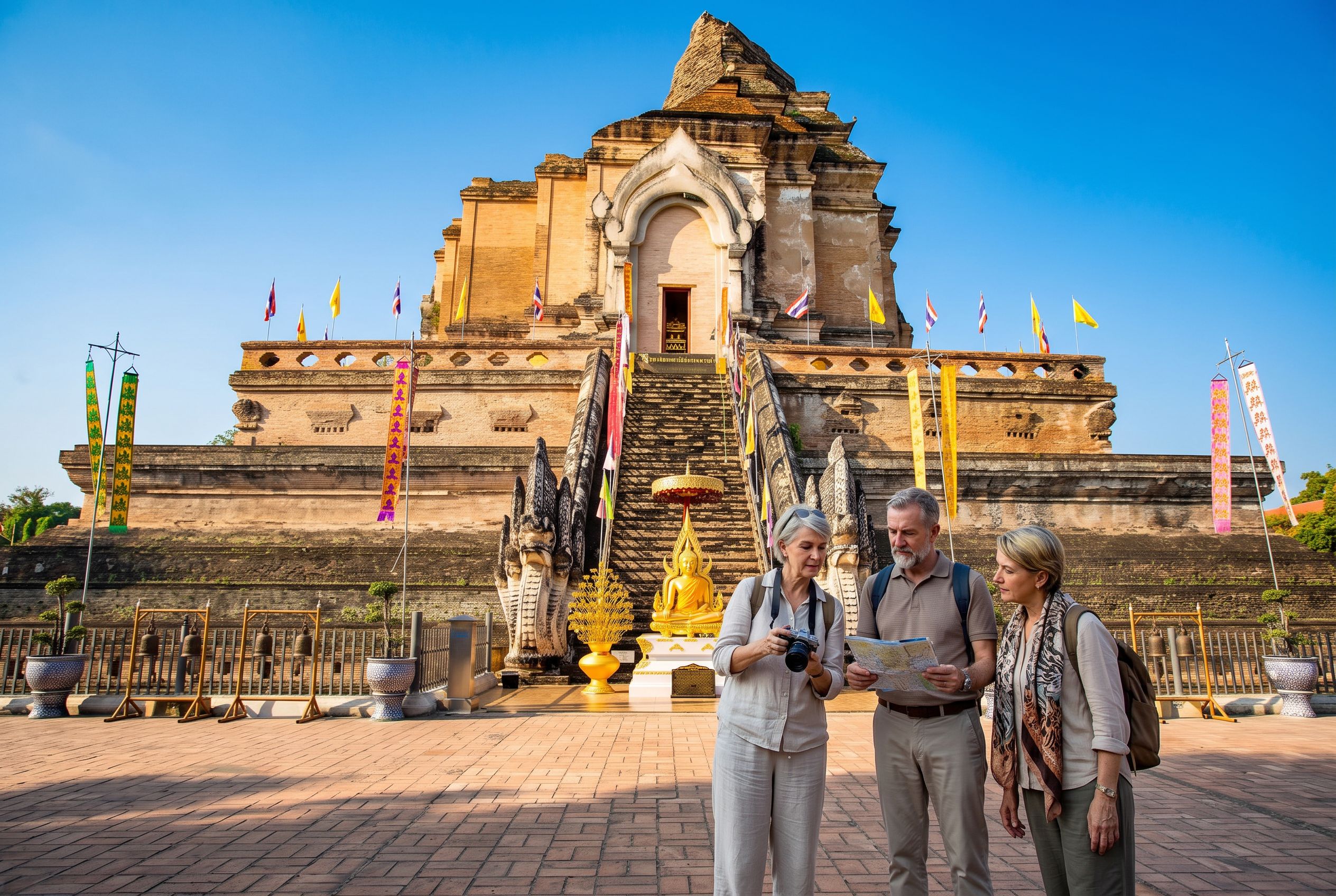
Begin with the flat, central temple cluster: Wat Phra Singh, Wat Chedi Luang and Wat Chiang Man. All three are described as ground-level, mostly flat or compact, and they sit within easy walking distance of each other. Keep the walking short and break for lunch indoors.
Wat Phra Singh is described as within easy walking distance of other central sights, mostly flat and step-free at ground level. Wat Chedi Luang is described as easy to combine with nearby temples on mostly flat ground. Wat Chiang Man, identified as Chiang Mai's oldest temple, has flat, compact grounds with shaded areas.
That is a morning, not a day. Walk one temple, sit, walk the next. The three-to-four-hour guided Old City walk that covers this ground is described as very relaxed in pace, with only around half an hour of it spent actually walking.
 AI-edited
In the afternoon, the Chiang Mai City Arts and Cultural Centre is a sensible indoor stop. It is open Wednesday to Sunday including public holidays, and closed Monday and Tuesday, according to the centre's own page at cmocity.com. It describes itself as three museums in one location, a public space in the middle of Chiang Mai Old City, and elevator access is mentioned in itinerary sources. Booking and admission conditions are not documented on the page gathered here; ask at the desk.
Day 2: What does a cooking class day look like?
A Thai cooking class is a half-day, usually morning or late afternoon, and it is one of the best low-strain activities in the city because most of it happens seated or standing at a station rather than walking. Book one that includes a market visit, then rest through the afternoon.
Cooking classes are not documented gathered for this guide at the level of specific operators, prices or cancellation terms. What is documented is the wider context: Chiang Mai is a UNESCO Creative City of Crafts and Folk Art, and its food culture is central to that identity. The city also runs the Lanna Expo, which combines crafts, gastronomy and design.
Practical guidance for booking: ask the operator directly about the number of stairs at the venue, whether the class is held outdoors, and whether a hotel pickup is included. None of that is published in the material gathered here, so it needs to be confirmed at the time of booking rather than assumed.
The afternoon is deliberately empty. Rest, swim, or take a short walk in Nimman. The evening is a good slot for the night markets, covered below.
Day 3: Is Doi Suthep worth it, and can you avoid the stairs?
Wat Phra That Doi Suthep is reached by a staircase of about 306 to 309 steps, but a cable car or funicular bypasses the climb for visitors avoiding stairs. Entry and the funicular are purchased on site. Treat it as a half-day outing, not a full day.
This is the least easy of the named places in Chiang Mai because of the hill approach and the stair climb. The funicular reduces the physical demand considerably, and once at the summit the area is generally described as accessible. The source does not document advance booking, cancellation terms or staffed assistance services for the temple beyond the stair-bypassing option.
No senior fare is documented for Wat Phra That Doi Suthep. Entry and the funicular are bought on site.
Wat Umong is singled out as especially accessible, and Wat Phalat is described as mostly easy to navigate. Both are lower-strain substitutes for the Doi Suthep half-day.
Day 4: What happens on an elephant sanctuary day?
An elephant sanctuary works best as a half-day or single-day experience rather than an all-day endurance test, according to itinerary advisers working with older travellers. Book a sanctuary that limits walking and includes transport, then keep the evening light.
That is a gap worth naming: ask the operator directly about the amount of walking, the terrain, the availability of shade and seating, and whether pickup from your hotel is included.
Travellers aged 50 and over consistently say Chiang Mai works best as a slow, temple-and-café city with selective day trips rather than a packed schedule. One adviser working on a trip for parents in their sixties said it is better to build in afternoon downtime after a busy morning. Another recurring theme is to choose private cars or Grab for flexibility rather than a heavily scheduled tour.
If the sanctuary day runs long, skip the evening outing entirely. Day 5 is lighter by design.
Day 5: Markets, crafts and a gentle finish
Jing Jai Market is the strongest low-stress stop for a final day. One visitor report describes it as completely wheelchair accessible, and notes that weekends are much bigger because of extra artisan stalls. Go in the morning, then rest before a final evening out.
Chiang Mai municipality closes some roads on Saturdays and Sundays for local handicraft sales, according to the Chiang Mai Province official tourism page. The same page states that one market is fully accessible for disabled and elderly people, with a designed slope and level, smooth walking paths. That fact applies to the market listed on the municipal tourism page, not to Chiang Mai city generally.
Ban Kang Wat was described in one visitor report as a bit small and cramped for older visitors, despite a nice atmosphere. Worth knowing before you commit a morning to it. Our guide to Chiang Mai's markets and handicrafts covers the shopping side in more detail.
For the final afternoon, Royal Park Rajapruek is the calmer outdoor option, with wide paved paths, accessible toilets and golf-cart or shuttle help mentioned in itinerary sources. A tourism listing on the Chiang Mai Province official site gives opening hours of daily 8:00am to 6:00pm and admission of 100 baht for adults and 50 baht for children. The operator's own page was not captured in the material gathered here, so confirm current hours before travelling.
How do the night markets fit into a relaxed plan?
The night markets are best treated as an evening activity after a rest, not as a continuation of the day. Chiang Mai Night Safari offers a documented senior discount: visitors aged 60 and over get 50 per cent off with ID, and that discount must be purchased on site and is not available online.
Chiang Mai Night Safari is identified in one guide as a low-effort option. Its booking page states that disabled persons get free admission on presentation of a disability card, and that the senior discount is on-site only. Timed ticketing appears to be part of the system, but the opening-hours and closure schedule were not captured in the official excerpt gathered here. Confirm before you go.
For the street markets themselves, the practical advice from traveller reports is consistent: use well-lit, busy routes and verified transport at night. Crowded tourist areas and traffic are the main cautions after dark.
Brokenships Chiang Mai is open daily from 10:00am to 10:00pm with last entry at 9:30pm, and is closed on New Year's Day and during Songkran and its substitution holiday. Adults pay 200 baht and seniors aged 65 and over pay 150 baht. Groups of 15 or more must book at least seven days in advance.
Getting around without wearing yourself out
Use rides rather than trying to walk everything. Airport taxis are available at the arrivals hall, and the airport shuttle bus runs at 40 baht for routes A1 and A2 and 60 baht for A3. The RTC city bus is documented as air-conditioned with wheelchair accessibility.
The airport shuttle bus page at Chiang Mai International Airport documents the fares and routes. A1 runs airport to Nimmanhaemin Road to Huay Kaew Road to the City Moat. A2 runs airport to Mahidol Road to Night Bazaar to Chang Klan hotels.
A citiesinsider.com page states a flat fare of 30 baht on regular RTC routes and 50 baht on airport routes, with children under 13 riding free, two designated wheelchair spaces, priority seating and low-floor or ramp access. That page is not the operator's own, so treat those details as secondary support rather than primary documentation. A direct official website for the RTC City Bus operator was not captured in the results.
Grab and private cars come up repeatedly in traveller advice for older visitors, specifically for flexibility over fixed tour schedules.
Health, safety and what to do in an emergency
Save the Thai emergency numbers before you travel: 1669 for medical emergency or ambulance, 191 for police, 199 for fire and rescue, and 1155 for the Tourist Police with English-language support. The nearest clearly documented hospital in central Chiang Mai is Maharaj Nakorn Chiang Mai Hospital on Intawaroros Road.
Pharmacy access is documented at the hospital's Pharmacy Division, and Chiang Mai University Pharmacy branches are also listed in the municipality. A single universally agreed nearest pharmacy to a specific hotel district is not documented, so ask your hotel on arrival.
Ambulance transport in Thailand generally goes to the nearest available hospital, according to UK government health guidance, which also lists Maharaj Nakorn Chiang Mai Hospital among Chiang Mai medical facilities. Our guide to health, vaccinations and peace of mind in Chiang Mai covers the practical preparation.
For daytime city travel, Chiang Mai is generally workable. After-dark movement deserves more care because crowded tourist areas and traffic are the main cautions.
What else should over-50s know before booking?
Five days is enough for the core of Chiang Mai at a relaxed pace.
Build in an afternoon rest after every busy morning. Keep evening movement to well-lit, busy streets and verified transport. Treat Doi Suthep as a half-day outing only if the cable car or funicular suits your group.
senior fares are not documented for most Chiang Mai attractions, and regular closing days or maintenance closures are not documented for specific sites beyond Brokenships Chiang Mai and the Chiang Mai National Museum's Wednesday-to-Sunday exhibition schedule. Chiang Mai National Museum charges 20 baht for Thai visitors and 200 baht for foreign visitors, with exhibition hours Wednesday to Sunday, 09:00 to 16:00.
Ask directly, confirm at the desk, and keep the plan loose enough to change.


