
Chiang Mai rewards the cautious eater. The city's food culture runs on high heat, fast turnover and fresh cooking, three things that work in the traveller's favour. The practical rules are simple and well documented: drink sealed or filtered water, choose stalls that are busy with locals, order food cooked in front of you, and carry rehydration salts for the day a dish disagrees with you. None of this requires anxiety. It requires a small amount of planning, done once, before you sit down.
This guide covers water, ice, street food, fruit and salads, spice, and what to pack for an upset stomach. Vaccinations and general health cover sit outside its scope and have their own dedicated guide. What follows is drawn from published safety guidance, traveller reports and official municipal and hospital information, and it is written for travellers aged 50 to 70 who want to eat well in Chiang Mai without spending the trip worrying about it.
Is Chiang Mai's tap water safe to drink?
No. Multiple Chiang Mai travel guides state plainly that tap water should not be drunk, and one advises against it "under any circumstances." The Provincial Waterworks Authority's treatment standard is reported as meeting drinking-water quality criteria at plant level, but pipework and storage tanks can reintroduce contamination between the plant and the tap. Use sealed bottled or filtered water for drinking.
The distinction matters. According to a Chiang Mai guide on drinking water, tap water is widely used for bathing, washing and cooking with heat, and many long-term residents brush their teeth with it. That is a local habit, not a recommendation for a two-week visitor. One Chiang Mai safety guide advises sealed or filtered water only and states that the city's tap water is not drinkable, which makes a reusable bottle with a filter, or a standing supply of bottled water, the sensible baseline for a hotel room.
Bottled water is cheap and available everywhere, from 7-Eleven branches to hotel minibars. Refill stations are also common across the city. A Chiang Mai water discussion notes that refill stations can be used for years without problems, but users should check whether the machine carries service labels and evidence of regular cleaning. If a machine looks unmarked or neglected, walk to the next one.
What about ice in drinks?
Ice is a grey area rather than a red line. One traveller forum reports that round ice with a hole through the centre is acceptable, while shaved or block ice should be avoided. A Chiang Mai safety guide advises skipping ice from street vendors altogether. If you are cautious, order drinks without ice or drink from sealed bottles.
The reasoning behind the round-ice distinction is that commercially produced ice, the kind with a hole, is made in factories under controlled conditions. Shaved and block ice is more likely to have been produced or stored informally. That logic is sensible but it is not an official standard, and no Chiang Mai-specific ice regulation appears.
In practice, most hotels, restaurants and cafes in the city serve commercially produced ice, and the risk sits mainly with roadside carts and market drinks. If you are ordering a smoothie or a fruit shake from a market stall, you can ask for it without ice. The same forum thread notes that some travellers go further and choose hot bottled water or soft drinks because they do not trust the ice at all. That is a personal threshold, not a requirement.
 AI-edited
Is Chiang Mai street food safe for older travellers?
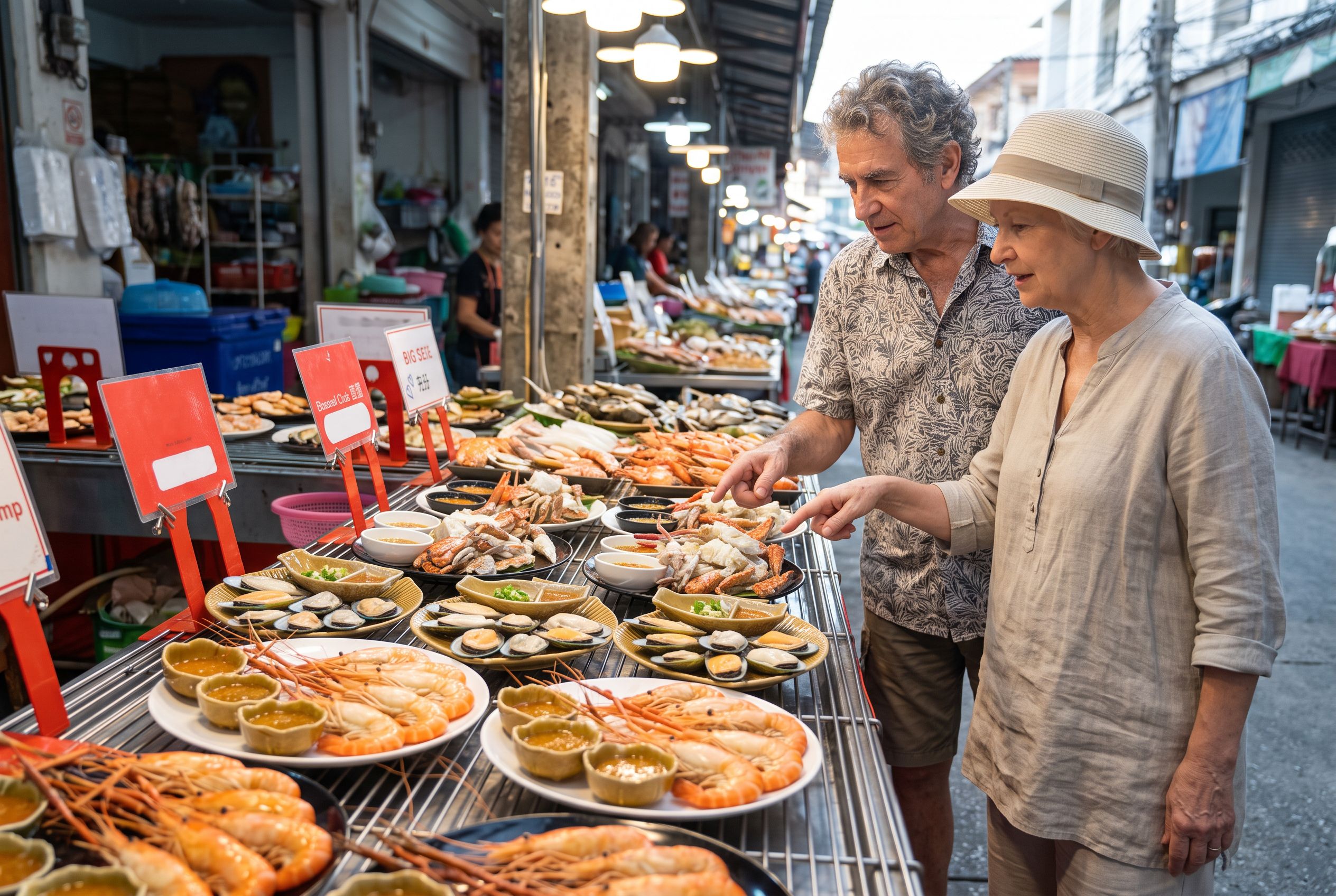
Street food in Chiang Mai has a strong record when vendors are busy, according to published safety guidance. The consistent signal across traveller reports is turnover: eat where there are plenty of current customers, especially locals, and where food is cooked to order in front of you. A solo-travel guide for over-50s goes further, calling street food "often safer than a restaurant" because it is cooked at high heat while you watch.
That is the reassuring headline, and it is well supported. A further Chiang Mai safety guide describes street food as having an "excellent safety record when vendors are busy," while noting it is not risk-free. Several travellers in a Chiang Mai street food discussion say they have eaten street food in the city many times without problems, and the same thread repeatedly frames "busy with locals" as the main safety signal.
The practical rules that emerge from those reports are worth writing down:
- Eat during normal meal hours, particularly lunch between about 11:30 and 14:00, rather than late afternoon when food may have sat out longer.
- Choose stalls where food is cooked in front of you, not scooped from a tray that has been standing.
- Look at the tables and the floor. A Reddit post advises checking both for cleanliness and flies, and warns that food prepared an hour or more ahead "can get you very ill."
- Treat a queue of Grab or Foodpanda drivers waiting at a stall as a positive sign of popularity and freshness.
- Be more cautious with seafood and raw items unless you can judge freshness carefully.
- Avoid pre-cut fruit sitting out, and anything that looks like it has been held too long without reheating.
The night markets are the easiest place to apply these rules. Travellers in a Chiang Mai street food thread name Kalare, Pavilion and Anusarn as the safest bets among the crowded night-market areas, and recommend arriving near opening time so the food is at its freshest. The same thread notes that several commenters have eaten at places like Kalare many times without problems.
One safety guide notes that a bad stomach ache followed a visit to Northgate Market, and advises carrying stomach medication and using common-sense caution. That is a single reported experience, not a verdict on the market. It is a reminder that no stall carries a guarantee, and that the sensible posture is attention rather than avoidance.
For travellers who want to go deeper into what to order and where, our guide to what to eat in Chiang Mai covers the northern Thai dishes worth seeking out, and our roundup of Chiang Mai's finest restaurants and riverside dining covers the sit-down end of the spectrum.
Should I eat fruit and salads in Chiang Mai?
Peeled fruit is fine. Salads and unpeeled produce are the items to treat with care, because they may have been washed in tap water. One Chiang Mai guide aimed at travellers over 50 advises avoiding salads and unpeeled produce if you are being cautious. Fruit you peel yourself, or fruit that has been peeled in front of you, carries far less risk.
The logic is straightforward. Cooking kills what washing may leave behind, and tap water is the concern. A plate of raw herbs and leaves, common alongside northern Thai dishes, may have been rinsed in tap water and not cooked afterwards. That does not make every salad dangerous, but it does mean the cautious traveller orders cooked dishes and peels their own fruit.
Mango with sticky rice, a Chiang Mai staple, is usually safe: the mango is peeled to order and the rice is cooked. Cut fruit from a market tray that has been sitting in the heat is a different proposition. Buy whole fruit and peel it in your room, or buy from a vendor who cuts it while you wait.
How do I handle the spice?
Northern Thai food can be genuinely hot, and the heat is not always adjustable after the dish is made. The practical approach is to ask for it mild ("mai phet") when ordering, to keep a cooling drink to hand, and to build up rather than starting with the hottest dishes. Spice is not a safety issue; it is a comfort one, and it is easily managed.
Chiang Mai's signature dishes, including sai ua (northern sausage), nam prik dips and various curries, vary widely in heat from stall to stall. A dish that is mild at one vendor can be fierce at the next. Asking for mild is normal and vendors are used to the request. If you are unsure, order a dish you have had before alongside something new, so there is always something on the table you know you can eat.
Spice and stomach upset are separate matters. A hot dish does not cause illness, and a mild one does not prevent it. If you have a sensitive stomach, the more useful precaution is to eat freshly cooked food and avoid the items listed above, rather than to avoid chilli.
What should I pack for an upset stomach?
Pack oral rehydration salts, a stomach medication you have used before, and hand sanitiser. One Chiang Mai safety guide specifically recommends rehydration salts, DEET repellent, sunscreen and plasters as commonly useful items in the city. Pharmacies are everywhere, and Watsons and Boots branches on Nimman Road and at Central Festival have English-speaking staff.
Rehydration salts are the single most useful item on the list. If stomach upset does occur, the documented route is to use a nearby pharmacy or hospital.
Pharmacies are easy to find across the city. The Maharaj Nakorn Chiang Mai Hospital Pharmacy Division sits at 110 Intawaroros Road, Si Phum, Mueang Chiang Mai, and Chiang Mai University lists a CMU Pharmacy with a branch next to the Faculty of Pharmacy on Suthep Road and another at the CMU Health Centre. For everyday items, the Watsons and Boots branches named above are the most straightforward for travellers who want to explain a symptom in English.
When should I seek medical help?
Seek help if you cannot keep fluids down, if you develop a fever, or if you show signs of severe dehydration. The documented emergency route in Thailand is 1669 for ambulance and medical emergencies, which operates as part of a countrywide network and usually transfers patients to the nearest available hospital. You may request a specific hospital.
Chiang Mai has well-documented private hospital capacity. According to the U.S. Consulate's Chiang Mai health-facilities list, private ambulance services operate for Bangkok Hospital Chiang Mai, Chiang Mai Ram Hospital, Lanna Hospital, McCormick Hospital and Sriphat Medical Centre. A Chiang Mai safety guide notes that Chiang Mai Ram Hospital and Bangkok Hospital Chiang Mai both have 24-hour A&E, international desks and direct billing to insurers.
The UK government's guidance states that most private hospitals in Thailand deploy their own ambulances in emergencies, usually for a fee, but it does not give Chiang Mai-specific pricing. Ask your insurer before you travel what is covered and how a direct billing arrangement is triggered.
For non-medical emergencies, 191 is the police number in Thailand, and the U.S. Consulate's Chiang Mai guidance separately lists 191 as the non-medical emergency line. The Tourist Police number is 1155. Vaccinations and broader health cover are outside this guide and have their own dedicated article.
Where does Chiang Mai's water come from, and does it matter?
The Provincial Waterworks Authority's treatment-water standard is reported as meeting drinking-water quality criteria at plant level, but practical guidance still favours bottled, filtered or boiled water because pipework and storage tanks can reintroduce contamination. The issue, as one Chiang Mai water discussion puts it, is usually the pipes rather than the source.
That distinction explains why the official standard and the traveller advice do not contradict each other. Water can leave a treatment plant within standard and still arrive at a tap carrying something it picked up along the way. A Chiang Mai water thread notes that water may be fine for showering and brushing teeth, but travellers should not assume every condo or neighbourhood has the same quality.
There is one location-specific caution worth knowing. For Chiang Mai province, an official public-health update in 2025 said the Kok River was contaminated with heavy metals in parts of Mae Ai District, and residents were told not to drink or cook with river water there until it is declared safe. Mae Ai District is in the far north of the province, well away from the city, and the advisory concerns river water rather than municipal supply. It does not affect a normal visit to Chiang Mai.
At city level, Chiang Mai Municipality reported in April 2026 that moat water was within standards during Songkran preparations, with no pollution exceeding limits, and that it had placed floating buoys and stationed officials, firefighters and rescue staff around the moat. That is a municipal water-quality confirmation for a specific event, not a statement about drinking water.
Practical questions before you eat
The short version: drink sealed or filtered water, skip ice from street carts if you are cautious, eat where the crowd is, order food cooked in front of you, peel your own fruit, and carry rehydration salts. Pharmacies and hospitals are well distributed across the city, and English-speaking staff are available at the branches named above.
A few planning points are worth settling before you arrive. The safest evidence available is broader Thailand travel guidance, which recommends choosing safe food and drink practices including boiling, cooking, peeling or leaving food.
If you are combining food safety planning with getting around, our guide to how accessible Chiang Mai is for older travellers covers transport and walking conditions, and our piece on the quietest hotels in Chiang Mai covers where light sleepers can rest.
Finally, a note on the season. Chiang Mai's cool season runs from November to February and is the peak visitor period, with December and January typically the driest and coolest months. The hot season from March to May brings higher temperatures and the region's burning-season haze, with air quality at its worst in March and April. None of this changes the food and water rules above, but heat affects how much water you need to drink, and the haze affects how much time you will want to spend outdoors at market stalls.
| Item | Documented guidance | Source type |
|---|---|---|
| Tap water | Not drinkable; use sealed or filtered water | Chiang Mai safety guide |
| Ice | Round ice with a hole reported as acceptable; shaved or block ice to be avoided | Traveller forum |
| Street food | "Excellent safety record when vendors are busy" | Chiang Mai safety guide |
| Salads and unpeeled produce | Avoid if being cautious; may be washed in tap water | Over-50s Chiang Mai guide |
| Rehydration salts | Recommended for the day bag | Chiang Mai safety guide |
| Emergency number | 1669 for ambulance and medical emergencies | U.S. Consulate and UK government guidance |
Rates and prices for water delivery, refill stations and pharmacy items are indicative and vary by season and booking channel.


