
Lake Garda's heritage sights reward those who arrive early, book ahead, and pace themselves. The Vittoriale degli Italiani, Parco Giardino Sigurtà, the Scaliger castles of Sirmione and Malcesine, and Isola del Garda each offer something distinct—from a poet's eccentric hilltop estate to a barrier-free garden park with ten kilometres of paved avenues. For travellers aged 50 to 70, the key is matching each site's demands to your comfort level, and knowing which ferry connections and ticket options make the day smoother.
 AI-edited
This guide focuses exclusively on these five heritage destinations. The Roman villa grottoes beneath Sirmione's tip, the Grotte di Catullo, are a separate visit and fall outside this guide. Here, we concentrate on what to see, opening seasons, ticketing, walking distances, steps, ferry access, and which sites are easiest underfoot.
Which heritage sites are easiest underfoot?
Parco Giardino Sigurtà is the clear winner for easy walking, with over 10 km of porphyry avenues, most of the main routes level and firm underfoot, and an accessible panoramic train for those who prefer not to walk the full circuit. Il Vittoriale involves moderate hillside walking with some steps, while the Scaliger Castle in Sirmione has many staircases and is not wheelchair accessible inside.
Sigurtà describes itself as a wide, accessible setting and says most of its main routes are level and firm-surfaced, which guest reviews echo when they praise the paths and shaded benches. The park's accessibility page also lists three barrier-free toilets along the main itinerary, admission free of charge for visitors with an Italian L.104 certificate or a Disability Card, and a reduced €14 fare for the person accompanying them instead of the usual €18. For anyone who finds long distances tiring, the park hires out electric golf carts at €20 an hour per vehicle, seating up to four, and electric bicycles at €6.50 an hour. The park notes that the golf carts are not built for people with impaired mobility and are hired at the visitor's own responsibility.
Il Vittoriale sits on a hillside above Gardone Riviera, and the Foundation describes the park itself as laid out on a hill, with routes that run partly uphill and partly down. It also states plainly that the historic character of the estate prevents the architectural barriers from being removed altogether, so the visit route is only partly accessible. The Prioria has numerous barriers inside and cannot be visited by anyone with a mobility impairment, who can instead watch the film about the house in the Auditorium. The step-free points the Foundation names are the Museo d'Annunzio Segreto, the Pilo del Piave and amphitheatre, the rose garden, the Giardino delle Vittorie, Piazzetta Dalmata, the loggias and the Museo l'Automobile è femmina. The Scaliger Castle in Sirmione is the most demanding: official accessibility guidance notes the interior is not accessible in a wheelchair, and recent guests describe "many steps and staircases" that would be difficult for anyone with mobility concerns.
What makes Parco Giardino Sigurtà worth the trip?
Sigurtà is a 600,000-square-metre landscaped park near Valeggio sul Mincio, open daily from 7 March to 15 November 2026, 9:00–19:00 with last entry at 18:00 — but 9:00–18:00 in March, October and November, with last entry at 17:00. It offers reduced pricing for visitors over 65, free entry for those with qualifying disability certification, and a self-paced visit pattern rather than a strenuous climb.
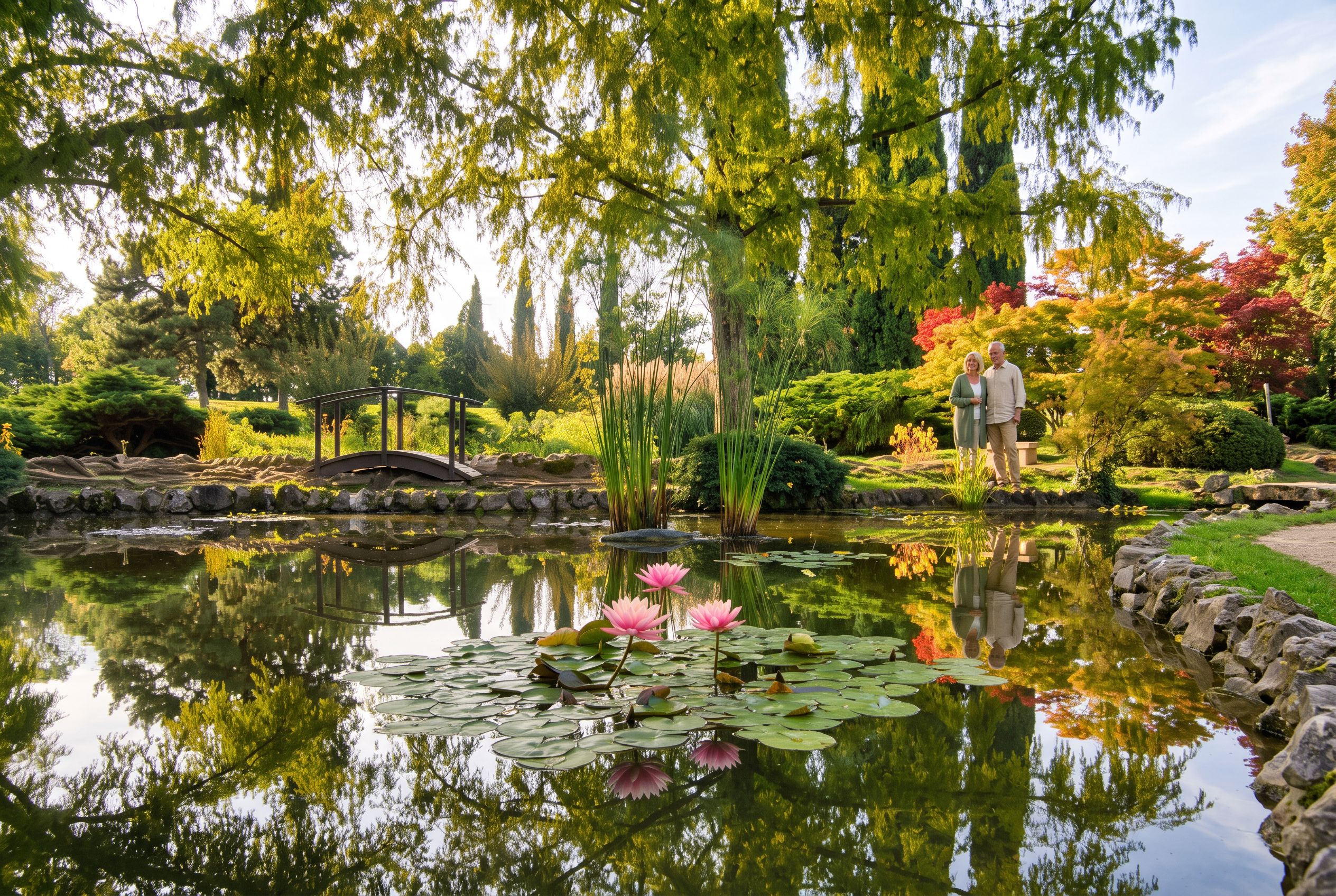
The park's signature features include the Great Oak, a sessile oak more than four hundred years old, and the Water Gardens, two broad pools that carry floating tulip beds in spring and water lilies and lotus flowers in summer. The tulips run from March into April, more than a million of them across some three hundred varieties; the roses open from June along the kilometre-long Viale delle Rose. Autumn brings warm colours and cooler walking temperatures. Guests consistently describe the grounds as "beautifully kept" and "peaceful," with clean toilets and shaded paths that provide relief even in hot weather.
As of August 2026, the park holds a Google rating of 4.6 out of 5 from over 32,700 reviews. The park puts the panoramic train tour at about 35 minutes and €5 per person, free for visitors with an Italian L.104 certificate or a Disability Card, which makes it an excellent way to orient yourself before exploring on foot. A guided shuttle tour of about an hour runs on Sundays in spring for €7. The park is on a hill, so walking the full circuit takes 2–4 hours; the train, golf carts, and e-bikes are practical alternatives for those who prefer not to walk long distances.
One practical caveat from guest feedback: buses to the park have been unreliable. The nearest free car park is about 600 metres from the main entrance, and the park reserves free spaces for disabled guests closer in, in the Parcheggio Rosso and Parcheggio Giallo, at the Italmark supermarket in via Cavour 16 and along several neighbouring streets. For everyone else, arriving early in peak season is essential—the park's own 2026 schedule notes that on special dates, access is contingent on online tickets only and limited until sold out.
"It's highly recommended to take the small train tour that runs through the park," one Google reviewer wrote in June 2025. "The ride lasts about 35 minutes and circles the entire park, giving you a sense of its size and helping you decide which areas you'd like to explore on foot… We spent about three wonderful hours there — you could easily spend even more."
How do I visit Il Vittoriale degli Italiani?
Il Vittoriale is open year-round except holidays and Mondays in November, December, and January. The estate combines a villa, museums and extensive gardens; the park ticket covers the grounds and the museums standing in them, while d'Annunzio's house needs a fuller ticket—check which ticket type (A, B, or C) covers what you want to see before arriving.
This eccentric estate was the home of poet Gabriele d'Annunzio, and it reflects his theatrical personality. The villa is stuffed with artefacts from his life and adventures, while the gardens include an open-air amphitheatre, a naval ship bow (the Puglia) set into the hillside, and the mausoleum where d'Annunzio is buried. The views across the lake from the upper terraces are memorable.
The Foundation's own visitor information sets out which part needs a guide: the Prioria, d'Annunzio's house, can be seen only on a guided visit of about thirty-five minutes in groups of ten, at a fixed time printed on the ticket. The Museo D'Annunzio Eroe and the other museums in the grounds are included in the park ticket and can be walked through freely. The culture ministry listing confirms the site is open all year, but with different hours for different parts of the "cittadella." The most convenient way to reach it is by car via the SS45bis from Salò or Riva del Garda; parking is on Via del Vittoriale and is paid.
One recurring piece of guest feedback is that the site is "not well signposted," so allow extra time to find your way around. The gardens alone require a moderate walk on uneven ground, and the buildings involve stairs. For those who prefer a shorter visit, the garden ticket alone provides a pleasant hour or two of wandering with lake views.
Which Scaliger castle is worth the climb?
The Scaliger Castle in Sirmione is the more famous and accessible of the two, with a compact historic centre around it, free entry for under-18s and for everyone on the first Sunday of the month, but no over-65 concession. Malcesine's castle is smaller, sits above the town and is reached on foot; over-65s pay a reduced 5 euro ticket there, and it closes for the winter.
Sirmione's castle sits at the entrance to the old town, surrounded by water on three sides. Its distinctive crenellations and harbour make it one of the most photographed sights on the lake. The interior includes walkways along the ramparts and a climb up the keep that rewards you with panoramic views over the peninsula and lake; the darsena, the castle's fortified dock, opens only on guided visits. The visit route is heavily stepped, but the museum itself describes the castle as partly accessible: the main and secondary courtyards can be reached at ground level, as can the first floor of the cassero, and there are accessible toilets on site.
Malcesine's castle, the Castello Scaligero di Malcesine, is a smaller medieval fortress perched above the town. Its main draw is the view from the top, which takes in the northern lake and the mountains beyond. The castle is reached on foot by a short but steep climb from the town centre, and the inside is stepped too, with staircases up to the conference room and the tower. The Monte Baldo cable car is no help here: it climbs the mountain, and its valley station in Via Navene Vecchia is simply a five-minute walk from the castle. That ride is a separate excursion with its own guide.
For Sirmione, the easiest approach is to take the train to Peschiera or Desenzano and then use a lake steamer, rather than driving into the peninsula. Cars are not allowed into the old town, so even if you drive, you must park outside and continue on foot — or take the Arriva ShuttleBus, which runs through the old town and across the peninsula every 15 to 20 minutes from 10:00 until after midnight, from 28 March to 27 September 2026, for €2 a ride. Forum travellers recommend buying your online ticket before going to avoid queues, and arriving early—Sirmione gets crowded, especially on summer weekends.
What is Isola del Garda and how do I visit?
Isola del Garda, the largest island on the lake, is privately owned and open for guided tours only, from 29 March to the end of October in 2026 — but never on Saturdays or Mondays. Access is by the owners' own boats from lakeside towns on both shores, and the tour includes the neo-Gothic Venetian-Byzantine villa and its formal Italian gardens.
The island sits near the western shore, close to San Felice del Benaco. The Borghese Cavazza family, who own it, welcome visitors on scheduled tours that must be booked in advance; it cannot be visited independently. The villa itself is a striking pink-and-cream confection, and the gardens are laid out in formal Italian style with cypress avenues, rose beds, and terraces overlooking the water.
On arrival guests are split into Italian, English and German groups. The stay on the island runs to two or two and a half hours, of which the guided part takes about an hour, and the boat crossing comes on top of that. The route is more demanding than the setting suggests: three staircases of about twenty-five steps each, two between the garden terraces and one inside the villa, and you need to be able to take a few steps unaided to board the boat. Guests who cannot manage the stairs can be driven up to the terrace by golf cart, but two of the garden terraces are then out of reach. There are accessible toilets on the island, and the owners advise against the visit for anyone with a heart condition, and against electric wheelchairs altogether. Boats leave from more than a dozen lakeside ports, and the crossing is short only from the nearest ones: ten to fifteen minutes from San Felice del Benaco, Portese or Gardone Riviera, twenty-five to thirty from Garda, Bardolino or Torri del Benaco, but a full forty-five minutes each way from Desenzano and Sirmione, and up to an hour from Lazise.
Because the island is privately managed, opening days and times vary each season. As of August 2026, the best approach is to check the official tour operator's website for the current schedule and book well ahead, particularly for summer visits. The island is a peaceful contrast to the busier lakeside towns, and the gardens are well maintained.
How do ferries connect these heritage sites?
Navigazione Laghi runs regular ferries and hydrofoils along the lake, connecting Sirmione, Gardone Riviera, Malcesine, and most other towns. Ferries are the most relaxed way to travel between sites, with the added benefit of lake views and no parking worries.
The ferry network is extensive. Sirmione is served by both ferries and hydrofoils from Desenzano, Peschiera, and other southern ports. Gardone Riviera, where Il Vittoriale is located, is a regular stop on the western shore route. Malcesine, in the north, connects to Limone, Riva del Garda, and the eastern shore towns.
For a heritage-focused itinerary, a practical approach is to base yourself in one town and use ferries for day trips. For example, from Sirmione you can take a morning ferry to Gardone Riviera for Il Vittoriale, then return in the afternoon. Alternatively, combine Malcesine with a ferry ride along the northern shore, which is among the most scenic stretches of the lake.
Ferry tickets can be purchased at the docks or online. The over-65 reduction applies from Monday to Friday only, Saturdays and public holidays excluded, and only on the ordinary services rather than the hydrofoils and catamarans; take an identity document to prove your age. Timetables vary by season, with reduced services in spring and autumn, so check the current schedule before planning your day. As of August 2026, the ferry service remains the most reliable public transport option for reaching these sites without a car.
| Route | Ferry time | Notes |
|---|---|---|
| Sirmione to Gardone Riviera | 50–70 min | Direct or via Desenzano |
| Gardone Riviera to Malcesine | 60–90 min | Scenic western shore route |
| Malcesine to Limone | 20–30 min | Northern lake crossing |
| Desenzano to Sirmione | 15–20 min | Frequent hydrofoil service |
What should I eat near these heritage sites?
Lake Garda's culinary traditions centre on lake fish, olive oil, and local wines. Near the heritage sites, look for historic lakeside cafés and village piazzas rather than crowded waterfront dining strips for a calmer, more authentic experience.
Around Sirmione, try the local lake fish—trout, sardines, and whitefish—often served grilled or in a risotto. The old town has several historic cafés where you can pause for an espresso or a glass of Chiaretto, the lake's signature rosé wine. In Gardone Riviera, near Il Vittoriale, the town's promenade offers a handful of family-run trattorias serving polenta and lake fish dishes.
Near Sigurtà, the town of Valeggio sul Mincio is famous for its tortellini di Valeggio, a delicate pasta dish with a butter and sage sauce. The park itself has several bars and snack stands, though recent guests note that food options inside are limited—consider packing a picnic or eating before you arrive.
In Malcesine, the castle's hilltop position means you are close to the town's narrow streets, where small osterias serve local specialities. The northern lake area is also known for its olive oil production, and you will find shops selling locally pressed oil and lemon products, including limoncello.
For a slower, senior-friendly food experience, choose historic lakeside cafés and village piazzas during non-festival hours. The Bardolino wine festivals and Torri del Benaco olive oil events are culturally representative, but they draw crowds—save those for a separate visit if you prefer quieter dining.
When is the best time to visit these sites?
April to June and September to October offer the best balance of pleasant weather and manageable crowds. July and August bring heat and peak-season congestion, especially at Sirmione's castle and the ferry docks. Mornings are consistently calmer than afternoons at all five sites.
Spring is ideal for Sigurtà, when more than a million tulips are in bloom from March into April; the roses along the Viale delle Rose follow from June. The park's own schedule confirms it opens from 7 March in 2026, and the spring months are when the gardens are at their most colourful. Autumn, particularly October, offers warm colours and cooler walking temperatures, with the added benefit of harvest-season produce in local markets.
For Il Vittoriale, the gardens are pleasant throughout the open season, and the guided visits to the Prioria run year-round. The site is closed on Mondays in November, December, and January, so plan around that if you are visiting in winter. The villa's interiors are less dependent on weather, making it a good option for cooler or rainy days.
Sirmione's castle is busiest from late morning through early evening in high season, and it is closed on Mondays. The Comune di Sirmione has added 30 special opening shifts under a sponsorship agreement with the regional museums directorate and the local hotel and restaurant consortium, running from 2 June to 1 November 2026: holiday afternoon openings from 13:30 to 19:30, mostly on Sundays and public holidays, plus a handful of evening openings from 19:30 to 23:30 in July. Several of those dates carry free admission as well.
Isola del Garda tours run from late March to the end of October, with the most frequent departures in summer and a thinner schedule in the shoulder weeks. The island's gardens are at their best in late spring and early autumn, when the roses and other flowering plants are in full display.
What are the ticket prices and senior discounts?
Sigurtà offers reduced pricing for visitors over 65 and free entry for those with qualifying disability certification, with a reduced fare for an accompanying person. Sirmione's castle costs 10 euros full price, with free entry for under-18s but no over-65 rate, and free admission for everyone on the first Sunday of the month. Isola del Garda does have a reduced fare for over-65s.
At Sigurtà, the park also offers reduced-price tickets on Tuesdays and Thursdays, which is worth checking if your schedule is flexible. The park's official ticketing site confirms the 2026 season and the special dates when online tickets are required. As of August 2026, the park's live Google rating stands at 4.6 out of 5 from over 32,700 reviews, with guests consistently praising the value for money despite some comments about the cost of extras like the train and golf carts.
For Sirmione's castle the full ticket is 10 euros; the reduced 2 euro ticket is reserved for EU citizens aged 18 to 25, so there is no over-65 rate, though under-18s enter free. A joint ticket covering the castle, the Grotte di Catullo and the Roman villa at Desenzano costs 20 euros and is valid for seven days. The castle is a state museum run by the Direzione regionale Musei Lombardia, and it is closed on Mondays. Tickets can be purchased online in advance, which forum travellers recommend to avoid queues.
Il Vittoriale's ticketing is more complex because of the different ticket types. The garden-only ticket is the most economical option, while the full ticket includes the villa and museum. The official Vittoriale website provides current prices and opening hours, and it is worth checking what each ticket includes before you arrive.
Isola del Garda tours are priced per person and include the boat transfer and guided visit. Bookings are essential, and the price reflects the private nature of the island and the small group sizes.
| Site | Senior discount | Booking advice |
|---|---|---|
| Parco Giardino Sigurtà | Yes, 65+ | Online tickets required on special dates |
| Il Vittoriale | Check ticket types | Book online; decide garden-only vs full |
| Scaliger Castle, Sirmione | No; free first Sunday | Closed Mondays; book online |
| Scaliger Castle, Malcesine | Yes, 65+ (5 instead of 7 euros) | Open 20 March to 1 November; stepped throughout |
| Isola del Garda | Yes, 65+ pay the reduced fare | Essential to book ahead; no tours Saturdays or Mondays |
How do I get to these sites without a car?
Trains connect to Desenzano and Peschiera on the southern shore, and ferries link the lakeside towns. From the train stations, local buses or ferries complete the journey to the heritage sites. Sigurtà is the most challenging to reach by public transport, so consider a taxi or organised tour.
For Sirmione, take a train to Desenzano or Peschiera, then a ferry or local bus to the peninsula. The ferry from Desenzano takes 15–20 minutes and drops you at the castle's doorstep. Forum travellers consistently recommend this approach over driving, given the parking difficulties in Sirmione.
For Il Vittoriale, the nearest train station is at Desenzano, followed by a bus or taxi to Gardone Riviera. The site's official information notes that the most convenient way to reach it is by car, but the bus service from Desenzano is workable, and taxis are available at the station.
For Sigurtà, the nearest train station is Peschiera del Garda, about 12 km from the park, and the APAM line 46 runs on from there to Valeggio sul Mincio, joined in summer by ATV line 482. Guest reviews repeatedly mention buses not arriving, so a taxi from Peschiera is the more reliable option, or you can join a guided tour that includes transport. If you do arrive by bus, show the day's APAM or ATV ticket at the Sigurtà ticket desk: it takes €3 off the full adult admission.
For Malcesine, the train does not reach the town directly. The nearest stations are at Verona or Rovereto, followed by a bus or ferry. The ferry from the southern shore takes 60–90 minutes but offers some of the lake's best views.
For Isola del Garda, boat departures are from Salò, Gardone Riviera, and San Felice del Benaco. These towns are all accessible by ferry or bus from the main transport hubs.
For those who prefer a structured approach, our guide to Lake Garda for travellers over 50 covers broader transport planning, while our comfort-focused hotel recommendations can help you choose a base that minimises daily travel.
What should I wear and bring for a day at these sites?
Comfortable walking shoes are essential, especially for the castles and Il Vittoriale's hillside gardens. Bring water, sun protection, and a light layer for ferry crossings, which can be breezy even in summer. At Sigurtà, consider packing a picnic, as food options inside are limited.
The terrain varies significantly between sites. Sigurtà's paved avenues are the easiest on the feet, while Sirmione's castle and old town involve cobblestones and steps. Il Vittoriale's gardens are on a hillside, so sturdy shoes with good grip are recommended. Malcesine's castle involves a steep climb, and the Monte Baldo cable car, if you take it, requires comfortable footwear for the mountain paths.
For ferry travel, a light jacket or shawl is useful, as the wind on the water can be cool even on warm days. In summer, start early to avoid the midday heat, and carry water—the sites have limited refreshment points, and queues can build at the busiest times.
At Sigurtà, recent guests note that there are "few refreshment points" and "few toilets," so plan accordingly. The park's own information confirms rest areas and wide, flat routes, but the practical experience is that you should carry what you need for a few hours.
Finally, bring your senior ID or passport for the age-based discounts at Sigurtà and Sirmione's castle. The discounts are applied at the ticket office, and having proof of age ready will speed up your entry.
How do I combine these sites into a sensible itinerary?
A practical approach is to group sites by geography: Sirmione's castle and old town as one half-day, Il Vittoriale and Isola del Garda as another, and Sigurtà as a full day on its own. Malcesine works well as a separate northern-lake excursion.
For a three-day heritage itinerary, consider this structure. Day one: Sirmione in the morning, arriving by ferry from Desenzano, exploring the castle and old town before the crowds build, then a lakeside lunch and an afternoon ferry onward. Day two: Sigurtà, arriving early and using the train or golf cart to cover the grounds efficiently, with a picnic lunch and a relaxed afternoon. Day three: Gardone Riviera for Il Vittoriale. Isola del Garda needs a day of its own — its boats leave Gardone Riviera at 09:05 on Tuesdays and Thursdays, and there is no afternoon departure to pair with a morning at the Vittoriale.
Malcesine is best combined with a visit to the northern lake towns of Limone or Riva del Garda. The castle itself is a compact visit, but the setting and the views make it worth the journey. If you are staying in the south, the ferry ride alone is a scenic highlight.
For those who prefer to minimise walking, our guide to spa hotels and thermal baths offers recovery options after a day of sightseeing. And if you are travelling with grandchildren, our family guide to Lake Como provides adaptable strategies for multi-generational trips.
One final note: the former Caserma XXX Maggio in Peschiera del Garda is planned to reopen as a five-star hotel in 2027, which may affect the wider lakefront tourism flow in coming years. For now, the heritage sites themselves remain unchanged, and the 2026 season is fully operational.
"What an amazing Castello this is to visit. An ancient place that greets you as you walk into Sirmione," a review left on Google in April 2026 records. "We visited early in the morning… When we left Sirmione a couple of hours later, there was a long line of people waiting to get in!! Go early!"
For more on the practicalities of a Lake Garda holiday, including where to stay and how to pace your days, our complete guide for travellers over 50 is a good starting point. The heritage sites covered here are the cultural highlights, but the lake itself rewards those who take it slowly.


