
Salzburg wears its Mozart heritage lightly, but for the culture-minded traveller, tracing the composer's footsteps through the Old Town is the heart of any visit. This guide focuses on the essential Mozart sites—his Birthplace and Residence—along with the DomQuartier state rooms and the best places to hear his music, all paced for a comfortable, rewarding day. We'll cover walking distances, steps, lifts, seating, and how to avoid the crowds, so you can focus on the music.
 AI-edited
Which Mozart museum should I prioritise?
For most visitors, Mozart's Birthplace on Getreidegasse is the more memorable stop, but the Mozart Residence on Makartplatz is the better choice if you need step-free access. The Birthplace is not barrier-free at all; the Residence is open to wheelchair and walker users through a side entrance, provided you telephone ahead.
The Birthplace at Getreidegasse 9 is where Wolfgang Amadeus Mozart was born on 27 January 1756. It's a narrow, multi-storey building with original instruments, letters, and family portraits. The narrow corridors and small rooms become cramped when tour groups arrive. As of August 2026 the museum holds a Google rating of 4.3/5 from 28,353 reviews, alongside a Tripadvisor rating of 3.8/5 from 3,511 reviews recorded in July 2026. The Mozarteum Foundation allows about an hour for a visit.
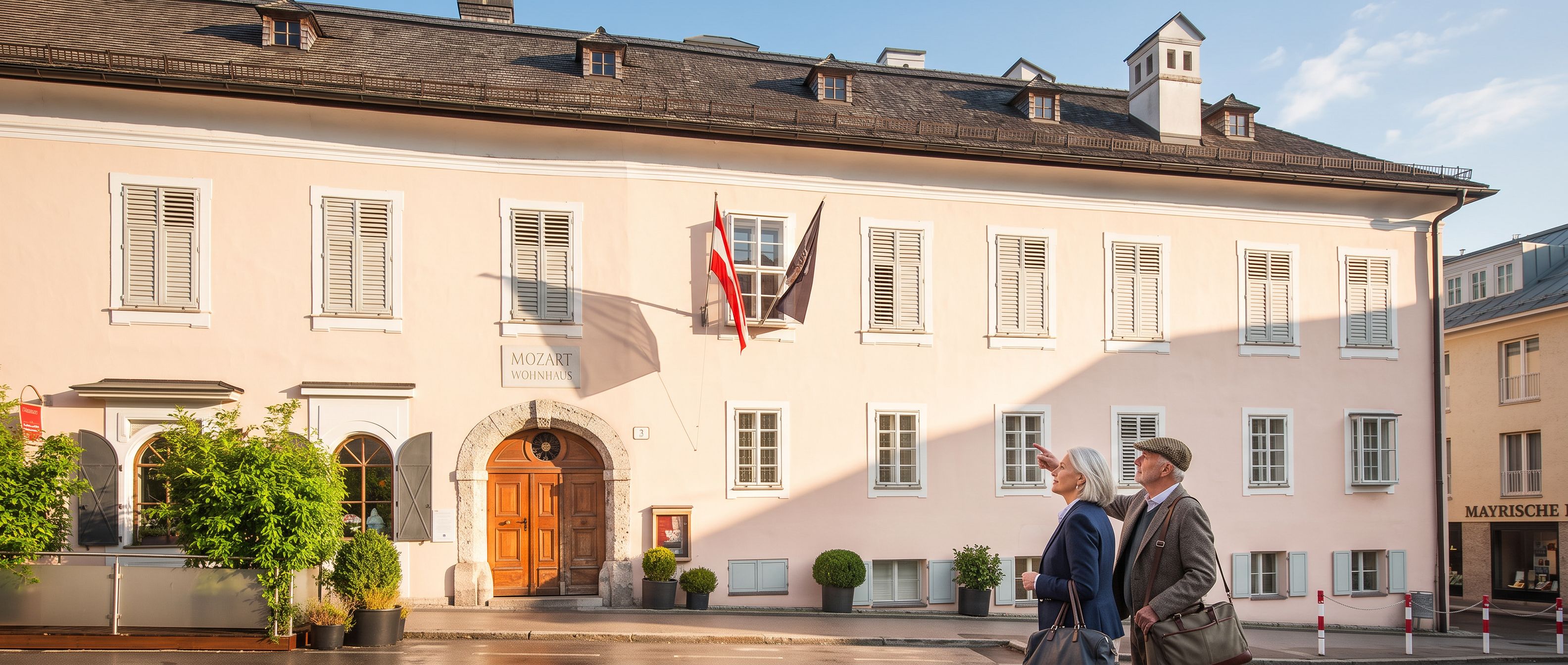
The Residence, a 10–15 minute walk away across the Salzach on Makartplatz, was the family's later home from 1773: an eight-room apartment on the second floor of the old Tanzmeisterhaus. Part of the building was destroyed in the Second World War and rebuilt, which some travellers find less emotionally resonant. Until 10 January 2027 it holds the exhibition Cosmos Magic Flute, with the clavichord on which Mozart composed The Magic Flute; the original family instruments are shown at the Birthplace. The foundation allows about an hour here too.
How accessible are the Mozart sites?
Mozart's Birthplace is not barrier-free and has no lift; you must climb narrow stairs to reach the exhibits. The Mozart Residence is open to wheelchair users through the side entrance at Theatergasse 2, where a lift serves every level — but ring +43 662 87 42 27 40 first, because staff must accompany you in it.
The Mozarteum Foundation states flatly that Mozart's Birthplace is "not barrier-free accessible", and gives the reason: the three-storey house at Getreidegasse 9 is under monument protection, so structural modernisation is not feasible. There are no lifts, and the corridors are tight. For visitors with limited mobility, this is a site to enjoy from the outside or skip entirely. The museum does offer an audioguide app, wall texts, and a mobile phone text guide, which helps seniors who prefer a slower, self-guided pace.
The Residence, by contrast, is described by the foundation as "accessible to people with wheelchairs or walkers", with every exhibition room reached without steps. Visitors with a valid disability pass are admitted free, and so is one companion if the pass carries a "B" mark. The Salzburg Museum's Neue Residenz at Mozartplatz remains closed for renovation until 2027, so that option is off the table for now.
What about the DomQuartier and Residenz state rooms?
The DomQuartier is a magnificent circuit of state rooms, galleries, and the cathedral terrace, all connected by a single route. It is largely barrier-free, with a lift from the courtyard and staff assistance to the second floor.
The Residenz was the prince-archbishops' palace, and Mozart performed in its state rooms as a child prodigy. The DomQuartier route takes you through the Residenz state rooms, the Residenzgalerie, the cathedral museum, and out onto the cathedral terrace with its panoramic views. The DomQuartier's own accessibility page says the complex was made barrier-free as far as monument protection allows: staff take you from the porter's lodge to the courtyard lift and up to the state rooms on the second floor. Wheelchairs can be borrowed if reserved in advance.
This is a quieter, more spacious alternative to the Mozart museums. The state rooms are grand and well-preserved, and the terrace offers a superb view of the Old Town without the climb to the fortress. Allow at least 1.5 hours; the ticket is valid all day. Note that the DomQuartier opens at 10 a.m. and closes on Tuesdays outside July and August, and that the Residenzgalerie stays shut until autumn 2027, so adults now pay the reduced €12, or €10 from the age of 65.
"Very palatial, wonderful exhibitions, access to the attic of the Dome organ and the adjacent terrace with a beautiful view. A very interesting museum, with centuries-old exhibits." — a guest wrote about the DomQuartier on Google in August 2024
Where can I hear Mozart's music well in Salzburg?
For an intimate, historically resonant experience, choose a concert at Mirabell Palace's Marble Hall or the Mozarteum Foundation's Wiener Saal. For a grander setting with views, the Hohensalzburg Fortress concerts at sunset are unforgettable.
Mirabell Palace's Marble Hall is one of the most beautiful indoor venues in Salzburg. Concerts run on most evenings at 8 p.m.: €46 buys a numbered seat in rows 1 to 10 of the centre block, €42 free seating. The palace is central, but the hall is on the first floor, and the lift for guests with limited mobility runs only from 7 to 8 p.m. and for 30 minutes after the concert.
The Mozarteum Foundation's Wiener Saal and Grosser Saal are purpose-built concert halls with excellent acoustics, and the easier choice if stairs are a problem: the main entrance at Schwarzstrasse 28 is step-free and two lifts serve both halls, with wheelchair places at a reduced fare. The foundation programmes Mozart concerts year-round, with Mozart Week 2027 running from 21 to 31 January.
For a unique experience, the Hohensalzburg Fortress concerts combine music with panoramic views of the city and Alps. The FestungsBahn funicular is the barrier-free way up — the footpath is too steep — but the operator says the interior of the fortress is not barrier-free. The sunset concerts in summer are particularly popular.
Salzburg Cathedral was Mozart's own church: he was baptised at its bronze font of 1311 and later played its organs. Sightseeing costs a €7 maintenance contribution, €5.50 with the Salzburg Card, and on Sundays the cathedral opens to visitors only from 1 p.m. Apart from the crypt it is barrier-free, with an induction loop for hearing aids.
How do I pace a music-and-museums day?
A well-paced day starts with the Birthplace at 9:00 AM, when it opens — 8.30 in July and August — followed by a coffee break at Café Tomaselli, then the Residence or DomQuartier before lunch. Afternoon is for a concert or a relaxed walk through Mirabell Gardens, with an evening concert to finish.
Here is a sample itinerary for a comfortable, senior-friendly day:
| Time | Activity | Duration | Notes |
|---|---|---|---|
| 9:00 AM | Mozart's Birthplace | about 1 hour | Opens 9am; 8.30am in July and August |
| 10:15 AM | Café Tomaselli | 30 min | Historic café, rich hot chocolate |
| 11:00 AM | Mozart Residence or DomQuartier | 1–2 hours | DomQuartier opens 10am, closed Tue except Jul/Aug |
| 12:30 PM | Lunch (Linzergasse or Old Town) | 60 min | Try Brettljause or Tafelspitz |
| 2:00 PM | Mirabell Gardens & Palace | 45 min | Level, free, good for a stroll |
| 3:30 PM | Rest or shopping (Getreidegasse) | 45 min | Avoid peak hours on Getreidegasse |
| 5:00 PM | Early dinner | 60 min | Salzburger Nockerl for dessert |
| 8:00 PM | Concert (Mirabell or Mozarteum) | about 2 hours | Schlosskonzerte start at 8pm, doors 30 min before |
The Old Town is compact and relatively flat. The walk between the Birthplace and the Residence takes about 10–15 minutes and crosses the Salzach. The DomQuartier stays on the Old Town side, by Residenzplatz. Mirabell Gardens is a 5-minute walk from the Residence on the same bank, with no bridge in between.
For a more relaxed pace, consider spreading this over two days. Our guide Salzburg for Travellers Over 50: The Complete Guide offers a full two-day itinerary with accommodation and dining recommendations.
What should I know about crowds and timing?
Getreidegasse, especially around Mozart's Birthplace, is the busiest pedestrian street in Salzburg. Visit early (9:00 AM) or late (after 4:00 PM) to avoid the worst crowds. The Residence is generally quieter.
Tickets are sold at the box office in each museum as well as online, so you can simply turn up; last admission is 30 minutes before closing. However, the Birthplace can become congested with tour groups between 10:00 AM and 2:00 PM. The Residence, being less popular, is a good alternative for a mid-day visit.
The cathedral square and Residenzplatz also get busy, but the DomQuartier's single-entry system means you can move at your own pace once inside. Mirabell Gardens is free and open until 11 p.m. from April to September and until 10 p.m. in winter, which makes it a good late-afternoon stop when other sites are crowded.
For a calmer experience, spread visits out, use seated breaks at cafés, and choose less crowded stops such as the riverfront paths or the St. Sebastian Cemetery, which guest reviews consistently describe as quiet and peaceful.
Where to stay and what to eat?
For comfort and convenience, choose a hotel in the Old Town near the river or on Linzergasse. For dining, try Salzburger Nockerl, Brettljause, or Tafelspitz at a traditional Gasthaus.
Accommodation in the Old Town puts you within walking distance of all Mozart sites. Our guide Where to Stay in Salzburg When Comfort Comes First lists senior-friendly hotels with lifts, walk-in showers, and good breakfasts. For a wellness-focused stay, see The Best Spa Hotels In and Around Salzburg for Rest and Wellness.
For dining, the classic Salzburg dishes are well worth trying. Salzburger Nockerl is a fluffy soufflé dessert, best shared. Brettljause is a cold platter of meats, cheese, and pickles—perfect for a light lunch. Tafelspitz is boiled beef with horseradish and apple sauce. For a relaxed café break, Café Tomaselli at Alter Markt 9 is the oldest coffee house in Austria, still family-run after more than 300 years. The hot chocolate is famously rich.
For food shopping, the Old Town's pedestrian streets have bakeries, cheese shops, and the Salzburg Salz shop on Wiener-Philharmoniker-Gasse, a few minutes from the Birthplace, which sells local salt products.
What about the fortress and other sights?
The Hohensalzburg Fortress is a top attraction, and the FestungsBahn funicular is the only barrier-free way up. The operator says the interior is not barrier-free and warns of many steps and inclines; fully accessible are the panorama terrace and the bastion at the mountain station, and a lift in the bell tower reaches the courtyard and the armoury exhibition.
The fortress offers spectacular views and a museum of medieval life. The funicular runs from the Old Town and is covered once by the Salzburg Card; on its own, a basic ticket including the funicular is €15.50, and there is no senior rate. For a less strenuous visit, skip the interior and enjoy the terrace views. The fortress also hosts concerts, especially at sunset in summer.
Other low-exertion options include the Mirabell Gardens and the St. Sebastian Cemetery, where Mozart's father Leopold and his widow Constanze are buried; a ramp from Linzer Gasse, to the right of the church, avoids the steps. The Salzburg Marionette Theatre, founded in 1913 with a Mozart Singspiel, keeps The Magic Flute in its repertoire in both a full and a shortened version.
"A must-visit in Salzburg. A fascinating glimpse into Mozart's life, with well-preserved rooms and insightful exhibits." — one Google reviewer wrote about the Mozart Residence in April 2026


