
Located in the heart of the Austrian Alps, Salzburg is a city that rewards a measured pace. Its compact Baroque core, bookended by the Salzach River and the towering Hohensalzburg Fortress, is one of Europe’s most walkable historic centers—provided you know where to save your energy. For travellers aged 50 to 70, from the active hiker to the leisurely stroller, this guide lays out how to navigate the city’s cobblestones, hills, and cultural riches without overdoing it. We’ll cover the layout, where to base yourself, the best museum and music experiences, a realistic daily rhythm, and the practical realities of mobility and comfort.
 AI-edited
How is Salzburg laid out for a visitor?
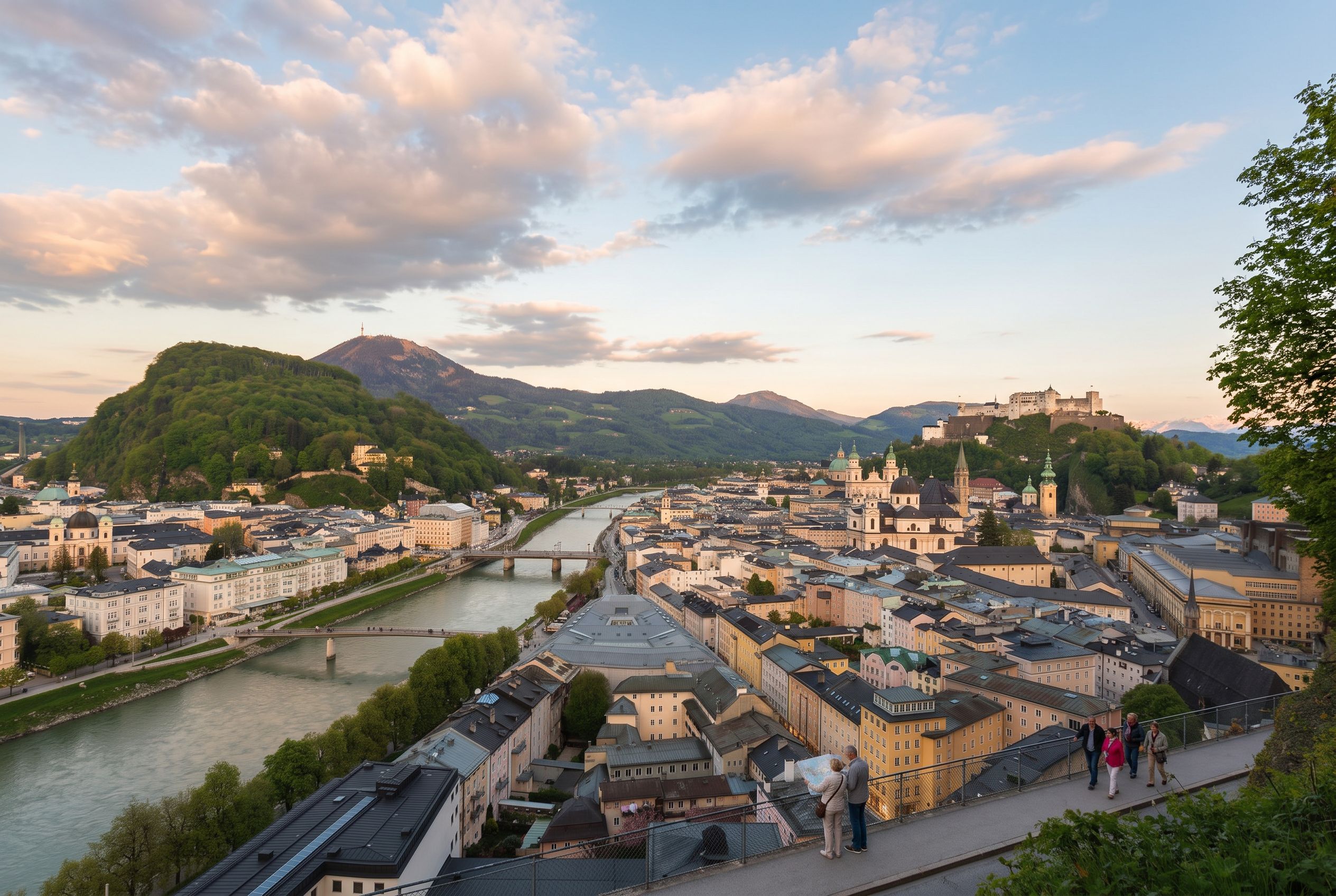
Salzburg is split by the Salzach River into two main halves: the compact, hilly Altstadt (Old Town) on the left bank and the flatter, more modern Neustadt (New Town) on the right. The fortress looms above the Altstadt, while the riverbanks offer level, scenic paths. Most major sights cluster within a 15-minute walk of each other in the Old Town, making it easy to explore without long transfers.
The Altstadt is a UNESCO World Heritage site, a maze of narrow lanes, grand squares, and Baroque facades. The main shopping street, Getreidegasse, is pedestrian-only and lined with wrought-iron guild signs. The river itself is a natural orientation point: the Salzach flows north-south, and the fortress hill (Festungsberg) rises steeply on the left bank. Across the river, the Neustadt holds the main train station (Salzburg Hbf), the Mirabell Palace and Gardens, and a grid of quieter streets with hotels and restaurants.
For a senior traveller, the key insight is that the city is vertically compact—you can walk from the river to the fortress funicular in under 10 minutes—but the terrain varies dramatically. The riverfront promenades are flat and smooth. The Old Town’s pedestrian zone is mostly level but paved with cobblestones. The hills (Festungsberg, Mönchsberg, Kapuzinerberg) are steep and best tackled with mechanical assistance. In short, Salzburg is walkable — but it is not effortless walking.
Where should I stay in Salzburg?
For travellers over 50, the best base is the Altstadt or the area just across the river near Mirabellplatz. Staying in the Old Town puts you steps from the fortress funicular, Mozart’s Birthplace, and the cathedral, while the Mirabell district offers quieter streets, level access, and a short walk to the river. Avoid the hillside suburbs unless you have a car.
The Altstadt is ideal for those who want to step out and be in the heart of the action. Hotels here are often in historic buildings, which can mean stairs, narrow corridors, and no lift—always check before booking. The area around Mirabellplatz, on the Neustadt side, is a strong alternative: the Mirabell Gardens are flat and bench-filled, the bus to the train station runs frequently, and the walk to the Old Town across the Staatsbrücke bridge takes about 10 minutes on level ground.
For most travellers in their 50s and 60s the deciding factors are a quiet room, a good breakfast and a lift. A review left on Google in July 2026 for the IMLAUER Palais Mirabell at Mirabellplatz 8 describes what that looks like in practice: “Great communication before arrival, a warm welcome once we arrived. The newly renovated rooms are beautiful and practical. We had courtyard facing, which were v quiet.” Street-facing rooms in older buildings with single glazing are the ones to ask about. If you value sleep, request a room facing the courtyard rather than the street.
How accessible is the Old Town?
The Old Town is generally good for seniors if you stick to the main pedestrian routes and use the funicular for the fortress. Cobblestones are the main challenge—they are uneven and can be tiring for knees and hips. The riverfront paths are flat and smooth, offering a comfortable alternative for a stroll. Many attractions have barrier-free entrances, but always check individual sites for step-free access.
Salzburg’s tourism board actively promotes accessible travel. According to Salzburg’s official barrier-free travel page, many attractions, churches, event venues, and restaurants have wheelchair-accessible entrances. The Festungsbahn funicular is barrier-free, providing easy access to the fortress summit. Salzburg AG runs 108 low-floor articulated trolleybuses, all with a kneeling function and a fold-out ramp at the second door, and the tourism board notes that the vast majority of public transport vehicles have low-entry doors. ÖBB lists lifts and escalators at Salzburg Hauptbahnhof; personal assistance has to be booked with the Mobility Service Centre at least three hours before departure.
However, the historic fabric imposes limits. The DomQuartier, for instance, has been adapted “within the limits of monument protection,” meaning some areas still have steps. The footpath up to the fortress is steep and gravelly—about 100 metres of elevation gain—and is not recommended for anyone with balance or endurance issues. A guest wrote of the FestungsBahn on Google in November 2025: “Very nice funicular ride up to the castle. Easy to buy the ticket online as a combined ticket with the castle. Definitely recommend it.”
For those using a cane or rollator, the main challenges are narrow pavements on Getreidegasse and the lack of ramps at some older cafés. Public accessible toilets are available, but many require a Euro-Key—a standard key for disabled-access facilities across Austria. It is issued by the Austrian Disability Council rather than sold to visitors: applicants need a disability pass with the matching entry, a section 29b parking permit or a medical certificate, and for those who qualify it is usually free.
What are the top sights for travellers over 50?
The five must-visit locations for seniors are: Hohensalzburg Fortress (via funicular), Mirabell Palace and Gardens, the Old Town itself, Mozart’s Birthplace, and the Salzach riverbank promenade. Each offers a different experience—history, gardens, culture, and relaxation—and all but Mozart’s Birthplace, which the Mozarteum Foundation states is not barrier-free, can be reached with minimal exertion if planned well.
Hohensalzburg Fortress
This is Salzburg’s signature landmark, visible from almost anywhere in the city. The funicular (Festungsbahn) takes you to the top in under a minute, avoiding the steep 100-metre climb. Once inside, the fortress museums, state rooms, and panoramic terraces are well worth the visit. As of August 2026 the fortress holds a Google rating of 4.6 out of 5 from 53,995 reviews. The operator is precise about the limits: the panorama terrace and the bastion by the mountain station are fully accessible, and a lift in the bell tower reaches the castle courtyard, the armoury exhibition, the tavern, the Kuenburg bastion and the marionette museum — but the interior of the fortress as a whole is not barrier-free.
Mirabell Palace and Gardens
These formal gardens are a senior-friendly highlight: level paths, plenty of benches, and a direct view of the fortress. The Marmorsaal in the palace hosts weddings, conferences and concerts, while the gardens are free and, according to the city, open all year: 5am to 11pm from April to September and 7am to 10pm from October to April, with some sections closed in winter. Salzburg’s tourism board states that the palace and the gardens provide barrier-free access. It’s the perfect spot for a mid-morning rest or an afternoon stroll.
Salzburg Old Town
The Altstadt is best experienced on foot, but at a slow pace. Start at Kapitelplatz, walk through the cathedral square, and wander down Getreidegasse. The cobblestones are manageable if you wear sturdy shoes with good grip. Allow two to three hours for a relaxed loop, with a coffee stop at a café like Tomaselli or Fürst (home of the original Mozartkugel).
Mozart’s Birthplace
Located at Getreidegasse 9, this museum takes about an hour according to the Mozarteum Foundation. It’s a short indoor break between walks, with exhibits on Mozart’s early life. The Foundation states plainly that Mozart’s Birthplace is not barrier-free. The Mozart Residence across the river is the step-free alternative: it can be entered without steps through the Theatergasse door, which staff unlock when you call ahead.
Salzach Riverbank
The river promenades are the flattest walking surfaces in the city. The path along the left bank, from the Staatsbrücke to the Müllnersteg, measures about 850 metres of level, paved ground. It’s ideal for an evening stroll or a morning walk before the crowds arrive. Roughly halfway along it passes the valley station of the MönchsbergAufzug at Anton-Neumayr-Platz, and the city lists an accessible public toilet at the Müllner Schanze near the far end.
How do I get around the city?
Public transport is the best option for seniors: the city’s 108 trolleybuses are low-floor with fold-out ramps, frequent, and cover the entire city. The walk from the train station to the Old Town is about two kilometres on level ground, so allow roughly half an hour at an unhurried pace; most travellers over 50 prefer the bus (10-15 minutes) to save energy. Taxis and ride-shares are widely available for door-to-door service.
Salzburg’s trolleybus network is efficient and accessible. Line 3, for example, runs from the Hauptbahnhof past Mirabellplatz to the Mozartsteg at the edge of the Old Town, and Ferdinand-Hanusch-Platz on the Altstadt side is the main interchange. In the city core zone a single ride costs €3.00 from the driver, or €2.50 each in a pre-purchased pack of five; a 24-hour ticket is €5.20 from a machine, the app or online and €6.40 on board, on the tariff in force since 1 January 2026. The transport authority’s senior fare of around 20 per cent requires an ÖBB Vorteilscard Senior rather than proof of residence, so most visitors will not qualify — museums are a different matter, and Mozart’s Birthplace, for instance, charges seniors €15 instead of €18.
The bigger saving is the Guest Mobility Ticket, introduced on 1 May 2025. Every overnight guest in the province of Salzburg receives it digitally or as a PDF at check-in, and it covers all public transport in the province for the whole stay. It is financed by a mobility fee charged on top of the overnight tax, so there is nothing to buy and nothing to collect at the tourist office. For the fortress, the operator describes the footpath as about 100 metres of climb, partly gravelled and steep in places, taking roughly 15 to 20 minutes — and warns of gravel, steep stone steps and bumpy paving along the way.
What about museums and music for culture lovers?
Salzburg is a paradise for music and museum lovers, with Mozart’s legacy at its heart. The key venues are the Mozart Birthplace, Mozart Residence, DomQuartier, and the Salzburg Museum, whose main building in the Neue Residenz stays closed for renovation until 2027. For live music, the Salzburg Festival runs from 17 July to 30 August 2026, and the Stiftung Mozarteum holds concerts all year round.
The Mozart Birthplace is a must for classical music fans, with original instruments, letters and portraits. The Mozarteum Foundation puts a visit at about an hour and states that the house is not barrier-free. The Mozart Residence, on the other side of the river, has a step-free entrance on Theatergasse that staff open on request, and also takes about an hour. A combined ticket for both houses costs €25 and stays valid for 48 hours from validation.
The DomQuartier is a museum complex that includes the cathedral, the Residenz, and the art gallery. It has been rebuilt for accessibility within the limits of monument protection: wheelchairs can be borrowed at the porter’s lodge, and both lifts may be used only when a member of staff accompanies you, so announce yourself on arrival. The highlight is the Dombogenterrasse, the terrace linking the Residenzgalerie and the cathedral, with views over the Old Town. Admission is €15 for adults in full operation and €12 when only part of the circuit is open. The Salzburg Museum in the Neue Residenz has been closed for a complete renovation since November 2023 and is expected to stay shut until 2027, so plan around it.
For live music, the Salzburg Festival is world-renowned, but it’s also the busiest and most expensive time to visit. For a quieter experience, attend a concert at the Mozarteum or the Kollegienkirche. Many churches host free organ recitals during the summer. The Felsenreitschule, a riding school turned performance venue, can be seen on the public tours of the Festival houses run by the Salzburger Festspiele: €7 for adults, meeting at the Festival shop in Hofstallgasse, and a valid Salzburg Card covers one visit.
What is a realistic pace for a day in Salzburg?
A realistic day for a traveller over 50 includes two to three major sights, a long lunch, and a rest in the afternoon. Start at 9:00 am after a good breakfast, visit one indoor site (like Mozart’s Birthplace), then walk to the fortress via funicular. Have lunch near the river, rest at Mirabell Gardens, and finish with a stroll along the Salzach. Avoid packing in more than four stops.
Salzburg’s compact size makes it tempting to rush, but the cobblestones and hills demand a slower rhythm. A common mistake is trying to see the fortress, the Old Town, and a museum all before lunch. Instead, spread your activities across the day with a proper break. The riverbanks are perfect for a picnic or a coffee with a view.
Austrian law lets shops open from 6:00 am to 9:00 pm Monday to Friday and to 6:00 pm on Saturdays, and requires them to close on Sundays and public holidays. Salzburg has its own exception: inside the inner-city zone, shops whose range is limited to souvenirs, postcards, art and craft work may open on Sundays and holidays between 8:00 am and 6:00 pm. Sights are open on Sundays, making it a good day for cultural visits. If you’re visiting in summer, the heat can be intense in the narrow streets—carry water and a hat.
When is the best time to visit for seniors?
The best times for travellers over 50 are May, June, September, and October. These shoulder months offer mild weather, fewer crowds, and lower prices. July and August are peak season with the Salzburg Festival, high temperatures, and packed streets. Winter (December to February) is cold but magical for Christmas markets and quieter sightseeing.
The City of Salzburg’s tourism statistics show how uneven the year is: in July 2026 the city’s accommodation businesses reported 213,051 arrivals and 387,746 overnight stays, 3.8 per cent more than a year earlier. The festival season drives that peak — the Salzburg Festival ran from 17 July to 30 August 2026. For a calm visit, aim for late spring or early autumn. The fortress itself is open 365 days a year, but the funicular has maintenance windows — 9 to 13 November 2026 and 11 January to 14 March 2027 — when only the footpath and the outdoor areas are open. The river paths are pleasant in all but the coldest weather.
If you enjoy Christmas markets, the first two weeks of December are ideal: the Salzburger Christkindlmarkt runs from 19 November 2026 to 1 January 2027, and by early December the city is decorated but not yet at peak holiday crowds. January is quiet and cold, with some attractions on reduced hours—check ahead.
What about mobility and comfort on the ground?
Mobility in Salzburg is manageable for most seniors, but requires planning. The main challenges are cobblestones, hills, and stairs in older buildings. The solutions are: wear sturdy shoes, use the funicular for the fortress, take buses for longer distances, and book hotels with lifts. Benches are plentiful in the Old Town and along the river.
For those with knee, hip, or balance issues, the fortress walk-up is the route to avoid. The Mönchsberg ridge is the low-stress escape at the other end of the same hill: the MönchsbergAufzug lifts you from Anton-Neumayr-Platz to the top station at 485 metres for €3.40 one way or €4.80 return, and a FestungsBahn return ticket even allows the descent to be taken by that lift instead. Check the hours before an evening walk — in 2026 the lift runs 8am to 7pm on Mondays and 8am to 9pm from Tuesday to Sunday, with later hours from 18 July during the Festival.
The city publishes a list of public toilets; in the inner-city area the accessible ones are at the Nonntal bus terminal, Hanuschplatz, the Müllner Schanze, the top station of the MönchsbergAufzug, the Mirabellgarten aviary and Wiener-Philharmonikergasse. Accessible toilets are marked and can be opened with a Euro-Key. The nearest pharmacy is Apotheke zum Goldenen Biber at Getreidegasse 4, open Monday to Friday 9:00 am to 6:00 pm and Saturday 9:00 am to 1:00 pm, with Advent Saturdays running until 5:00 pm. For emergencies, the hospital Landeskrankenhaus Salzburg is at Müllner Hauptstraße 48, and the ambulance number is 144.
“Garden is beautifully sculptured with trees and flowers. So spacious and relaxing. Plenty of benches around the garden. Everything was well kept and the flowers were blooming in multi colors” — one Google reviewer wrote about the Mirabell Gardens in June 2026
Can I combine Salzburg with other destinations?
Yes, Salzburg is an excellent base for day trips to the Salzkammergut region, including Hallstatt and the Zillertal valley. For families with grandchildren, we have dedicated guides to Hallstatt With Grandchildren and The Zillertal With Grandchildren. For active seniors, the Cycling and E-biking the Zillertal guide covers gentle valley rides.
On the 2026 timetable, direct trains from Salzburg Hauptbahnhof reach Vienna in about 2 hours 25 minutes, Munich in about 1 hour 42 minutes and Innsbruck in about 2 hours 6 minutes. The Zillertal is further than it looks: Salzburg to Jenbach takes about 1 hour 48 minutes without a change, and the Zillertalbahn needs another 50 minutes from there to Mayrhofen. It rewards the journey with gentle walks, e-biking and traditional villages. The Zillertal is particularly good for active seniors who want to combine culture with nature.
For those who prefer a more leisurely pace, the Salzkammergut lakes are within easy reach: on the 2026 timetable Mondsee is 56 minutes from Salzburg Hauptbahnhof without a change, St. Wolfgang about 1 hour 9 minutes and Hallstatt about 1 hour 54 minutes with one change, the last stretch to the village by ferry across the lake. Each offers flat lakeside paths and historic villages. A day trip to Hallstatt is popular but can be crowded—visit on a weekday in shoulder season for the best experience.
What about safety and health while visiting?
Salzburg is a very safe city with low crime rates. The main health considerations are staying hydrated in summer, wearing sun protection, and knowing where to find medical help. The emergency number is 112, the ambulance is 144, the doctor-on-call service on 141 covers nights and weekends, and 1450 gives health advice around the clock. Pharmacies are well-stocked and can advise on minor ailments.
Austria’s public health portal collects all four numbers on its emergency numbers page, worth saving before you travel. For minor issues, the pharmacy at Getreidegasse 4 is central and open during business hours. Duty pharmacies rotate; the Austrian Chamber of Pharmacists says the one currently on duty can be found through its pharmacy search or by calling 1450 free of charge.
Tap water in Salzburg is safe to drink and of excellent quality. The city’s climate is continental: on the 1991–2020 averages published by GeoSphere Austria, July days reach about 27°C and July nights stay near 16°C, while in January the average daytime high is 3.6°C and the average night falls to −1.3°C. Expect thunderstorms in summer and frozen paving in winter. Pack layers and a waterproof jacket regardless of season.
What should I pack for a trip to Salzburg?
Pack comfortable walking shoes with good grip for cobblestones, layers for changing weather, a daypack for water and snacks, and a small umbrella. If visiting in summer, bring sun protection and a hat. In winter, pack warm gloves, a scarf, and thermal layers. A Euro-Key for accessible toilets is useful but not essential.
Sturdy, broken-in shoes are non-negotiable. A light rain jacket is useful year-round, as showers can appear suddenly. For the fortress funicular and museums, a small backpack is better than a shoulder bag—it leaves your hands free for balance.
If you plan to use public transport, check whether your accommodation has already issued you a Guest Mobility Ticket — every overnight guest in the province gets one at check-in — before buying anything. A refillable water bottle is handy, as public fountains are common in the Old Town. Finally, bring a sense of humour—Salzburg’s charm is best enjoyed at a relaxed pace.
Frequently Asked Questions
Is Salzburg expensive for seniors?
Salzburg is moderately expensive, comparable to other Austrian cities. The published admission prices give the clearest picture: Hohensalzburg Fortress is €15.50 with the funicular, Mozart’s Birthplace €18, and the DomQuartier €15, which comes to €48.50 for the three. A 24-hour Salzburg Card costs €35 from November to March and €38 from April to October, so it pays off once you take in three major sights. Anyone staying overnight in the province also receives a free Guest Mobility Ticket at check-in, covering all public transport for the length of the stay. Museum concessions exist — Mozart’s Birthplace charges seniors €15 — but the fortress has no senior tariff at all.
Can I visit the fortress without climbing?
Yes, the Festungsbahn funicular provides barrier-free access to Hohensalzburg Fortress. The ride takes 54 seconds, runs every ten minutes and costs €6.30 for a return trip on its own, or €15.50 as part of the fortress basic ticket (included in the Salzburg Card). The operator confirms that the panorama terrace and the bastion by the mountain station are fully accessible, while the interior of the fortress is not. The footpath climbs about 100 metres in 15 to 20 minutes over gravel and steep stone steps and is not recommended for those with mobility concerns. Watch the maintenance windows: the funicular is out of service from 9 to 13 November 2026 and from 11 January to 14 March 2027.
Are there guided tours suitable for seniors?
Yes, many walking tours are designed for slower paces. Salzburg’s official tourism board works with certified Salzburg Guides who offer around 80 different tours in 18 languages, and it states that barrier-free tours are available on request — worth asking for when you book. Public city tours run every day of the week and can be booked online. For a look inside the Festival venues, the Salzburger Festspiele run public guided tours of the Großes Festspielhaus, the Felsenreitschule and the Haus für Mozart for €7, and a valid Salzburg Card covers one of them.
What if I have a medical emergency?
Dial 112 anywhere in Europe, or 144 for an ambulance in Austria. The doctor-on-call service is 141, staffed mainly from 7pm to 7am, from Friday 7pm to Monday 7am and all day on public holidays; 1450 gives health advice around the clock. The main hospital is the Uniklinikum Salzburg at Müllner Hauptstraße 48, whose central emergency department is open 0 to 24 hours. The pharmacy at Getreidegasse 4 is central and open Monday-Friday 9:00 am-6:00 pm, Saturday 9:00 am-1:00 pm. Duty pharmacies rotate; the current one can be found through the Chamber of Pharmacists’ search or by calling 1450.


