
Venice rewards walkers, and it punishes them. A day of bridges, calli and vaporetto steps leaves most travellers over 50 with tired legs and a wish for somewhere quiet to put them up. The answer, increasingly, is to sleep where the spa is. The Lido, a flat island of beachfront hotels twenty minutes by water from St Mark's, has become the calmer half of the Venetian pair, while a handful of properties in the historic centre run serious wellness floors of their own.
lifts, step-in access, quiet rooms, treatment range and thermal water. Rates are indicative and vary by season and booking channel. General hotel picks for the city sit in our complete guide to Venice for travellers over 50.
Why do so many spa stays happen on the Lido rather than in central Venice?
The Lido suits spa stays because it is flat, open and quieter at night, with beachfront hotels and barrier-free transport. Central Venice has fewer documented wellness hotels, and its hotel spas tend to be small. For travellers 50-70 who want rest rather than constant sightseeing, the Lido's resort rhythm is the practical choice.
Local tourism information for the island describes the Lido as having hotels and inns with ramps, lifts, adapted chairs and seats, accessible ferry berths, and island buses with platforms and reserved wheelchair seats (Lido without Barriers). That infrastructure is unusual in the lagoon and it changes what a spa holiday here can look like.
Guest feedback gathered across Lido spa-hotel listings repeatedly describes the island as a quiet base away from central Venice, with the vaporetto stop, shops and beach within walking distance of the main street properties. The trade-off is real: if you want to be in the middle of the sights all day, the Lido means two boat rides a day. If you want to sleep well, it means one.
What does the Ausonia Hungaria offer guests who want to rest?
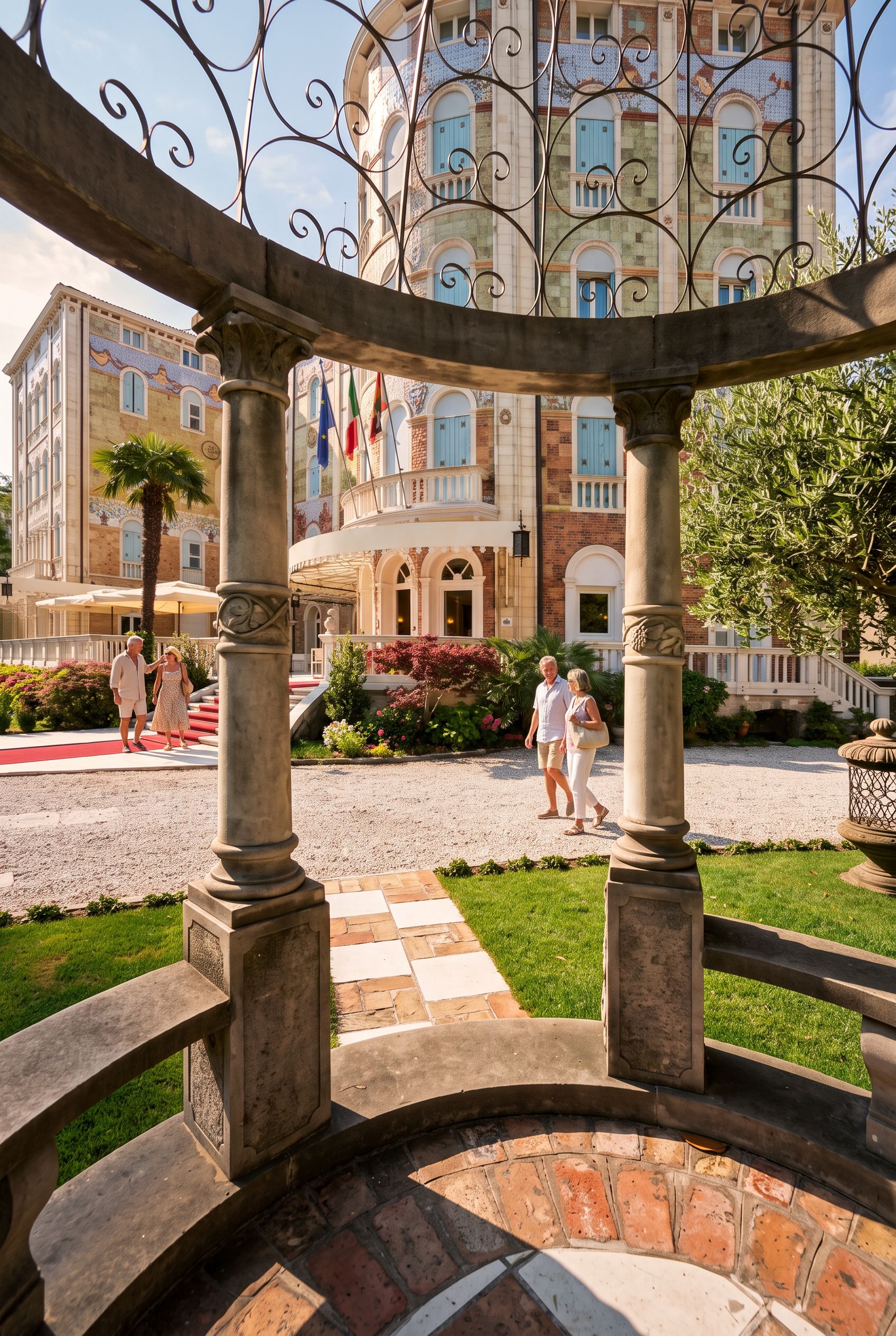
Ausonia Hungaria Wellness & Lifestyle Hotel is a five-star property on the Lido's main street with a spa, sauna, Turkish bath, massage, a seasonal outdoor pool and a rooftop terrace. It sits a few minutes' walk from the Lido vaporetto stop, and guests describe it as a quiet base away from the crowds.
The hotel's own pages describe a wellness area with treatments and a seasonal outdoor pool, and the official Lido tourism booking page states that the spa is for hotel guests. Guests writing on Google in April 2025 described the welcome and service warmly: "The hotel's welcoming and attentive staff ensures that each moment is an authentic experience. At Ausonia Hungaria, every detail speaks of effortless elegance and a genuine connection to the place."
"The hotel's welcoming and attentive staff ensures that each moment is an authentic experience. At Ausonia Hungaria, every detail speaks of effortless elegance and a genuine connection to the place.❤️ 100% recommended!" (Google, April 2025)
Reviews also mention a basement spa with Thai massages, a garden, and a rooftop bar open for sunset drinks with views over Venice and the lagoon. Breakfast is served à la carte at the table rather than as a buffet, which some guests found slow and repetitive. Several rooms have a clear glass wall between the bathroom and bedroom, and motion-sensor bathroom lighting that switches on automatically at night.
 AI-edited
Two practical notes from guest feedback: some front-facing rooms pick up noise from the bar area, and certain room categories are small. The hotel does not publish step counts or shower-style details for its accessible rooms; ask when booking. As of September 2026, the property holds a Google rating of 4.6 out of 5 from 789 reviews.
Is the Melia Venezia Lido a good choice for a quiet spa break?
Melia Venezia Lido is a newly opened hotel about a minute's walk from the Lido vaporetto stop, with modern, quiet rooms, a highly rated breakfast buffet and easy access to the beach. It is not a spa hotel in the full sense; guests describe it as a comfortable, well-run base rather than a wellness destination.
Guest feedback consistently reports the rooms as new, clean, modern and quiet, with comfortable beds and a choice of pillow firmness. Reception is singled out for help with directions, bookings and special occasions. A guest wrote on Google in March 2026 that the hotel is "situated very close to the public transportation and on the main road with all the shops," with staff "very friendly and helpful."
Two planning points recur in reviews. Air conditioning is centrally controlled and cannot be adjusted from individual rooms, and some guests report rooms running warm. Some rooms have windows that cannot be opened, and parking spaces are limited. The breakfast area is small and can get crowded with waiting times, though the buffet itself is rated highly for quality and variety.
Which Venetian spa hotels use thermal water and therapeutic treatments?
Aman Venice, in the historic centre, is the clearest documented example in Venice proper: it offers three treatment rooms, a fitness studio, thermal bathing treatments using waters from Salsomaggiore Terme, personal training programmes and spa rituals. The wider thermal tradition of the region sits inland at Abano Terme, which has its own dedicated guide.
Aman's own wellness pages state that thermal bathing treatments use the healing waters of Salsomaggiore Terme, and that the spa offers three "healing pathways." The property does not document accessibility details such as step-in access or lift provision in the material reviewed; ask when booking.
The Euganean thermal tradition, with its mud therapies and inhalation treatments, is centred on Abano Terme in the Province of Padua rather than on the lagoon. That subject is covered separately in our thermal-baths guide and is not the focus here.
What about the Lido's historic grand hotels and their spas?
The Hotel Excelsior Venice Lido Resort reopened in May 2026 after a major refresh, with a restored Palm Court, redesigned rooms and suites, and new terrace dining and beach-club facilities. Its spa provision is not documented on an official page excerpt reviewed here, and one hotel review describes the property as having a pool and gym but no spa.
The Excelsior's beachfront position and private beach with cabanas, seasonal bar and restaurant, pool, gym and tennis courts are documented.
The wider Lido hotel scene is in the middle of a revival. Reporting in September 2026 describes work beginning on 11 September 2026 on the Grand Hôtel des Bains, closed since 2010, with more than €200 million committed and a target reopening in 2030. Regional coverage in 2026 also notes the opening of a new four-star superior property in a restored 1920s building, part of what the press has called a quiet luxury revival on the island (Euronews, September 2026).
How accessible are the spa hotels and the Lido itself?
The Lido has the strongest documented accessibility in the Venice area: ramps, lifts, adapted chairs and seats, accessible ferry berths, and buses with platforms and reserved wheelchair seats. Individual spa hotels document less. Where a property is silent on step-free access, shower style or lift provision, that detail is not documented and should be confirmed at booking.
Local tourism information states that Lido establishments offer adapted chairs and seats, ramps and walkways for barrier-free access, and that the island is connected to Venice and the mainland by ferry lines with accessible berths and dedicated seats for wheelchair users. Buses on the island have platforms and reserved seats.
For individual properties, the picture is thinner. La Residence & Idrokinesis in Abano Terme is described as fully accessible, but the accessible features are not itemised. Hotel Tritone Venice documents accessible rooms and 24/7 medical assistance. Abano Ritz lists disabled access without detailing steps, lifts or room adaptations. Aman Venice does not document accessibility details. Hotel Terme Venezia does not document them either.
When is the quietest time to go, and how do you avoid the crowds?
Venice is busiest from June to August, with July the peak month, and quietest from December to February, especially January. April to June and September to October combine better weather with fewer visitors. Terme Euganee advises weekday visits for a quieter experience.
Month-by-month climate data for Venice shows July averaging around 25.2°C and August 24.8°C, while January averages about 4.2°C and December about 5.0°C. Rainfall is fairly even through the year, so planning around temperature and crowd levels makes more sense than planning around rain.
For a spa stay specifically, the shoulder months are the practical sweet spot: warm enough for the outdoor pool at the Lido properties, cool enough to enjoy a sauna or Turkish bath without discomfort, and quiet enough that the vaporetto is not standing-room only. July and August combine heat, crowds and price pressure.
Note that acqua alta risk in autumn and winter is referenced in climate and travel sources for the lagoon setting. For a fuller picture of seasonal planning, see our Venice guide for travellers over 50.
What do spa hotel stays in Venice and on the Lido cost?
Published rates for the properties in this roundup are limited. Ausonia Hungaria lists prices starting at €114. Hotel Cipriani, which is not a spa hotel in the same sense, runs roughly €1,300 in April and late October and €2,300 or more in June and September. Rates are indicative and vary by season and booking channel.
Most spa hotels in Venice and on the Lido do not publish their treatment prices or package rates on the pages reviewed here. Where a property does publish, the figures are worth checking directly against your dates, because the same room category can cost differently depending on booking channel and cancellation terms.
Half-board is not documented as a standard option at the properties in this roundup. Where it exists, it is arranged directly with the hotel. For a rest-focused stay, breakfast is the meal most guests comment on, and the Lido properties generally score well on it.
How should travellers 50-70 book a spa stay here?
Book directly with the property where possible, ask specifically about spa access, treatment booking and accessibility, and confirm cancellation terms in writing. The Lido properties are generally reached by vaporetto from Santa Lucia station or Piazzale Roma, with the crossing taking about 35 minutes.
Ausonia Hungaria's own contact page gives the waterbus lines serving the Lido stop: line 5.1 departing every 20 minutes with a 45-minute journey along the Giudecca Canal, line 1 departing every 12 minutes with a one-hour journey, and line 2 departing every 12 minutes taking 50 minutes. The Alilaguna direct service to the Lido runs every 30 minutes with a maximum journey time of one hour, at €15 one way or €27 return including luggage.
From the Lido stop, the walk to the main-street hotels takes a few minutes. Villa Mabapa notes about 10 minutes on foot from the Venezia Lido stop. Hotel Rigel says it is less than five minutes on foot from public water transport, with services running day and night.
What health and safety provisions should you know about?
Venice has a main hospital on the island, Ospedale SS. Giovanni e Paolo in Castello, and pharmacies are widespread in the historic centre. The emergency number is 112, and 118 is also used for urgent medical help. Hotel Tritone Venice documents 24/7 medical assistance for guests.
For the Lido, health infrastructure is reached via the same ferry and bus network that serves the hotels. Safety and mobility support on the island are documented through accessible transport and beach access infrastructure rather than through hotel-level medical services.
Individual spa hotels in this roundup do not generally publish their medical assistance arrangements. Hotel Tritone Venice is the exception, with 24/7 medical assistance documented. For the others, ask at booking what medical support is available and how far the nearest pharmacy is.
For a slower afternoon between treatments, our guide to Rome's parks and gardens shows the same principle applied elsewhere in Italy: plan the rest, not just the sights.
Which spa hotel suits which kind of traveller?
For a full wellness hotel with a spa, pool and rooftop on the Lido, Ausonia Hungaria is the clearest documented choice. For a modern, quiet, well-run base near the vaporetto with a strong breakfast, Melia Venezia Lido works well. For thermal bathing in Venice proper, Aman Venice is the documented option. For a multi-day thermal cure, look inland at Abano Terme.
The Lido's advantage for travellers 50-70 is structural: flat ground, accessible ferries, quieter nights and resort-style space. The disadvantage is the daily crossing if you want to be in the historic centre. Central Venice's advantage is proximity to everything; its disadvantage is that hotel spas there tend to be small, and one FlyerTalk comment on a famous Venice hotel described its spa as modest compared with modern hotel spas.
Whichever you choose, the planning that matters is the same: confirm spa access and treatment booking before arrival, ask about step-free routes and shower style, request a room away from bars and lifts, and check cancellation terms. The rest is water, warmth and time.
For gentle walking routes that pair well with a spa stay, see our guide to easy strolls and piazzas for the same approach applied to another Italian city.


