
Chiang Mai rewards a certain kind of traveller: the one who has stopped rushing. Founded in 1296 as the capital of the Lanna Kingdom, the city is described by UNESCO as the "Rose of the North", and it has been a UNESCO Creative City of Crafts and Folk Art since 2017. For visitors aged 50 to 70, the appeal is not a checklist of sights but a rhythm. Mornings at a temple before the tour buses arrive, a long lunch in the shade, an afternoon cooking class, and a market that only comes alive after dark on a Sunday. This guide covers the standout experiences across those interests, with the practical detail that matters: how much walking each one demands, where the shade and seating are, and how to sidestep the midday heat and the crowds.
Chiang Mai is also listed by UNESCO as part of the Global Network of Learning Cities, with membership since 2020, which says something about how the city wears its history. The experiences below are chosen for effort level as much as for interest.
When is the best time to visit Chiang Mai?
The cool season from November to February is the most comfortable window for sightseeing, with clear skies and lower rainfall. March and April bring heat and smoke, September is the wettest month, and mid-February is specifically flagged for poor air quality during burning season.
Chiang Mai's year divides into three repeating patterns. November to February is cool and drier, March to May is hot, and June to October is rainy. Month-by-month averages for the city show January as the coolest month, April as the hottest with an average high of 37°C, and September as the wettest. February is the driest month at 10 mm, while August is the wettest at 223 mm, and the city receives about 1,139 mm of rain a year. Sunshine tells the same story: Chiang Mai averages 8.6 hours a day in March against 3.6 in August.
That dry, bright March figure comes with a caveat. Burning season is flagged for mid-February, when air quality can be significantly poor, and a traveller planning for an older companion was advised to avoid that period for exactly this reason. The local tourism sector describes peak demand as running from late October to the end of January, so the most comfortable months are also the busiest. If avoiding heat, smoke and rain matters most, March, April and September are the clearest months to avoid.
Which Old City temples suit a gentle morning?
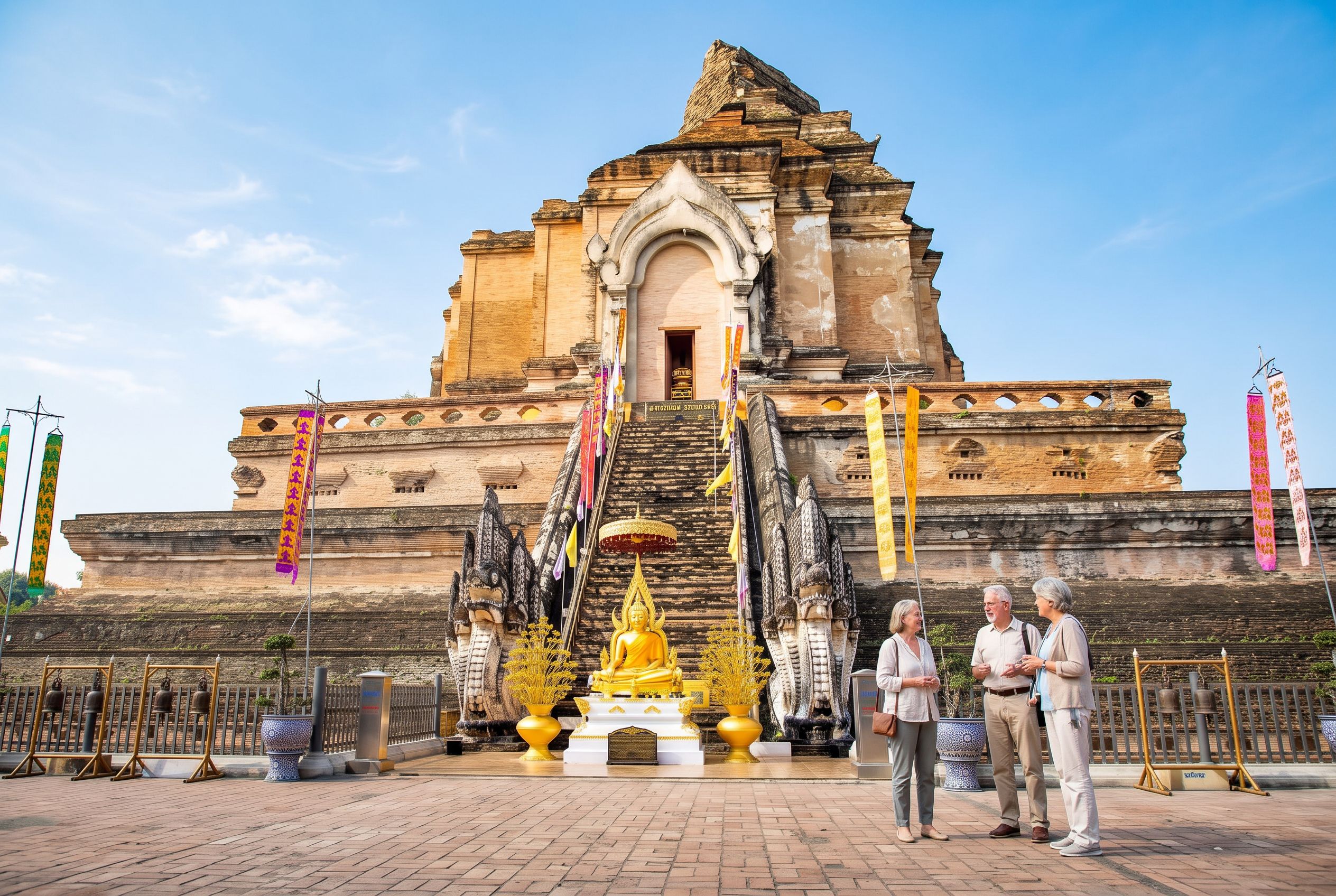
The flat Old City temple circuit is the best-supported low-effort option, with Wat Phra Singh, Wat Chedi Luang and Wat Chiang Man all offering largely level main grounds, shade and benches. Courtyards are usually easier walking than the surrounding streets, where uneven sidewalks and high kerbs are common.
one describes it as flat with uneven sidewalks and obstacles, while another says the terrain on the Old City walking route is flat throughout. Kerbs, scooters, carts and drains can make some stretches awkward or tiring. The practical answer is to move between temples by short taxi or songthaew hop and save your walking for the courtyards themselves.
Wat Phra Singh is described as largely flat and step-free at ground level, with broad paved grounds and room to move between halls, though some buildings still have threshold steps. Wat Chedi Luang, the central historic complex, has mostly level main courtyard areas with benches and shade, but some steps around the ruins and side areas. Wat Chiang Man, identified as Chiang Mai's oldest temple, has flat, compact grounds with shaded areas and a step-free main hall area, though the steep pagoda steps are best avoided. Temple visits require removing footwear before entering buildings; sandals are fine for walking to the sites.
 AI-edited
the sources say Old City temples are free or low-cost, but exact fees are not consistently documented, and no senior or over-65 pricing is documented for these places. No closure days are documented either. Where exact booking terms are not published for a site, they are not documented, and walk-in visits are implied throughout. For a fuller treatment of the individual temples, see our dedicated guide to the temples of Chiang Mai.
How do you reach Wat Phra That Doi Suthep without the stairs?
Exact fares and operating conditions are not consistently documented, so confirm on arrival.
The mountain temple is the one experience on this list that requires a deliberate journey. By road, Chiang Mai International Airport to Doi Suthep is 29 km, about 50 minutes with clear roads (free-flowing traffic, no stops). From the Old City the drive is shorter, but the mountain road curves, so if you are prone to motion sickness, ask for a seat near the front and take the journey slowly.
The 306 steps are the traditional approach, and the lift is the alternative. Because the sources disagree on exactly how far the lift carries you and what it costs, treat this as a detail to confirm with your driver or the site on the day rather than something to plan around in advance. A private operator, Authentic Thai Tours, runs a specifically named "Oneday Doi Suthep & San Kamphaeng Hot Springs Accessible Tour" that includes an accessible van with a hydraulic wheelchair lift, an English-speaking guide, lunch and admission fees, and it says starting times, pace, rest periods and walking distances can be adjusted to the guest's needs. The operator's own site does not show a senior fare for these tours.
Which outdoor stop is easiest on the legs?
Royal Park Rajapruek is the clearest low-strain outdoor option, with wide paved paths, benches at regular intervals, accessible toilets near the main entrance pavilion, and a golf-cart shuttle when operating. It is open daily from 8:00 a.m. to 6:00 p.m., with admission of 100 baht for adults and 50 baht for children.
The park is described as one of the most accessible large parks in northern Thailand, and the bench-and-shuttle setup implies a calm, low-effort visit. The shuttle runs when operating, so if you are relying on it, ask at the entrance rather than assuming. No booking or cancellation terms are documented for the park, and no senior tariff is published for it.
Two other low-effort options are worth knowing. The Chiang Mai City Arts & Cultural Centre offers elevator access and ground-floor-friendly routes, with step-free options noted, and one source suggests asking staff for step-free routes and quieter galleries. It is an indoor cultural stop, which makes it a sensible choice on a hot or hazy afternoon. The Three Kings Monument plaza is a flat, open starting point for getting oriented, with benches and shade and short, mostly level walking. No booking is needed for either.
For a calmer, garden-based half day, the Queen Sirikit Botanical Gardens were recommended in a mobility-focused discussion as a nice half-day stroll, and Huay Tung Tao for a track around the lake. Both were framed as easier alternatives to temple-heavy touring.
Is a cooking class worth it, and how much standing is involved?
A cooking class is one of the most popular half-day activities in Chiang Mai and suits travellers who want a cultural experience without long walks.
In a long forum account of a seven-day stay, one contributor described a rhythm of lazy mornings with long breakfasts and swims mixed with active sightseeing, plus a massage every single day. A cooking class fits that pattern neatly: it occupies a morning or afternoon, it is usually indoors or shaded, and it ends with a meal you do not have to go out for.
This guide cannot tell you which ones offer stools at the prep bench, air-conditioned classrooms or step-free access. Ask those questions when you enquire. The same applies to pricing: no class rates are documented here, so treat any figure you see as indicative and confirm with the operator. If you want to pair a class with recovery time, our guide to spa and wellness retreats in Chiang Mai covers the massage culture that forum contributors describe as a daily fixture.
How do you choose an ethical elephant sanctuary?
What can be said with confidence is about terrain and heat rather than about any named operator. Sanctuaries sit outside the city, generally in wooded or valley settings, and a visit typically involves time on your feet on ground that may be uneven. Ask specifically about those points, and ask how much of the visit is spent standing versus seated.
On heat, the general Chiang Mai pattern applies with force: April averages a high of 37°C, and the cool season from November to February is the most comfortable window for any outdoor activity. A morning visit in the cool season is the sensible plan. No sanctuary rates, booking terms or cancellation policies are documented, so confirm all of those with the operator. If a sanctuary cannot answer direct questions about rest areas and walking distances, that is useful information in itself.
What should you know about the Sunday Walking Street?
The Sunday Walking Street market is described in forum accounts as an absolute must, and a mobility-focused discussion notes it can be crowded but still offers plenty to see and eat. It is a walking market, so plan for crowds, bring patience, and consider arriving early in the evening before the crush builds.
Crowds are part of the deal. For travellers aged 50 to 70 who tire in dense pedestrian traffic, the practical approach is to walk a section rather than the whole length, to keep to the edges where there is more room, and to treat the market as an evening of grazing and browsing rather than a route to be completed.
One accessibility signal is worth noting, though it applies to a different market rather than the Sunday Walking Street. The provincial tourism page states that one Chiang Mai city market fully facilitates disabled and elderly people, with a specially designed slope for the handicapped and walking paths linked together in a level smooth surface, making paths and corners accessible to wheelchair users. That is a strong signal for that particular market, but no full citywide accessibility map was documented, and the Sunday market's own facilities are not documented. Ask at your accommodation about the best entry point and the least crowded stretch.
How do you get around, and what about the heat?
Chiang Mai International Airport sits about 4 km from the city centre, and its official transport page lists public car service, public bus, shuttle bus, taxi and car rental. City buses run on a clear timetable from 06:00 to 23:30, and the official airport taxi desk in arrivals is described as the simplest and most predictable option, with a fixed fare.
The airport's own pages list shuttle routes A1, A2 and A3 from the airport to the city centre, and the RTC city bus system includes R3 Red and R3 Yellow airport-connected loops serving Chiang Mai Gate, Tha Pae Gate, Chang Phuak Gate, Nimmanhaemin, Suan Dok, Night Bazaar and Central Airport. For arrival logistics in detail, see our guide to getting to Chiang Mai and onward transfers.
Once in the city, forum contributors consistently advise using Grab, Bolt, InDrive or songthaews rather than relying on long walks, especially outside the Old City. One practical transport tip in a Chiang Mai thread said songthaews should not cost more than 30 THB for short rides, while tuk-tuks at night may need negotiation around 100 to 150 THB. Those figures come from a forum rather than an operator, and no published rate exists for these services, so treat them as a rough guide only.
Do your outdoor walking before mid-morning and after late afternoon. Spend the middle of the day indoors at the Chiang Mai City Arts & Cultural Centre, in an air-conditioned café, or back at your accommodation. The moat area has been under active road works and resurfacing, so comfortable walking routes and taxi access may change by section and date; the Chiang Mai CityLife reported in August 2026 that road reconstruction along the outer moat was accelerated so the city could reopen smoother roads before high season.
What health and safety details should you have on hand?
For medical emergencies in Chiang Mai, the documented numbers are 1669 for ambulance, 191 for police and 1155 for Tourist Police, with some sources also listing 199 for fire and rescue. The clearest documented major hospital within the municipality is Maharaj Nakorn Chiang Mai Hospital at 110 Intawaroros Road, Si Phum, Muang.
Chiang Mai University Pharmacy is documented in the city, with one branch next to the Faculty of Pharmacy on Suthep Road and another at the CMU Health Centre. A government healthcare guide warns that pharmacy standards vary in Thailand and says hospital pharmacies are generally more reliable, especially for people taking new or multiple medicines. For a traveller aged 50 to 70, that makes hospital or major-hospital pharmacy services the sensible default.
On safety, the airport and transfer pages emphasise structured, official transport options and fixed-route services, which supports straightforward arrival logistics. Keep the numbers above saved in your phone before you arrive.
How many days in Chiang Mai is enough?
forum contributors describe lazy mornings with long breakfasts and swims, active sightseeing in the cooler hours, and a massage most days.
That rhythm suggests the city rewards a slower schedule rather than a compressed one. A seven-day account from a forum contributor recommended not spending too long only inside the city, suggesting countryside and mountain outings such as Mae Rim, Doi Inthanon or Chiang Dao as additions. By road, Chiang Mai International Airport to Mae Rim is 23 km, about 35 minutes with clear roads (free-flowing traffic, no stops).
Our guide to where to stay in Chiang Mai when comfort comes first covers the accommodation side in detail. On the question of how many days, the honest answer is that no source states a number, and the better approach is to build in rest days and see how the heat treats you.
What else should you plan around?
Chiang Mai is a UNESCO Creative City of Crafts and Folk Art, recognised in 2017, and its tourism pattern is seasonal, with peak demand from late October to the end of January. The city's main hospitals and airport sit within Mueang Chiang Mai district, and the airport's official transport page lists public car service, public bus, shuttle bus, taxi and car rental.
Two recent changes are worth knowing. The Chiang Mai Zoo Aquarium reopened after years of closure for renovations, with a modernised facility, air-conditioning, an all-accessible safety walkway and upgraded habitats for 80 kinds of aquatic wildlife, reported by Nation Thailand in April 2024. Separately, the MRTA reported in December 2025 that the Red Line rail project was being extended from Mae Hia Saman Samakkee Intersection toward Royal Park Rajapruek and Chiang Mai Night Safari, specifically to connect tourist attractions and address PM2.5 and tourism needs. That is a planning-stage project rather than a finished service.
to 10:00 p.m. with last entry at 9:30 p.m. and closed on New Year's Day, Songkran Festival and the substitution day for Songkran. Group visits of 15 or more must be booked at least 7 days in advance. Beyond those, no senior or over-65 fares, reduced tariffs or pass discounts are documented for Chiang Mai city or province. Rates are indicative and vary by season and booking channel.
Chiang Mai works best for the over-50s when it is treated as a place to settle into rather than tick off. The temples reward an early start, the parks reward a slow circuit, and the markets reward an evening stroll rather than a marathon. Plan around the heat, keep the emergency numbers saved, and leave room in the schedule for the long breakfasts and daily massages that experienced visitors describe as the real rhythm of the city.


