
The Dolomites keep two calendars. One is written in snow and lift schedules; the other is written in cattle bells, harvest suppers and brass bands. For travellers aged 50 to 70, the second calendar is the more rewarding, and it runs almost the whole year. The official Dolomiti event pages group their listings under headings such as local traditions, history and the Great War, enogastronomy, music, theatre and film, and castles and fortresses, which tells you something useful before you book a single night: culture here is not a summer sideshow. It is the main event, spread across the seasons.
What follows is a month-by-month reading of that calendar, with a frank note on how busy each window is and what the published record does and does not say about access. Where a detail is not documented, this article says so rather than guessing. The weather itself, and the question of which month suits which walk, belongs to a separate guide on when to visit the Dolomites for fine weather and fewer crowds.
What festivals are held in the Dolomites?
The published calendar runs from late June to early January, with the densest cultural stretch from late August to early October. Summer brings free mountain concerts and village music festivals, autumn brings cattle-return processions and harvest food events, and winter brings Christmas markets in Bolzano, Bressanone, Ortisei, Sëlva and San Candido.
The Dolomites' official event calendar shows recurring seasonal categories rather than one continuous programme, with many listings running from spring into late October and a separate winter block concentrated from late November to early January. That structure matters for planning: the gaps between dated events, not a single named low season, are where the quiet sits.
Summer's headline is I Suoni delle Dolomiti, listed by the official programme for 24 August to 3 October 2026, with 18 events in the Trentino Dolomites. The organisers state plainly that the concerts take place in locations reached on foot by both audience and musicians. That makes them scenically exceptional and logistically demanding, and it is the single most important thing to understand before committing to one.
 AI-edited
Village summer is a different proposition. In Moena, Val di Fassa, the Dolomites Music Festival is published as five festive days from 25 to 28 June and on 4 July, with concerts, parades, folk groups, live shows and traditional food under a tent at the C. Benatti sports ground at the village entrance. Cortina d'Ampezzo's official summer page lists Sunset in Music from 23 June to 30 August 2026, the Fèŝta de ra Bàndes on 11 July 2026, the Dolomites Blues & Soul Festival from 20 to 22 August 2026, and the Rosadira Festival on 21 August 2026. The Cortina360 Alpine Guides Festival falls on 14 August, starting at 6.00 p.m. at the Lino Lacedelli Indoor Climbing Gym, according to the Dolomiti Bellunesi listing.
What happens in the Dolomites during autumn?
Autumn is the busiest cultural season of the year. Cattle return from the high pastures in the Almabtrieb, harvest and food festivals overlap across Trentino, South Tyrol and the 3 Zinnen area, and the last mountain concerts run to 3 October. Late September to early October is the most crowded window in the published calendar.
The Almabtrieb is the seasonal return of livestock from alpine pastures, often marked by music and dance. The Schlern/Sciliar area source notes that in Siusi it takes place at the beginning of October each year, and that the timing depends mainly on the weather. That weather dependency is worth holding onto: a date published months ahead is a plan, not a promise.
Cortina d'Ampezzo's official page lists the Fešta del Dešmonteà for 17 to 18 October 2026, described as "when the mountain returns home", with flavours and music in the heart of the resort. It is a dated village event in the main core, which makes it one of the busier shoulder-season occasions locally. The published page does not give crowd-control rules or traffic limits, so plan arrival times yourself.
In the 3 Zinnen Dolomites area the autumn programme is unusually specific: the Golden³Dolomites potato festival in Niederdorf/Villabassa on 27 September 2026, the Dolomiti Gourmet Festival in Innichen/San Candido from 1 to 3 October 2026, and a Traditional Autumn Festival in Innichen on 4 October 2026. Trentino's seasonal calendar adds the Grand Desmontegar Festival and the Grape Festival, both listed in late September.
One practical note from the forums, offered as traveller experience rather than official guidance: a Rick Steves forum post reports a reduced round-trip lift ticket price on the day of the Compatsch Almabtrieb, and the same thread notes the 2026 date was planned for 3 October. No published rate exists for that reduction, so treat it as something to confirm locally.
Are the Bolzano and Bressanone Christmas markets worth the trip?
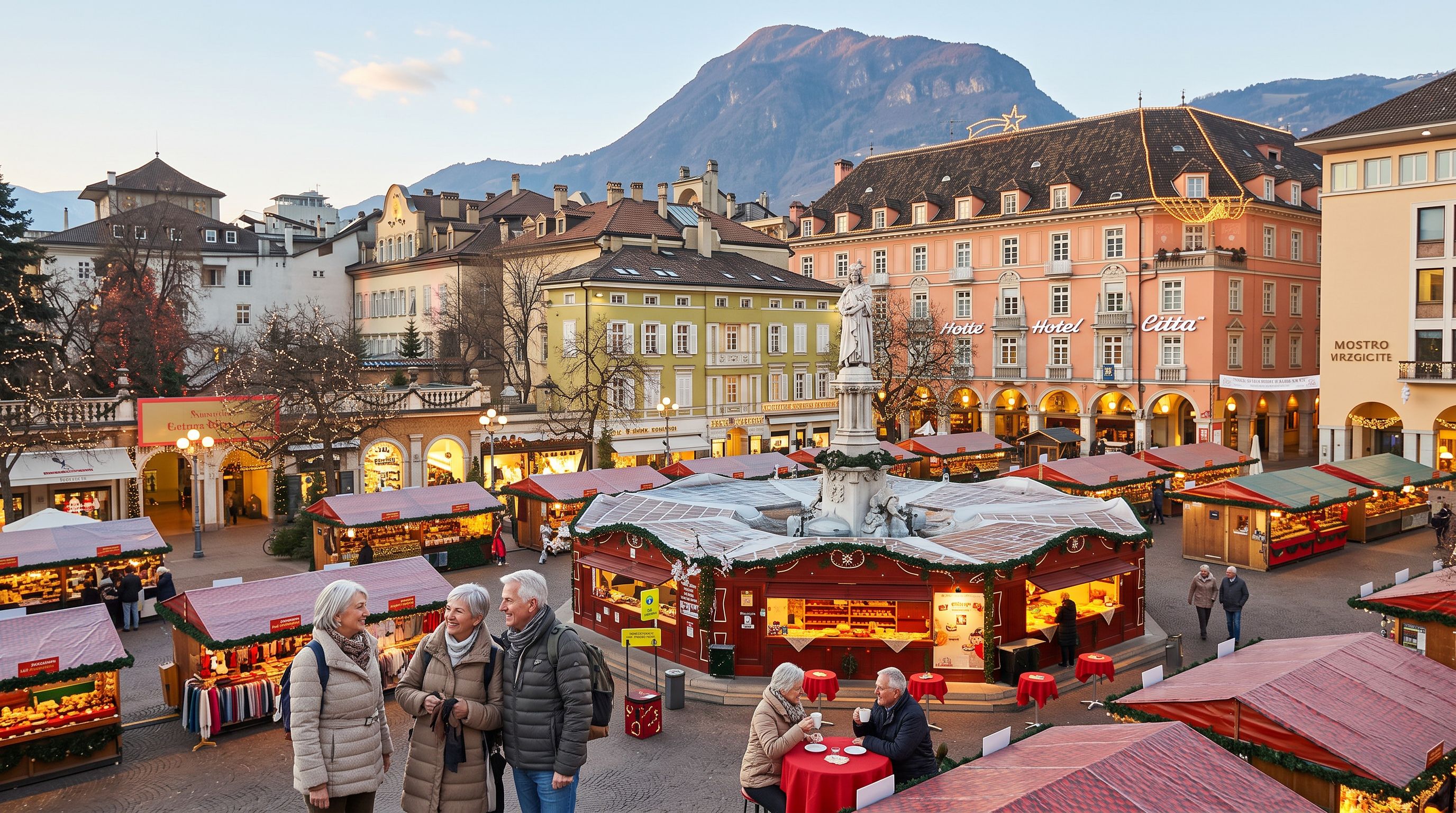
Both are central-town markets with straightforward urban access. Bolzano's runs from 27 November 2026 to 6 January 2027 and is described by the Dolomites Christmas-markets page as the biggest in Italy, with around 150 decorated stalls at Walther Square. Bressanone's runs the same dates, framed by the cathedral, St. Michael's parish church and the town hall.
The Bolzano market is listed as open Monday to Sunday, 10:00 to 19:00, freely accessible, and held at Walther Square and the surrounding streets. It closes on 25 December. Guest feedback gathered across Google and Tripadvisor reviews describes the market as spread through the historic centre rather than confined to one square, with the train station very close by and arriving by rail repeatedly described as the way to avoid parking problems.
The same reviews note that stalls sell handcrafted items, ornaments and local food including apple strudel, speck-filled pretzels and mulled wine, that the market is small enough to see in a couple of hours, and that crowds build toward midday and are heaviest at weekends. Several reviewers suggest going earlier in the day. A minority report unfriendly service at individual stalls, which is worth knowing but is not the pattern.
Bressanone adds a winter draw for non-skiers: the Light & Music Show Brixen is listed from 26 November 2026 to 9 January 2027. In the 3 Zinnen area, Christmas in the Dolomites opens in Innichen/San Candido from 27 November 2026, with Krampus and Perchten in Sexten on 12 December 2026 and Christmas Mountain Music in Sexten on 28 December 2026.
Val Gardena publishes its own dates: the Ortisei Christmas market from 28 November 2026 to 6 January 2027 and the Sëlva market from 29 November 2026 to 3 January 2027. The provisional Ortisei hours run 11:00 to 19:00 for shops and 11:00 to 20:00 for food and drink on 28 and 29 November, then from 6 December to 6 January Monday to Friday 16:00 to 19:00 for shops and 16:00 to 20:00 for food and drink, with longer weekend hours. Sëlva's provisional hours show evening openings on 29 November 2026 and selected December and January dates, with gastronomy stands open until 20:00.
What winter events run beyond the markets?
The winter calendar is event-heavy and spans several valleys. Dolomiti NordicSki lists the BMW IBU World Cup Antholz-Anterselva from 14 to 17 January 2027 and the South Tyrol Moonlight Classic Seiser Alm on 22 January 2027. Val Gardena groups its winter highlights under a Christmas valley heading that includes Rock the Dolomites and the Südtirol Gardenissima.
The broader ski-event calendar shows competition dates across Antholzertal/Anterselva, Cortina d'Ampezzo, Seiser Alm/Alpe di Siusi, Val Gardena and the 3 Zinnen Dolomites, confirming that winter programming is spread rather than concentrated in one resort. The Dolomiti NordicSki calendar also lists the Milano-Cortina 2026 Olympic torch relay and later international ski events.
For anyone who prefers watching to skiing, the practical consequence is that accommodation in event valleys fills early on race weekends, and that a quiet midwinter weekday outside the Christmas dates is a different trip entirely from a race weekend. The published calendars cluster around specific dates, so the gaps between them are the calmer stretches.
How busy is each season, and when should you avoid the Dolomites?
The clearest busy windows in the published calendars are late August, late September to early October, and the Christmas-to-Epiphany period. Midwinter weekdays outside the market dates are likely to be calmer, though no Dolomites-wide avoid rule is documented.
On the specific question of September crowds, the event calendar strongly suggests yes around late September, when multiple festivals and concerts stack up across Trentino, the Dolomites and the 3 Zinnen area. On whether October is too late, the documented calendars say no: October still carries active autumn food and tradition events plus the tail of I Suoni delle Dolomiti until 3 October.
On whether November is worth visiting, the answer from the calendars is yes for winter atmosphere, because Bolzano's market begins on 27 November and winter shows and markets appear from late November. Traveller reports in forum threads repeatedly point to mid-September to mid-October as a shoulder window with fewer people and good walking conditions, and one thread notes that local taverns and farm inns open their parlours after harvest from early October to late November, which suits a slower, food-led visit. For where to eat well in that window, see our guide to the Dolomites' finest restaurants and mountain rifugi.
One caution belongs here rather than in a footnote: quiet-season travel can still be interrupted by races and lift work. Val Gardena's official Q&A page recorded road closures, parking bans and public transport suspensions in Selva during the HERO Südtirol Dolomites on 12 to 14 June 2025, including Streda Nives, Streda La Sëlva, Streda Mëisules, Streda Rainel, Streda Dantercëpies and the new La Sëlva bridge, with traffic bans extending toward the Sella and Gardena passes. Check local notices before booking a shoulder-season week.
How accessible are these festivals for older visitors?
The UNESCO Dolomites Foundation's visitdolomites.com resource currently features 36 trails accessible to everybody, including people with limited mobility, the elderly and families with small children, plus 13 panoramic viewpoints reached by fully accessible lift systems. These are documented for the trails, not for festival venues.
That distinction is the honest answer to the accessibility question. The Foundation states that the trails were developed with associations managing accessibility and are located across all nine Dolomites Systems, and that detailed technical information sheets in English, German and Italian let a user analyse a route and judge independently whether they can complete it. That is a genuinely useful tool for this readership, and it is documented at the visitdolomites accessible routes map.
For the event venues themselves, the picture is thinner. Step-free access, lifts, seating and assistance services are not documented for the specific Dolomites festival sites named here, so those details need checking venue by venue. Central-town markets in Bolzano and Bressanone are the most straightforward for general access, and Bolzano's market is listed as freely accessible. Mountain concerts in I Suoni delle Dolomiti are deliberately placed at sites reached on foot, which makes them scenic but less convenient than a town-centre event.
Senior or over-65 fares, reduced tariffs and passes are not documented for these event pages. Closing days and maintenance closures are likewise not documented, with one exception: the Bolzano Christmas market closes on 25 December.
What should you know about safety and booking?
The emergency number for mountain rescue across the Dolomites is 112, and the Val Gardena tourism guide states that helicopter rescue missions are not free. The Veneto Dolomites use 118 for medical emergencies, with the operations centre active 24 hours a day.
The Dolomites safety guidance states that 112 is the single European emergency number and works even without credit, a SIM card or a locked phone. Callers should be ready to give what happened, how many people are involved, the condition of anyone injured, the exact location and the weather conditions. For a readership that walks in the mountains, that is the one paragraph worth saving to a phone.
Booking flows, cancellation terms and assistance-service procedures are not documented for the cultural events named here. Nearest pharmacy and medical-help locations are not documented for the individual festival sites, though Val Gardena's regional guide mentions an outpatient clinic and pharmacies in Selva di Val Gardena at valley level rather than per venue. Where a specific venue's access or assistance matters to you, the reliable route is to contact the local tourist office directly.
Altitude deserves a mention for anyone arriving from low ground and heading straight to a concert at 2,000 metres. Our separate guide on altitude, health and peace of mind in the Dolomites covers that ground.
What food traditions belong to this calendar?
Enogastronomy is a standing category in the Dolomiti event listings, with autumn as its peak. Named events include the Speck Alto Adige Festival in the Plan de Corones area, the Eisacktaler Kost along the Eisack Valley, and pear-flour events listed as Pear flour autumn and Birmehlherbst.
The Val Gardena calendar carries Culinarium Urtijëi, explicitly a culinary experience, which shows how food programming sits inside the cultural calendar rather than beside it. The Eisacktaler Kost event is described as traditional South Tyrolean cuisine paired with modern creativity along the Eisack Valley.
For travellers who plan a trip around eating rather than walking, the harvest window from early October to late November is the one traveller reports single out, when farm inns open their parlours after the harvest. Our round-up of Dolomites hotels worth booking for the food covers where to base yourself for that.
Specific historic cafes, market-opening patterns and market accessibility details are not documented for the Dolomites as a whole, so those are questions for the individual town's tourist office.
How do you plan around the crowds?
Build the trip around the gaps, not the headline events. The calendars cluster around dated festivals, so the days between them are the quieter stretches. Mid-September to mid-October is repeatedly described in traveller reports as a shoulder window with fewer people and good walking conditions.
Three habits make the difference. First, check the event calendar for your exact valley before fixing dates, because programming is concentrated in Cortina, Val Gardena, Seiser Alm, Toblach and the major enogastronomy sites, and those are the busiest places on event days. Second, treat published dates as provisional where the organisers say so: the Ortisei and Sëlva market hours are published as provisional, and Almabtrieb timing depends mainly on the weather. Third, if you are travelling for a specific event, confirm it locally in the week before.
They are silent in a consistent way. No Dolomites-wide crowd-avoidance map, no ranked list of congested places, and no documented quiet hours or off-peak windows exist in the material gathered here. The workable substitute is the calendar itself: read the dates, and travel between them.


