
Chiang Mai sits in a valley in northern Thailand, roughly 700 kilometres north of Bangkok, and its international airport handles the final approach for almost every long-haul traveller heading this way. The awkward part is rarely the destination. It is the routing from Europe, the choice of cabin for a body that has to sit still for fifteen hours, and the last five kilometres from the terminal to a hotel bed. This guide covers those three stages and stops there. Getting around once you are in the city is a separate subject with its own dedicated guide.
What makes Chiang Mai manageable as a long-haul arrival is the scale of the airport. It is a compact two-terminal building close to the city, not a sprawling hub where you walk for twenty minutes between gates. The trade-off is that no European city has a nonstop service here, so every itinerary from the UK or the continent involves at least one connection. Planning that connection well is the single most useful thing a traveller aged 50 to 70 can do before booking.
Can you fly direct to Chiang Mai from Europe or the UK?
No. No nonstop service from the UK or Europe to Chiang Mai is documented. Every European itinerary involves at least one stop, typically through Bangkok, Abu Dhabi, Taipei, Hong Kong or Singapore. The shortest published routes to Europe run around 15 to 16 hours total, so the connection pattern matters more than the airline.
Chiang Mai International Airport is the main gateway to northern Thailand, in Mueang Chiang Mai District, and it has direct service to 31 airports worldwide as of September 2026, with 30 airlines operating from the airport. The documented nonstop routes include Abu Dhabi, Beijing, Busan, Chengdu, Chongqing, Hong Kong, Kuala Lumpur, Luang Prabang, Mandalay, Seoul-Incheon, Singapore, Shenzhen, Taipei and several domestic Thai cities. Europe is not on that list.
For UK travellers, the practical answer is to connect through one of those hubs. KAYAK's Chiang Mai to Europe route page lists the shortest published routes to Europe from Chiang Mai as Frankfurt am Main at 15 hours 5 minutes, Amsterdam at 15 hours 20 minutes and London at 16 hours. The same page shows one-stop itineraries via Abu Dhabi or Beijing.
Two airline channels are worth knowing about. China Airlines' Journey to Europe connection page lists Chiang Mai in its Europe offer through Taipei, with Amsterdam, Vienna, Rome, Frankfurt, London and Prague among the destinations. Etihad publishes dated fare pages for Chiang Mai to Frankfurt, Amsterdam, Paris, Dublin and Manchester, all with round-trip economy prices and dates in late 2026. That matters less for the price than for the booking structure: you can buy the whole long-haul itinerary through a single airline channel rather than stitching together separate tickets.
Which route and stopover suits an older traveller best?
Prefer a single stop through a major hub over a two-stop itinerary, even when it costs more or adds an hour. Bangkok is the busiest connection and the one where tight transfers cause the most trouble. Experienced travellers consistently advise choosing the longer layover rather than the shortest possible transfer.
The reasoning is documented rather than theoretical. Forum travellers who connect through Bangkok caution strongly against tight connections because domestic flights can be delayed and the airport transfer itself can be a long trek with lengthy passport-control lines in high season. The same advice recurs: leave generous connection time, especially when the onward leg is a long-haul international flight.
There is a second, quieter argument for the one-stop routing. A two-stop itinerary adds a second set of stairs, a second security queue and a second walk between gates, and those are the parts of long-haul travel that tire an older body more than the flying itself. The documented hub connectivity from Chiang Mai runs through Taipei, Abu Dhabi, Hong Kong, Singapore and Bangkok, so a single-stop itinerary is available from most European departure points.
One forum tip worth carrying: if you have the option, put the comfort where the hours are. The short domestic hop into Chiang Mai changes little between economy and business, while the long onward haul changes a great deal. Spend the upgrade on the ocean crossing, not the final hour.
Business or premium economy for an older body?
What is documented is that the airlines selling Chiang Mai to Europe itineraries offer multiple cabin options in their booking flow, while the public fare pages show economy examples only.
That gap is worth stating plainly rather than filling with generalities. The searched official and airline pages do not publish Chiang Mai-specific advice on hydration, walking or in-flight movement either. So the honest position is this: cabin choice on this route is a general airline decision, not a Chiang Mai rule, and any seat measurement you see quoted for it should be checked against the specific aircraft and carrier at the time of booking.
For older travellers, the practical implication documented here is to prefer one-stop routings through a major hub rather than relying on a tight multi-stop itinerary. A comfortable connection you can walk at your own pace is worth more than a wider seat on a schedule that leaves you running.
If you are weighing the two cabins, ask the airline directly for the seat pitch, recline and aisle access on the exact aircraft type scheduled for your dates. Those figures vary by carrier and by aircraft, and no source in this material publishes them for Chiang Mai routes.
How do you manage a fifteen-hour flight at 60-something?
What is documented is a recovery tip: get morning sunlight and walk outside after arrival, which travellers describe as especially useful after an overnight flight.
The jet-lag advice is the one concrete, sourced point. A forum exchange frames morning daylight and a walk outdoors as the practical way to reset after flying overnight, and that is easy to act on in Chiang Mai, where the old city moat gives you a flat, obvious circuit for a first morning.
On the flight itself, the useful planning move is to book your seat with the connection in mind rather than the leg. An aisle seat near the front of the economy cabin shortens the walk to the transfer gate, and on a one-stop itinerary that walk is the part that catches people out. Ask the airline about seat pitch and aisle access for your specific aircraft rather than relying on a generic cabin description.
Travellers who need that information should ask their airline and their hotel directly before departure, and carry any prescription medication in hand luggage.
 AI-edited
What happens when you land at Chiang Mai airport?
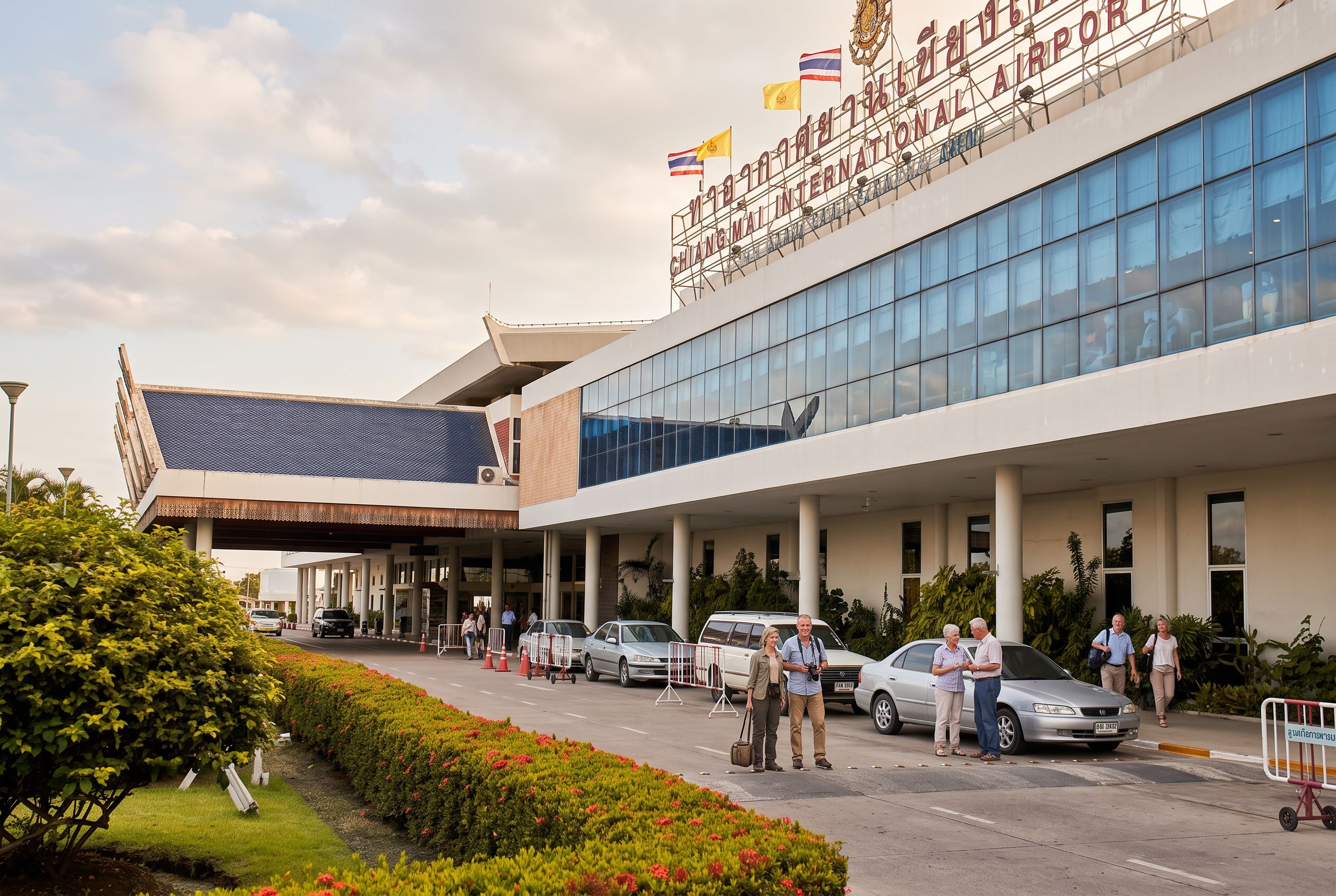
Arrival is straightforward. Chiang Mai Airport has two terminals in a single building, one for domestic and one for international flights, and the two are connected by a corridor. The Arrivals Hall for both sits on the ground floor, with departures from the upper floor, and baggage claim is in the Arrival Hall of both terminals.
The airport's own site describes the layout in those terms, and a rideshare operator's airport page adds that the two terminals are small and easy to walk between. Baggage carts are provided for passengers who need help with luggage, which matters after a long-haul leg. The information counter is on the ground floor of each terminal, and lost and found items are taken to the information desk on the lower ground floor of both.
Two practical details from the airport's own pages. Complimentary WiFi is available for two hours only, on the "@ AirportTrueFreeWiFi" network, so download anything you need before you rely on it. Exchange counters are in both terminals' Departures and Arrivals Halls, but travellers repeatedly note that airport exchange rates are poor. Take a small amount of cash there and arrange the rest in the city.
Restrooms are in the pre-security and post-security areas of both terminals. Car rental desks, foreign and local, are on the first floor of the Domestic Arrival Area; qualified renters must be at least 20 years old with a valid licence and an International Driving Licence.
What is the easiest transfer into town?
The official fixed-fare airport taxi is the most consistently recommended option. The airport's own site says the estimated fare from the airport to the heart of Chiang Mai starts at ฿105.00, and the airport is about 5km from the city district. Thailand's official travel portal puts taxi limousine service from Exit Gate No. 1 at 150 baht.
The airport publishes an official guide to driving, taxi and public transport, which confirms these as the arrival options at CNX. Taxis are accessible outside both terminals and are only allowed to pick up and drop off at the ground transportation centre of each terminal. The airport's own figure for the airport-to-city taxi estimate starts at ฿105.00, while the official travel portal lists taxi limousine service from Exit Gate No. 1 at 150 baht and taxi meter service at Exit Gate No. 2 at the meter fare plus an additional 50 baht.
On the ground, the setup is repeatedly described as simple: go to the taxi counter, state your destination, take the ticket, then exit to be matched with a driver. The rank is described as being to the left or northern exit after baggage claim. Travellers report the fare is fixed and usually around 150 baht into the city, with some quoting 120 to 180 baht depending on source and date. Those figures come from traveller reports rather than the airport's own published tariff, so treat them as indicative.
Bus, shuttle or taxi: which should you choose?
Choose by luggage and arrival time rather than by price. The official airport shuttle runs on routes A1, A2 and A3, with fares listed at 40 baht for A1 and A2 and 60 baht for A3. The airport's own site gives a one-way bus fare starting at ฿30.00. Public buses run from 6:30 a.m. to 10:30 p.m.
The shuttle routes serve specific corridors. One runs from the airport to Nimmanhaemin Road, Huay Kaew Road and the city moat. A second runs to Mahidol Road, the Night Bazaar and Chang Klan Road. A third runs to the Second Ring Road and the 700th Anniversary of Chiang Mai Stadium. The shuttle information counter is on the arrival level, with an information contact number of 094-843-3035.
Thailand's official travel portal gives the wider transport window as 6:00 a.m. to 11:30 p.m. and lists a van transfer service between the airport and resorts or hotels on main roads in and around Chiang Mai. The airport's own page says there are hotels in Chiang Mai offering complimentary shuttle services to and from the airport, and advises passengers to contact their accommodation in advance to arrange one.
Rideshare apps are the other common option. One airport guide puts Grab or Bolt at typically 80 to 150 THB with a journey of about 10 to 20 minutes, and red songthaews at 30 to 60 THB. Those figures come from a third-party guide rather than the operators themselves.
| Option | Published fare | Source |
|---|---|---|
| Airport taxi (estimated, to city heart) | From ฿105.00 | Airport site |
| Taxi limousine, Exit Gate No. 1 | From 150 baht | Official travel portal |
| Taxi meter, Exit Gate No. 2 | Meter fare plus 50 baht | Official travel portal |
| Airport shuttle A1 and A2 | 40 baht | Official travel portal |
| Airport shuttle A3 | 60 baht | Official travel portal |
| One-way bus | From ฿30.00 | Airport site |
One caution on all of these figures. A Chiang Mai tourism transfer page states its posted rates were effective from 1 November 2023 until 31 October 2025, which shows how quickly transfer pricing moves. The airport shuttle page itself asks travellers to verify fares and routes before travelling. Do that.
What if you need mobility assistance or have heavy bags?
Chiang Mai International Airport states that it provides disabled-friendly facilities that are convenient and accessible for persons with reduced mobility, and that passengers needing special assistance may contact their airline or the airport for wheelchair reservations. A rideshare operator's airport page advises contacting your airline at least 48 hours before departure if you need mobility assistance.
That 48-hour window is the single most useful number in this section. Arrange it before you fly, not at the gate.
Beyond that, the documentation thins out. No official source publishes step-free access details, lift counts or a dedicated assisted-boarding system for Chiang Mai Airport itself. Those specifics are not documented, so ask the airport or your airline directly if they matter to your journey.
At ground-transfer level, accessibility is service-dependent rather than guaranteed. One private transfer listing describes its service as stroller accessible and open to all travellers, permits service animals, but states it is not strictly wheelchair accessible unless the wheelchair folds and fits in the luggage compartment. A shared transfer listing for Chiang Mai airport arrivals states it is not wheelchair accessible. If you need a vehicle that takes a chair unfolded, confirm that with the operator before booking rather than assuming.
For travellers who simply do not want a long walk after landing, the recurring advice from those who have done it is to take the airport taxi rather than hunt for cheaper street transport. One forum post puts it as "save the walk" on a first visit. The airport taxi is described by travellers as comfortable and usually relatively new, which is not a small thing at the end of a long-haul flight.
Practical questions before you book
Have cash in baht ready for the airport taxi, because travellers report the airport taxis often want cash payment. Book your connection with a generous layover rather than the shortest available. And check with your hotel about lift access and shuttle arrangements before you commit, because neither is universal in Chiang Mai.
On accommodation, the pattern in guest reviews is worth knowing before you book. Reviews of Chiang Mai hotels repeatedly flag noise from aircraft, nearby bars and schools as the most common complaint, and accessibility limits such as no lifts or awkward stairs as the second. Some properties are consistently praised for quiet rooms and comfortable bedding. If quiet and easy access matter to you, that is the pattern to check against, and our guide to where to stay in Chiang Mai when comfort comes first covers the properties in detail.
On the airport side, the practical sequence is short. Land, clear immigration, collect bags, take a cart if you need one, change a small amount of cash, then walk to the taxi counter or the shuttle stop. The airport is about 5km from the city district, and the ride is short.
One last point on timing. The coolest and clearest period in Chiang Mai is reported as November to February, and March to April as the most polluted and hot. That does not change your flight, but it changes what you pack in the cabin bag and how comfortable the first morning walk will be.


