
Hoi An rewards slow travel. The historic core sits on largely flat ground, the riverside path along Bach Dang Street is paved and comparatively open, and the town runs designated pedestrian-only periods that keep motorbikes out of the busiest lanes. For travellers aged 50 to 70 who can manage uneven paving and the occasional step, that combination makes the Ancient Town unusually workable on foot. It is not, however, uniformly wheelchair accessible. Uneven paving, kerbs, raised thresholds, narrow historic interiors and crowded lanes are all documented features of the town, and access varies from building to building.
The practical reading is that Hoi An suits assisted touring rather than reliably independent wheelchair touring. A visitor using a cane or a walker can manage the riverside and the main pedestrian streets with careful route planning. A full-time wheelchair user should expect to need help over old paving and at steps, and should confirm each hotel, restaurant and attraction directly before arrival. This guide covers the town itself: terrain, the sights that ask least of your legs, where to sit down in air-conditioning, and the months that make all of it harder.
Is the Old Town actually flat and walkable?
Yes, broadly. Hoi An's Ancient Town is described in accessibility guidance as largely flat and pedestrian-focused, which makes slow sightseeing feasible for many older visitors. The catch is that flat is not the same as smooth. Historic tile and cobbled surfaces can be bumpy or slippery when wet, narrow lanes fill with people, and many old houses and shops have one or more entrance steps.
The UNESCO-recognised heritage core covers approximately 30 hectares and contains 1,107 listed heritage structures, according to the official heritage material. That is a compact area, and the streets, shops, restaurants and riverfront can be walked without an entry ticket. The ticket applies when you enter designated heritage buildings.
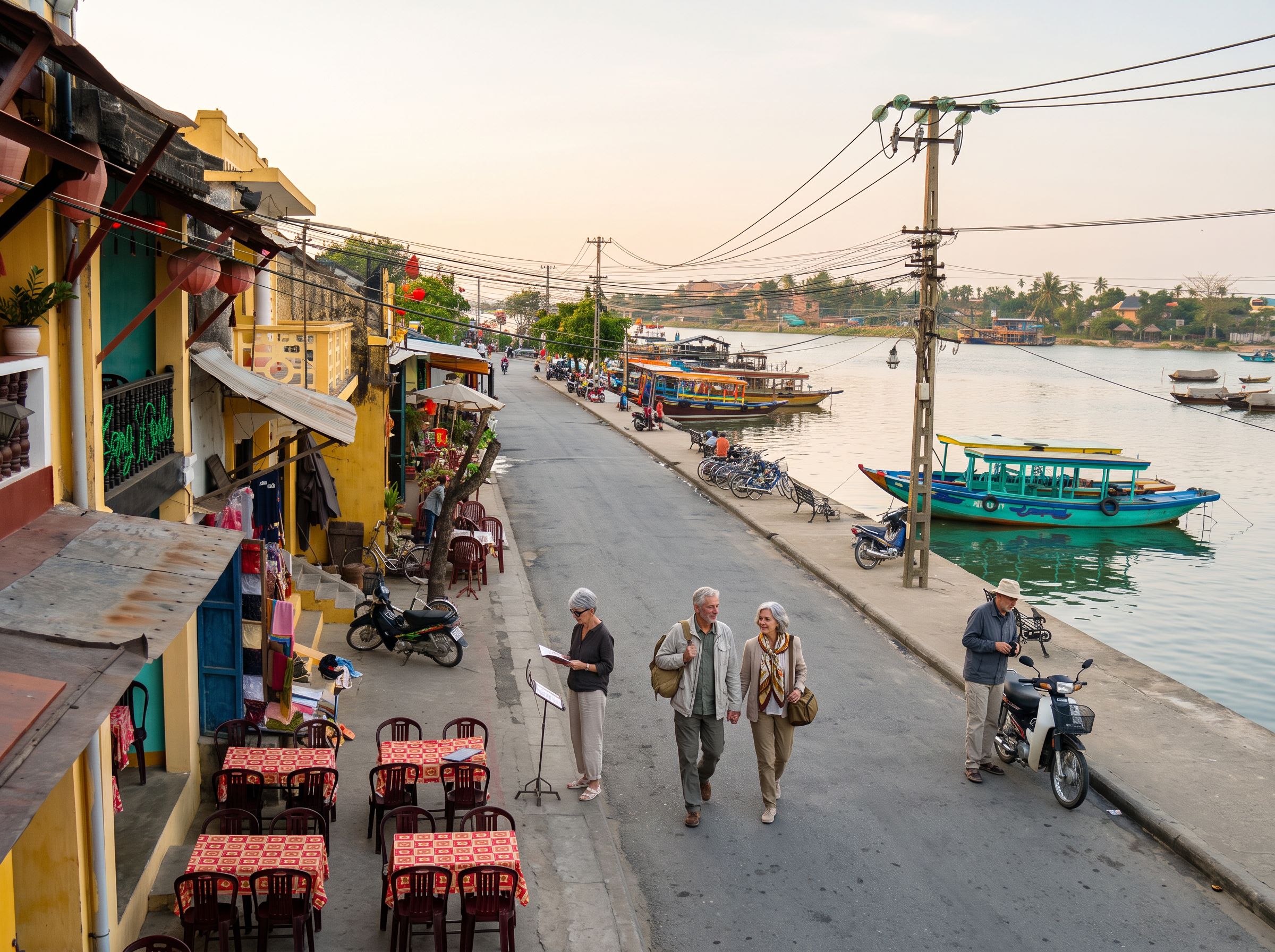
The most manageable route is the paved riverside path along Bach Dang Street, between the Japanese Covered Bridge area and the night-market side of An Hoi Islet. Kayra Tours describes this stretch as relatively flat and suitable for a leisurely stroll. The same operator describes Cau An Hoi, the pedestrian bridge linking the Ancient Town with An Hoi Islet, as wide and well paved.
Pedestrian-only periods help. The official heritage notice reports them as 09:00 to 21:30 in summer and 09:00 to 21:00 in winter, with Phan Chau Trinh Street pedestrianised from 17:30 until 21:30 in summer and 21:00 in winter. Outside those windows, motorbikes share some streets.
 AI-edited
What makes walking difficult, even on flat ground?
Uneven paving, gutters, high kerbs, decorative cobbles, temporary ramps and raised timber thresholds. Accessibility guidance for Hoi An describes access as variable rather than continuous, and a Reddit discussion updated in October 2026 warned of precarious pavements and kerbs it described as 18 inches in some areas. Wet paving adds slip risk.
One Hoi An mobility guide reports raised thresholds of up to 30 to 40 centimetres, and that figure should be read as applying to the buildings that guide discusses, not to every property in town. Historic houses and shops may have one or more entrance steps, and upper floors in old buildings are reached without lifts.
Sidewalks can be uneven or occupied by parked motorbikes, and crossings require patience because motorbikes flow around pedestrians. The same Reddit thread described the Old Town as particularly challenging for someone with severe knee arthritis.
Two practical adjustments help. A lightweight, foldable wheelchair and assistance with kerbs are recommended by a local Hoi An source.
Which sights ask least of your legs?
The riverside quay, Bach Dang Street and the market streets are the step-lightest ground. The Japanese Covered Bridge has steps, which sources specifically flag as making direct wheelchair access difficult. My Son Sanctuary, about an hour's drive away, involves long exposed paths and uneven brickwork according to a Hoi An mobility guide.
Within the ticketed monuments, the picture varies building by building. The heritage core holds Chinese assembly halls, merchant houses, family chapels, communal pagodas, museums and the Japanese Covered Bridge, and each has its own entrance arrangement.
Worth knowing: a Tripadvisor listing for a Hoi An ancient-town walking tour, updated in 2026, states plainly that it is not wheelchair accessible, and a separate Tripadvisor listing for an Ancient Town experience says the same. By contrast, Tripadvisor listings for Explore Highlights Hoi An, Hoi An Street Walking Food Tours and a Hoi An cooking-class experience each state that they are wheelchair accessible and that transportation and surfaces are accessible. Read the individual listing rather than the category.
Regional accessibility guidance notes that bridges and boat rides require assistance. That applies to the coconut-forest boat trips at Cam Thanh and to the speedboat crossing to the Cham Islands, roughly 30 minutes from the mainland. Boarding accessibility and transfer assistance are not documented for either.
Where can I sit down in air-conditioning?
What is documented is that the town's cafes, restaurants and shops line the walkable streets, and that the heritage ticket does not cover them, so you can drop in freely without a ticket.
Heat is the reason this matters. Hoi An's hottest stretch runs from roughly May to August, with typical highs around 33 to 34°C in June, July and August, and June identified as the hottest month in one long-term climate series. Older travellers and anyone with cardiovascular or respiratory limitations may find early-morning and evening touring more comfortable. Our guide to coping with the heat and humidity in Hoi An covers the timing in more detail.
Two documented indoor options sit inside the heritage programme itself. The official heritage notice lists traditional art performances at 10:15, 15:15 and 16:15 daily, plus Japanese tea-ceremony performances at 09:30 and 16:30 daily. Both give you a seated, shaded break in the middle of a walking day.
For a longer rest, the town's spa and massage offerings are a common afternoon pause. What to expect from a treatment, including booking and pricing conventions, is set out in our guide to a massage and spa day in Hoi An.
What about the evening crowds?
The pedestrianised evenings are the busiest and the most congested. The official heritage notice puts pedestrian-only hours at 09:00 to 21:30 in summer and 09:00 to 21:00 in winter, with Phan Chau Trinh Street closed to vehicles from 17:30. Accessible-tour operators recommend early morning or late afternoon instead.
Narrow lanes and major attractions become congested, and the evening lantern hours concentrate people along the riverfront. A Tripadvisor mobility-focused tour report specifically praised leaving early to avoid crowds and heat, and a traveller quoted in that report said a companion with mobility needs was pushed in a wheelchair because "the areas were not smooth", with the operator arranging the wheelchair and adapting the tour.
If you use a wheelchair or walker, the morning window is the more comfortable one. The town is at its emptiest before the pedestrian period peaks, temperatures are lower, and the riverside path is at its most open.
"They were always kind, attentive, and happy to recommend attractions and activities, making us feel truly cared for throughout our stay. Their hospitality made a lasting impression on us and turned a great hotel into an unforgettable experience." (Google, July 2026)
That review concerns a hotel rather than the town, but it reflects a pattern across Hoi An properties: staff are repeatedly described in guest feedback as quick to help, which matters when you need a chair carried over a threshold or a taxi brought to a specific corner. Hotel-by-hotel access is a separate subject with its own dedicated guide; our piece on choosing your base in Hoi An covers Old Town, riverside and beach locations.
How do I get to the Old Town, and how far is the walk?
Hoi An has no airport or railway station. The nearest airport is Da Nang International, roughly 30 km north, with a road journey of about 40 to 45 minutes, longer in heavy traffic or poor weather. Private cars, hotel transfers and app-based cars give door-to-door service and are more practical for mobility-limited visitors than changing buses.
Route 01SB runs between Da Nang Airport and Hoi An, terminating at the Cua Dai pier car park, with reported journey times of roughly 60 to 90 minutes. The available transport information does not document level boarding, wheelchair spaces or step-free access on that route. Travellers with limited mobility should verify those details with the operator before relying on it.
Drivers from resorts between Hoi An and Da Nang can take older visitors directly into the centre of the Old Town, avoiding a long approach on foot. That is worth arranging in advance, because "nearby" in Hoi An does not always mean an easy walk. The Reddit discussion noted that many of the better dining options sit outside the historic centre, making a hotel car or taxi preferable to walking between the Old Town and restaurants.
Rail travellers must transfer from a station in the wider Da Nang area.
How do I get to the beach, and what should I expect there?
An Bang, Cua Dai and Ha My are the Hoi An-area beaches identified for relaxation and water sports. Beach access surfaces, accessible toilets, mobility equipment, lifeguard provision and medical help are not documented, so treat beach access as unverified and ask locally before you set out.
Anantara Hoi An guests frequently mention complimentary bicycles used for rides along the river and to the beach, according to aggregated guest feedback. That is a guest-reported pattern rather than a town-wide facility, and cycling is not a realistic option for everyone in this readership.
The more reliable approach for limited mobility is a car or taxi to a specific beach entrance, arranged through your accommodation, with the drop-off point confirmed in advance. Because no source documents ramps, beach mats or accessible routes from parking at any of the three beaches, the detail that matters most is the one you confirm by phone or email before travelling.
When should I visit, and which month should I avoid?
February to April is the most favourable window: low rainfall, moderate temperatures and less oppressive humidity. October is the clearest month to avoid, with approximately 526 to 655 mm of rain depending on the dataset, and November also carries substantial rain and flood risk. Floodwater can make riverside streets and ground-floor premises substantially less accessible.
| Period | Typical daytime highs | Rainfall and conditions |
|---|---|---|
| January | About 24 to 26°C | Wet season easing; can stay cool and damp |
| February | About 26 to 28°C | One of the driest months; roughly 25 to 32 mm in some datasets |
| March | About 28 to 29°C | Very low rainfall, around 20 to 35 mm |
| April | About 31°C | Still relatively dry; heat begins to build |
| May to August | About 33 to 35°C | Hottest stretch; June among the hottest months |
| September | About 31 to 32°C | Rainfall rises sharply, about 297 to 314 mm in several datasets |
| October | About 28 to 30°C | Wettest month; about 526 to 655 mm in published climate tables |
| November | About 26 to 27°C | Very wet; continuing flood risk |
| December | About 24 to 26°C | Rainfall declines; can remain cool and damp |
No fixed opening season applies to Hoi An as a town. It is a year-round destination, and individual attractions, river activities, hotels and restaurants may alter hours or close temporarily during flooding, renovation or public holidays. Check flood conditions before you travel, and watch for recently washed paving, which can become slippery and obstruct routes.
May to August is hotter and generally busier, with July described as especially busy for European visitors in one Hoi An travel-climate dataset. The material does not provide a reliable official tourism-board visitor-count series for Hoi An, so crowd expectations should be treated as indicative.
What does the heritage ticket cover, and are there concessions?
The official heritage notice reports ticket categories of VND80,000 and VND120,000, covering different combinations of monument and museum entries. Walking the streets, eating, shopping and photographing in the town do not require the ticket. The official notice states the ticket is bought once and remains usable throughout a stay in Hoi An for up to three days.
One point of disagreement is worth flagging. Another source reports 24-hour validity. Sources differ on the validity period, so confirm the applicable rule at the ticket booth when you buy.
Concessions are narrower than many visitors assume. The official notice reports exemption for people with severe disabilities as defined by Vietnamese law, and a 50 per cent reduction for Vietnamese people with disabilities and elderly people under the relevant Vietnamese Elderly Law. It does not state a general over-65 discount for foreign visitors. Children under 16 are listed as exempt.
Groups buying eight or more tickets are reported by the official heritage notice as eligible for a free guide service covering the Ancient Town and its included monuments. A local guide identifies eight ticket booths around the heritage zone, including locations near Tran Phu and Hoang Dieu and at the Japanese Bridge entrance on Nguyen Thi Minh Khai Street.
What if I need medical help?
Saigon Hoi An General Hospital, at 06 Phan Dinh Phung, Hoi An Tay ward, is in the Hoi An urban area. Its Pharmacy Department supplies medicines, and the hospital publishes a 24/7 emergency hotline: 1900 8686 30. Outpatient hours are Monday to Saturday, 07:00 to 11:30 and 13:00 to 16:30.
A separate nearest-pharmacy address for Hoi An is not documented. The hospital's own Pharmacy Department is the most clearly documented medicine source in the town. The available search results do not provide a verified Hoi An-specific emergency-number listing; Vietnam's commonly used national numbers are generally 115 for medical ambulance, 114 for fire and 113 for police.
The nearest pharmacy or medical facility for each individual attraction is not documented, and neither is the nearest medical help for the Japanese Covered Bridge, the riverside route, the market or the beaches. Carry prescribed medicines and keep the hospital's emergency number to hand.
How should I plan a visit around limited mobility?
Treat the Old Town as suitable for assisted wheelchair touring rather than reliably independent wheelchair touring. Hoi An works well for an ambulant older traveller who can tolerate uneven ground and short steps, and poorly for anyone requiring continuous, fully step-free access, smooth pavements or accessible historic interiors.
- Arrange transport to the Old Town entrance rather than assuming "nearby" means an easy walk.
- Visit early in the day, when temperatures and crowds are lower.
- Plan a short sightseeing period, with frequent rests and riverside or hotel time between outings.
- Avoid relying on wheeled luggage or a wheelchair over cobbled parking areas and uneven pavements without assistance.
- Ask your accommodation specifically about the route from the vehicle drop-off point to the room, the breakfast area and the riverside.
- Confirm whether a wheelchair user remains seated throughout a tour or must transfer; commercial accessibility descriptions do not always make that clear.
One documented example of why the last two points matter: a Tripadvisor review of Anantara Hoi An Resort, updated in 2026, described its location near the Old Town as convenient for walking but said a particular room was "not very suitable for people with reduced mobility". Ground-floor accommodation does not by itself guarantee a step-free stay.
For tailoring, a common Hoi An errand that involves fittings and shop visits, our guide to having clothes tailored in Hoi An covers how to manage the process without long standing waits.
Access varies by hotel, restaurant, museum, bridge, pavement and vehicle route. Treat each one individually.
The practical summary
Hoi An is a good choice for travellers aged 50 to 70 when mobility is limited but some assistance is available. The town is compact, largely flat and rewarding to explore slowly, and the pedestrian periods remove the vehicle conflict that makes many historic centres stressful. The riverside path along Bach Dang Street is the most forgiving ground, and the heritage programme's seated performances give you a shaded pause in the middle of a walking day.
It is a more demanding choice for wheelchair users or people with poor balance, particularly during October and November, when rain, flooding and uneven historic surfaces can make the Old Town difficult to navigate. Plan around February to April, book transport rather than walking the approach, confirm the specifics of each building and vehicle directly, and keep the hospital's number with your medicines.


