
The Amalfi Coast is a UNESCO World Heritage Site recognised in 1997, a 25-kilometre sweep of cliff and sea along the Gulf of Salerno where the villages were built upward because there was nowhere else to build. For travellers aged 50 to 70 who would rather not spend a holiday on stone staircases, that geography is not an obstacle but a hint. The coast is at its most legible from the water, and the boats that serve it are frequent, cheap and comfortable.
This guide covers the water-based way to see the coast: which ferries link which towns, what a private charter involves, which villages reward a short flat wander at sea level, and which are better admired from the deck with a camera and no climbing at all. Hiking and the general accessibility picture for the region each have their own dedicated guides.
Why is seeing the Amalfi Coast by boat easier than by road?
Boat travel removes the two hardest parts of an Amalfi Coast day: the cliff roads and the staircases. Ferries run directly between the coastal towns, drop passengers at sea level, and cover in twenty minutes what the SS163 coast road takes far longer to drive in season. Private charters add a skipper, a cushioned seat and no timetable at all.
The road network here is genuinely difficult. The SS163 clings to the cliff between Amalfi and Positano, a stretch measured at 19 km and about 35 minutes with clear roads, free-flowing traffic and no stops (OpenStreetMap road routing). In summer that figure is theoretical. A January 2026 press report described a landslide partly cutting the coast in two by blocking the SS163 near Maiori, forcing road closure and detours, and a 2026 report said the Province of Salerno banned tourist coaches, scheduled buses and heavy vehicles on two inland roads, the SR 373 linking Ravello and Scala with Castiglione and the SR 366 linking Agerola to Amalfi via Furore and Conca dei Marini.
The sea has none of those problems. Travelmar, whose fleet of seven high-speed hydrofoils carries foot passengers only, publishes routes including Positano to Amalfi, Salerno to Amalfi, Cetara to Amalfi, Vietri sul Mare to Amalfi, Maiori to Amalfi, Minori to Amalfi, and the same towns linked to Positano. Amalfi sits at the centre of that network, which makes it the natural hub for a water-based itinerary.
How does ferry hopping between the towns actually work?
Buy a ticket at the port booth or online, turn up fifteen minutes before departure, and step off at the next town's jetty. Published services link Amalfi, Positano, Salerno, Sorrento, Capri, Maiori, Minori, Vietri sul Mare and Cetara, with many routes seasonal from spring through autumn and some year-round links from Salerno and Positano to Amalfi.
Positano Jet, which runs ferries between Positano, Capri, Amalfi, Sorrento, Salerno and Naples, asks passengers to arrive at the boarding area with a valid ticket at least 15 minutes before departure. That is the whole ritual. There is no queue for a funicular, no hunt for a taxi, no climb.
Baggage rules are worth knowing before you pack. Positano Jet allows one free piece of baggage with maximum dimensions of 40x20x25 cm, and anything larger or weighing more than 9 kg needs an XL baggage ticket. Travelmar includes one piece of hand luggage in the ticket price, with additional luggage subject to an extra fee payable at the port ticket office. Guide dogs travel free of charge on Positano Jet services.
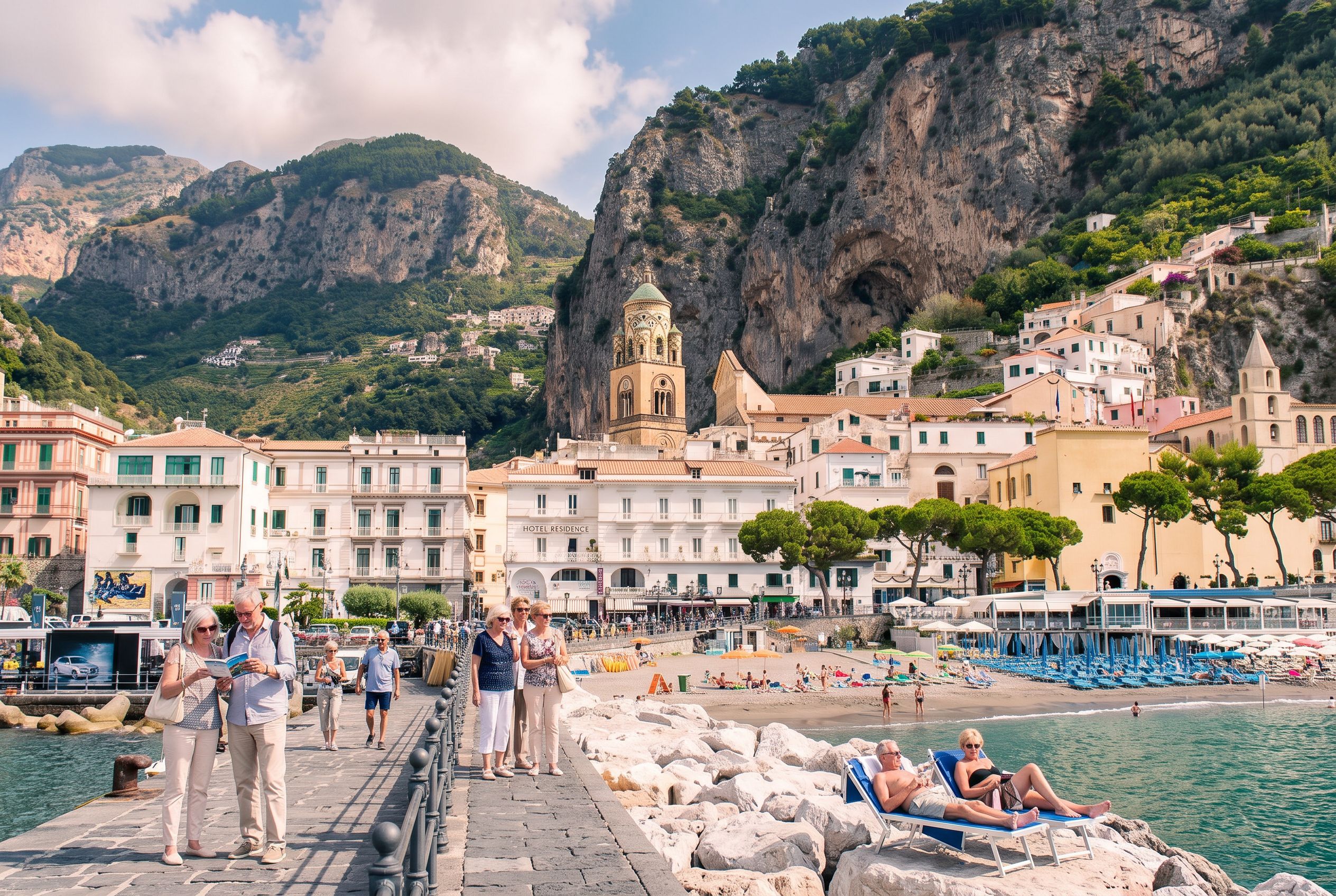
Fares vary by route, operator and date, so treat any figure you see as indicative. Published timetables show the Amalfi to Positano crossing at roughly 12 to 35 minutes depending on schedule, with fares from around €5 on one timetable and about €9 to €10 on others. Salerno to Amalfi appears at around 25 minutes to 1 hour 10 minutes from about €12, and the short hops to Maiori, Minori, Cetara and Vietri sul Mare typically run 10 to 60 minutes at low fares. For the full picture of surface connections, see our guide to getting around the Amalfi Coast by ferry and bus without a car.
 AI-edited
When do the ferries run, and what closes in winter?
The inter-town ferry service is published as running from early April until the end of October on one official page, while another schedule page lists many 2026 routes from 1 April to 3 November. In winter, one official travel page says only the Sorrento to Capri and Sorrento to Naples journeys remain available.
That winter reduction is the single most important planning fact for anyone building a trip around boats. The coast itself is a year-round region with no coast-wide opening season, but the ferry network that makes it easy is not. A winter visit means road transport or a private charter, and the official Amalfi travel page on boat connections sets out the reduced winter offering.
On a normal operating day, one official travel page describes services available from about 9 or 10 a.m. until 6 or 7 p.m., with departures every 20 to 30 minutes on some routes. The ferry pages reviewed are 2026 schedules, which means service planning is seasonal and should be checked close to travel dates rather than treated as a fixed year-round timetable. Maintenance closures and fixed weekly closing days are not documented for the boat operators covered here; confirm directly with the operator before you build a day around a specific sailing.
What does a private boat charter involve?
A private charter gives you a skipper, a route shaped around your own pace, and no stairs at either end. Operator pages publish private departures from Positano, Amalfi, Sorrento, Salerno, Praiano, Maiori, Minori, Cetara and Vietri sul Mare, in half-day and full-day formats, with pickup arrangements that can be made at your accommodation.
This is the format that suits travellers who want the coastline without the town. A 2024 Reddit post described a full-day Amalfi Coast boat tour that collected and returned travellers at their accommodation in Praiano, which removed the hassle of getting to a port. TripAdvisor reviews of Amalfi Coast boat tours repeatedly describe the boats as spotless, comfortable and well maintained, and the skippers as attentive and professional, flexible with photo stops and swimming breaks. Several reviewers say they would book again.
Shared trips exist for smaller budgets. One operator publishes a two-hour shared trip aimed mainly at people who want to see the Fiordo di Furore from the water, priced from €36 per person, and AmalfiCoast.boats describes a two-hour shared trip from Amalfi as the cheapest verified way onto this coast.
If you would rather not commit to a full day, self-drive is an option. Amalfi Port, described as sitting in one of the safest and most sheltered areas of the harbour, offers rubber boat rental without a licence, making it accessible to those with no boating experience, as well as rentals with a skipper. The marina also provides water taxi, fuel station, 24-hour surveillance and technical assistance, and sits just steps from the historic centre of Amalfi.
What are the cancellation and booking terms?
Terms vary by operator and product, not by coast-wide rule. One boat-tour operator states free cancellation up to 24 hours in advance, another states free cancellation up to 7 days before the scheduled tour, and a third, Amalfi Coast Watersport, states a 24-hour cancellation policy with weather-related cancellations at its discretion.
Amalfi Coast Day Tours states that boat-tour cancellations may be refunded if made 7 days or more in advance, with weather-based cancellations handled by the company. Amalfi Cruises states free cancellation up to one week before the tour and rescheduling or full refund in case of bad weather. Positano.com lists private sunset boat tours and an Amalfi Coast boat tour with a Positano visit from Sorrento, both with free cancellation up to 24 hours in advance.
One operator notes that tours may be cancelled on the day due to dangerous rough sea under Italian law, with the deposit refunded in that case. For some bookings made through Ferryhopper, the support page states a €6 change fee applies. Tickets booked through Positano.com are issued and managed by Ferryhopper or Traghetti Lines, and changes or cancellations must be handled through the issuing channel rather than the listing site.
Booking itself is straightforward. Ferry and hydrofoil tickets can be bought online or at port ticket booths, and forum contributors report booths and stands at the major ports, with hotel concierges able to help. Boat-tour departure ports named on published tour pages are Positano, Amalfi, Sorrento and Marina Grande di Capri.
Which towns are easiest to explore on foot from the jetty?
Amalfi, Minori, Cetara and parts of Sorrento have the most manageable waterfronts. Amalfi's waterfront and piazza are described as relatively flat, while Minori and Cetara are described as having comparatively accessible waterfronts with fewer steps than the cliff villages. Sorrento is repeatedly described in forums as the easiest base because it is relatively flat.
Amalfi is the practical centre. It is a principal town, a central ferry hub, and its street level is described as reasonably flat, which makes it more comfortable for limited walking than Positano. The cathedral area is a different matter: steps are required, and one source puts the main entrance at 63 steps, with the interior not fully step-free. The Chiostro del Paradiso and the cathedral remain the key landmarks, and they can be seen from the piazza without climbing if you choose.
Minori and Cetara are the quietest options on this list. Both appear on short ferry routes and are useful low-walking coastal bases, especially for travellers who want simple seaside access. Vietri sul Mare, at 21 km from Amalfi by road and about 40 minutes with clear roads, is the northern end of the coastal run and appears on the same short ferry routes.
Sorrento deserves its reputation as a base. Forum posters repeatedly recommend staying there and day-tripping the coast by boat, noting that the boat drops you at beach level in Positano, though you still need stairs if you want to explore above the waterfront. A forum tip suggests going from Sorrento toward Amalfi by bus on the outward leg and returning by boat.
Which villages are better admired from the water than climbed?
Positano and the Fiordo of Furore are the clearest examples. Positano is described as steep, stair-heavy and effectively inaccessible beyond a few lookout points, with stair streets and steep routes dominating movement. The Fiordo of Furore is reached by steep stairs only and is not accessible for wheelchair users. Both are spectacular from a boat.
Positano is the case that matters most, because it is the image most people carry of the coast. Multiple forum posts describe it as straight up and down and say it is not a good location for anyone unable to manage steep inclines and stairs. One contributor notes that the main areas near the ports are relatively flat, but that the charm of places like Positano lies deeper inland where the steps start. Its jetty is described by an operator as tiny and chaotic, which is worth knowing when boarding. Boat-viewing is suggested as the easiest way to experience it without climbing.
The Fiordo of Furore is framed by one operator explicitly as a place many visitors mainly want to see from the water. That is the honest description. Furore became a terminal stop from 7 April 2025 on a route linking the Amalfi Coast with Salerno Costa d'Amalfi Airport, so it can be reached without the stairs, but the fjord itself is a sea-level sight.
Ravello is a different proposition. It is reached by road rather than cliff stairs, but the town is uphill and less walkable than the seafront towns. A forum post notes that Villa Cimbrone offers major views and does not require steps once you get there, just a bus up. Villa Rufolo and Villa Cimbrone are the major cultural sites, and if you are considering an overnight there rather than a day trip, our review of the Belmond Hotel Caruso in Ravello covers the property in detail.
Is there anywhere on the cliffs with a lift instead of stairs?
Marina di Praia, below Praiano, is reached by a lift from the main road and a short stair-free path, according to one source. That makes it one of the more accessible beach settings on the coast and a rare exception to the stair rule. The Emerald Grotto at Conca dei Marini is the other named attraction in this stretch.
The lift is the detail that matters. Most cliff beaches on this coast are reached by descending staircases, and the return climb is what defeats a day out. Marina di Praia is documented differently, and it is worth planning a stop there rather than assuming every beach below the road is out of reach.
Praiano also appears on private charter departure lists, and the Amico Shuttle between areas around Praiano and Ravello was described in a 2024 Reddit post as smooth and only 15 euros round trip. That figure comes from a forum post rather than a published tariff, so confirm the current fare locally.
What should travellers with reduced mobility know before booking a boat?
Ferries are generally the more accommodating option, but the specific vessel decides. Alicost states that all its vessels can accommodate passengers with reduced mobility and that it provides boarding and disembarking assistance on its fast ferries, asking passengers to notify the company when booking and arrive at the dock at least one hour early.
Positano Jet's conditions state that passengers with reduced mobility must notify the company at least 48 hours before departure so staff can assess whether boarding, disembarkation and travel can be safely accommodated. The same page defines reduced mobility to include elderly passengers, which is the definition that matters here. A ferry schedule page for the coast notes that, by law, ferries must be accessible to passengers with limited mobility, while recommending that accessibility be confirmed and assistance requested before travel. Travelmar states that passengers with reduced mobility can expect assistance, though this service may not be available on smaller vessels.
Boat tours are a different category, and the picture is mixed. Several tour operators state the opposite of the ferry companies for their own trips: not wheelchair accessible, not suitable for reduced mobility, or limited accessibility. A sunset boat tour from Salerno, a half-day Amalfi Coast boat tour from Positano and a shared boat tour all exclude people with reduced mobility or wheelchair users, and one full-day option from Sorrento to Positano and Amalfi states that accessibility is limited. One listing describes a boat with cushions, an awning, a freshwater shower, a climbing ladder and a WC, but not accessible to people in wheelchairs or with reduced mobility.
Against that, CheckYeti and GetYourGuide show multiple wheelchair-accessible boat trips for the Amalfi Coast, including options from Amalfi and nearby ports, and one source says accessible or private charters are better for mobility-limited visitors. The practical rule is to ask the operator directly, in writing, about the specific boat. The property does not publish step counts for these vessels; ask when booking.
No source documents a special Amalfi Coast senior pass or over-65 fare for ferries or boat tours. Positano Jet documents reduced fares for children aged 3 to 12 and for residents in departure ports, but no over-65 tariff. Children aged 0 to 2 travel free without a seat. Pharmacy locations, medical help and local emergency numbers for the named places are not documented in the material reviewed here, so ask your accommodation to identify the nearest pharmacy on arrival.
What else should shape a low-walking boat itinerary?
Build the day around one or two ferry hops rather than five, keep the base on the water, and treat the boat as the sightseeing rather than the transfer. A full-day boat tour from Salerno up the coast, for example, included only a 1.5-hour stop in Amalfi, which is a realistic ratio for a water-first day.
Salerno is worth considering as a starting point. Operators describe it as the cheapest and least crowded way onto the coast, and ferry schedules show frequent access to Amalfi from there. Salerno Costa d'Amalfi Airport sits 46 km from Amalfi by road, about 65 minutes with clear roads and no stops, and reopened to commercial flights with expansion works continuing into 2026-2027.
On the ground, a colour-coded bus network simplifying movement between Amalfi, Positano, Ravello, Maiori and Agerola, with stops including Conca dei Marini, Furore and Praiano, was reported as starting on 11 April 2026, with Amalfi as its centre and guaranteed seats on some services. It is a useful fallback when the sea is up.
For a sense of what else is happening along the coast through the year, including the quieter months when the boats thin out, see our guide to Amalfi Coast festivals and quiet seasons. If you would rather have the routing handled for you, our piece on small-group and guided tours of the Amalfi Coast covers the organised options.


