
Ubud rewards the traveller who chooses carefully. The town and its surrounding villages in Gianyar Regency hold a royal compound, a lotus-pond temple, a forest sanctuary with more than a thousand macaques, terraced rice fields and a cultural calendar that runs from dawn to the evening dance. For visitors aged 50 to 70, the difference between a tiring week and a memorable one lies less in age than in matching each experience to the right hour, the right effort level and the right transport. This guide takes six of the town's defining experiences and sets out what each asks of the body, where the shade and seating are, and how to sidestep the midday heat and the crowds.
Ubud has no airport. International arrivals use I Gusti Ngurah Rai International Airport (DPS), which sits 42 km by road from Ubud, about 35 minutes with clear roads and considerably longer in traffic. A pre-booked car or hotel driver remains the most straightforward transfer, and the practical detail of flights, terminals and transfers is covered in our guide to getting to Ubud from Denpasar. Once in town, the central sights cluster tightly enough that a single unhurried morning can cover two of them.
What are the standout experiences in Ubud for older travellers?
Six experiences define a well-paced Ubud visit for the over-50s: the Tegallalang rice terraces, the Sacred Monkey Forest, a temple visit, a yoga or wellness session, the Ubud market and a Balinese dance performance. Each has a different effort level, and pairing a demanding one with a gentle one keeps the day comfortable.
The central circuit of Ubud Palace, Pura Taman Saraswati and the Monkey Forest is described by a senior-focused guide as paved, wide, mostly level, shaded and equipped with benches. The terraces north of town are a different proposition entirely, and the ridge walks and waterfalls around Ubud demand more than their short distances suggest.
A workable pattern for the over-50s is an early cultural visit, a shaded palace or museum around midday, and a shorter outdoor walk in the late afternoon. May, June, September and October offer the most favourable compromise between reliable weather and manageable visitor numbers, according to seasonal summaries of the area.
How demanding are the Tegallalang rice terraces?
Tegallalang is the most physically demanding of the six experiences. Visitors descend roughly 300 to 400 steps through the terraces and climb back the same way, a route that can take one to two hours. For anyone with balance, knee or endurance limitations, the terraces are better viewed than descended.
The terraces lie north of central Ubud rather than in the town itself, and the entrance charge is reported at IDR 50,000 in a published fee guide. No over-65 discount or senior pass is documented for the site. No regular closing day or maintenance closure appears in the retrieved material either.
There is a lower-effort alternative that travellers with older parents repeatedly recommend: viewing the terraces from a café rather than committing to the descent. Tis Café is named in forum discussions as a spot for rice-terrace views without the stair climb. The same advice applies to the wider landscape around Ubud, where distances may look short but elevation changes are substantial.
 AI-edited
Is the Sacred Monkey Forest manageable on foot?
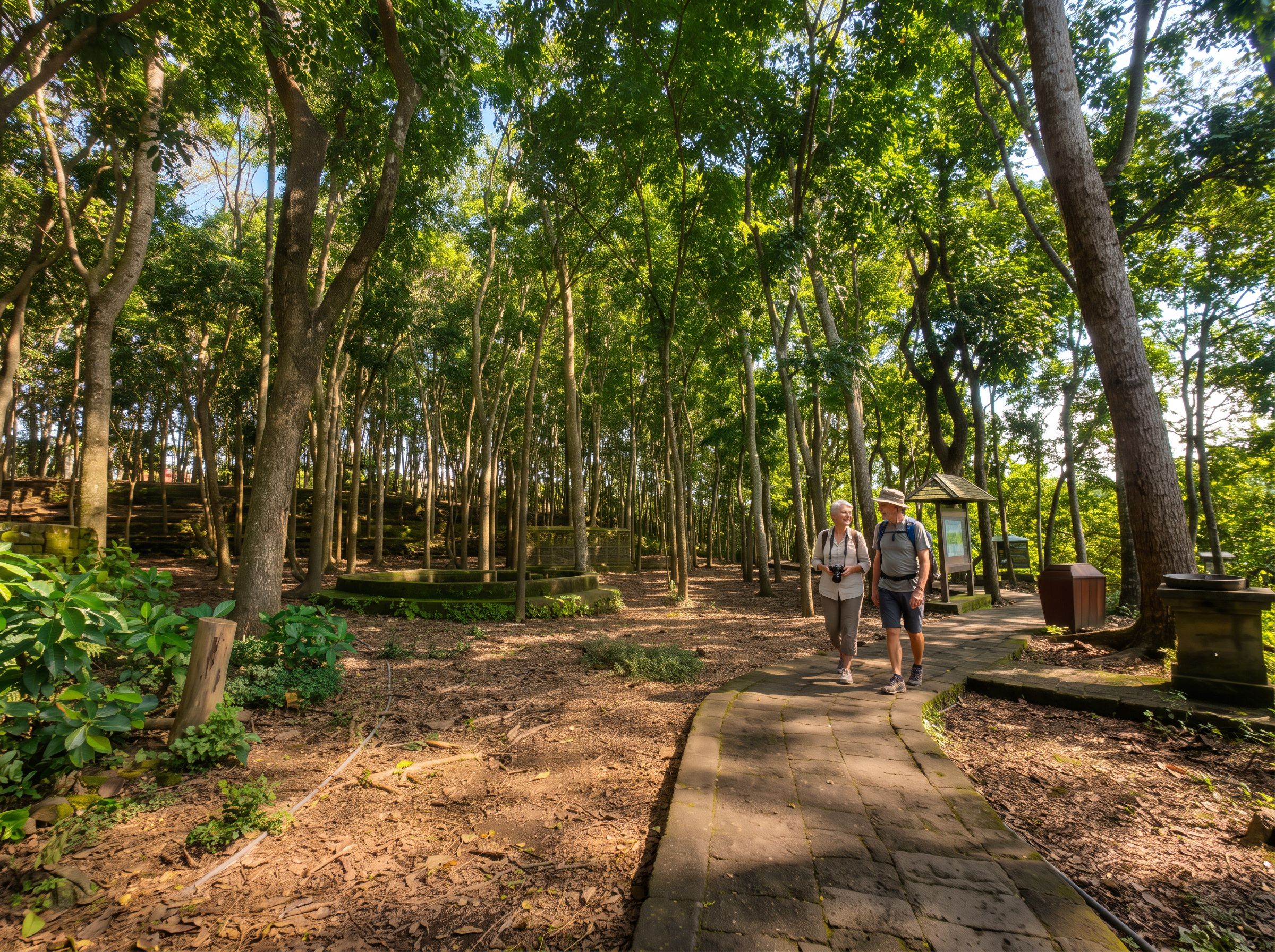
The Sacred Monkey Forest is manageable because visitors choose how far to walk, but it is not flat throughout. Some paths and areas are reached only by steep stairs and narrow ramps. Arriving at opening time brings fewer crowds, cooler air and more active monkeys during the morning feeding.
The sanctuary covers around 12.5 hectares and holds approximately 1,054 monkeys, according to the official visitor information at the Monkey Forest visitor page. Three temples stand inside the grounds, including Pura Dalem and a Holy Water Temple, and the official page notes that some areas are considered sacred and off-limits to visitors. The forest is open 09:00 to 18:00 daily with last entry at 17:00, and adult admission is IDR 130,000. No senior fare is documented.
Guest feedback gathered across Google reviews, where the sanctuary holds 4.5 out of 5 from 60,091 reviews as of October 2026, describes the forest as lush, shaded and well maintained, with staff present throughout to monitor the monkeys and remind visitors of the rules. The same reviews note that the terrain is not flat throughout, and that some paths involve steep stairs and narrow ramps. Comfortable walking shoes are advised by the operator, since paths can be uneven and slippery in the rainy season.
Safety guidance is specific and worth following. Macaques may take bags or valuables and may bite, so keep bags closed, carry no food, and secure loose spectacles and jewellery. The operator prohibits bringing food or drinks into the forest, forbids feeding the monkeys, and provides lockers in the lobby. An on-site first aid clinic and a professional nurse are available if anything goes wrong.
"Beautiful nature, iconic temples, and tons of monkeys wandering around. The park is clean and well-organized. Just keep an eye on your sunglasses, bags, and phone, and you'll have a great time!" a guest wrote on Google in September 2026.
Which temple suits a gentle morning?
Pura Taman Saraswati, the lotus-pond water temple in the centre of town, fits most naturally into a gentle morning. It sits within the paved, shaded central circuit alongside Ubud Palace and the Monkey Forest. Temple access can be restricted during ceremonies, so check at the entrance on the day.
Ubud Palace, the royal compound known as Puri Saren Agung, opens its outer courtyards during the day, reported as free, with grounds generally open from 08:00 to 18:00. Palace-specific steps, lifts, accessible toilets and exact walking distances are not documented, so ask on arrival. No regular closing day is recorded, though island-wide closure applies during Nyepi.
Sources differ on Saraswati admission: one lists a modest or variable charge, while another describes central attractions as free or low-cost. Confirm the current position at the gate rather than relying on either figure. No verified senior fare is documented for either site.
Temple dress matters. Sarongs and scarves are required at some temples, and one source states that a sarong and scarf must be worn at a named temple, though the excerpt does not identify the site clearly enough to apply the rule everywhere. Carry a sarong. Active ceremonies can restrict access, and inner sanctums are generally reserved for worshippers. The full picture of Ubud's sacred sites, including Goa Gajah and Tirta Empul, sits in our dedicated guide to Ubud's temples and palaces.
What does a yoga or wellness session involve?
Ubud's wellness offering ranges from drop-in yoga classes to multi-day retreats, and the over-50s can choose a single session without committing to a programme. The retrieved sources do not document a specific accredited wellness standard for Ubud, so choose a studio by the style of class and the pace, not by a badge.
No specific, verifiable wellness accreditation for Ubud is documented. That absence says nothing about the quality of individual studios; it simply means the traveller should ask directly about class length, the ratio of standing to floor work, and whether props such as blocks and chairs are provided.
For a first session, a restorative or gentle class in the morning suits the climate better than a vigorous midday practice. Ubud's year-round temperatures sit at approximately 20 to 30°C, with cooler evenings than coastal Bali, so an early class is also the most comfortable. Our companion piece on the wellness and yoga retreats of Ubud covers the longer-stay options in detail.
When is the Ubud market at its calmest?
The Ubud market is busiest in the middle of the day, when tour groups pass through. Early morning is calmer, cooler and easier underfoot. The retrieved sources do not document specific market opening hours, so confirm them locally before setting out.
The market sits in the centre of town, close to the palace and the Saraswati temple, which makes it easy to combine with a cultural morning. Payment methods vary by site: some local temple entrances and parking areas accept cash only, while the Monkey Forest is described as moving to cashless payment from April 2026. Carry a modest amount of cash and confirm before you buy.
Bargaining is customary in the market, and the practical approach is to agree a price before anything is handed over. The same principle applies to short car journeys in town: a 2016 Fodor's Travel Talk discussion reported fares of roughly IDR 50,000 to IDR 100,000 with the advice to agree the fare first, though prices change and that figure is a historical indication rather than a current rate.
Where can I see a Balinese dance performance?
Evening dance performances are reported at Ubud Palace, commonly scheduled at about 19:30, and the Monkey Forest's Wana Café area hosts Balinese dance every Saturday and Sunday at 11:00 and 16:00. The retrieved sources do not establish a current palace performance schedule or booking terms, so confirm on the day.
The daytime option at the Wana Café, next to the Monkey Forest, suits travellers who prefer not to go out after dark. Forum contributors repeatedly warn about poor lighting, drainage ditches and missing pavements on unfamiliar outer roads after dark, and advise carrying a flashlight in dim alleys. A daytime performance sidesteps that concern entirely.
For an evening performance, arrange transport in advance rather than walking back through unlit streets. A published Ubud guide to entrance fees and performance information reports the evening dance tradition, though it does not confirm a current schedule. Ask your hotel to book a car for the return journey.
How do I avoid the midday heat and the crowds?
Start early, rest at midday and walk again in the late afternoon. The terraces are best around 07:30 to 09:00, the Monkey Forest at its 09:00 opening, and the Campuhan Ridge Walk between 05:30 and 07:00. July and August are the busiest months, with Christmas and New Year close behind.
Ubud's dry season runs from April to October and its rainy season from November to March. January is among the wettest months, with heavy showers and high humidity, and December downpours can disrupt outdoor visits. Heavy tropical rain and localised flooding can particularly affect the Monkey Forest. March usually brings Nyepi, the Balinese Day of Silence, when normal activity stops across the island for 24 hours, including Ubud's tourism operations.
The heat is manageable with three habits: carry water, wear a hat, and treat shade as a planning tool rather than a lucky find. The central circuit is described as shaded and equipped with benches, which makes it the natural midday choice. The terraces and the ridge walk offer little relief once the sun is high.
| Experience | Effort level | Shade and seating | Best time |
|---|---|---|---|
| Tegallalang rice terraces | Demanding: 300 to 400 steps each way | Not documented | 07:30 to 09:00 |
| Sacred Monkey Forest | Moderate: some steep stairs and narrow ramps | Shaded forest; benches not documented | 09:00 opening |
| Ubud Palace and Saraswati Temple | Gentle: paved, wide, mostly level circuit | Shaded, with benches on the circuit | Morning or late afternoon |
| Yoga or wellness session | Varies by class | Not documented | Morning |
| Ubud market | Gentle | Not documented | Early morning |
| Balinese dance | Seated | Not documented | 11:00 or 16:00 weekends; about 19:30 evenings |
How should I get around Ubud without tiring myself?
Hire a private car and driver for anything outside the town centre, and walk only the central circuit. Ubud's pavements are narrow, damaged and uneven in places, and a step-free route through the town's attractions is not documented. Ride-hailing works but can be slow on Monkey Forest Road at lunch and dinner times.
Grab and Gojek are widely reported as easy to arrange, though car journeys can be slow during meal periods, and contributors suggest walking briefly to a more convenient pickup point when traffic or one-way systems delay the driver. A published Ubud transport guide sets out the options in more detail. Ubud's core streets were converted to one-way traffic with tour buses excluded from the centre from September 2026, and reports describe substantial congestion during the first day of implementation, so allow extra time and expect altered drop-off arrangements.
For outlying sights, a driver allows sightseeing to be arranged around shorter walks. The road distances are modest: Ubud to Goa Gajah is 6.5 km, about 10 minutes with clear roads, and Ubud to Tirta Empul is 17 km, about 20 minutes with clear roads. Both figures assume free-flowing traffic with no stops.
Night walking draws repeated warnings from forum contributors: poor lighting, drainage ditches, debris and missing pavements outside the centre. Avoid unfamiliar outer roads after dark. For medical needs, UbudCare Clinic 24 Hours on Jalan Raya Teges in Peliatan records round-the-clock operation with doctors, laboratory services and an on-site pharmacy, and BIMC Ubud Medical Centre on Jalan Raya Sanggingan in Kedewatan records 24-hour medical and emergency services. RSUD Gianyar is reported as Ubud's closest 24-hour hospital, approximately 13 km east. Ambulances may be slowed by traffic and hilly roads.
What should I know before I book?
International visitors pay a Bali tourist levy of IDR 150,000 through the official Love Bali portal, separate from attraction admission. No senior or over-65 concession is documented for any of the named Ubud attractions. Carry cash for smaller sites and confirm payment methods before you set out.
The levy applies to international visitors, and some visa and stay-permit holders, such as KITAS and KITAP holders, may be exempt. A retrieved Ubud guide reports a separate IDR 500,000 Visa on Arrival charge, but nationality-specific eligibility and passport-validity rules are not established. Check current immigration conditions before travel.
Mosquito protection is advised in Ubud's vegetated environment, and dengue is identified as a local health concern. Emergency numbers reported for Bali include 112 for general emergencies, 110 for police, 113 for fire, 118 or 119 for ambulance, and 115 for search and rescue. The Bali Tourist Police hotline is reported as +62 361 224 111. Response times and English-language availability in Ubud are not verified in the retrieved sources.
For accommodation, a hotel in central Ubud with a confirmed ground-floor room, walk-in shower and a pre-arranged car is more dependable than assuming the town is step-free. Our guide to where to stay in Ubud when comfort comes first covers the property detail, which sits outside this article's scope.
How should I shape a three-day visit?
Give each day one demanding element at most. Pair the terraces with an afternoon at the market, the Monkey Forest with a temple and a dance, and the wellness session with a gentle morning at the palace. This keeps the pace sustainable across a short stay.
Day one: the central circuit in the morning, taking in Ubud Palace and Pura Taman Saraswati while the air is cool and the paving is shaded. Rest at midday. Return for the market in the late afternoon. Day two: the Monkey Forest at the 09:00 opening, when the monkeys are active and the crowds are thin, followed by a seated lunch and a weekend dance at the Wana Café at 11:00 or 16:00. Day three: the terraces early, viewed from a café if the steps are not appealing, with the afternoon free.
Build in a rest day if the stay allows. Forum contributors consistently advise planning fewer major sights per day than the map suggests, and the most frequent regret among older visitors is expecting a short map distance to translate into an easy walk. Ubud rewards a slower rhythm, and the experiences above are better savoured across a week than crammed into three days.


