
Charleston is partly accessible for visitors with limited mobility, and the honest reading is that it rewards planning more than most American cities. The peninsula is largely flat, which helps anyone who tires easily, but its historic streets carry cobblestones, slate and brick sidewalks that make wheeled travel slow and sometimes awkward. Some museums and market halls are step-free and lend wheelchairs; many historic houses are not. The city publishes disability parking concessions, and a free shuttle shortens the distances between sights. What follows is a city-wide reading for travellers aged 50 to 70 who use a stick, a walker or a wheelchair, with the documented facts separated from the details nobody has published.
What does Charleston do well for visitors who tire easily?
Charleston's flat peninsula, free DASH shuttle and disability parking concessions do much of the work. The Charleston Museum lends manual and electric wheelchairs at no charge, the South Carolina Historical Society Museum has a wheelchair entrance on Meeting Street, and Charles Towne Landing lends wheelchairs and strollers from its Visitor Center. These are documented provisions, not a promise that every sight is step-free.
The City of Charleston states that vehicles displaying a disability placard or plate may park free at city-owned garages, lots and meters, a concession that removes a recurring cost and friction from a day out. The city also publishes a printer-friendly public garage and restroom guide, which is the document to download before setting out.
CARTA, the regional transit authority, describes all fixed-route buses as wheelchair accessible and ADA-compliant, with wheelchair lifts, a kneeling function for easier boarding, priority seating and space for mobility devices. Drivers can secure wheelchairs and scooters, and service animals are permitted. The free Downtown Area Shuttle, known as DASH, connects major attractions, hotels, historic sites and shopping areas, and CARTA presents it as a way of covering ground in the historic district without walking it.
Are Charleston's cobblestone streets and brick sidewalks hard to manage?
They can be. Charleston's historic downtown includes cobblestones, slate and uneven brick sidewalks, and recent travel guidance describes these as practical mobility obstacles rather than picturesque features. A Charleston tour operator quoted in that guidance warns that 300-year-old cobblestone and slate streets, graveyards and an uneven dungeon floor can be difficult for wheelchair and stroller users.
Forum evidence is more specific and more sobering. A Charleston discussion updated in November 2025 described sidewalks as sometimes impassable, with curb cuts that are hit and miss. A January 2025 walkability thread called downtown pleasant in places but criticised narrow sidewalks, tree roots, grates and low curbs, and noted that at busy times pedestrians step into the street to get around obstacles. The same thread described Charleston's summer heat as making walking nearly unfeasible for some people.
A senior-focused Charleston guide notes that Preservation Society walking tours commonly cover six or more blocks on these surfaces, which is worth knowing before joining one. Supportive footwear helps, and so does a rollator with large wheels or a wheelchair built for rough paving. The City of Charleston does not publish a street-by-street surface survey, so the practical approach is to treat any given block as unknown until you see it.
 AI-edited
Which museums and indoor sights are step-free?
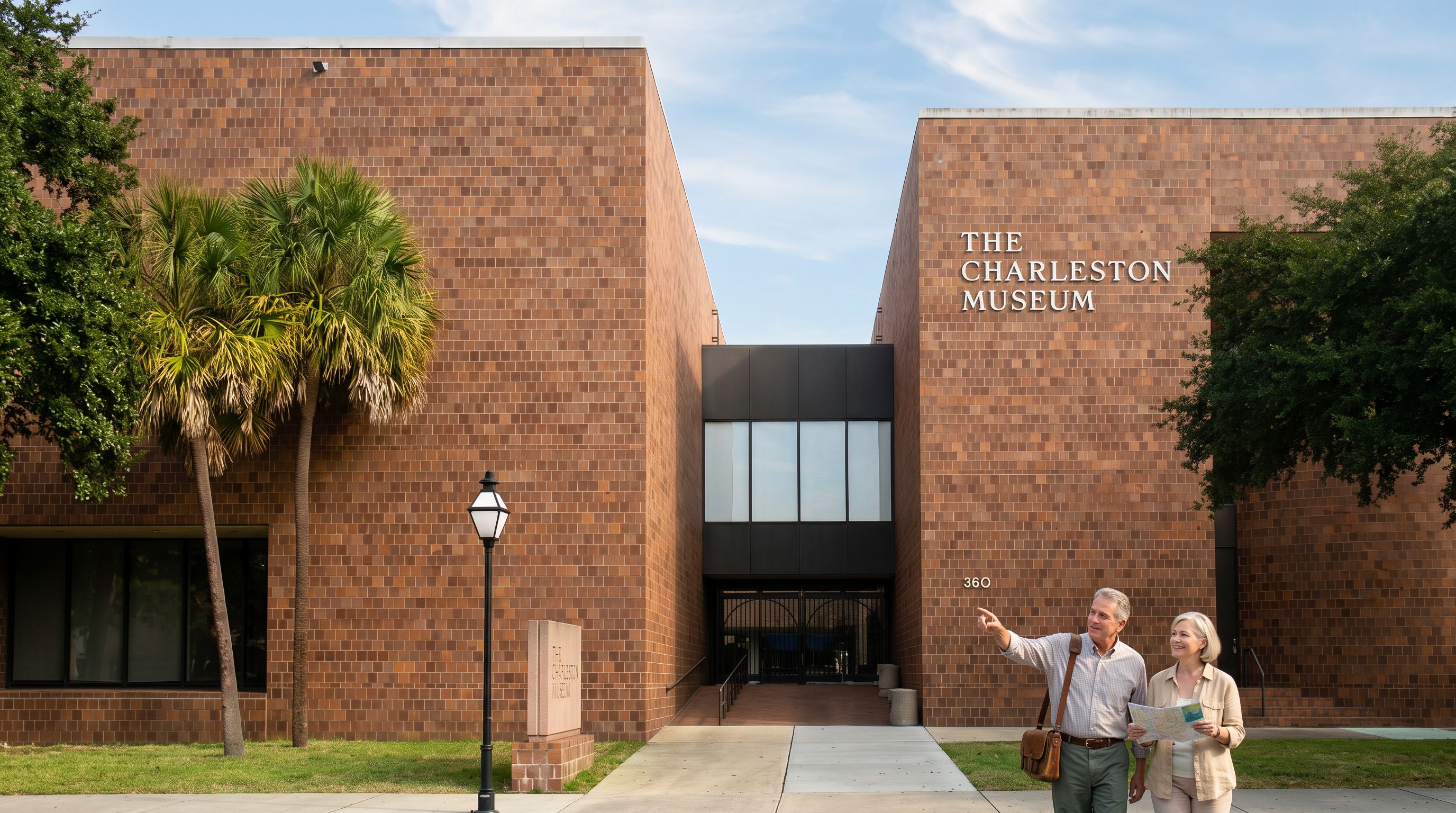
The Charleston Museum is the strongest documented option: it lends manual and electric wheelchairs free on a first-come, first-served basis, has ramps and elevators, and permits wheelchairs throughout the museum and its historic houses. The South Carolina Historical Society Museum has a wheelchair entrance on Meeting Street and elevator access to both floors.
The Charleston Museum's accessibility information is unusually detailed for the city. It welcomes identified service dogs, provides captioned videos, and offers photographic alternatives for historic houses that require stairs, which is a practical answer for anyone who cannot climb them. Guests describe the exhibits as well organised and easy to follow, with a clear path through Charleston's history, and note that benches are available and folding portable chairs are provided for anyone who wants to rest mid-tour. The building is air conditioned, which matters in July.
Guest feedback gathered on Google, where the museum holds 4.6 out of 5 from 2,381 reviews as of November 2026, repeatedly mentions friendly front-desk staff and the museum's usefulness on a hot or wet afternoon. One review from October 2026 reads:
"This place is very interesting with a lot of great exhibits. It wasn't crowded and we had a great time." (Google, October 2026)
Two planning notes come from the same guest feedback. The on-site car park is small, and parking behind the building is validated at the front desk for free or reduced cost. Combo tickets bundle the museum with nearby historic houses, but the second house included is more than a mile away, so the pairing suits a visitor with transport arranged rather than one on foot. Visitors who read most displays report spending three to five hours, so plan for at least two.
What about the historic homes with stairs?
Many historic properties are not wheelchair accessible, according to recent travel guidance, and the Charleston Museum's own provision of photographic alternatives for houses that require stairs confirms that stairs are part of the experience. The city does not publish a single register of which house entrances are step-free, so each one has to be checked directly before booking.
This is the area where the gap between expectation and reality is widest. Charleston's preservation-related tourism is built on eighteenth and nineteenth century buildings, and a November 2025 forum discussion about taking relatives who used walkers noted that many older buildings were grandfathered out of modern accessibility requirements. That is a structural fact about the building stock, not a criticism of any one house.
The practical response is to ask two questions of any house you plan to visit: is there a step-free entrance, and is the ground floor alone worth the ticket? Where the answer is not documented, assume nothing in either direction. A historic building is not automatically a staircase, and a garden setting is not automatically level.
For the wider story of the region's great houses and their grounds, our guide to Charleston's plantations and the Lowcountry's history covers the context that the house tours only sketch.
How do the DASH trolley and CARTA work for wheelers and walkers?
DASH is free and connects the historic district's main attractions, hotels and shopping areas, and CARTA states that all fixed-route buses are wheelchair accessible with lifts, kneeling capability and space for mobility devices. What is not documented is step-free access at every DASH stop, or a continuous step-free pedestrian route through the historic district.
That distinction matters. A wheelchair-accessible vehicle does not guarantee an accessible boarding point, and CARTA does not publish a stop-by-stop access survey. Ask the driver, or call CARTA before relying on a particular stop.
Visitors unable to use fixed-route buses may use CARTA's Tel-A-Ride paratransit service, which runs origin to destination. CARTA says visitors can qualify using suitable disability certification from their home transit system, or by being found eligible in Charleston. Visitors with qualifying disability documentation can also receive reduced CARTA fares by showing a Medicare card or a disabled-identification card from their home transit system. No over-65 fare, senior pass or general reduced tariff for CARTA, DASH or Charleston's main attractions is documented.
From the airport, Charleston International sits about 12 miles from the historic district, and CARTA Route 11 Dorchester/Airport connects the terminal with the Charleston area, with its airport stop near passenger pickup and the rental-car lot. Arrivals and departures are on the same level, and the airport reports accessible circulation, terminal TTY phones and ramped loading bridges for major airlines. Some regional aircraft may require stairs from the tarmac or a lift, so passengers should confirm boarding arrangements with the airline, as the Charleston Area Convention & Visitors Bureau's accessibility pages set out. The airport also provides up to 48 hours of free accessible parking for qualifying users who present a valid disability placard and matching driver's licence at exit, with ordinary charges afterward.
The Amtrak station is in North Charleston rather than the historic centre, so a taxi, ride-hailing service or pre-arranged transfer is generally needed to reach peninsula accommodation. Station-specific step-free details are not documented. Charleston has no metro or tram system.
Can I get onto the water or out to a park?
The public Historic Charleston Harbor Tour is described as wheelchair accessible, but boarding uses a roughly 30-foot ramp whose steepness changes with the tide, and the operator states plainly that electric wheelchairs and mobility scooters cannot be accommodated. Charles Towne Landing, a state historic site, lends wheelchairs and strollers free from its Visitor Center.
The harbour tour runs 90 minutes from the Charleston Maritime Center, near Calhoun and Concord, with adult tickets at $42 to $44 for ages 12 and over and children three and under free. Tickets are non-refundable and there are no stops. The operator advises calling to confirm the best timing for wheelchair access because the ramp is steeper at high tide, and notes that stairs are required to reach the lower level, which is enclosed and climate controlled. The Carolina Belle has two decks, a glassed-in Main Salon and an Observation Deck. The public tour runs from mid-February through Thanksgiving, with weekend cruises in December.
For Fort Sumter excursions, the cited travel guidance reports that only Liberty Square is able to board wheelchairs and scooters. The boats have lifts and accessible restrooms, but changing tides and weather mean accessibility cannot be guaranteed. The same guidance reports a $39 senior fare for the Fort Sumter ferry without clarifying the exact age threshold or dating an official fare page.
Charles Towne Landing spreads across 664 acres with six miles of trails, a 12-room exhibit hall, the Animal Forest and the reconstructed ship Adventure. Park grounds open 9 a.m. to 5 p.m. daily, the Visitor Center and gift shop 9 a.m. to 4 p.m. daily, the Animal Forest 10 a.m. to 4 p.m. daily, and the Adventure 10 a.m. to 4 p.m. daily except Tuesdays. Everything listed closes on Christmas Day. Admission is $12 for adults, $7.50 for a South Carolina senior, $7 for youth aged 6 to 15 and free for children five and under; the operator does not state the age at which the senior rate begins.
Two temporary conditions apply. The Adventure leaves for annual winter maintenance, with return dates varying by year. At the time of the operator's notice, approximately half of the Animal Forest, starting at the puma and bear exhibits, was closed Monday through Friday for construction, with weekend operation described as usual. Note also that pets and service animals are not permitted in the Animal Forest. A December 2025 forum report described much of the grounds as paved and easy to roll on, based on stroller use, but it did not document every route, gradient or restroom.
Where are the public restrooms, and what about the heat?
The City of Charleston publishes a public garage and restroom guide as a downloadable PDF, which is the most reliable single source for planning stops. On heat, official visitor guidance identifies March to May and October to November as the most comfortable periods, while July and August are punishing for anyone who finds walking strenuous.
The climate figures, recorded at Charleston International Airport in North Charleston rather than downtown, show why. July averages a high of 91.3°F with roughly 21.4 days reaching at least 90°F. August is the wettest month at 6.97 inches. November is the driest at 2.66 inches with a 69.4°F average high, which makes it the kindest month for a walking-light itinerary. January averages a 60.2°F high with occasional freezing nights.
| Period | Average high | What it means on foot |
|---|---|---|
| January | 60.2°F | Cool, generally suitable for walking, occasional freezing nights |
| April | 77.1°F | Warm and more comfortable than summer |
| July | 91.3°F | Hottest month, about 21.4 days at or above 90°F |
| August | 89.8°F | Wettest month at 6.97 inches, high overnight humidity |
| October | 77.9°F | Comfortable transition, humidity breaks |
| November | 69.4°F | Driest month at 2.66 inches, among the best for walking |
The Charleston area recorded 7.91 million overnight visitors in 2025, according to figures attributed to the College of Charleston's Office of Tourism Analysis, so the popular months are busy as well as hot or cool. For a fuller month-by-month picture, see our guide to what a comfortable Charleston trip costs, which covers seasonality alongside budget.
What medical help is nearby if something goes wrong?
Charleston has a documented downtown pharmacy and a downtown hospital with 24-hour emergency care. CVS Pharmacy at 59 George Street is the nearest documented downtown pharmacy, and Roper Hospital at 316 Calhoun Street is identified as providing 24-hour emergency treatment. For anything life-threatening, call or text 911.
Charleston County Emergency Management can be reached on (843) 746-3800, and the Charleston County Rescue Squad on (843) 225-7728. The City of Charleston Citizen Services Desk on (843) 724-7311 is a municipal information line, not an emergency service. The MUSC Health Adult Emergency Department at 96 Jonathan Lucas Street is open 24 hours daily on 843-792-2300 and treats complex injuries, life-threatening illnesses, heart attacks, strokes and accidents; the source does not document its accessible entrances, parking or distance from the attractions.
For routine prescriptions, MUSC Health Pharmacy at University Hospital, 171 Ashley Avenue on the first floor of the University Medical Center, is open Monday to Friday, 8:30 a.m. to 5:30 p.m., and closed Saturday and Sunday, on 843-876-0199. A separate 24-hour CVS is documented at 5215 Ashley Phosphate Road in North Charleston, outside the City of Charleston.
No source identifies the nearest pharmacy or medical facility to Charles Towne Landing or to the city's parking facilities. The city does not publish a formal municipal risk assessment covering uneven surfaces, curb transitions or heat for older visitors.
How should a slower traveller structure the days?
One outdoor area and one indoor attraction per day, with door-to-door transport for longer hops, is the pattern that forum contributors and travel guidance converge on. Choose accommodation south of Calhoun Street and close to the specific sights you plan to see, rather than relying on the broad label downtown.
Forum contributors regarded the historic core as the most pedestrian-friendly part of Charleston while noting that accessibility varies sharply from block to block. They described door-to-door transport as the easiest approach where sidewalks make wheeled travel difficult, and recommended taxis, ride-sharing or a guided bus tour for longer transfers. In a December 2025 discussion specifically about travelling with older, physically weak relatives, contributors recommended guided bus tours of the historic district and short, manageable outings rather than extensive walking.
Treat a short historic-district walk as potentially slow. Allow extra time for uneven paving, narrow sidewalks, pedestrians, parked cars and curb cuts that may not line up conveniently. The city has installed new pedestrian refuge islands and rapid-flashing-beacon crossings with accessible ramps at specific locations in 2026, and new beacons and crosswalks at three West Ashley Greenway crossings in 2025, but these apply to those crossings, not to every historic sidewalk. Construction of a bicycle and pedestrian bridge linking West Ashley, Brittlebank Park and the Ashley River Walk began in 2025, with completion previously expected in summer 2027, and nighttime lane closures on US 17 may affect journeys in the meantime.
Where you stay shapes all of this. Our neighbourhood guide to choosing your base in Charleston covers the geography; hotel-by-hotel access is outside this article and has its own dedicated guide. If a quieter afternoon appeals, a Charleston spa day is one way to break up a walking-heavy week.
What still isn't documented, and what should I ask?
Charleston publishes no citywide survey of pavement quality, gradients, curb cuts or accessible crossings, and no complete register of which attractions are step-free. The city does not document whether its historic streets suit a particular wheelchair, rollator or mobility scooter. Those gaps are the reason to confirm details directly rather than assume them.
Several specific questions have no published answer. The City of Charleston does not document the distance from its parking facilities to the attractions, nor sidewalk conditions, slopes or curb accessibility along the way. Charles Towne Landing documents wheelchair loans but not route gradients, path surfaces, distances between exhibits, accessible toilets or lift access. The harbour tour's operator documents the ramp and the stairs but not a reserved wheelchair or assisted-boarding service. No source documents a requirement or facility for reserving a wheelchair, an accessible tour or mobility assistance in advance.
Ask the operator, not the booking platform. For a historic house, ask about the step-free entrance and whether the ground floor alone justifies the ticket. For a bus stop, ask CARTA whether that specific stop has an accessible boarding point. For a restaurant or museum, ask where the nearest accessible restroom is, because the city's restroom guide covers public facilities rather than private ones.
One further caution belongs here rather than anywhere else: no reliable, place-specific crime statistics or official neighbourhood-by-neighbourhood safety assessment for the City of Charleston appears in the public material reviewed, so check conditions for your exact accommodation and route, particularly after dark.


