
Chiang Mai rewards travellers who treat the city as a base rather than a destination. The flat Old City offers the easiest walking conditions in the region, and from there a handful of excursions reach mountains, waterfalls and elephant sanctuaries within a morning's drive. This guide covers five day trips that suit travellers aged 50-70: Doi Inthanon, the Mae Sa valley, an ethical elephant sanctuary, Lampang and the Sticky Waterfalls. Each entry sets out travel time, effort level, heat exposure and the logistics that matter most.
Chiang Mai's in-city sights, including the National Museum, Night Safari and Royal Park Rajapruek, are covered in our separate guide to seeing Chiang Mai with little walking and out of the heat. What follows stays outside the municipality.
Which day trips from Chiang Mai are actually worth the effort?
Five excursions justify a full day from Chiang Mai: Doi Inthanon National Park, the Mae Sa valley, an ethical elephant sanctuary, Lampang and the Sticky Waterfalls. Doi Inthanon and Mae Sa suit low-to-moderate effort; Lampang and Sticky Waterfalls demand more. All five are reachable by private car, organised tour or public transport, with private vehicles giving the most control over pacing.
The Chiang Mai provincial tourism authority describes Doi Inthanon as the most comfortable mountain to visit in the region because of its road access, and distinguishes short trails from long ones for visitors of different abilities and ages. That official framing matters for this age group: the mountain's headline sights do not require hiking.
Effort levels across the five trips vary considerably. Doi Inthanon runs low to moderate if you stick to the summit, the Ang Ka nature trail and the roadside waterfalls, and high if you add the Kew Mae Pan trail. Mae Sa valley is low to moderate depending on which attraction you choose. An elephant sanctuary is low to moderate, though surfaces can be uneven and outdoor exposure substantial. Lampang is moderate to high as a same-day return, mainly because the journeys consume several hours. Sticky Waterfalls is moderate to high if you climb.
Doi Inthanon: is Thailand's highest mountain manageable in a day?
Yes. Doi Inthanon sits about 100 km southwest of the Old City, roughly 1½ to 2 hours each way, and the main sights are reached by vehicle and short walks. Foreign adults pay 300 baht entry, cars 30 baht, and the Royal Twin Pagodas charge a separate 100 baht. Allow 8 to 10 hours for the round trip.
The park lies in Chom Thong District, not in Chiang Mai municipality. Published operating hours are approximately 05:30 to 18:30 daily, with the visitor centre listed as open 08:00 to 16:00 and individual attractions generally closing between 16:00 and 17:00. A ticketing listing gives the address as 119, Ban Luang, Chom Thong District, and a ticket enquiry number of +66 53 286 729; because that listing is not the park's own official site, confirm hours and fees directly before departure.
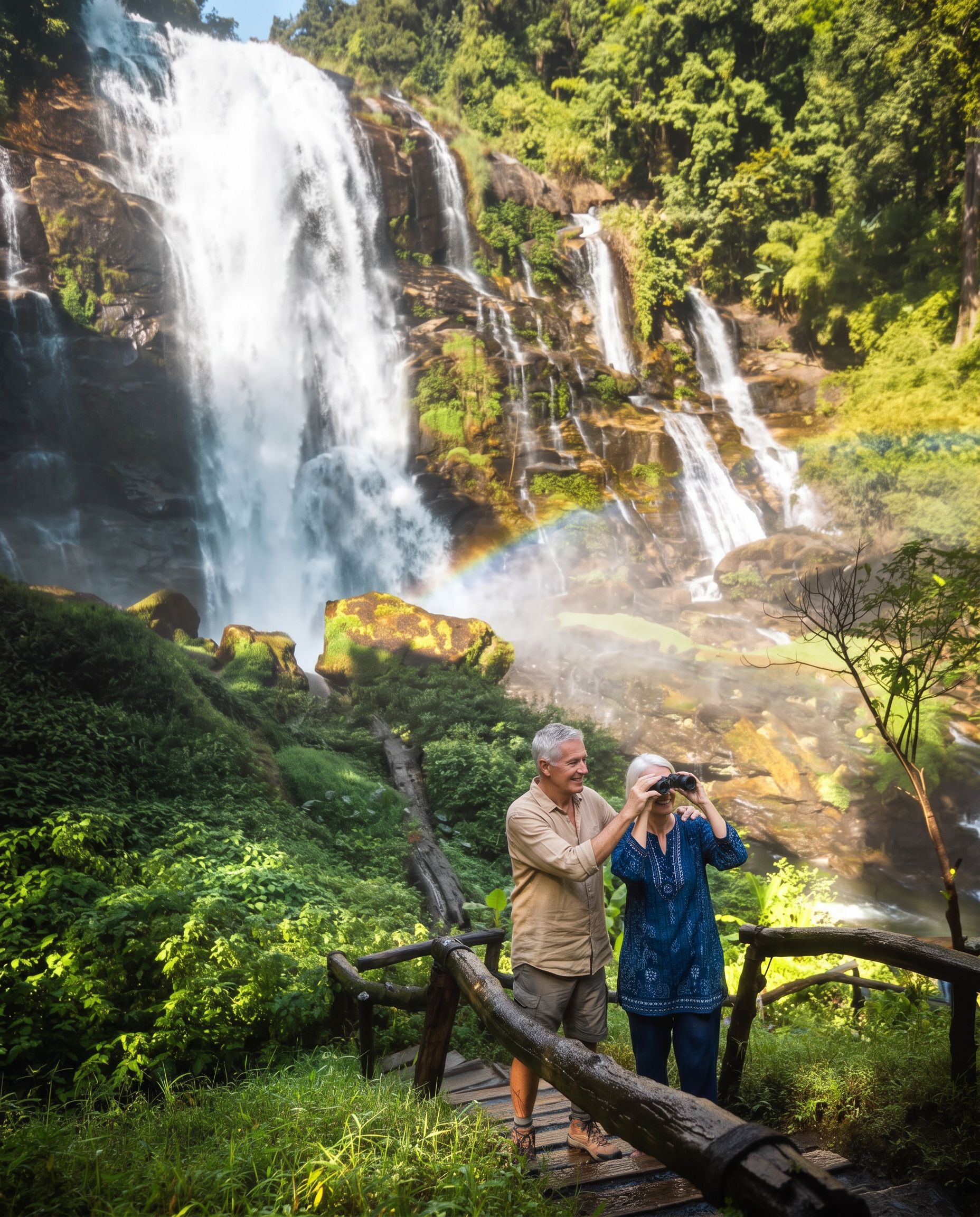
The summit stands at 2,565 metres. Mae Klang, Wachirathan, Sirithan and Siriphum waterfalls are described as accessible from the road or by short walks, which makes a waterfall-focused visit less strenuous than a full hiking itinerary. Wachirathan sits about 21 km inside the park and involves a short walk of roughly 200 metres from its car park. The Ang Ka Luang nature trail at the summit can be reached by car.
 AI-edited
The Kew Mae Pan trail is the exception. It runs approximately 3 km, requires a guide, and the published guide charge is 200 baht. It closes approximately June to October for ecological recovery. Travellers who prefer limited walking can prioritise the summit, the pagodas and Wachirathan while skipping Kew Mae Pan entirely.
The road is the principal comfort consideration. A Reddit discussion updated 18 January 2026 characterises the ascent as extremely twisty, with tight bends, fast traffic and aggressive local driving, and recommends a hired car rather than a motorbike unless the rider is highly competent. A separate Reddit report dated 2 May 2025 recommends a private car and driver because it allows visitors to linger at stops rather than follow a rigid group-tour schedule.
Public minivans from Chiang Mai can take approximately 2 to 3 hours to reach the park and may not provide convenient transport between attractions inside it, according to a Reddit discussion dated 2 May 2025. General admission is reported as payable at the gate, with no advance booking required. No senior or over-65 concession is documented. The park does not publish step counts, lifts, wheelchair surfaces or accessible toilets for individual sites; ask when booking.
Mae Sa valley: what can you see without a long walk?
The Mae Sa valley in Mae Rim District sits northwest of Chiang Mai, about 45 minutes from the Old City to Mae Sa Waterfall via Highway 107 and Route 1096. It suits a flexible day because you select individual roadside attractions rather than committing to one continuous trek. Most attractions operate roughly 08:00 to 17:00.
Mae Sa Waterfall is the anchor. It is a series of ten cascading falls along a paved, well-marked trail of about 1 to 1.5 km one way, with rest areas, viewpoints and a suspension bridge. Three parking areas let visitors start higher up the trail, and a parking lot above the river allows access for those who cannot or prefer not to walk the full route. Wheelchair-accessible ramps reach roughly the fourth to fifth level, though some ramps are steep and require a strong pusher. Guest feedback on Google, where the waterfall holds 4.4 out of 5 from 2,537 reviews as of October 2026, repeatedly notes that sections of the trail and rocks are slippery from moss and algae, and that the upper falls around levels seven to ten are steeper and more difficult for older or less mobile visitors.
"Well worth a trip to this waterfall. Very green and very attractive. Be careful of your footing because it is quite slippery." (Google, July 2026)
Facilities include clean restrooms at the parking lots, food stalls and vendors at the lower and upper car parks, and picnic mats and baskets available for loan. Entry is 100 baht for foreign adults and 50 baht for children, plus 20 baht for a motorbike or 30 baht for a car, and the park closes at 17:00. The water is often brown or muddy from clay soil, and the upper levels are sometimes closed.
Elsewhere in the valley, Queen Sirikit Botanic Garden opens 08:30 to 17:00, with admission of 100 baht for an adult and 50 baht for a child; the canopy walkway opens at 09:00. Orchid farms generally run 07:00 to 17:00 with admission commonly listed at 40 to 60 baht. According to Beautiful Chiang Mai's Mae Sa valley guide, attractions generally operate during daytime hours and Mae Sa Waterfall is listed as open 08:00 to 17:00. These times come from a destination guide rather than a government authority, so check with each attraction.
Daytime conditions can be hot and humid at these lower elevations. Begin with outdoor walks and schedule gardens or cafés during the warmer middle of the day. A private car or driver is preferable because the valley is a collection of separate sites rather than one central visitor complex.
How do you choose an ethical elephant sanctuary?
Look for observation and feeding rather than bathing or riding. A standard single-day Elephant Nature Park programme is listed at 2,500 baht, including transfer from Chiang Mai, lunch and approximately 4 to 5 hours observing and feeding elephants. The programme no longer offers bathing, presented as a deliberate welfare decision.
Elephant experiences are generally in Mae Rim or nearby districts rather than Chiang Mai municipality. Elephant Nature Park is described as just beyond the Mae Sa valley on Route 1095, though operators commonly combine it with a Mae Sa day. The park is roughly a 1.5-hour drive from downtown Chiang Mai.
The park operates a strict hands-off policy: visitors walk among the elephants, prepare and place food in troughs, and observe from a respectful distance, with no riding, bathing or direct touching. Guest feedback consistently describes guides as knowledgeable and friendly, able to identify each elephant by name and recount its rescue history. Hotel pickup and drop-off, van transport and office-based booking are described as well organised. The included vegan buffet lunch is repeatedly praised, and the site is also home to large numbers of rescued dogs and cats.
"Incredible experience. Very hands off and respectful of the beautiful beautiful elephants. The tour guides are very knowledgeable and each elephant has such a story." (Google, August 2026)
As of October 2026, Elephant Nature Park holds 4.5 out of 5 from 616 Google reviews. Other booking platforms describe elephant-sanctuary programmes as lasting roughly three to seven hours and emphasise no riding and no tricks. A listed combined elephant, waterfall and bamboo-rafting excursion takes approximately nine hours, including about 2.5 to 3 hours with elephants, 40 to 50 minutes of rafting and about an hour at a waterfall.
The day is hot with long periods outdoors, so bring water, sunscreen and a hat. Confirm these with the individual operator before paying. Overnight rooms at Elephant Nature Park have no air conditioning and the beds are described as very hard.
Lampang: is it worth the journey as a day trip?
Lampang is a realistic regional excursion but a long day. Published transport figures vary: one listing gives the Chiang Mai to Lampang train at approximately 2½ hours for 23 baht, while another reports buses taking about 1 hour 20 minutes at 75 to 120 baht and one daily train at approximately 2 hours 11 minutes, priced 60 to 1,000 baht depending on class. Treat it as moderate to high effort.
Lampang is a separate province and municipality east of Chiang Mai. The Tourism Authority of Thailand's four-day Lampang, Lamphun and Chiang Mai itinerary assigns Lampang one day and lists Ratchadapisek Bridge, Kat Kong Ta, Wat Mon Phraya Chae, Wang Huea Reservoir and Kiu Lom Dam. That official itinerary confirms Lampang as a realistic excursion, but it does not state a Chiang Mai to Lampang travel time, senior fare, accessibility arrangements or opening-day policy; those details are not documented in the available official source.
Transport listings disagree on schedules and fares. One gives a second-class bus from Lampang to Chiang Mai departing on the hour and costing 48 baht to Chiang Mai Arcade bus station. Another reports buses from Lampang to Chiang Mai approximately five times daily, taking about 1 hour 20 minutes, with fares of 75 to 120 baht. The differing published figures indicate that fares, operators and departure patterns should be checked for the intended travel date rather than treated as a single fixed timetable. Rome2Rio's Lampang to Chiang Mai route information gives approximately 1½ to 2½ hours each way depending on bus or train, with fares varying by service.
Bus travel is potentially quicker; train travel may be more comfortable for those who prefer a slower journey. The listed sights include bridges, markets, temples and a reservoir rather than a single concentrated attraction, so walking surfaces, shade and seating will vary by site. Lampang's lowland climate can be hot, especially around midday.
For travellers aged 50-70, Lampang is better approached in one of three ways: a private car with a driver, allowing stops and rest breaks; an organised day tour with hotel pickup; or an overnight stay, which is more comfortable than a rushed return. Choose one compact town itinerary, arrange the return ticket before sightseeing, and avoid combining Lampang with another distant attraction.
Sticky Waterfalls: who should attempt the climb?
The Sticky Waterfalls, also called Bua Tong Waterfall, sit in Mae Taeng District north of Chiang Mai. The attraction is built around climbing textured limestone, and commercial listings describe some tours as not wheelchair accessible and requiring moderate fitness. A listed half-day tour lasts approximately 4.5 hours. Visit only if everyone is comfortable with stairs, uneven paths and getting wet.
The distinctive feature is climbable limestone, and commercial tour descriptions specifically market the ability to climb the waterfall and visit turquoise pools. The attraction is designed around uneven, wet and sometimes slippery movement, even where the limestone itself provides grip. One excursion states that Sticky Waterfalls is not wheelchair accessible while also describing a moderate physical-fitness requirement; these are operator-specific statements, not a universal park regulation.
A Reddit discussion updated 3 November 2025 describes it as a long half-day trip out and back from Chiang Mai rather than a quick stop, and reports that tour vans and red songthaews were seen at the site, though it does not provide reliable information about step-free access or seating for older visitors.
Confirm current access conditions, stair sections, handrails and wet-surface requirements directly before booking. Travellers with knee, balance or stair concerns should ask the operator specifically about the distance from the vehicle to the viewing areas and whether wet or uneven surfaces are involved. If the group is not comfortable with stairs and uneven paths, use the visit as a viewpoint-and-picnic stop only if the operator confirms safe non-climbing access.
How should travellers 50-70 get to these places?
A private car with driver is the most comfortable option for Doi Inthanon and the Mae Sa valley, because the principal sights are spread across each area rather than concentrated in one complex. Organised tours suit the elephant sanctuary and Lampang. Public transport is possible but involves more changes and less control over pacing.
For Doi Inthanon, a private car, driver or organised tour is the practical option because the principal sights are spread through the mountain park. For Mae Sa valley, a private car or driver is preferable for the same reason. The listed Elephant Nature Park package includes transfer from Chiang Mai, removing the need to arrange local transport independently. Group tours may cover more sights efficiently, but the reports imply less control over pacing.
For travellers aged 50-70, a private vehicle with an agreed itinerary, working air-conditioning, space for walking aids and permission to skip strenuous stops is likely the most comfortable arrangement. Our guide to small-group and guided tours of Chiang Mai covers how to assess operators, and getting around Chiang Mai by songthaew, Grab and private car explains the local transport options in detail.
When is the best time to make these trips?
October to February is the most favourable period for the Mae Sa valley, citing cooler weather and fuller waterfall flow. Late winter is also when Giw Mae Pan's rhododendrons bloom at Doi Inthanon. In the rainy season, approximately May to October, trails may be slippery, though waterfalls are more powerful and the landscape greener.
The summit of Doi Inthanon is substantially cooler than Chiang Mai, but waterfalls and lower parts of the park can be humid. Start early to reduce heat and traffic, prefer the cool season for walking and waterfall visits, build in shaded rests and water breaks, and avoid combining two distant attractions simply to fill a tour itinerary. Treat March to May heat and smoke conditions as a reason to shorten outdoor activities.
The available official material does not provide a month-by-month road-closure calendar, senior fare, reduced-mobility shuttle, lift or seating policy for Doi Inthanon. Chiang Mai Citylife's local reporting covers wildfire and PM2.5 conditions across 2025 and 2026; check current air quality before booking outdoor days in the burning season.
Practical questions before you book
Confirm lift access, bathroom design and breakfast timing at your Chiang Mai hotel before booking day trips, because early departures for Doi Inthanon and late returns from Lampang depend on them. Guest reviews of Chiang Mai hotels consistently point to choosing a quiet, well-serviced base with reliable sleep.
Tripadvisor's 2025 roundup of quiet Chiang Mai hotels repeatedly describes properties on quiet streets while remaining close to the Old City, markets and restaurants, with comments about comfortable beds, quiet air-conditioning and rooms tucked away from disturbance. For limited mobility, confirm lift access and bathroom design directly before booking; Tripadvisor states that U Chiang Mai has three floors and no elevator, with staff assisting with luggage, and advises guests with mobility limitations to take the absence of lifts into account. Tripadvisor also notes that some Meliá Chiang Mai rooms and the lounge are in different buildings and on different floors, which may be relevant after a full-day mountain excursion. Our closer look at 137 Pillars House covers one option in detail.
Breakfast pacing should be confirmed if departing early for Doi Inthanon. For guests sensitive to aircraft noise, check the exact hotel location and request a quiet room; Novotel Chiangmai Nimman Journeyhub sits under the airport's flight path, with Tripadvisor reviews ranging from finding occasional aircraft noise acceptable to describing flights from early morning into the evening as seriously disruptive to sleep and afternoon rest.
Chiang Mai International Airport has a major expansion planned. Chiang Mai Citylife reported in June 2026 that a new international terminal is proposed south of the existing airport, with current terminal buildings renovated for domestic flights, apron improvements and a 1,100-space car park, and completion expected in 2034. For day-trippers this is a long-term project rather than an immediate change, though future construction could affect airport traffic and road access.
Rates, fares and opening times quoted throughout are indicative and vary by season and booking channel. Confirm directly with each operator or authority before departure.


