
Chiang Mai rewards the traveller who plans around the sun rather than against it. The historic core is compact, the major temples sit close together, and a private car with driver turns a scattered day into a sequence of short, shaded stops. For visitors aged 50-70 who prefer not to walk far, the city works best as a morning-and-evening destination, with the middle hours spent indoors, in an air-conditioned vehicle, or back at the hotel.
This guide covers what genuinely functions with minimal walking, what to skip, and how to build a day that keeps the walking short and the heat at arm's length. A broader look at access across the city sits in our dedicated Chiang Mai guide for travellers over 50.
How much walking does Chiang Mai actually involve?
Less than most Thai cities, if you plan it. The walled Old City is relatively flat and holds several major temples within short distances of one another, and a private car with driver is the recommended approach for visitors who do not want to walk long distances. Pavements, however, are often narrow, uneven or obstructed.
The Old City is the practical base. Wat Phra Singh and Wat Chedi Luang sit close enough to combine, and a three-hour guided tour covering Wat Chedi Luang, Wat Phan Tao and Wat Phra Singh was reported to involve only about 20 to 30 minutes of actual walking, because the temples are close together and the pace was relaxed (Reddit, February 2026).
That figure comes from a forum report rather than an operator's published itinerary, so treat it as indicative. What it illustrates is the shape of a low-walking day: one cluster, short distances, long pauses.
The limitation is the ground itself. A January 2026 Reddit discussion on limited mobility warns of rough or missing sidewalks, high kerbs around the moat, pedestrian bridges with stairs and few handrails, and frequent changes in level. The same discussion cautions that a wheelchair symbol on a map app does not necessarily mean accessible toilets or genuinely step-free access.
Which temples work with minimal walking?
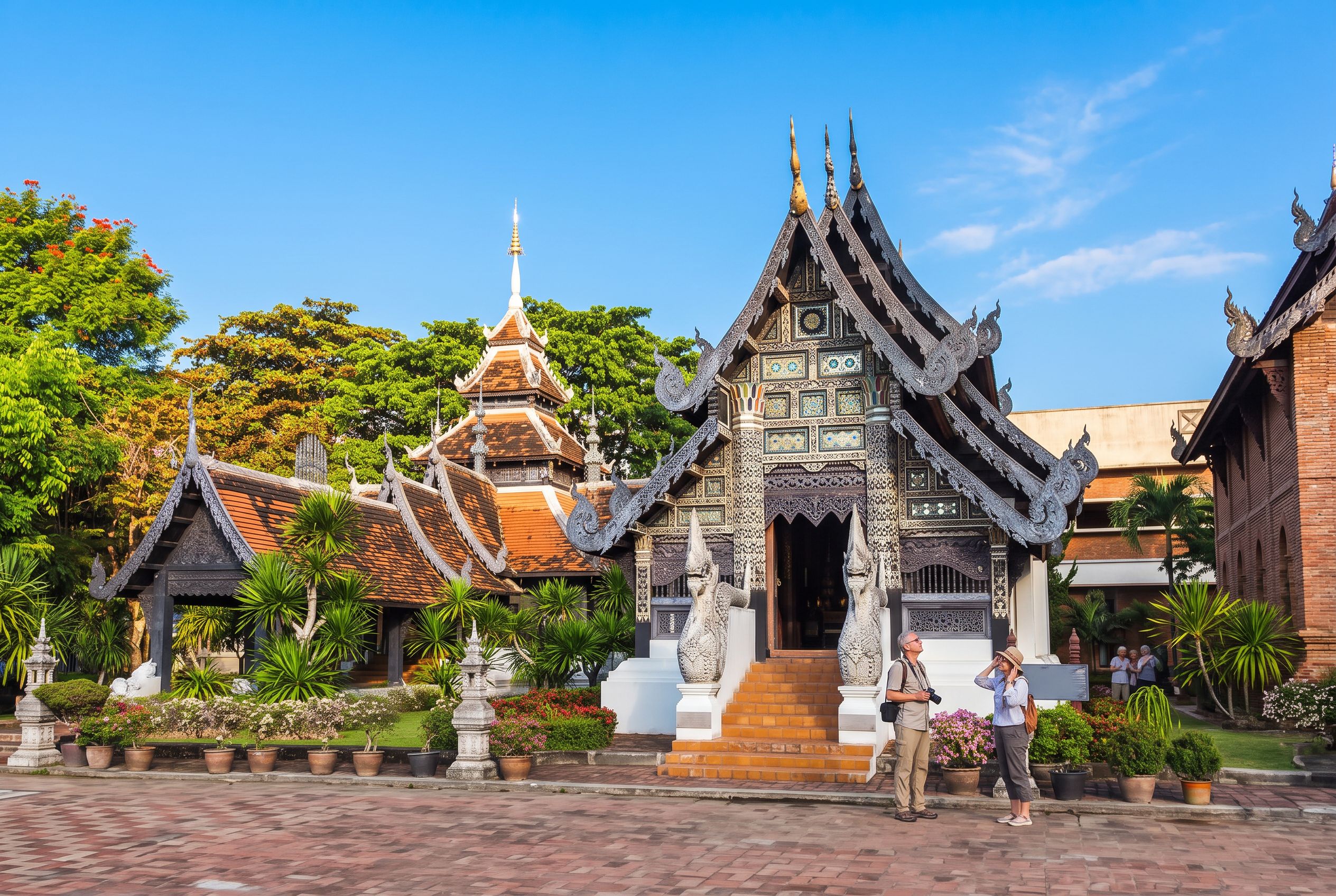
Wat Phra Singh and Wat Chedi Luang are the two easiest major temples, both inside the flat Old City and close enough to pair. Wat Phra That Doi Suthep is the hardest on foot, but a funicular bypasses most of the 306-step staircase, which changes the calculation entirely.
Wat Phra Singh is free to enter and open daily, approximately 06:00 to 20:00, according to the 2026 OutThailand guide. It is described as mostly accessible at ground level, though exact step-free routes inside are not documented. Wat Chedi Luang, a short distance away, is reported at 40 baht for foreign visitors with hours given as approximately 06:00 to 18:00 or 20:00. The same guide gives approximate rather than official hours for the Old City temples, so confirm locally before setting out.
Upper terraces and some temple areas may involve steps. The academic accessibility study cited found that the seven Chiang Mai attractions it assessed lacked facilities such as ramps, accessible parking, suitable pathways and accessible toilets. That is a finding about the wider city, not a verdict on any single temple, and it means the practical answer is to ask on arrival rather than assume.
 AI-edited
Can you see Doi Suthep without climbing the stairs?
Yes. A funicular or cable car bypasses most of the staircase, and the road approach means visitors can drive most of the way up the mountain. The traditional route is roughly 306 to 309 steps. Published guides differ on the funicular fare, so confirm on arrival.
The temple sits at 1,073 metres on Doi Suthep, about 15 km from central Chiang Mai, and is open daily from 5:00 am to 9:00 pm. Foreign visitors pay a 30-baht entrance fee, with a funicular tram or elevator to the hilltop costing an additional 20 to 50 baht. The mountain road up is winding and takes roughly 30 to 40 minutes from the Old City, which travellers prone to motion sickness may want to prepare for.
A Fodor's trip report specifically noted that the tram was valuable in very hot conditions, recorded there as 108°F. A Reddit discussion on limited mobility notes that the tram bypasses most stairs, but temples may still require some steps, and visitors may need to remove their shoes. The same thread recommends a portable folding chair for putting shoes on and off or resting during longer outings.
Practical points from guest feedback: a strict dress code is enforced, with shoulders and knees covered and sarongs available for rent or free loan near the base. Shoes must be removed before entering the inner golden courtyard, and a shoe storage area is provided. The upper terrace and observation deck give wide views over the city and the airport runway, and the terrace has seating with nearby cafés and restaurants.
"Once at the top, the golden chedi immediately stands out, gleaming brilliantly in the sunlight and creating a peaceful, almost surreal atmosphere. The grounds are well maintained, and there's a calm, spiritual energy throughout." (Google, April 2026)
As of October 2026, Wat Phra That Doi Suthep holds a Google rating of 4.7 out of 5 from 12,111 reviews. The courtyard and stupa area can be crowded, particularly in the late afternoon and at sunset.
Where can you spend the hot middle of the day?
The Old City's museums are the answer. The Tourism Authority of Thailand lists the Lanna Folklife Museum, Chiang Mai Historical Centre and Chiang Mai City Arts & Cultural Centre as central cultural stops, with admission listed at 90 baht per person per museum in its 2020 itinerary, updated in 2025.
These are indoor visits and can be arranged as short, air-conditioned stops by private car or ride-hailing vehicle. The Tourism Authority does not publish accessibility details or guaranteed vehicle drop-off points for them, so ask the driver to drop you as close as the road allows.
Opening information is inconsistent across listings. Chiang Mai City Arts & Cultural Centre is given as Wednesday to Sunday with Monday and Tuesday closures in some listings, and Tuesday to Sunday in others. Chiang Mai National Museum is published as Wednesday to Sunday, 9:00 to 16:00, closed Mondays, Tuesdays and public holidays, with reported foreign admission of 100 baht. Some listings state free admission for seniors, but the age threshold is not specified. Confirm before visiting.
For a fuller picture of what guided options exist and how they are priced, see our guide to small-group and guided tours of Chiang Mai.
How do you get between sights without long walks?
A private car with driver is the most comfortable and predictable option for older travellers, though no current official tariff was found. Ride-hailing and songthaews fill the gap, with published local guidance giving typical red-songthaew fares of about 50 to 100 baht per person.
A private songthaew is reported at approximately 400 to 600 baht round trip, including waiting time. Grab or similar ride-hailing journeys are reported at approximately 250 to 400 baht one way, depending on traffic and time. These are indicative local-guide prices, not guaranteed fares, and they vary by season and booking channel.
The RTC Chiang Mai City Bus is described as air-conditioned, with a standard 20-baht fare payable in cash to the driver. A Bangkok Rabbit card is reported as accepted, and a tourist card is listed at 180 baht for one day or 400 baht for three days of unlimited trips, according to Wikivoyage. The same source says the network includes airport connections but only a limited number of routes, and it does not provide a current official route-by-route timetable.
For a private car, request a vehicle with easy entry, air-conditioning and sufficient luggage or mobility-device space. No general Chiang Mai senior or over-65 discount for taxis, songthaews, temples or city attractions is documented. Our guide to songthaews, Grab and private cars in Chiang Mai covers the options in more detail.
What should you skip if you tire easily?
Skip the Doi Suthep staircase, the Monk's Trail, Mae Sa Waterfall and any full walking-street route. Doi Inthanon works only if the itinerary is tightly limited to vehicle-accessible viewpoints. Chiang Mai Zoo is described as an outdoor, hilly attraction requiring roughly three to five hours.
The Monk's Trail is described in published access information as a hike. Mae Sa Waterfall involves a 35 to 50-minute visit or more, and may close temporarily for safety during periods of heavy rain.
Doi Inthanon National Park is roughly 90 minutes to two hours from Chiang Mai by car, with 300-baht foreign-adult admission plus a 30 to 100-baht vehicle fee reported by the 2026 OutThailand guide. Waterfalls and main visitor areas generally operate around 08:00 to 16:00. A December 2023 Reddit trip report visited the summit, Twin Pagodas, a hill-tribe market, a restaurant and a large waterfall on one car-based day trip, and recommends choosing only the park stops that suit the group. The forum reports support the summit, Twin Pagodas, market and waterfall as a practical combination, but they do not document walking times for each stop.
Ban Kang Wat may be less comfortable for older visitors: a February 2026 Reddit report found the arts village small and cramped, despite liking its atmosphere.
Which gentler half-days are worth the drive?
Royal Park Rajapruek, Queen Sirikit Botanical Garden and Huay Tung Tao are all identified by a senior-focused source as gentler half-day options for visitors seeking less demanding sightseeing. Royal Park Rajapruek reports a tram and stroller access, which makes it more manageable than a walking-only garden visit.
All three sit outside the Old City, so a private car is preferable. Confirm details directly before committing a day.
Chiang Mai Night Safari is identified as a low-effort choice with the clearest documented accessibility features of the group. A secondary guide describes the site as wheelchair accessible, with ramps and designated viewing areas, and reports wheelchair and stroller rental. It gives a Day Safari from 1:00 to 4:00 p.m. and a Night Safari from 6:00 to 11:00 p.m. Discounts for seniors are reported, but the amount and age threshold are not stated. Exact walking distances and transfer distances are not documented.
Wat Umong was reported as fully accessible and Wat Pha Lat as generally easy to navigate in a February 2026 Reddit discussion about an 80-year-old with limited mobility. Jing Jai Market was singled out as wheelchair-friendly, and the same report calls the market enormous on weekends, when additional artisan stalls operate.
How do the walking streets and the heat fit together?
Both walking streets are free-entry evening markets: Sunday on Ratchadamnoen Road from around 4:00 p.m., Saturday on Wua Lai Road from around 5:00 p.m. Browsing requires standing and walking through crowds, with limited guaranteed seating and shade. Visit a short section rather than the full route.
Chiang Mai Province's tourism site describes one market in the city as having level, smooth paths and a specially designed ramp intended to facilitate access for disabled and elderly visitors. The result identifies the market as accessible but should be checked at the exact venue before relying on it for wheelchair access.
On timing, a published Chiang Mai itinerary identifies November to January as the best general period and recommends avoiding the burning season, especially March and April. A Reddit discussion explicitly says February is not the best time to visit because of burning season, although it suggests staying in the Old City if travelling then. The exact worst dates vary by year and are not documented.
A December 2025 Reddit post described daytime heat as intense but said mornings and evenings were pleasant for exploring, and noted that humidity made the heat feel worse. For travellers sensitive to heat or smoke, plan outdoor visits for roughly early morning or late afternoon, and use the middle of the day for museums, cafés, massage, hotel rest or an air-conditioned vehicle.
Where should you stay to keep walking short?
The Old City puts the main temples and the Sunday market within a short transfer, which reduces daytime walking. But central location alone is not enough: verify lifts, ground-floor rooms, vehicle drop-off and bathroom access directly with the property before booking.
Guest feedback on U Chiang Mai, in the Old City, repeatedly praises comfortable beds, clean rooms and a welcome swimming pool after sightseeing in the heat, and describes staff as welcoming and helpful, including assistance with luggage for guests with mobility difficulties. Several Tripadvisor entries describe the hotel as quiet even though it is on a central road, with one March/April 2026 listing saying noise was undetectable. Its breakfast service model includes "whenever/wherever", which can suit guests who prefer a slower start or wish to avoid midday heat.
The same reviews carry a consistent warning: U Chiang Mai has no elevator and several floors. Staff carry luggage, but guests with mobility limitations may need to use stairs repeatedly. One account describes uneven-height steps, and another Tripadvisor review says a guest with mobility issues was allocated a top-floor room. Tripadvisor also notes that cars may not reach the entrance on Sunday evenings because of the market.
At Chiang Mai Hotel receives praise for air-conditioning, helpful reception staff and a substantial breakfast, and is listed with a walk-in shower. Tripadvisor guests report noise from the nearby Lana Square area into the early hours, though other guests say the hotel itself is set back and quiet. One Tripadvisor review describes the mattresses as very hard, and another says breakfast became repetitive after several days. The bathroom includes both a shower and a large corner bath.
Novotel Chiangmai Nimman Journeyhub sits beneath the airport flight path. Tripadvisor guests report aircraft noise, with one review finding it acceptable and noting earplugs, while another says flights disturbed sleep and afternoon rest. One complaint mentions an ageing bathroom, mould stains and a stained shower curtain. Hop Inn Chiang Mai does not provide breakfast and has complaints about internal sound transmission, though it is praised for being set back from traffic noise. Hotel De Wualai is described as simple but good, close to Wat Sri Suphan and the walking street, with complaints about internal sound transmission.
For a closer look at one Old City property, see our review of 137 Pillars House, Chiang Mai.
What does a comfortable low-walking day cost?
Temple entry is modest, transport is the main variable. Wat Phra Singh is free, Wat Chedi Luang around 40 baht for foreign visitors, and Doi Suthep 30 baht plus 20 to 50 baht for the funicular. A private songthaew runs about 400 to 600 baht round trip.
Museum admission is listed at 90 baht per person per museum for the three central Old City cultural stops, in the Tourism Authority's 2020 itinerary updated in 2025. Chiang Mai National Museum reports 100 baht foreign admission, with some listings stating free admission for seniors at an unspecified age threshold. Doi Inthanon National Park reports 300-baht foreign-adult admission plus a 30 to 100-baht vehicle fee.
These are indicative figures and vary by season and booking channel. For a fuller breakdown of what a comfortable trip costs, our guide to Chiang Mai trip costs sets out the wider picture.
How should you plan the days?
Two or three days allows one short morning outing, one indoor or café-based afternoon and a rest day or half-day excursion. Carry a folding seat or lightweight portable chair, sun protection, water and shoes that are easy to remove.
The folding-chair recommendation comes directly from the limited-mobility discussion. The available official material does not document specific rest-friendly cafés, seating policies or air-conditioning for named Chiang Mai cafés, so treat café stops as something to identify on the ground rather than plan around in advance.
No universal Chiang Mai sightseeing pass or citywide senior pass is documented. The material does not document Chiang Mai-specific emergency numbers; Thailand's standard emergency numbers should be confirmed through an official Thai government or consular source before departure rather than relying on an unsourced list.
Where the detail matters most, ask the operator directly. The temples do not publish step counts or step-free route maps, and the funicular fare varies between published guides. A short email or a question at the hotel desk resolves in a minute what no guide can settle in advance.


