
Chiang Mai rewards the traveller who hands over the logistics. The city is spread out, its public transport is limited to songthaews, tuk-tuks and taxis, and several of its best-known sights sit well beyond a comfortable walk from one another. For travellers aged 50-70 who would rather not negotiate a fare at every stop, the organised tour market here is unusually deep: licensed local operators, hotel tour desks, roadside agencies and international booking platforms all compete for the same day-tripper, and the practical differences between them matter more than the marketing.
What follows is a guide to choosing among them: what a genuinely small group looks like, what to ask before money changes hands, how to plan around heat and stairs, and where the documented gaps in accessibility lie. Self-guided itineraries are covered in our separate guide to getting around Chiang Mai by songthaew, Grab and private car.
What kinds of guided tours can you book in Chiang Mai?
Chiang Mai's guided market splits into three practical categories: small-group join-in day tours, fully private tours with a driver-guide, and transport-only private driver services. Operators publish temple circuits, Doi Suthep and Doi Inthanon excursions, Chiang Rai and Golden Triangle runs, elephant sanctuary visits, zipline and jungle trekking days, street-food and night tours, and multi-day packages of one to five days.
The distinction that matters most for older travellers is not the theme but the format. A join-in tour shares a vehicle with strangers and follows a fixed route. A private tour gives you the vehicle and the guide, and several operators state explicitly that start times and itineraries can be adjusted for weather or interest, provided the total duration is respected. A transport-only service gives you a driver and a custom route with no guiding at all.
That last option is worth understanding, because experienced travellers on the Fodor's forums repeatedly make the point that some sights need only a driver, not a guide. Doi Suthep is the standard example: a poster on those forums said it is enough to hire a driver for Doi Suthep and the Elephant Conservation Center. Deciding first whether you want guiding or merely transport is the single most useful decision you can make before you start comparing prices.
What does "small group" actually mean here?
Published caps vary by operator. Touring Center, based in Chiang Mai, states its join-in tours are "small group guaranteed" with a maximum of 9 people per group. A Reddit post describes small-group tours of up to 7 people in an air-conditioned minivan with an English-speaking guide. Shared van tours are commonly reported at around 7 to 8 people, with hotel pickup and drop-off as standard.
Those figures come from different sources and describe different products, so treat any specific number as belonging to the operator that publishes it rather than to Chiang Mai as a whole. The practical point is that "small group" is a marketing phrase, not a regulated category. The only reliable way to know is to ask for the maximum number and get it in writing before you pay.
Vehicle type matters as much as headcount. Several Chiang Mai private-tour operators publish air-conditioned car or van transport, and one operator describes its tours as private and comfortable with an air-conditioned car, limousine or van. Air conditioning is not a luxury here; it is the difference between arriving at the next temple fresh and arriving depleted.
Who are the licensed operators, and how do you tell them apart?
Chiang Mai has a documented pool of licensed inbound operators. Chiang Mai Local Tours publishes agency licence number 24/00775 and describes its guides as well trained, knowledgeable and fully certified. Chiang Mai Guideline states it is a TAT-licensed inbound travel agent offering private tours, group tours and car rental with driver. Travel Hub Chiang Mai states it is a licensed inbound tour operator offering privately escorted tours for your own group.
Licensing is checkable and worth checking. A Thai tour operator licence number, or TAT licensing, is a concrete claim you can ask an operator to confirm. Chiang Mai Local Tours publishes its number openly. Chiang Mai Guideline publishes its TAT status. Travel Hub Chiang Mai describes itself as a licensed inbound operator and publishes both join-in day tours for different budgets and privately escorted tours.
Other operators in the market publish different specialisms. Touring Center states its programmes are all-inclusive with no hidden cost, no optional tours or activities and no shopping stops. Private Guide in Chiang Mai says it provides professional English-speaking tour guides as well as drivers and can make customised tours for any occasion. Chiang Mai Private Tour publishes personalised private packages of one to five days across Chiang Mai, Chiang Rai and Northern Thailand, with private transportation, itinerary planning, hotel options, meals and entrance fees included in customised packages.
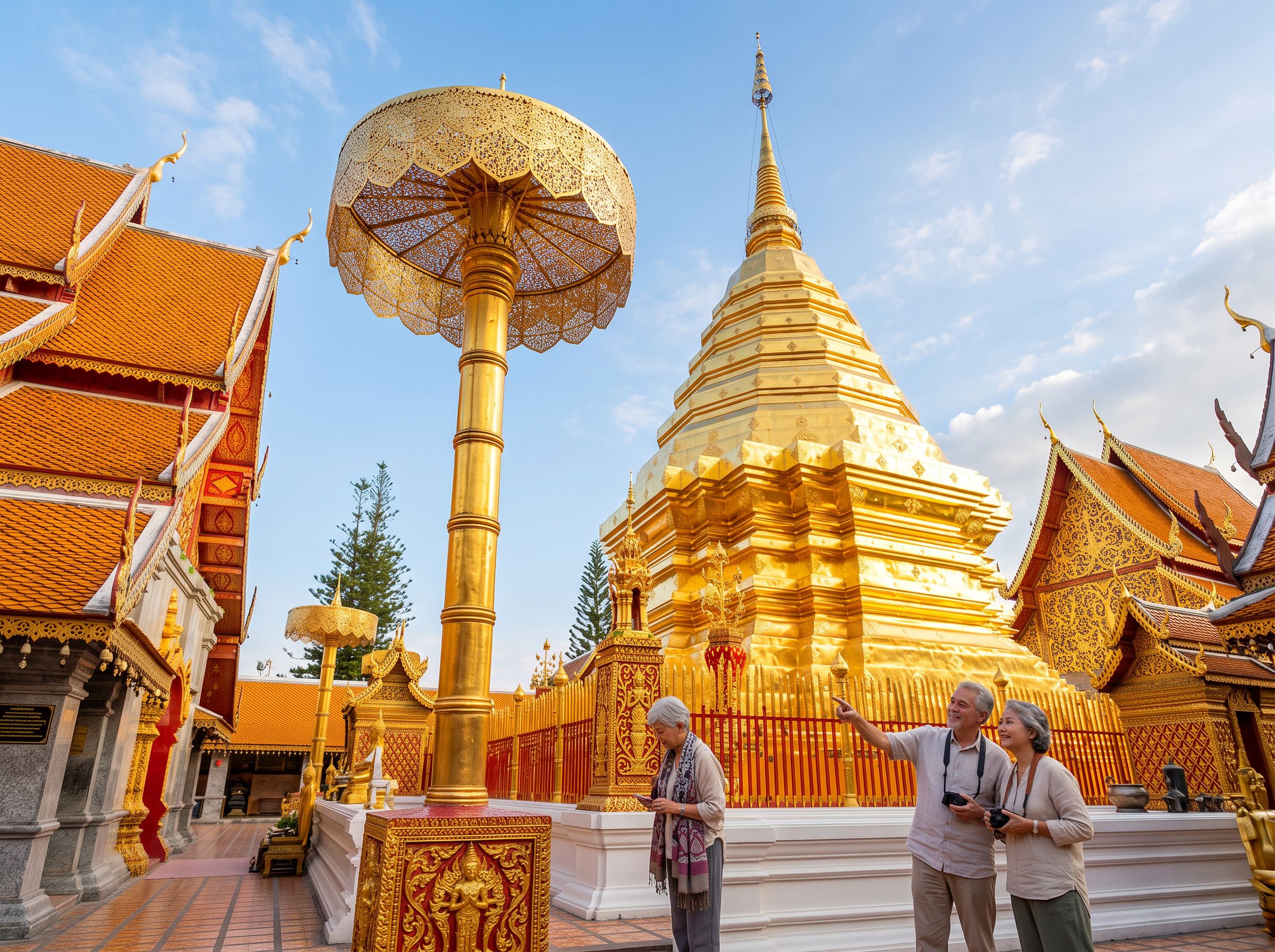 AI-edited
For travellers with mobility requirements, Authentic Thai Tours is the operator in this set that publishes accessibility detail directly: it says it provides private and accessible travel experiences for wheelchair users, seniors and families, that its accessible van has a hydraulic lift, and that itineraries can be adjusted for mobility needs, comfort, rest periods, travel pace and walking distances. It also publishes a private "Doi Suthep & San Kamphaeng Hot Springs Accessible Tour" with an English-speaking guide, lunch and admission fees included.
What should you ask before booking?
Ask eight things: the maximum group size; whether the vehicle is air-conditioned and what type it is; whether the guide speaks English throughout the day; whether the pace can be slowed for heat, steps and rest breaks; what is included (lunch, water, entrance fees, hotel pickup); whether there are shopping stops or extra-pay add-ons; the cancellation policy; and what licence the operator holds.
The shopping-stop question is not paranoia. A recurring warning across traveller forums is that low-cost small-group outings can lose time to shopping detours at commission-paying places and reduce flexibility on timing and stops. One Chiang Mai operator, Touring Center, addresses this head-on by publishing that its programmes include no shopping stops and no optional activities. If an operator does not say so, ask.
Inclusions vary more than the headline price suggests. Some operators state their tours are all-inclusive; others state only that custom packages include meals and entrance fees. One licensed operator confirms availability, pickup time, inclusions and final price before booking, with customers sending date, group size and preferred tour by WhatsApp. Getting the inclusion list in writing before payment is standard practice among the better operators.
On guides, the question is whether the person is English-speaking throughout the day and whether they hold formal certification. Operators in Chiang Mai publish English-speaking guides and, in some cases, TAT-certified or licensed guides, so this is a reasonable thing to require rather than hope for.
How do you book, and what are the cancellation terms?
Booking is easy and often last-minute. Travellers on the Fodor's forums report that local agencies and hotel tour desks frequently have tours ready for next-day or even same-day departure, and that the abundance of agencies, hotel desks and roadside tour stands makes last-minute booking practical. Cancellation terms vary by platform and operator, so read them before paying.
Documented cancellation terms across the booking platforms are generous but not uniform. Klook's half-day temples product offers free cancellation with 24 hours' notice and booking confirmation within minutes. GetYourGuide's private driver service with custom itinerary offers free cancellation up to 24 hours in advance. Withlocals, which offers only private tours in Chiang Mai, states cancellation as a refund up to 7 days before, with rescheduling possible.
Pickup arrangements differ in a way that matters if you have limited mobility or are staying somewhere awkward. Tripadvisor's "Customized Day Tour in Chiang Mai" states pickup is from hotels in Chiang Mai centre town only. GetYourGuide's private driver service states pickup at a precise location such as a hotel lobby or residence, and explicitly says street-side pickups are not accommodated due to traffic risks. If your accommodation sits on a lane a van cannot enter, establish the meeting point in advance.
No maintenance-closure schedule or regular closing day was documented for the named Chiang Mai tour services reviewed here, beyond the booking-platform cancellation rules already stated. Where a specific product's operating days are not published, ask the operator directly.
How do you manage the heat, the stairs and the pace?
Plan around the season and around stairs. Chiang Mai's cool season runs November to February and is described in a 2026 safety guide as clean, dry and the most pleasant time of year. Air pollution is highly seasonal rather than year-round, tied to the burning months outside that window. The wet season peaks around September and October, with heavy downpours and possible flooding in low-lying parts of the city and the Old City moat area.
For anyone sensitive to smoke or heat, timing is the single largest variable in how a guided day feels. Our guide to Chiang Mai through the year, festivals and quiet seasons covers how those windows interact with the city's event calendar.
On the ground, stairs are the recurring physical obstacle. Klook's half-day temples product states plainly that the activity involves considerable walking and stairs, is not recommended for anyone with impaired physical mobility, and is not stroller- or wheelchair-accessible. That is a specific product disclosure, not a verdict on Chiang Mai, but it illustrates why the question "are there stairs, steep paths or uneven ground at the actual sites visited?" belongs in every booking enquiry.
Doi Suthep is the standard example of a site with a steep approach. Some sources say the climb can be bypassed by a tram, cable car or funicular. Because that detail is not published consistently, confirm the current arrangement with your operator rather than assuming it.
How accessible are Chiang Mai's guided tours?
Accessibility is documented at the level of individual operators and individual sites, not as a citywide standard. Authentic Thai Tours publishes a hydraulic-lift accessible van and adjustable itineraries. Tripadvisor's custom day tour states the product is wheelchair accessible, has wheelchair-accessible surfaces and is near public transportation. Klook's temples product states the opposite for its own tour. There is no documented Chiang Mai-wide accessibility standard for tours.
A 2020 academic study on accessible tourism in Chiang Mai found that seven studied places were still not ready to be accessed, because of missing ramps, parking, pathways and suitable toilets. The same study notes a provincial manual with four routes for elderly and disabled visitors covering seven attractions, launched under the campaign "Hearty Travel across Thailand without Limits." At province level, the official tourism page states that one street market in Chiang Mai fully facilitates disabled and elderly visitors, with a designed slope, level smooth paths and wheelchair access.
Those are the documented facts, and they cut both ways. Some provision exists and is published; a general citywide guarantee does not. Because the province-level sources do not publish universal lift, seating or assistance-service standards for tours, those services are not documented as a general Chiang Mai rule and should be confirmed with each operator individually.
Where an operator's page does not state steps, lifts, distances on foot, terrain, nearby medical help or assistance services, those details are not documented. Ask before booking rather than after.
What about health, pharmacies and emergency numbers?
Chiang Mai has 24-hour emergency medical response via 1669. Bangkok Hospital Chiang Mai and Chiang Mai Ram Hospital both have 24-hour in-house pharmacies for walk-in customers outside normal retail hours, according to a medical resource for travellers. Boots and Watsons branches are easy to find on major roads and at Central Festival, with English-speaking staff at some locations. The Tourist Police line is 1155.
The full set of documented numbers is worth carrying: 1669 for ambulance and medical emergencies, 191 for police, 199 for fire and rescue, and 1155 for the Tourist Police, described as 24/7 English-speaking support for visitors. The Tourism Authority of Thailand call centre is listed as 1672 for general tourist assistance.
For a day tour, the practical preparation is unglamorous. A Chiang Mai safety guide says mosquito repellent, rehydration salts and basic first-aid items are stocked city-wide, though that is a general city claim rather than a site-specific one. Sunscreen and a hat are commonly needed; one source notes an airport pharmacy stocking sunscreen. Sturdy walking shoes are recommended by multiple sources because sidewalks and pavement in the Old City are uneven.
Where the nearest pharmacy or clinic to a specific attraction is not stated, it is not documented. If you take regular medication, carry it with you rather than leaving it at the hotel.
What does a guided day in Chiang Mai cost?
Touring Center, Travel Hub Chiang Mai, Chiang Mai Guideline, Chiang Mai Local Tours and PM Tours all publish tour descriptions without showing specific fares in the material available. Two figures do appear in traveller forums: a quoted fare of 800 baht for the trip to Doi Suthep, and a driver charging 250 baht an hour.
Those two figures come from Fodor's forum posts, not from operator rate cards, and no published rate exists alongside them. Treat them as indicative of what travellers have reported paying, not as current prices. Rates for guided tours in Chiang Mai vary by season, group size, inclusions and booking channel, and should be confirmed directly with the operator at the time of booking.
No Chiang Mai-wide visitor pass, age-based reduced fare or over-65 concession is documented for guided tours or province-level tourism. A documented over-65 concession appears only for one named attraction, Brokenships Chiang Mai, at 150 baht for visitors aged 65 and over. That is a single venue's policy, not a citywide fare programme, and it does not extend to tour pricing.
For a fuller picture of what a comfortable Chiang Mai trip costs across accommodation, transport and meals, see our breakdown of what a comfortable Chiang Mai trip costs.
When should you book, and what might disrupt a tour day?
Book ahead for a specific guide or a private vehicle, and book on the day for a standard join-in tour. Local agencies and hotel tour desks frequently have tours ready for next-day or same-day departure. Forum contributors with experience of the city say it is better to book a known driver or guide in advance even if it costs a little more, because quality varies.
Several current city projects can affect traffic and access around the centre. The Mae Kha Canal renovation is ongoing, with the city clearing waterside houses and building walkways, according to a 2026 construction and transport roundup. A new 48-hectare park opened in September 2024 and parts of the site closed temporarily from 20 November 2024 to prepare for the Chiang Mai Flower Festival 2025, which was scheduled for 29 November to 5 January. Chiang Mai Design Week 2024 ran from 7 to 15 December 2024 across the old city and nearby districts, bringing event crowds and temporary activity changes.
Longer-term transport works are in the pipeline rather than on the ground. The Chiang Mai Mass Transit project's MRTA page states Cabinet approval is targeted for April 2027, construction for October 2028 and opening in December 2032. The Red Line tram proposal is at study and design stage for a 21 km route including 6.5 km underground. Chiang Mai International Airport is in a long-term expansion plan that could affect arrivals, with one article citing a target of 20 million passengers a year by 2033. None of these should disrupt a tour day now, but they explain why central traffic can be slow.
One final planning note: ask what happens if smoke, rain or flooding affects the itinerary. Operators that publish flexible start times and route adjustments are the ones best placed to answer.
For travellers who prefer their arrangements made for them, Chiang Mai's guided market is deep enough that the real work is not finding a tour but choosing the right one. Establish whether you want guiding or transport, ask for the group cap and the inclusion list in writing, confirm the stairs and the pace, and check the cancellation terms. Do that, and the city's spread-out geography stops being an obstacle and becomes simply the thing the driver handles. If your plans extend to accommodation, our review of 137 Pillars House, Chiang Mai covers one property in detail.


