
Chiang Mai province holds one of the world's largest concentrations of captive elephants, and the camps that surround the city range from genuine rescue operations to attractions that still put tourists on an elephant's back. For travellers aged 50 to 70 who want to meet elephants without supporting exploitation, the difference matters more than the brochure. The good news is that a responsible half-day visit is also the gentlest option physically: observation from the ground, short walks, no river bathing, no climbing onto anything. The work is in choosing well.
Thailand's Livestock Department counted roughly 90 elephant camps and 871 elephants in the Chiang Mai area, according to reporting by Thai News. That scale is why the word "sanctuary" needs checking. It is not a protected or regulated term in Thailand, and the same reporting warned that ethical labels can sit on top of continued feeding, bathing and other hands-on activities. What follows is how to tell the difference, what a half-day actually involves, and what to ask before you pay.
What actually separates an ethical sanctuary from a riding camp?
The clearest marker is simple: no riding of any kind, including bareback, trekking and short rides, and no performances, painting, tricks or bullhooks. Beyond that, the most welfare-focused programmes are observation-led, with elephants free to walk away and visitors kept at a distance rather than positioned for photographs.
Elephant Nature Park, in Mae Taeng district about 60 km north of the city, states that it is a permanent home for elephants rescued from riding, logging and shows, and that it does not use chains or allow riding or forced shows. A secondary guide reports that the park was founded in 1995 by Lek Chailert, banned riding in 2003 and does not offer tourist bathing.
Elephant Sanctuary | Est. 2007 advertises no riding and describes its half-day as walking, observation, photography and an elephant lesson. Elephant Home Sanctuary states that it offers no riding, hooks, chains, performances or forced interaction, and says visitors can observe how mahouts handle the elephants.
One further test is whether the programme has changed. Elephant Freedom Project in Mae Wang district announced on 5 March 2025 that it would become completely hands-off from June 2025, removing feeding, bathing and touching in favour of observation, education and guided walks. That is a sanctuary-level decision, not a policy across Chiang Mai.
What does a responsible half-day actually look like?
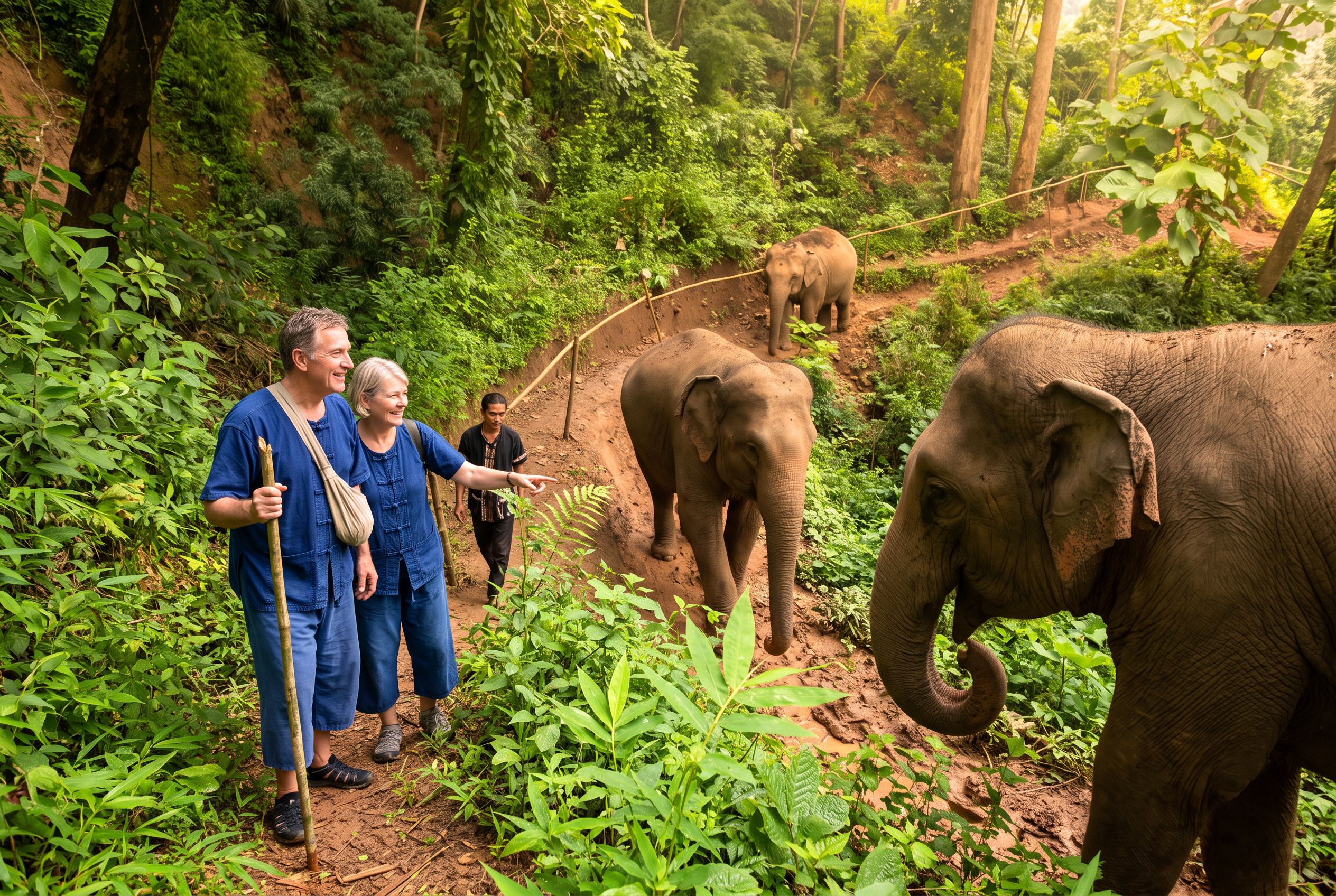
A typical ethical half-day runs roughly six hours door to door: hotel pickup in the morning, a drive of one to one and a half hours, two to three hours at the sanctuary preparing food, feeding from a controlled position and walking or observing, then lunch and the return drive. You are on your feet for part of it, not all of it.
Elephant Nature Park's cited programme description includes round-trip hotel transport and a meal, with a half-day format built around mahout-led interpretation, fruit and rice-ball preparation, and supervised feeding from elevated platforms. Elephant Sanctuary | Est. 2007 lists pickup at 07:00–07:30 and return around 12:30–13:00 for its half-day morning programme, and 07:30–07:45 with a return at approximately 15:30–16:00 for the full day, using air-conditioned 12-seat vans.
Elephant Pride, roughly 1.5 hours south of the city, lists hotel pickup, a Karen Hill Tribe lunch, drinks, insurance and guide support in its package. Chang Chill's recorded account describes no riding, bathing or direct interaction, with respectful observation from a distance and no feeding or touching.
 AI-edited
Guest reviews of the Chiang Mai Elephant Sanctuary Observation and Bamboo Rafting product repeatedly mention water, tea, coffee, lunch and regular toilet opportunities, which is useful planning detail for older visitors. Reviews of Ethical Elephant Sanctuary describe a plentiful vegetarian lunch and guides who use food rather than force.
How much walking is involved, and what is the ground like?
Expect low to moderate effort: uneven forest and dirt paths, occasional mud, and periods of standing rather than continuous walking. A 2026 guide characterises ethical Chiang Mai elephant outings that way, and a recorded visit to Chang Chill describes about two hours of walking in total, on paths that are sometimes narrow and uneven.
Elephant Park states specifically that its paths are mostly flat dirt trails, with uneven ground near the river, and recommends comfortable walking shoes. It welcomes older visitors, asks guests to disclose mobility needs in advance, and says guides can slow the pace or provide additional support. Wheelchair access, lifts, exact distances and seating provision are not documented by the operator.
Elephant Jungle Sanctuary's Chiang Mai full-day product includes jungle walks and mud-spa activities, so uneven ground and potentially muddy footing should be expected on that programme. Its own FAQ states that all fitness levels are welcomed, but that some locations and programmes, such as the Walk With Elephants experience, require a moderate hiking ability.
Ask the operator directly for the walking distance, the number of steps and where you can sit in the shade.
How do I book, and what does a half-day cost?
Book direct with the operator, at least 24 hours ahead, and expect to pay in the region of ฿1,800 to ฿2,500 per adult for an ethical half-day, or roughly ฿2,000 to ฿3,000 for a full day. Rates are indicative and vary by season and booking channel, and no senior or over-65 fare is published by any of the operators named here.
Elephant Nature Park is reported at ฿2,500 per adult half-day and ฿3,500 per adult full-day in the 2026 guide, with no senior reduction stated. A Mae Wang programme reported in the same guide sits at around ฿2,050 per adult and ฿1,000 for children aged 4 to 11, with children under four free. Elephant Sanctuary | Est. 2007 lists ฿2,200 for a half-day and ฿2,800 for a full day, with children's rates but no over-65 fare. Living Green Elephant Sanctuary lists ฿2,200 for adults, ฿1,300 for children aged 4 to 8 and free entry for infants aged 0 to 3, again with no senior fare shown.
Elephant Nature Sanctuary's operator lists a private half-day programme at ฿4,500, including a private guide and car, hotel pickup and return, food preparation, feeding, walking, lunch and insurance. The source does not establish that this is a current senior fare.
Elephant Pride accepts online bookings up to 150 days ahead through its website, using major credit cards, and sends confirmation and pickup details by email. Elephant Park takes bookings by message, email or WhatsApp, with WhatsApp support advertised around the clock. Cancellation terms are not documented for most of these operators.
How do I get there, and how long is the drive?
Most sanctuaries sit one to two hours from Chiang Mai city, so the drive can take as long as the visit itself. Elephant Nature Park is about 60 km north in Mae Taeng district, roughly one to one and a half hours depending on traffic and pickup point. Mae Wang sanctuaries, west of the city, run about one hour and 40 minutes each way.
Pickup arrangements vary by operator and by distance from the Old City. Elephant Pride advertises free pickup within 4 km, a ฿400 surcharge for 4 to 8 km, and asks visitors to make contact for locations farther away. Elephant Jungle Sanctuary and Living Green Elephant Sanctuary each advertise free pickup within 5 km of Chiang Mai's Old City, with a surcharge possible outside that radius.
Vehicle type is worth asking about. Elephant Jungle Sanctuary states that it uses comfortable, spacious, air-conditioned vans with professional drivers for most programmes, but local transport such as red songthaew trucks or covered pickup trucks with rear seating for its Feed Me and Feed & Shower programmes. Its Grand Canyon branch is approximately 40 minutes from the city, shorter than most.
The transport information concerns operators' advertised services. It does not confirm wheelchair lifts, low steps, transfer assistance or guaranteed seating. If boarding a high van is difficult, ask before booking whether the vehicle has a low step and whether staff can assist.
Is it suitable if I have mobility concerns?
No source supplied documents step-free access, lifts, accessible toilets, wheelchair-appropriate trails, dedicated seating or a formal assistance service at any of the Chiang Mai sanctuaries named here. The Chiang Mai Elephant Sanctuary Observation and Bamboo Rafting product, and the Observation and Waterfall product, are both explicitly listed as not wheelchair accessible.
That does not close the door. It means the arrangements have to be negotiated in advance, in writing. Elephant Jungle Sanctuary's FAQ states that guests who are pregnant, wheelchair bound, have mobility difficulties or any other relevant pre-existing condition are required to inform the sanctuary prior to visiting, and that depending on the circumstances visitors may need to sign a waiver confirming their health is robust enough for a tour involving large animals. The same FAQ states that guests with mobility issues should inform the operator before the visit so it can ensure they are sent to a location suited to their needs.
Elephant Park asks guests to disclose mobility needs in advance and says guides can slow the pace or provide additional support. No other named operator publishes a comparable statement.
A visitor who uses a cane, tires easily or has balance concerns should ask for the exact walking distance, gradient, rest points, toilet access and vehicle drop-off position before booking. Those details are not consistently published for the named sanctuaries.
When should I go, and what about heat and rain?
November to February is the cooler, drier period recommended by a Chiang Mai-area travel guide, with mornings preferable, particularly during the rainy months. Popular dates in that window fill quickly, according to the secondary guide, so book ahead. The recommendation applies to the sanctuary region rather than proving conditions at any individual camp.
Operators' pages do not publish month-by-month closure calendars, heat thresholds, rain cancellation rules, shaded-route guarantees or seasonal reductions in walking. Elephant Jungle Sanctuary states that the date of a visit may not be changed because of poor weather and that it remains operational despite rain and mild conditions, which is worth knowing before you commit.
Flooding has disrupted elephant facilities in the Chiang Mai area. Travel and Tour World reported in October 2024 that several facilities were damaged, while Elephant Freedom Project reported minimal damage and a quick return to operation, resuming guided jungle treks, river walks and conservation sessions. Check conditions shortly before departure.
October 2025 reporting described a tourism slowdown affecting sanctuaries across Chiang Mai and putting pressure on visitor-dependent operations, including Elephant Nature Park's ability to fund food, medical care and site maintenance. The same article described the park as still functioning and retaining a hands-off approach, though it also mentioned feeding and bathing as visitor activities, an inconsistency that makes confirming current programme details worthwhile.
What should I ask before I pay?
Send a short list of questions by email or WhatsApp and keep the written answers. The single most useful question is whether elephants can leave the visitor group whenever they choose, followed by the total walking distance, terrain, steps, shade, seating, toilet access and vehicle arrangements.
Ask whether the programme is entirely no-riding, no-hooks, no-chains and no-performances. Ask whether you can participate by observation only rather than feeding, touching or bathing. Ask what happens in heavy rain or extreme heat, and what the cancellation, closure and refund rules are. Ask whether the quoted amount includes hotel pickup, lunch, insurance, entrance fees and the exact programme.
For Mae Wang, verify the exact operator and route, because the district contains multiple elephant programmes with different welfare policies, terrain and prices. Treat reports of ethical status as programme-specific rather than operator-wide.
Elephant Jungle Sanctuary publishes clear cancellation terms: a full refund for cancellations more than 48 hours before the visit, and a 50% refund for cancellations 24 to 48 hours before. Bookings must be made at least 12 hours before the assigned pickup time for the Half Day Visit, One Day Walk With Elephants and Feed and Shower experiences, and at least 2 hours for the Feed Me experience. Other operators do not document cancellation terms.
For anything beyond the elephants, from temple visits to the flat walking of the Old City, see our guide to seeing Chiang Mai with little walking and out of the heat. If you would rather leave the logistics to someone else, our piece on small-group and guided tours of Chiang Mai covers how those are structured. And if the sanctuary is one stop on a longer stay, day trips worth making from Chiang Mai has its own dedicated guide.
What else should I settle before the day?
Carry a valid photo ID or passport matching the booking name, leave large bags behind, and pack sun protection, insect repellent and waterproofing for your camera. Several operators prohibit oversize luggage and pets, and one lists a photo ID requirement.
Elephant Jungle Sanctuary listings require a valid photo ID or passport matching the booking name, and state that large bags, suitcases and oversized luggage are not permitted, with pets also prohibited. The same operator offers luggage storage at its Chiang Mai office for the duration of a visit, and asks guests who wish to bring a suitcase to inform it beforehand. Its FAQ states that all dietary requirements and restrictions can be accommodated, and that Visa and Mastercard are accepted for website bookings.
Elephant Sanctuary | Est. 2007 says its packages include accident insurance, with registration completed in the van. Elephant Pride lists insurance in its package. Elephant Jungle Sanctuary states that all visitors are covered by its insurance policy but highly recommends personal travel and medical cover.
For emergencies, Thailand's ambulance number is 1669 and the police emergency number is 191. For the Mae Wang sanctuary area, the cited local hospital is Mae Wang Hospital in Ban Kad, telephone +66 53 365 130. These numbers apply regionally and are not a substitute for asking your specific operator about its evacuation procedure, first-aid provision and nearest hospital.
No source publishes regular closing days, annual maintenance closures or revision closures for the sanctuaries. Treat availability as date-specific and obtain written confirmation before making non-refundable arrangements. If you are extending the trip, our closer look at 137 Pillars House covers one city-centre option in detail.


