
Northern Thailand rewards a slower rhythm than most first-time visitors allow. The classic two-week loop links Chiang Mai, Chiang Rai, Pai and the Golden Triangle by car, minivan and short flights, and it works best when you treat Chiang Mai as the anchor and let the other three be shorter, separate stays. The region's cooler, drier window runs from late November to early February, and that is when this itinerary is at its most comfortable for travellers aged 50-70.
This is a high-level plan, not a street-by-street guide. Each base has its own dedicated article elsewhere on this site, and the point here is the shape of the journey: how many nights where, how you move between them, and what the heat and pace ask of you.
What is the best shape for a two-week Northern Thailand trip?
The most workable shape is a split base: roughly six to seven nights in Chiang Mai, two to three in Chiang Rai, two in Pai and one to two around the Golden Triangle, with the order chosen so you cross the Chiang Mai–Chiang Rai leg only once.
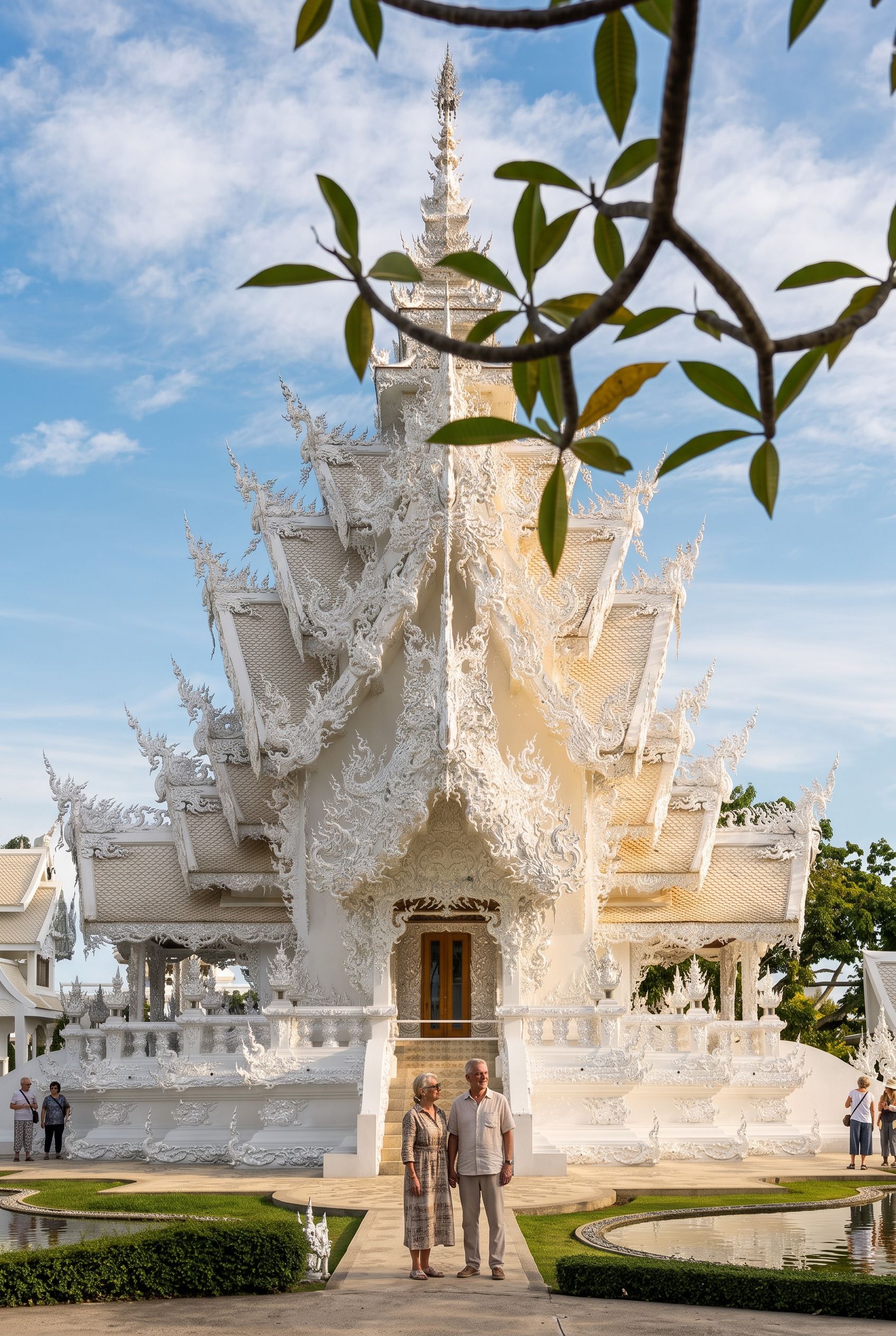
A Fodor's discussion describes the Chiang Mai to Chiang Rai car journey as approximately three hours. A January 2026 Reddit report made the same trip by bus, then spent a single full day visiting the White Temple, Blue Temple, Big Buddha, Choui Fong Tea Plantation and Black House before returning. The writer said it was feasible but that flying out of Chiang Rai the following day would have made the schedule "more relaxed." That is the central lesson of this route: the day-trip version works, but it is tight.
The same report's principal advice was to fly into Chiang Rai and travel onward to Chiang Mai, or reverse the direction, so that only one intercity bus leg is required. For a two-week trip, that single-leg principle is worth building the whole plan around. Fly into one city, drive or ride to the other, and let the rest of the journey radiate from there.
How many nights should you spend in each base?
Chiang Mai suits six or seven nights, Chiang Rai two to three, Pai two, and the Golden Triangle one to two. A Fodor's trip report recommends four nights in Chiang Mai alone, using separate days for the city, Doi Suthep and a guided rural outing.
Chiang Mai is the practical anchor for older travellers because it concentrates accommodation, hospitals, restaurants and cultural attractions in a relatively compact city. Another Fodor's discussion suggests two to three full days in Chiang Mai plus excursions, and recommends using the city as a base for two or three full days while treating some northern sights as day trips rather than changing hotels repeatedly. The two positions are not far apart: four nights is a minimum, six or seven lets you add the day trips without moving.
Chiang Rai earns two to three nights if you want the White Temple, Blue Temple and Black House without the compressed single-day dash. Pai, reached by a winding mountain road, is a two-night stop for most travellers. The Golden Triangle, where Thailand meets Laos and Myanmar, is a one- to two-night add-on rather than a base in its own right.
For the detail behind each stop, see our separate guides to day trips worth making from Chiang Mai and to seeing Chiang Mai with little walking and out of the heat.
| Base | Suggested nights | Onward transfer |
|---|---|---|
| Chiang Mai | 6–7 | Car or bus to Chiang Rai, about 3 hours |
| Chiang Rai | 2–3 | Road transfer toward the Golden Triangle |
| Golden Triangle | 1–2 | Return south, then west toward Pai |
| Pai | 2 | Mountain road back to Chiang Mai |
 AI-edited
How do you get between the bases?
Short flights, private cars and minivans cover the intercity legs; the Chiang Mai to Chiang Rai drive is about three hours by car, and the bus cost roughly 300 baht per person in a January 2026 report. The return leg in that report used a VIP bus with larger, more comfortable seats.
Chiang Mai International Airport sits about 5 km from the city district, according to the airport's own transfer page, with an estimated fare from the airport to the heart of Chiang Mai starting at ฿105.00. The same page states that the one-way bus fare starts at ฿30.00. Car rental desks are on the first floor of the Domestic Arrival Area, and the airport's page notes that renters must be at least 20 years old with a valid licence and an International Driving Licence.
Chiang Mai Railway Station is not at the airport. The airport's transfer information places it about 9 to 10 km away, reached by taxi or another road transfer, as set out on the Chiang Mai airport transfer page. the source material describes Pai as safe and quiet but notes that the road to Pai is the risk. That is a mountain road with many curves, and it is worth planning as a daytime journey.
The January 2026 Reddit report hired a driver through Grab for about 2,500 baht for a full day. The driver warned that the Black House was extensive and wooded, and that visiting it late would make the day tight. That is useful for anyone trying to compress Chiang Rai's sights into one day.
When should you go, and how does the heat affect the pace?
Late November to early February is the strongest window, with December and January offering the best combination of cooler temperatures and dry conditions. March and April are the least comfortable months because of intense heat and recurring smoke from agricultural burning.
January is the coolest month, with an average high of about 85°F (29°C) and a low of about 59°F (15°C), generally dry and clear. February is warm and comparatively clear, the clearest month, with clear, mostly clear or partly cloudy conditions about 75% of the time, though smoke risk begins to become relevant. April is the hottest month, with an average high of about 97°F (36°C) and a low of about 74°F (23°C), and it is often the most difficult month for older visitors because of heat and smoke combined.
Smoke risk is most significant from approximately February to April, normally peaking in March. Chiang Mai's basin geography can trap smoke from burning in northern Thailand and neighbouring countries. The wetter period runs roughly late April to late October, with September the wettest month at an average rainfall of about 7.1 inches.
What should you know about mobility and terrain?
The flat Old City in Chiang Mai is the best-supported area for independent walking, though pavements can be narrow, uneven or obstructed and kerb ramps are inconsistent. Wat Phra That Doi Suthep involves roughly 306 to 309 steps, with a cable car or funicular as an alternative.
A 2020 accessibility study found that seven studied Chiang Mai attractions generally lacked adequate ramps, designated parking, pathways and suitable toilets. That is a city-level finding, not a verdict on any single site, and it means the detail you need is often not published. A fully step-free route through Chiang Mai's historic sites is not documented.
The airport's domestic and international areas are connected within one terminal building by an air-conditioned corridor, which may reduce outdoor walking during transfers, according to published airport guidance. For travellers carrying mobility equipment, a pre-booked private car or hotel transfer is likely to be more practical than a songthaew or bus, but vehicle access must be confirmed directly with the operator.
Ask each hotel and each site directly, and treat any published accessibility label as a starting point rather than a guarantee.
Is Northern Thailand safe, and is it on any red list?
Chiang Mai, Chiang Rai and Pai are not covered by the UK travel warnings that apply to Thailand's far south. UK advice warns against all but essential travel to Pattani, Yala, Narathiwat, specified districts of Songkhla and areas near the Cambodian border, and Chiang Mai is not included in those warnings.
The available travel guidance does not describe Thailand as being on a UK countrywide red list; UK warnings apply to specified areas rather than Chiang Mai, as set out in current Thailand safety guidance. UK guidance does warn that Middle East escalation can cause flight disruption, cancellations and airspace closures, including for travellers transiting through the region. That is a transit and airline-routing issue for Chiang Mai, not a reported conflict affecting Chiang Mai itself.
On the ground, the documented risks for visitors are chiefly access-related: uneven or obstructed pavements, traffic, and difficulty boarding informal shared transport. The available Chiang Mai-specific material also documents two rules worth knowing: criticising the Thai monarchy can be prosecuted under broadly interpreted lèse-majesté laws, and drones must be registered with Thailand's National Broadcasting and Telecommunications Commission before flying.
Emergency numbers relevant in Chiang Mai municipality are 1669 for medical emergencies, 191 for police, 199 for fire, and 1155 for Tourist Police, as listed by Chiang Mai University's health and safety page. Because published sources conflict, save both 1699 and 1155 for tourist-police assistance, and 1699 and 1669 for medical help.
What medical and pharmacy support is available?
Chiang Mai has documented hospital and pharmacy infrastructure, which is one reason it works as the anchor base. Chiang Rai has Bangkok Hospital Chiang Rai and Overbrook; Pai has a government hospital, and Chiang Mai is three hours away.
A named pharmacy within the Chiang Mai municipality area is Chiang Mai University Pharmacy, with branches next to the Faculty of Pharmacy on Suthep Road and at the CMU Health Centre. The same source identifies Maharaj Nakorn Chiang Mai Hospital, also known as Chiang Mai University Hospital, at 110 Intawaroros Road, Si Phum, Mueang Chiang Mai, Chiang Mai 50200.
The Tourism Authority of Thailand's Chiang Mai listing also gives local contacts including a Chiang Mai Ambulance Radio Center and a rescue service, and the TAT Chiang Mai office is listed as open daily from 08:30 to 16:30.
For the Pai leg, the distance from Chiang Mai matters.
What are the entry requirements for Thailand?
U.S. citizens visiting Thailand for fewer than 60 days are reported not to require a visa, but pre-arrival online registration is required. A passport valid for at least six months beyond arrival is strongly recommended, and the Thailand Digital Arrival Card must be completed within the three days before arrival.
Other nationalities must check the Royal Thai Embassy or Thai immigration guidance directly, because the rules differ by passport.
One dated change is worth flagging for anyone planning well ahead: visa-free entry dropped from 60 to 30 days on 15 September 2026, according to current safety and entry guidance. If your trip falls after that date, confirm the current allowance before booking flights. Overstaying immigration permission can result in penalties, so build a buffer into your departure date.
How should you pace the two weeks?
Pace the trip so the longest transfers fall early, keep one full rest day after each move, and avoid stacking two demanding days back to back. The January 2026 traveller who packed five Chiang Rai sights into one day found the schedule workable but not relaxed.
A Fodor's trip report describes a full day around Mae Hong Son as involving "a lot of driving," with several stops, and the same report found Mae Hong Son time rushed despite two nights there. That is a useful warning about the western loop: distance in northern Thailand does not look large on a map, but the roads are slow.
The same is true for a specific Mae Sa attraction: no exact operator, senior tariff, closure calendar or mobility policy is documented in the available results.
If you want to add a cooking class or an elephant experience, both fit naturally into the Chiang Mai block rather than the moving days. Our guides to a Thai cooking class in Chiang Mai and to an ethical elephant sanctuary visit from Chiang Mai cover those in detail.
What does this trip cost, and how should you book?
Published figures are patchy. The airport bus starts at ฿30.00 one way and the airport-to-city fare starts at ฿105.00, both from the airport's own transfer page. A January 2026 Reddit report put the Chiang Mai to Chiang Rai bus at about 300 baht per person, and a Grab driver for a full day at about 2,500 baht.
The bus and Grab figures come from a forum report, and no published rate exists for those specific services, so treat them as indicative only. Rates generally vary by season and booking channel, and the same journey can cost differently depending on whether you book through a hotel, an app or a local operator.
For flights, the strongest booking advice is structural rather than financial: fly into one city and out of the other so you cross the Chiang Mai–Chiang Rai leg once. That single decision removes a return journey and, in the January 2026 traveller's assessment, buys back a more relaxed schedule.
Car rental at the airport requires an International Driving Licence and a minimum age of 20, per the airport's transfer page. Parking at the airport starts at ฿20.00 for the first hour and ฿250.00 per day if you plan to leave a vehicle.
What else should you know before you book?
Carry passport identification, because eligibility and prices can vary between Thai citizens, foreign visitors, seniors, children and people with disabilities. A Chiang Mai-wide senior pass is not documented, and the clearest recorded senior concession is for Brokenships Chiang Mai, where visitors aged 65 and over are listed at 150 baht.
The Chiang Mai Night Safari is also reported as offering selected senior discounts purchased on site with identification, but the source does not establish a single permanent rate. Royal Park Rajapruek reports discounts for visitors aged 60 and over, with the exact current senior price not stated. Because these terms change, ask at the ticket desk and carry your passport.
Chiang Mai itself is a year-round city and has no single documented opening season; hotels, restaurants, temples and museums operate on individual schedules. For particular attractions, opening days, maintenance closures and ticket concessions must be checked with the attraction directly.
Finally, note that several transport improvements are proposed but not operating. The Mass Rapid Transit Authority of Thailand held a public hearing in December 2025 on extending the proposed Red Line to Royal Park Rajapruek and Chiang Mai Night Safari, and the project remains at feasibility and design stage. An Austrian company revived a cable-car proposal for Doi Suthep in October 2025, but it was not reported as under construction. Plan road transport for now.


