
A cooking class is one of the few Chiang Mai experiences that sends you home with something you can use on a Tuesday night in your own kitchen. The format is well established: a market or garden visit, hands-on preparation at your own station, and a meal built from what you have just cooked. The city's schools vary widely in setting, pace and kitchen heat, and the differences matter more for travellers in their fifties and sixties than the brochure photographs suggest.
What follows is a planning guide rather than a recommendation list. It covers how to choose between a half day and a full day, what standing versus seated cooking actually involves, how dietary requirements are handled, and which questions to put to a school before you pay. Restaurant dining in Chiang Mai has its own dedicated guide and is not covered here.
What actually happens during a Chiang Mai cooking class?
A typical class runs three and a half to six hours and combines a market or garden visit with hands-on preparation at an individual station, followed by eating what you have cooked. Participants choose dishes from a menu at the start, and instructors explain unfamiliar herbs, vegetables and curry ingredients as they go.
The structure is consistent across the schools documented here. Thai Secret Cooking School, which sits in the San Sai district among rice fields and farming communities, includes a local market tour with both its Half Menu and Full Menu classes, and its full-day itinerary adds a garden walk where students pick fruit and vegetables before cooking (Thai Secret Cooking School full-day class).
Hands-on means hands-on. Listings describe each participant working at their own station and preparing dishes personally rather than watching a demonstration, and one half-day class advertises "one wok per person." The food you make is generally eaten as part of the experience, and several schools send participants home with a cookbook. Thai Secret provides a 48-page Thai Secret Cookbook, and guests at both Thai Secret and Thai and Akha Cooking Class report receiving printed recipe material at the end.
 AI-edited
Is the market tour worth it?
Yes, for most first-time visitors. The market stop is where instructors explain Thai herbs, vegetables and curry ingredients, and it is usually included in both half-day and full-day prices. It does involve walking on hard surfaces, and one guest review described roughly two hours lost to traffic on the way to a farm-based school.
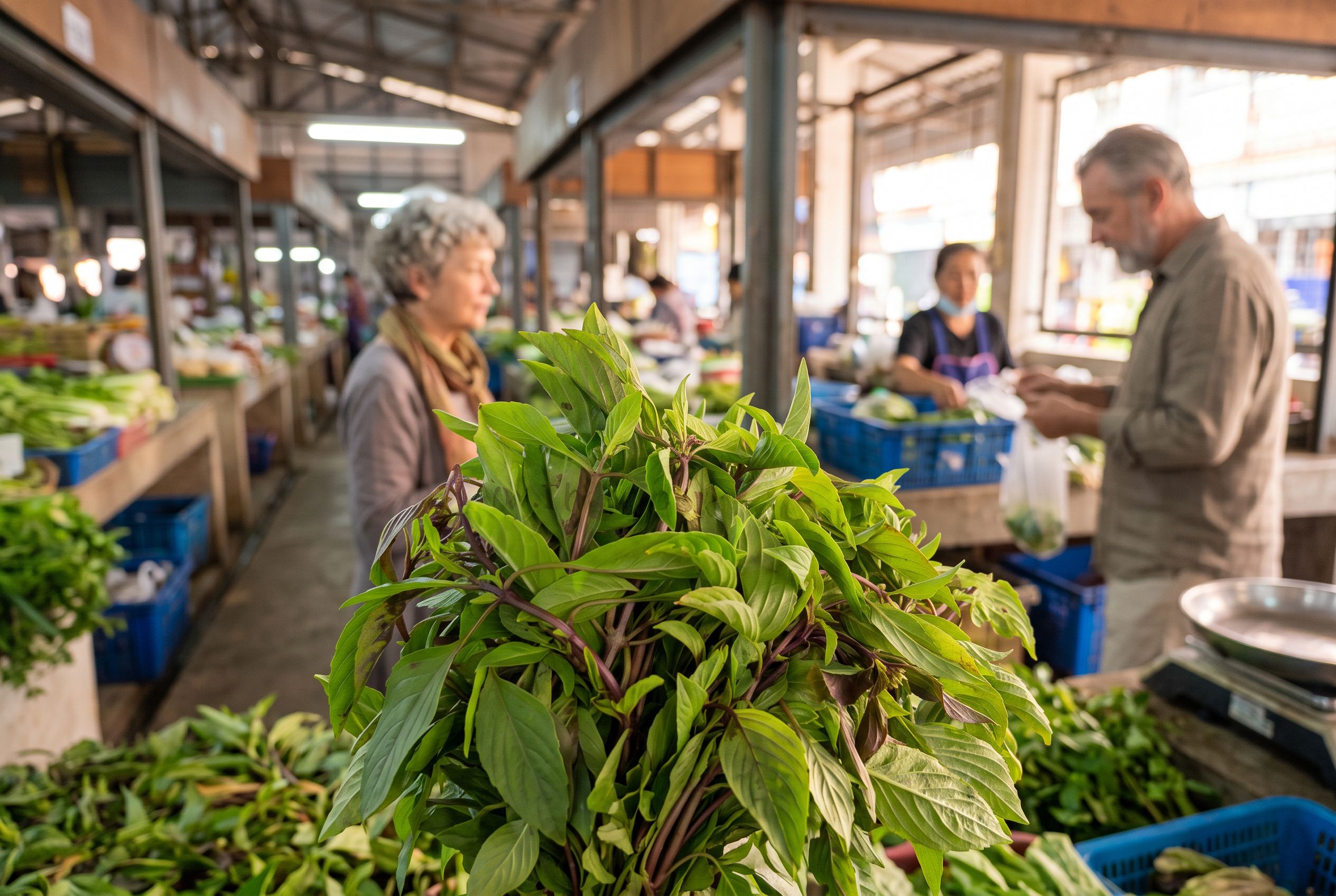
The market visit is the part of the day that changes how you cook afterwards. Instructors point out rice varieties, herbs and spices, and explain how to source Thai ingredients at home. Thai Secret notes that the market tour is included with both the Half Menu and Full Menu classes, and that seasonal produce varies: during the hot season, for example, red ant eggs sometimes appear.
Guest feedback on the market segment is not uniformly positive. A Tripadvisor review of one half-day class described the market stop as not very interesting and the overall class as conducted at a "military pace." That is a single account rather than a pattern, but it is a useful reminder that market time varies in length and depth between schools.
Half-day or full-day: which suits you better?
Half-day classes run roughly three and a half to four hours and are the safer choice for most travellers in their fifties and sixties. Full-day classes run about six hours and involve more dishes, more eating and more time on your feet. Several guests who took the shorter option reported being full and tired by the end.
The figures are published. Thai Secret's Half Menu costs 1,000 Thai baht per person with pickup around 8:00 to 8:30 a.m. and return around 1:30 p.m., and includes four dishes chosen from 10 menu options, without dessert. The Full Menu costs 1,200 Thai baht per person with the same pickup window and return around 3:30 p.m., and includes five dishes chosen from 14 options. Payment is in Thai baht cash only.
Guest feedback leans towards the shorter session. Contributors to travel forums who took classes at Thai Kitchen Cookery Centre and Thai Akha Kitchen advised choosing the half-day format because the food was filling and the day tiring, with several describing themselves as stuffed and tired after the shorter session. A Tripadvisor review of a six-hour class took the opposite view, saying it did not feel like a long session because the pace was right and there were plentiful short breaks.
How much standing is involved, and can you sit?
These are active classes. Published descriptions consistently include market walking, ingredient preparation, curry-paste pounding and cooking at an individual station. The schools documented here do not publish how many stools are available, whether stations are height-adjustable, or the kitchen temperature, so anyone with knee, balance or standing limitations should ask before booking.
This is the single most useful question to put to a school, and it is the one the published material answers least well. A class advertised as hands-on should not automatically be assumed to be physically demanding, but the material confirms active participation rather than a seated lecture.
One Chiang Mai cooking experience states that participants sit on floor cushions, with stools available for those unable to sit on the floor, and is not recommended for travellers with back problems. Thai Secret states that its main cooking area is level, but that garden paths can be uneven and more difficult to walk after rain. Those are the operator's own words, and they are worth reading before you choose a farm-based school over a city one.
What about kitchen heat and pace?
No source records the exact kitchen temperature, cooking duration, rest breaks or class pace for the named Chiang Mai schools. Farm and garden classes take place partly outdoors. Seasonal heat, rain cover and wet paths should be checked directly with the school rather than assumed.
Some kitchen environments are documented. Thai and Akha Cooking Class is described in guest feedback as having a spacious, clean, air-conditioned cooking space with a dedicated station for each pair of students. Thai Secret describes its kitchen as an open cooking environment. The distinction matters in Chiang Mai's hot season, and it is a question worth asking in plain terms: is the kitchen open-air, fan-cooled or air-conditioned?
Pace is harder to pin down. Thai Secret states that it usually has three sit-down tasting times after cooking different categories, which gives the day a natural rhythm. If you prefer a slower day, say so when booking.
Can the school handle dietary requirements?
Several schools accommodate vegetarian, vegan, gluten-free and coeliac requirements, and guests at Thai Secret report that these were handled. The cited operator and booking pages do not publish a complete allergen policy or guarantee for severe allergies, and no verified operator policy was available for allergy-safe or low-sodium cooking.
Thai Secret states plainly that it is an open cooking environment and not an allergen-free kitchen. That is the honest position, and it is the one to plan around if you have a serious allergy. For milder requirements, the picture is better: guest feedback reports that vegan, vegetarian, gluten-free and other dietary needs were accommodated at Thai and Akha Cooking Class, with spice levels and measurements adjusted to personal preference.
One point deserves care. "Vegetarian" should be clarified explicitly in Chiang Mai, because fish sauce and shrimp paste may otherwise remain in sauces or curry pastes. Ask whether ingredients are kept separate and whether the same wok, mortar, pestle or chopping board is used for other dishes. The schools do not publish this, so it has to be a direct question.
Do these classes suit older travellers?
Broadly yes, with planning. Age ranges published by the schools are wide rather than senior-specific: Smile Organic Farm lists ages 0 to 75 and Thai Akha Kitchen 6 to 99. Accessibility varies sharply between schools, and the detail is not documented for most of them.
Two schools stand out in the listings. Thai Akha Kitchen's Tripadvisor listing states that it is wheelchair and stroller accessible, has wheelchair-accessible surfaces, is near public transport and offers infant seats. The Galangal Cooking Studio listing states that the class, transport and surfaces are wheelchair accessible, and that service animals are allowed. Those are booking-platform labels rather than operator statements, and they should be confirmed when booking.
Several other classes are marked not wheelchair accessible in their listings, including the Organic Farm half-day class, Baan Thai Cookery School, Smile Organic Farm, the Sky-and-Noodle evening class and the Tom Yum home-cooking class. Step-free access, accessible toilets, lifts, seating and reduced-mobility provisions are not documented for most exact Chiang Mai classes. Baan Thai is described as a two-storey house with the school on the second floor, but the material does not document a lift.
Transport is worth a question of its own. Thai Secret notes that the red songthaew has a higher step and covered bench seating, and offers airport pickup or drop-off for 200 Thai baht per direction. If boarding a high step is difficult, ask what vehicle is used.
How do you book, and what should you ask first?
Book directly with the school or through a platform, and confirm the pickup zone before you pay. Thai Secret offers free pickup within a set area and uses Hotel M Chiang Mai near Tha Phae Gate as the meeting point for guests staying outside it. Cancellation terms vary by operator.
Group size is the other variable. Thai Secret states that many of its classes are small, often around two to four guests. The Organic Farm class caps at 12 participants, and the Civitatis listing states a daily limit of eight, with free cancellation up to 24 hours before the activity and no refund for later cancellations or no-shows. The Organic Farm class offers a full refund when cancelled at least 24 hours before the start time. Benny's Home Cooking was reported in forums as normally capped at eight people.
One booking detail is easy to miss. The Civitatis listing says children under 12 may accompany guardians but cannot participate in the cooking. Thai Secret states that children ages 5 and older may participate, depending on maturity and ability to follow safety instructions, and that one non-cooking companion may attend by advance arrangement for 600 Thai baht, relaxing in the dining area while the cooking takes place.
| Detail | Half Menu | Full Menu |
|---|---|---|
| Price per person | 1,000 Thai baht | 1,200 Thai baht |
| Pickup | Approximately 8:00–8:30 a.m. | Approximately 8:00–8:30 a.m. |
| Return | Approximately 1:30 p.m. | Approximately 3:30 p.m. |
| Dishes | Four, chosen from 10 options | Five, chosen from 14 options |
| Dessert | Not included | Included |
Rates are indicative and vary by season and booking channel. Payment at Thai Secret is in Thai baht cash only.
What do guests actually say?
Feedback across the documented schools is strongly positive on instruction, organisation and portion size. As of October 2026, Thai Secret Cooking School holds a Google rating of 4.9 out of 5 from 408 reviews, and Thai and Akha Cooking Class holds 5 out of 5 from 841 reviews.
Recurring themes in the review sets are worth noting. Guests at Thai Secret describe classes run by the owner-instructor herself, teaching in clear English and explaining ingredients, techniques and Thai food culture in detail, with menus chosen at the start and dietary requirements accommodated. Guests at Thai and Akha Cooking Class describe punctual hotel pickup, a kitchen a short drive from the city rather than a long bus journey, and instructors who teach both Thai and Akha dishes while explaining Akha culture and food history.
"We attended the full day cooking class (definitely stay for the full experience) and it was incredible! May offers multiple options to choose from for five courses, and even with a decent size class, she masterfully manages to check in and teach each person." (Google, May 2026)
Portion size comes up repeatedly. Guests at Thai and Akha Cooking Class report cooking and eating around 10 to 11 dishes, with takeaway containers available for leftovers, and Thai Secret guests are advised to arrive hungry. If you are weighing up a full day, that is the practical consideration: the eating is as substantial as the cooking.
Practical planning for the day
Wear comfortable casual clothes and footwear suitable for a garden and a kitchen. Carry cash in Thai baht. Confirm your pickup point and time the day before, and keep the local emergency numbers to hand.
Thai Secret's own advice is to wear comfortable casual clothes and footwear suitable for the garden and cooking. If your class includes a garden or farm visit, that advice matters more than it sounds. Thai Secret also notes that after a long night of rain or during torrential rain, the garden visit may be shortened or omitted, so a wet-season booking may lose part of the outdoor element.
For medical planning, Chiang Mai's emergency numbers include ambulance and medical emergency on 1669, police on 191, tourist police on 1155, and fire and rescue on 199. Private hospitals listed by the U.S. Consulate include Bangkok Hospital Chiang Mai on +66-52-089-811 and Chiang Mai Ram Hospital on +66-52-004-601. The schools documented here do not publish on-site medical provision, so ask about emergency transport arrangements when you book.
If you want to build the class into a wider trip, our guide to day trips worth making from Chiang Mai covers how to pair a cooking morning with an afternoon excursion, and seeing Chiang Mai with little walking and out of the heat is useful if the market segment sounds like more time on your feet than you want. For a gentler half day altogether, an ethical elephant sanctuary visit from Chiang Mai follows a similar pickup-and-return rhythm.
Choosing your class
Decide first between city and countryside, then between half day and full day, then confirm the kitchen environment and the seating. The schools documented here do not publish stool counts, standing time or kitchen temperatures, so those answers come from the operator, not the website.
A city school with an air-conditioned kitchen and a short transfer suits anyone who wants the cooking without the heat and the drive. A farm school with a garden walk and an open-air kitchen suits anyone who wants the growing side of Thai food and does not mind uneven paths after rain. Both formats deliver the same core experience: a market, a station of your own, and a meal you made.
The questions to put to any school before booking are straightforward. Can a participant sit during demonstrations and preparation? Is there a stool at every station? How long must participants stand continuously? Is the kitchen open-air, fan-cooled or air-conditioned? Is hotel pickup available from your exact accommodation, and what vehicle is used? Whether the market visit is shortened during heavy rain, and whether outdoor walking takes place during the hotter months, are both worth asking in the same email.
Ask about stairs from the entrance to the kitchen, the toilet location, the maximum group size, and whether staff can chop ingredients or handle heavy pans. If you have an allergy, ask whether ingredients are kept separate and whether the same wok, mortar, pestle or chopping board is used for other dishes. None of this is published, and all of it is answerable in a single reply.


