
The Dolomites hold more than 30 via ferrata routes around Cortina d'Ampezzo alone, according to the Cortina d'Ampezzo tourism body, and the cables, ladders and iron rungs that give the sport its name were first fixed to these rock faces during the First World War. For a fit traveller in their fifties or sixties, the appeal is obvious: a genuine vertical adventure without the years of technical climbing that a rock route would demand. The caution is equally obvious. These are exposed alpine faces, and the grading, the guide and the weather matter far more than the birth date on your passport.
This guide is written for the adventurous but sensible. It explains what the easiest graded routes actually involve, what a guide and a kit will cost you in effort, how the altitude and the exposure feel to older legs, and where to find gentler protected alternatives when a classic ferrata looks like a step too far. Ordinary hiking in the Dolomites is a separate subject with its own dedicated guide.
What exactly is a via ferrata, and is it climbing?
A via ferrata is a protected mountain route where steel cables, rungs and ladders are fixed to the rock, so you climb with a harness clipped to the cable rather than with a rope and a partner. Dolomite Mountains grades them from 1 to 5 for technical difficulty and A to C for overall alpine commitment, and notes that most routes in the Dolomites fall between grades 1 and 3.
The distinction matters for anyone weighing this up at 55 or 65. You are not free-climbing. You are moving up a prepared line, clipping and unclipping your lanyard at each anchor as you go. The effort is real, but it is closer to a steep, sustained staircase than to a rock climb.
What the grade letters tell you is how serious the day is. Dolomite Mountains describes grade A as the least commitment and grade C as the greatest, and it states plainly that there are no "easy" via ferrata trips by definition. Even a route classed as not very difficult can carry exposed sections, according to the safety guidance published by Visit Dolomiti Bellunesi.
Which routes suit a first-timer over 50?
The gentlest documented introductions are short, low-commitment routes such as Ferrata Gran Cir at Passo Gardena, Via Ferrata Sass de Stria at Falzarego, and the protected trails at Fanes Waterfalls and the Tofana Cave near Cortina. Dolomite Mountains lists Ra Gusela, Averau and Grande Cir among the relatively easy ferratas suitable for first-time climbers.
Ferrata Gran Cir, also called Kleine Cirspitze, is the name that recurs most often as a beginner's first route. It sits at Passo Gardena, within reach of the Val Gardena lift network, and specialist sources describe it as beginner-friendly and suitable for families.
Near Cortina, the official tourism body groups a set of routes under the heading "EASY". That list includes Ferrata Averau, Ferrata Ra Gusela, Ferrata Ra Pegna, Ferrata Grotta di Tofana, Galleria Lagazuoi, Ferrata Barbara e Cascate di Fanes, and several sentieri attrezzati (equipped paths) such as Astaldi, Olivieri and the Giro del Castelletto. The Via ferrata Cascate di Fanes is described on the same official page as suitable for everyone from beginners to families, graded Easy, and taking about four hours.
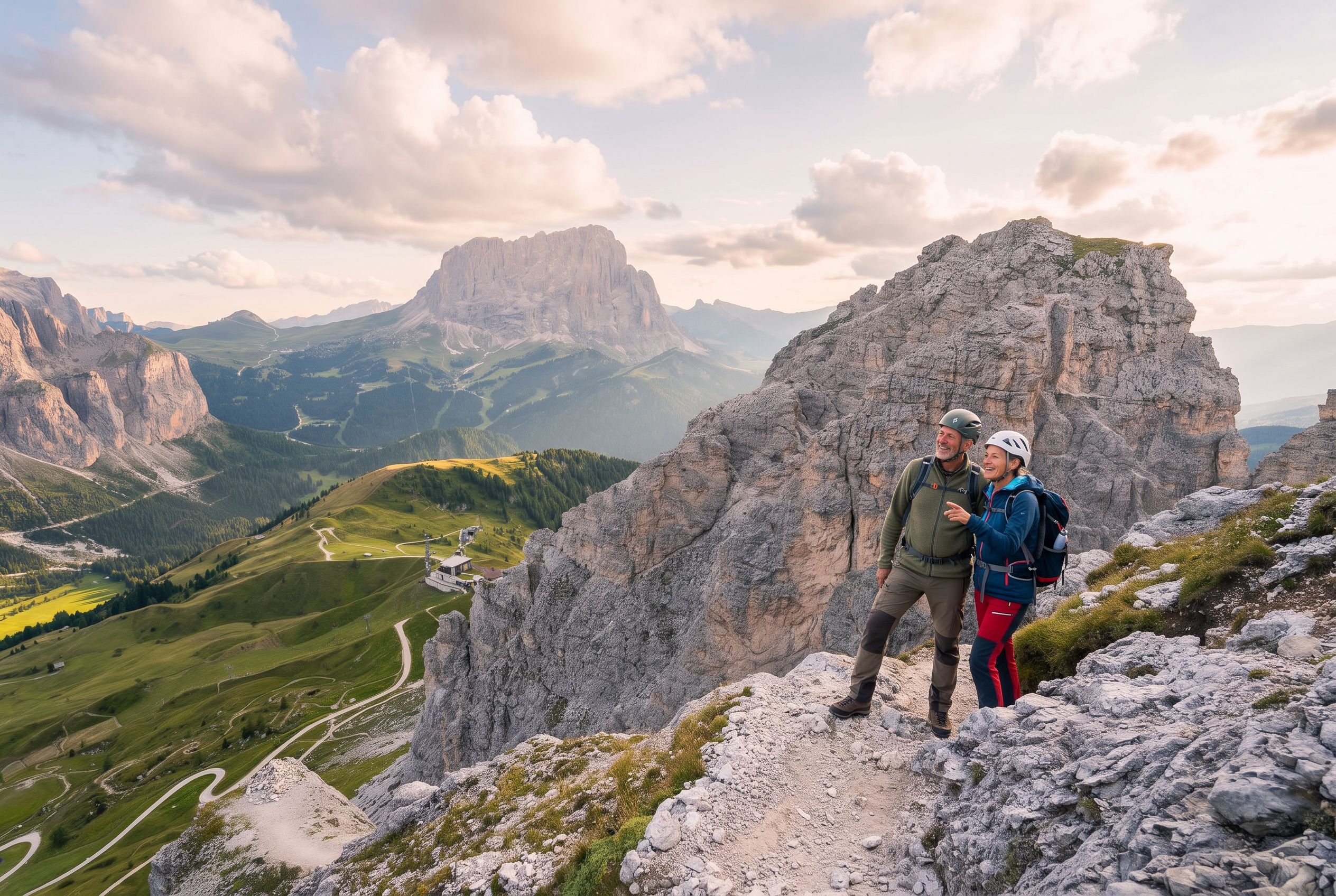 AI-edited
If you want a first taste without committing to a full exposed ferrata, the protected trails are the sensible stepping stone. Fanes Waterfalls is described as more than a true via ferrata, a scenic protected trail and one of the most interesting beginner-friendly options in the Dolomites. The Tofana Cave is described as one of the shortest and most accessible protected routes in the Ampezzo Dolomites.
Do you need a mountain guide?
Yes, for a first route. The Cortina d'Ampezzo tourism body says it always recommends doing via ferratas accompanied by an expert mountain guide, and Visit Dolomiti Bellunesi states that beginners are strongly recommended to hire a mountain guide. Guided trips in the Dolomites are led by UIAGM/IFMGA professional mountain guides.
This is not a commercial nudge. The published safety advice from Visit Dolomiti Bellunesi's via ferrata guidance is that there should never be more than one person on the same stretch of cable at the same time, and that correct clipping technique is not optional. A guide teaches that technique on the rock, in the order it needs to be learned.
Guides also solve the kit problem. Dolomite Mountains states that on every via ferrata trip it provides all the equipment needed, including a helmet, and that all its climbing trips are led by UIAGM/IFMGA professional mountain guides. For a traveller who does not want to buy a harness and lanyard for a single holiday, that removes the largest practical obstacle.
If you would rather hire gear locally and go with an experienced companion instead, the Cortina tourism body notes that helmets, harnesses, gloves and via ferrata kits can be hired from the many rentals in Cortina. The pages reviewed for this guide do not identify a direct operator-run rental programme at the ferrata sites themselves, so arrange kit in town before you set out.
What equipment do you actually need?
The non-negotiable items are a certified EN 958 via ferrata set (a lanyard with two carabiners and an energy absorber), a climbing harness and a helmet. Gloves and sturdy footwear are also recommended. The British Mountaineering Council advises that the lanyard should meet EN 958.
Beyond the hardware, the clothing list is dictated by the mountain rather than the season. Forum contributors who have done these routes repeatedly stress helmets, warm layers and a willingness to turn back, and note that the Dolomites are more demanding than some other ferrata regions because of loose rock, gravel and fast-changing weather.
Gloves earn their place for a practical reason: they improve grip on the steel cable and the rungs. A traveller in their early fifties, writing about a first via ferrata, reported that gloves made a noticeable difference to hand comfort over the course of the route.
How fit do you need to be, and does altitude matter?
The published requirement is moderate physical fitness for a commercial via ferrata experience, and the Cortina tourism body asks for excellent physical condition. The real demand is not athleticism but comfort with exposure, a sure step and the stamina to keep clipping and moving for several hours above a drop.
Age is a weaker predictor than mountain experience. Contributors to Dolomites forums suggest that route choice should depend on prior mountain experience more than on age or gender, and one recommends starting at a C grade before moving up. That is a grading reference to the commitment letter, not a fitness score.
The psychological load is the part older newcomers most often underestimate. A traveller in their early fifties described a via ferrata as not any more physically difficult than climbing ladders, but said the real issue was being exposed on a rock face and needing to unclip and reclip at every anchor point. The same account called a suspension bridge mentally challenging at first, and reported that the route became easier further along. That traveller, by then in their late fifties, said they would not hesitate to do it again and explicitly recommended using a guide.
Treat a first route as a full day out, start early, and build in a rest at a refuge rather than pushing straight through.
What are the real safety risks?
Exposure, weather and loose rock, in that order. Dolomites.com advises avoiding thunderstorms or heavy rain because the metal sections become slippery and dangerous, and the same source gives the best season as late June to early October. The mountain emergency number across the Dolomites is 112.
Thunderstorms are the sharpest hazard. A Dolomites guide notes that thunderstorms make the steel cable dangerously attractive to lightning, which is why the published advice is consistent about early starts, checking the forecast, and turning back without hesitation if the weather changes.
Terrain quality is the second. Forum reports from the Dolomites warn that the routes can be physically manageable while the real risk sits in loose rock, gravel and weather volatility rather than in pure climbing difficulty. Helmets exist on these routes for that reason.
If heights are the concern, the published advice is not to push through. Visit Dolomiti Bellunesi advises would-be ferrata users to evaluate their fear of heights before attempting a route, and to choose an easier route or a guide-led alternative instead.
For anything more than a scraped knuckle, the documented number for mountain incidents in the Dolomites is 112. The safety pages advise giving your location, the number of people involved, the nature of the emergency, and, if possible, the trail name and GPS coordinates.
When should you go, and what might be closed?
The documented season for via ferrata runs from mid-June to late September, with Dolomites.com naming late June to early October as the best window. Early-season snow can keep routes closed: Planetmountain reported in June 2024 that many via ferratas around Cortina d'Ampezzo were still closed because of snow.
Closures are not only seasonal. In August 2025, Planetmountain reported that the via ferrata on Croda Marcora was closed because of ongoing rockfall from a landslide, affecting access from Cortina d'Ampezzo and San Vito di Cadore. Route status is worth checking close to your travel date rather than months ahead.
Access infrastructure is also shifting. A new 3S lift replacing the historic aerial tramway at Campitello and Col Rodella in Val di Fassa was scheduled by its operator for December 2025, intended to ease peak-time bottlenecks. In Val Gardena, the Autonomous Province of Bolzano began an environmental impact assessment into a proposed upgrade of the Furnes–Seceda facility. Neither is a confirmed opening or closure for the current season.
Transport planning has become more reservation-driven. The Tre Cime toll road reopened on 25 May 2025 and requires a reservation, and shuttle systems in the area increasingly reward advance booking over walk-up spontaneity, as set out on the Dolomiti Bus tourism pages.
What if you decide a ferrata is not for you?
The documented substitute is a protected trail or an accessible lift-based viewpoint rather than a ferrata. The UNESCO Dolomites Foundation is reported to list 36 accessible trails and 13 accessible viewpoints across the nine mountain systems, including routes suitable for people with limited mobility, older visitors and families with small children.
Via ferrata itself is not documented as step-free or mobility-friendly, and the guidance points reduced-mobility travellers toward lifts, cable cars and accessible trails instead. That is a statement about the ferrata routes, not about the Dolomites as a whole.
For a gentler day on foot, our guide to easy meadow and lakeside walks in the Dolomites covers the level options, and seeing the Dolomites with little walking sets out the lift, terrace and level-meadow alternatives in detail.
One lift-based option is worth naming here because it pairs well with a ferrata holiday. The Seiser Alm cable car operates from mid-May to early November, daily until 6 pm and until 7 pm in high season, and the operator states that its ropeways make it possible for people who cannot manage long distances on foot to explore the entire Seiser Alm. The same operator publishes a senior fare for people born before 31 December 1958 of €18 for a single ride and €26 for an uphill and downhill ride. Reduced-rate tickets can only be bought at the ticket offices, and the person claiming the reduction must be present with valid ID.
How do you plan the trip and what will it cost?
Base yourself where lifts shorten the approach. Val Gardena is recommended as a base because multiple ferratas are reachable within about 45 minutes, and Cortina provides access to many classic routes by bus. The Gardena Card covers all 17 lift facilities in the valley for three or six consecutive days.
Lift access is the single biggest lever on how hard a ferrata day feels, because it removes the ascent to the start. In Cortina, the tourism body notes that lifts open in summer reach the starting points of many itineraries, and that a Vertical Pass covers them. In Val Gardena, the Gardena Card gives three or six consecutive days of access across the valley's 17 lift facilities.
No general over-65 fare for via ferrata is documented, because ferratas are not ticketed in the way lifts and ski passes are. A guided via ferrata experience sold commercially lists a maximum of 20 travellers, a moderate fitness level, and states it is not wheelchair accessible and not recommended for people with back problems, heart problems or other serious medical conditions. The pages reviewed do not publish a price for that experience, so ask the operator directly.
Where no senior fare is published, it is not documented found. Published reduced tariffs in the Dolomites are operator-specific rather than universal. Rates are indicative and vary by season and booking channel.
| Item | Documented detail | Condition |
|---|---|---|
| Seiser Alm cable car season | Mid-May to early November | Daily until 6 pm, until 7 pm in high season |
| Seiser Alm senior fare | €18 single, €26 uphill and downhill | Born before 31 December 1958 |
| Seiser Alm reduced tickets | Ticket offices only, valid ID required | Person claiming reduction must be present |
| Gardena Card | All 17 lift facilities in the valley | Three or six consecutive days |
| Dolomiti Supersummer Card | Valid 23 May to 9 November 2026 | Personalised and non-transferable |
For a comfortable base between ferrata days, our review of Cristallo, a Luxury Collection Resort in Cortina d'Ampezzo covers what an over-50 traveller can expect from a Cortina stay. If you would rather keep the walking short between routes, half-day hikes in the Dolomites for active over-50s pairs well with a ferrata itinerary.
Is a Dolomites via ferrata realistic at 60 or 70?
For a fit, height-comfortable traveller in that bracket, yes, with the right route and a guide. Forum contributors aged 50 and over describe these routes as very doable for fit adults, while stressing that exposure, weather and route choice matter more than raw athleticism. The main challenge is often psychological rather than technical.
The most cautious advice that recurs is to start on an easier ferrata with a guide, then build up gradually rather than jumping into a harder classic route. A guided first-timer wrote that they would attempt other routes on their own later, after gaining confidence on the first one.
The published requirements vary by operator and by route, and the honest position is that suitability depends on fitness, exposure tolerance, weather and the specific line you choose. If you are unsure, the protected trails and the lift-based viewpoints are a legitimate holiday in their own right, not a consolation prize.
One last practical note for the planning file: a medical service in Selva di Val Gardena is listed with the phone number 0471 794266, open daily in the main tourist season and closed on Wednesday. Pharmacy Sella in Ortisei is named as the nearest pharmacy in one source, with Bressanone and Bolzano named as the nearest hospitals.


