
The Dolomites are a mountain range that most people picture in terms of boots, poles and long ascents. That picture is incomplete. A network of cable cars, gondolas and chairlifts carries visitors from valley floors to high meadows and panoramic terraces in minutes, and several of the best-known viewpoints are reached with almost no walking at all. For travellers aged 50 to 70 who want the scenery without the strain, the practical question is not whether the Dolomites can be seen from a lift, but which lifts, which terraces and which short, level paths deliver the most for the least effort.
This guide concentrates on that question. It covers the lift systems with documented access and fares, the plateau and lake viewpoints that reward a short stroll rather than a climb, and the practical details (seasons, prices, senior reductions, medical backup) that make a low-walking itinerary work. General step-free access across the region and full hiking routes sit outside this article; the wider accessibility picture has its own dedicated guide at Dolomites accessibility for older travellers.
Which Dolomites lifts get you to a view without a climb?
The best-documented low-walking option is the Seiser Alm (Alpe di Siusi) gondola, which the operator states is fully accessible, with free travel for wheelchair users, blind passengers and people with 100% disability, and reduced fares for seniors born in 1960 or earlier. The Renon cable car from Bolzano and the Tre Cime cable car to Stiergarten are also documented as lift-based viewpoints, though less fully.
The Seiser Alm operator is explicit that its ropeways let people who cannot manage long walking distances explore the entire plateau, and that all ropeways carry pushchairs. That is an unusually clear statement for a mountain lift, and it makes the plateau the natural first stop for anyone planning a Dolomites trip around minimal walking.
Elsewhere, the pattern is the same even where the paperwork is thinner. The Renon cable car from Bolzano to Soprabolzano is stated by its operator to be accessible for wheelchair users, and the cabins cut the ride to the plateau to 12 minutes. The Tre Cime cable car's ticket page states that Stiergarten is accessible by that cable car, which supports a viewpoint visit with no ascent on foot. Across the region, the lift network is presented by the Dolomites tourism authority as the means by which the mountains are made accessible to families, leisurely hikers, culture lovers and mountaineers alike, as set out on the official Dolomites cable car pages.
 AI-edited
Why is Seiser Alm the easiest big panorama?
Seiser Alm is the largest high alpine meadow in Europe, and the gondola lifts visitors onto the plateau itself rather than to a single summit. From the top station, the terrain is open meadow with a bus service across it, so a full day of scenery is possible with very little walking and no climbing.
The scale is the point. Because the lift delivers you onto the meadow rather than to a peak, the views unfold as you move across the plateau, and the operator's own accessibility provisions mean the gondola is designed for passengers who cannot cover long distances on foot.
For seniors, the fare structure is unusually generous. According to the official Alpe di Siusi cable car page, the 2026 summer fare is €21 one way and €30 return, with a senior rate (born in 1960 or earlier) of €18 one way and €26 return. Wheelchair users and blind passengers are listed as free, with companions paying the regular price. A multi-journey pass covering 3 return journeys per season is listed at €73 on the same page.
One condition matters. The operator states that discounted tickets can only be bought at the ticket offices, and that the eligible person must be present in person with valid ID; without that, the full price is charged. Budget for a counter queue rather than an online purchase.
When do the lifts run, and when should you go?
Most Dolomites lifts operate from late May or June through autumn, and the Seiser Alm gondola runs from 22 May to 2 November 2026, with longer hours in high summer. The quietest window sits outside the 7 June to 6 September 2026 high-frequency period.
Timing is the difference between a relaxed terrace lunch and a queue. The Seiser Alm operator publishes a higher-frequency period from 7 June to 6 September 2026, which implies the broader season is less concentrated outside that window. The Dolomites tourism authority states that lifts generally run from May or June through autumn, which supports early-season and shoulder-season visits for a quieter experience.
Hours shift within the season. According to the official Alpe di Siusi cable car page, the gondola runs 8:00 to 18:00 from 22 May to 6 June 2026, then 8:00 to 19:00 from 7 June to 6 September 2026, then back to 8:00 to 18:00 until 2 November 2026. Those extra evening hours in midsummer are worth knowing if you prefer a late-afternoon ascent after the morning crowds have gone up.
Two cautions belong here. The Seiser Alm summer lift table lists several chairlifts and gondolas with their own operating windows, so not every lift runs for the full season. And the wider source set does not document specific maintenance closure dates for the individual lifts beyond the Seiser Alm operating seasons. Check the operator's page for the exact lift before you build a day around it.
Which other summits and lakes reward you without a climb?
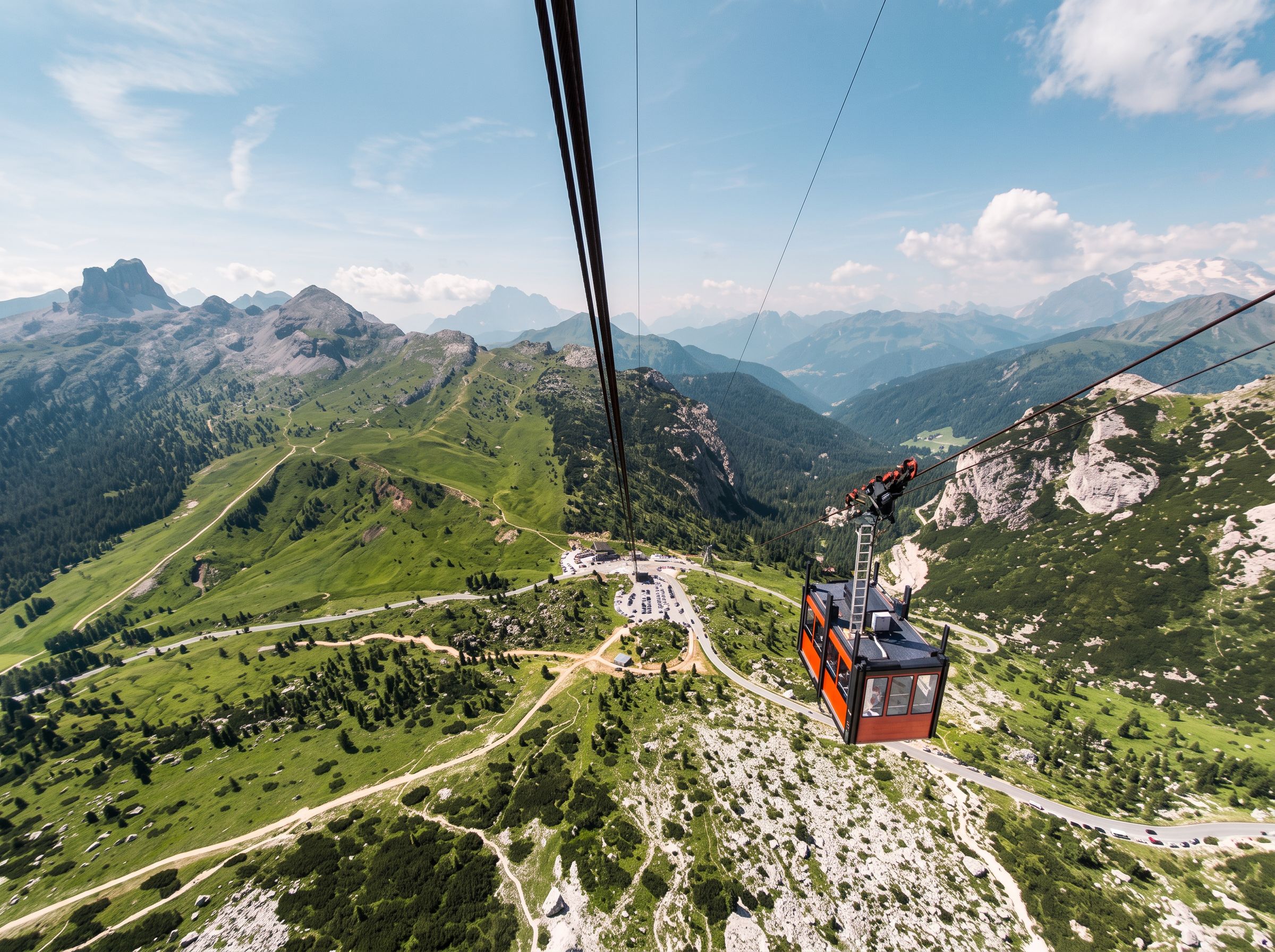
Beyond Seiser Alm, the Lagazuoi cable car from the Falzarego Pass is the standout for low-effort access: the operator states it is fully accessible to disabled people, with no architectural barriers from the pass car park to the panoramic terrace at the mountain station, and ramps and a lift serving the exhibition area.
Lagazuoi is worth singling out because the access detail is unusually specific. According to the Skipass Cortina accessibility page, the Lagazuoi EXPO Dolomiti exhibit space at the cable car top station is equipped with ramps and lifts so that everyone can visit the exhibitions. The same page states that trails from the top station have been designed with a 10% maximum gradient for people with reduced mobility and wheelchair users, reaching Rifugio Lagazuoi, the war emplacements and the summit cross of Piccolo Lagazuoi.
The cable car itself runs 6 June to 18 October 2026, daily 09:00 to 16:40, according to the Alta Badia summer lifts page. That page does not show a fare, and the Lagazuoi source documents no senior or over-65 rate. Treat the price as something to confirm at the ticket office.
In Val di Fassa, several summer lifts serve high viewpoints with published fares and dates. The Paolina lift runs 30 May to 11 October, 08:15 to 17:45, at €18.50 one way and €26 return. Alba to Col dei Rossi runs 13 June to 13 September, 08:30 to 17:20, at €15.50 one way and €28 return. Alba to Ciampac runs the same dates, 08:30 to 17:30, at €16 one way and €25 return. Pradel to Salei runs 27 June to 20 September, 09:00 to 17:00, at €11 one way and €19.50 return. All figures come from the official Val di Fassa summer lifts page.
Are there level meadow strolls for people who prefer not to walk far?
Yes, and the Seiser Alm plateau is where they are best documented. The operator states that its ropeways let people who cannot manage long walking distances explore the entire plateau, and a bus service runs across the meadow, so a distant restaurant can be reached without a long walk back.
The plateau's open meadow terrain is the reason it works for short, gentle outings. The operator's own wording is that the ropeways open the whole plateau to passengers who cannot cover long distances on foot, and that pushchairs are carried on all ropeways, which is a useful proxy for how gentle the immediate surroundings of the top stations are.
What the source set does not do is give exact walking distances, step counts or gradient ratings for the Dolomites as a whole. The Seiser Alm operator publishes no step counts for the plateau paths. If a specific distance matters to you, ask at the lift station rather than relying on a general promise.
The wider Dolomites property does publish a structured accessible-trail programme. According to the UNESCO Dolomites accessible-trails page, the visitdolomites.com site features 36 trails accessible to everybody, including people with limited mobility, older adults and families with small children, plus 13 panoramic viewpoints reachable by fully accessible lift systems. The same programme publishes detailed technical information sheets in English, German and Italian so that a reader can analyse a trail and judge independently whether they can complete it. That is the most useful planning tool in the whole source set for a low-walking trip, and it is catalogued on the Open Dolomites accessible routes and viewpoints map.
Can you see the Dolomites by car and terrace lunch instead?
Yes. The passes themselves are the attraction, and several lift base stations sit directly at roadside car parks, which means a driving day can combine a mountain pass, a cable car ascent and a terrace lunch without any sustained walking. The Falzarego Pass, where the Lagazuoi cable car starts, is the clearest documented example.
The logic of a driving itinerary in the Dolomites is that the road climbs to the viewpoint. The Lagazuoi cable car base sits at the Falzarego Pass, and the operator states there are no architectural barriers from the pass car park to the panoramic terrace at the mountain station. That is a drive-up, ride-up, sit-down day.
Seiser Alm works differently. The gondola base is reached from the valley, and the plateau itself is closed to general traffic, which is precisely why the lift and the meadow bus matter so much for anyone who does not want to walk far.
The source set does not publish a van itinerary for the Dolomites, and it does not name a single official "prettiest" place across the whole range. What it does support is the pattern above: the Seiser Alm and Lagazuoi lift stations are the clearest low-walking bases, and both are reachable by road.
What practical details should you settle before you go?
Three things: medical backup, emergency numbers and how you will book. The Dolomites emergency number is 112, published across the region including for mountain rescue. In the Veneto Dolomites, 118 is the health emergency number, with a 24/7 operations centre.
For the Ortisei area, the Val Gardena tourist information names Pharmacy Sella at Reziaplatz 73B as the nearest pharmacy, and states that Bressanone and Bolzano are the nearest hospitals. For urgent medical emergencies in that area, 112 is published. The Veneto Dolomites health guide states that the regional emergency system runs 24/7 and includes emergency rooms and first-aid points, and that the ULSS1 Dolomiti network coordinates 76 affiliated pharmacies with continuous pharmaceutical coverage.
Booking is where the documentation thins out. The Seiser Alm operator does not publish advance booking, online booking or cancellation terms for the gondola. The Renon cable car source does not document fare rules, booking terms or cancellation conditions. The Tre Cime and Stiergarten sources do not document senior fares or cancellation terms. Plan to buy at the ticket office and to ask about assistance services in person.
On fares, the Renon cable car is the exception with published figures: the Ritten destination page gives €8 one way and €13 return, with combined cable-car-plus-train tickets at €12 one way and €20 return. The source does not document a senior rate for that cable car.
What should you skip if you are not walking far?
Skip any plan that depends on a single lift running without a fallback, and skip summit targets that require a trail from the top station. The source set documents lift-accessible viewpoints clearly, but it does not document on-foot distances, gradients or step counts for most of them, so a summit that looks close on a map may not be.
The most useful discipline is to build each day around two options rather than one. The Seiser Alm lift table lists several chairlifts and gondolas with their own operating windows, so a day that assumes every lift is running is a day that can unravel. The wider source set does not document specific maintenance closure dates for the individual lifts, so the operator's page is the place to check on the morning itself.
It is also worth being clear about what the accessible-trail programme does and does not claim. The UNESCO accessible-trails material documents 36 accessible routes and 13 accessible viewpoints across the Dolomites property, and it publishes technical sheets so a reader can judge a route for themselves. It does not make a general claim that every easy-looking path in the Dolomites is suitable for every visitor. The programme's own framing is available on the UNESCO Dolomites accessible activities page.
Finally, if you want company and a fixed itinerary rather than self-driving, that is a different kind of trip with its own logistics, covered in our guide to small-group and guided tours of the Dolomites for travellers 50-70. And if you would rather base yourself at a hotel with a lift at the door, the wider picture of getting around the Dolomites by cable car, bus and ski pass is worth reading before you book.
How many days do you need for a low-walking Dolomites trip?
The source set does not document a single official answer on how many days in the Dolomites is enough. What it does support is a structure: one day for Seiser Alm, one for a Lagazuoi or Val di Fassa lift, and one for a driving pass with a terrace lunch, with a spare day for weather.
That structure follows from the documented geography rather than from any published recommendation. Seiser Alm and the Lagazuoi cable car sit in different parts of the range, and the Val di Fassa lifts form a third cluster. Trying to combine all three in a single day means long transfers and no margin for a lift that is not running.
The source set also does not name the nicest town in the Dolomites, and it does not identify a single prettiest part of the range.
For Seiser Alm, hours are longer in high summer. For Madonna di Campiglio, the tourism page states accessibility separately for winter and summer, noting that in summer all lifts open to the public except the Grostè gondola are completely barrier-free and accessible. That is a lift-by-lift distinction, not a seasonal warning.
How do you reach the Dolomites without a car?
Public transport reaches the main valleys, and the Venice to Cortina link is the best documented. According to Dolomiti Bus, there is a direct connection from Venezia Marco Polo airport to Cortina of approximately two hours with no intermediate stops, and the bus stop sits in the Arrivals area of the airport.
The same operator states that its buses are equipped with access ramps and accessible seats for people with disabilities or limited motion. That matters for anyone planning a low-walking trip without a hire car, because it means the airport-to-mountain leg is documented rather than assumed.
Once in the valleys, the local bus networks connect the lift base stations. The source set does not publish a single region-wide pass covering every lift, and the Seiser Alm summer page lists prices by category rather than as a universal Dolomites ticket. Expect to pay lift by lift, or to buy a multi-journey pass where the operator offers one.
If you are weighing up where to stay, two properties in the range have their own dedicated reviews on this site: Cristallo, a Luxury Collection Resort in Cortina d'Ampezzo and Rosa Alpina in San Cassiano. Neither is a lift-base property in the sense described above, so check the location against your chosen lift before booking.


