
Lake Garda has a way of getting under your skin. The largest lake in Italy stretches 51 kilometres between the Dolomite foothills and the Po Valley, its waters shifting from deep alpine blue in the north to a softer Mediterranean turquoise in the south. For travellers aged 50 to 70, the question is rarely whether to go, but when — and that single decision shapes everything from ferry queues to whether you can find a quiet table at a lakeside café.
The honest answer, backed by climate records and traveller reports alike, is that the sweet spot falls in two windows: late May to mid-June, and mid-September to early October. These are the months when the lake delivers warm, swimmable days without the July-August crush, and when the boats are still running to the summer timetable — which in 2026 ends on 4 October. November through March offers the quietest atmosphere, but you trade that calm for closed restaurants and, in the depth of winter, no scheduled boats at all.
This guide walks you month by month through the lake's Mediterranean-style climate, ferry timetables, garden and cable-car seasons, and the crowd patterns that define each season. We'll steer you toward the shoulder windows that give you the best of both worlds — and tell you honestly what you give up if you chase the absolute quietest weeks.
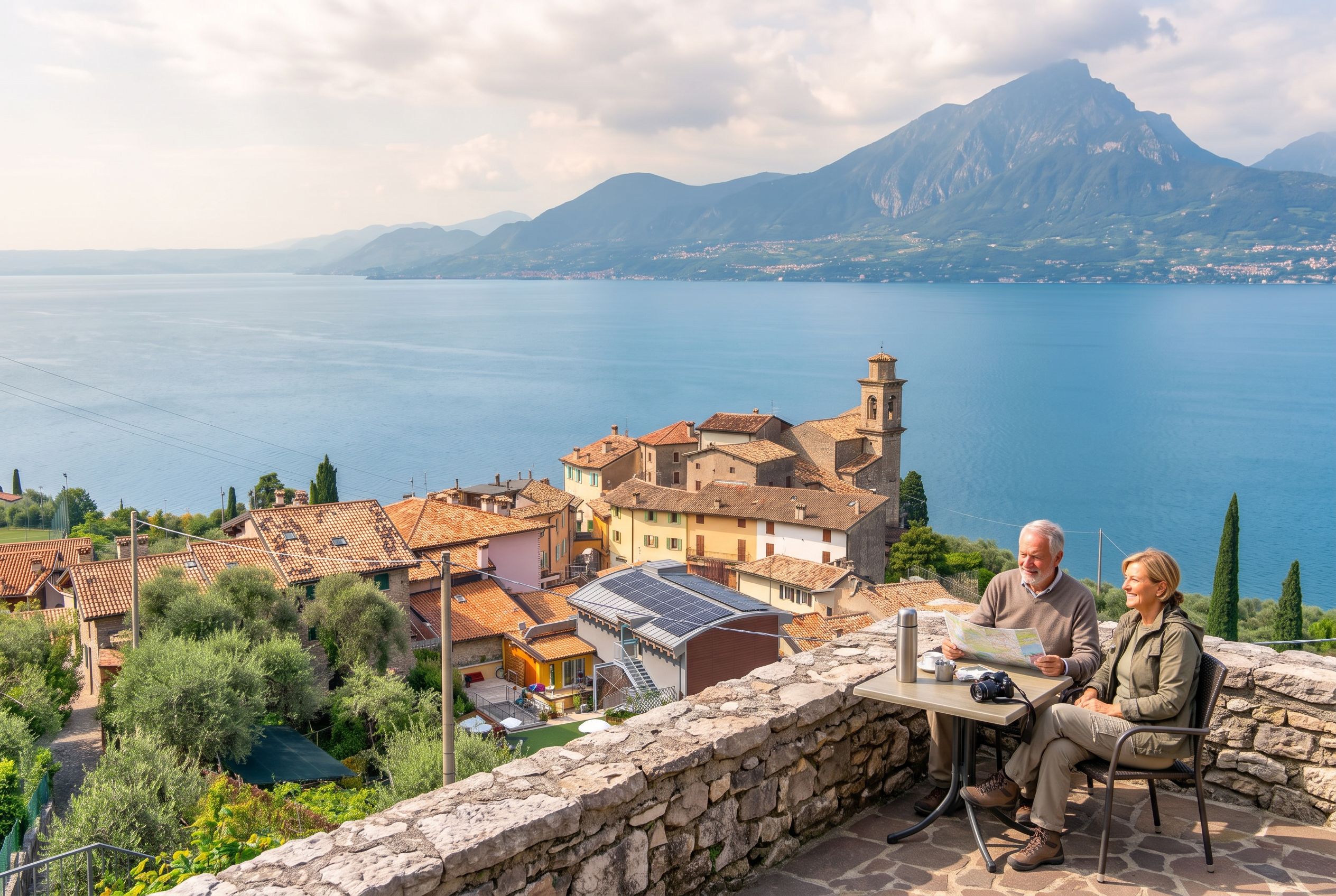 AI-edited
What makes Lake Garda's climate so mild?
Lake Garda's microclimate is warmer than its northern Italian location suggests, thanks to the lake's sheer size and the sheltering effect of the surrounding mountains. At the Arco reference station Meteotrentino runs at the northern end of the lake, the average daily maximum is close to 24°C in May, around 30°C through July and August and about 25°C in September (reference values from records kept since 1985). This is why olive trees and lemon groves thrive here.
The lake acts as a thermal reservoir. It absorbs heat through summer and releases it slowly through autumn, which means October evenings stay milder than you might expect for a destination at this latitude. The mountains to the north — Monte Baldo rising to 2,218 metres — block cold continental air, while the lake's 370 square kilometres of water moderate temperature swings.
Rainfall does not follow the pattern most visitors expect. The reference values Meteotrentino publishes for its Arco station at the northern end of the lake (records since 1985) make October and November the wettest months of the year, at roughly 122 and 119 mm, while July is the wettest of the summer months at around 100 mm. April and September come out almost identical, at roughly 87 and 89 mm. Choosing between a "quiet" week in April and one in September is therefore a question of crowds and opening times, not of rain.
For travellers who want to understand how the terrain affects walking comfort, our dedicated guide on how accessible Lake Garda is for older travellers covers the cobbled streets and hillside paths in detail. The short version: Regione Lombardia's accessibility survey describes the lakeside promenades of Desenzano, Salò, Gardone Riviera and Gargnano as broad, level and evenly paved, and notes that several streets in Sirmione are level, well paved and free of obstacles. Malcesine holds the Bandiera Lilla accessibility award, and its lakeside cycle-and-foot path is barrier-free along the whole length of the municipality.
When is the best time for warm weather without the crowds?
The consensus across climate records, traveller forums, and guest reviews points to two windows: late May to mid-June, and mid-September to early October. In both periods, daytime temperatures hover in the low-to-mid 20s°C, the water is swimmable, and the ferry queues that define July and August have not yet formed — or have already dissolved.
Let's break down why these windows work so well. In late May, the lake has had all spring to warm up. The water is still brisk but refreshing for a short swim, and the air feels genuinely warm by mid-afternoon. The crowds are building toward summer but haven't peaked. Schools in Italy and northern Europe are still in session, so the family rush hasn't begun.
September offers a different kind of magic. The lake has been baking all summer, so the water holds its warmth well into the month and is noticeably warmer than in June. Since March 2019 APPA Trento's monitoring probe off the Sabbioni beach at Riva del Garda has reported the lake temperature at one metre depth in real time, which is the closest thing to an official reading before you travel. The air temperature drops to a more comfortable range than August's peak, and the crowds thin noticeably after the first week, once schools resume across Europe.
Guest reviews from outside the peak weeks describe the same shift:
"We went there at around 6pm and it was really quiet. The sunset was stunning and city view was beautiful under the sunset. Worth the hiking from city centre. Nice castle!" — a review left on Google in October 2025 about Sirmione's Scaliger Castle
For those who want the absolute quietest experience, November offers the most deserted lake — and the steepest trade-off. We cover it in detail below.
What about July and August — is it really that busy?
Yes, July and August are genuinely crowded, and the heat is real. Average daily maxima at the Arco reference station run around 30°C through July and August, and its records since 1985 include August days above 39°C. Sirmione, in particular, is bluntly described by forum contributors as a "zoo in July." If you want warm swimming weather and don't mind crowds, this is your window — but for most travellers aged 50-70, the shoulder months offer a better experience.
The summer high season runs from roughly mid-June through the end of August, with the absolute peak in August when Italian families take their holidays. Sirmione and Malcesine are the busiest calls on the lake — the 2026 summer timetable lists more than twenty boats a day in each direction at Malcesine — and the queues at the ticket windows build in the midday heat. Restaurants require reservations for dinner, and the lakeside promenades become a slow-moving river of people.
That said, summer has its defenders. The water is at its warmest in August, and the long evenings are perfect for a late swim followed by dinner on a terrace. The ferry network runs at maximum frequency, so you can hop between towns with minimal waiting once you're on board. And if you time your outings for early morning or late afternoon, you can dodge the worst of both the heat and the crowds.
The strategy experienced visitors recommend is simple — be at the sights before the day-trippers arrive:
"Get there early to avoid queues and large groups. Beautiful ruins, with great views. Interesting museum. Bought tickets on the door." — a Google reviewer wrote in June 2026 about the Grotte di Catullo in Sirmione
If you're considering a summer visit, booking accommodation well in advance is essential, and you'll pay a premium. The quietest hotels on Lake Garda guide can help you find a calm base even in high season.
How do ferry schedules change by season?
Navigazione Laghi's scheduled boats are seasonal, not year-round. The 2026 timetable runs from 29 March to 4 October, with the dense summer version valid from 16 May; in it Desenzano has sixteen scheduled departures a day, spaced anywhere from five minutes to an hour and a half apart. Thinner timetables cover the weeks either side. In the depth of winter the scheduled boats stop altogether: between 3 November 2025 and 6 March 2026 the only service running was the Torri del Benaco–Toscolano Maderno car ferry.
This is one of the most practical considerations for your timing decision. The ferries are the easiest way to move between towns without dealing with parking or hill climbing. In summer, the network is your oyster. In midwinter there is no scheduled network at all to plan around.
The consequence is easy to miss. A trip planned for late October, or for the Christmas markets, cannot use the scheduled boats at all, and the one service that keeps running is a crossing between the two shores rather than a route along the lake, so it replaces almost none of the network.
| Validity | Timetable | Departures from Desenzano |
|---|---|---|
| 16 May – 4 Oct 2026 | Full summer | 16 a day, gaps of 5 to 95 minutes |
| 1 Apr – 15 May 2026 | Spring | 17 a day, fewer calls on the northern lake |
| 6 Oct – 2 Nov, 7 – 31 Mar | Reduced | 11 a day |
| 3 Nov – 6 Mar | None | Torri del Benaco–Toscolano Maderno car ferry only |
For day trips, the ferry is also the most scenic way to see the lake. The journey from Desenzano in the south to Riva in the north takes about two hours and passes the dramatic cliffs of the Trentino shore, the castle at Malcesine, and the terraced olive groves above Limone. In the shoulder months, you'll have more room on deck and better views without craning around other passengers.
When do the gardens and cable cars open?
The seasons differ sharply from one attraction to the next. The Heller Garden in Gardone Riviera is closed from 1 November to 1 March and otherwise opens 9am to 7pm. The Malcesine–Monte Baldo cable car runs all year except March and November, when it shuts for maintenance until shortly before Christmas. The Vittoriale degli Italiani is open all year, closing only on public holidays and on Mondays in November, December and January.
The gardens around the lake are a major draw for many travellers, and their seasons shape when you should visit. The Heller Garden in Gardone Riviera, begun in 1903 when Arthur Hruska started turning a neglected vineyard into a botanical garden and reshaped after 1988 by the Austrian artist André Heller, is at its lush best from May through September. The Vittoriale degli Italiani, the eccentric estate of poet Gabriele D'Annunzio, has terraced gardens overlooking the lake that are particularly lovely in late spring when the wisteria blooms.
For the Monte Baldo cable car, the experience changes dramatically by season. In May and June, the mountain meadows are carpeted with wildflowers, and the air at the top station is fresh without being cold. By September, the foliage begins to turn, and the views across the lake to the Dolomites are often crystal clear. In winter the cable car carries skiers and a few hardy sightseers, but it stops for maintenance from the start of November until shortly before Christmas, and again for the whole of March.
If you're planning around garden visits, late May is arguably the single best month — the spring bloom is at its peak, and the temperatures are ideal for wandering outdoor spaces. September offers a second, quieter window with the autumn colours just beginning.
What about winter — what actually closes?
From November through March, expect a significant reduction in services. Many hotels close entirely, particularly in smaller towns, and restaurants that remain open often operate on reduced hours. The scheduled boats stop altogether in midwinter — in the last published timetable from 3 November to 6 March, leaving only the Torri del Benaco–Toscolano Maderno car ferry — and some attractions close for the season, the Heller Garden from 1 November to 1 March. You'll have the lake nearly to yourself, but you'll need to plan carefully.
The winter trade-off is real. On one hand, November is the emptiest month on the lake, and the timetable explains why: in the last published winter edition the scheduled boats stopped on 3 November, and most of the day-trip traffic stopped with them. You can walk the promenades in near solitude, and the light on the water in winter is extraordinary — low and golden, with the snow-capped peaks of Monte Baldo as a backdrop. On the other hand, you'll need to check opening hours for everything, and some days will be too cold for comfortable lakeside strolling.
Daytime highs in winter range from the single digits to the low teens: the Arco reference values give an average daily maximum of about 10°C in December and January and about 12°C in February. It's not bitter cold, but it's not warm either. December visits find a lake that is deserted but chilly. Restaurants in the larger towns like Riva and Desenzano largely stay open because local residents use them year-round, but the tourist-oriented places close.
For travellers who want the quiet without the closures, the last week of September and the first days of October are the better compromise: the crowds have thinned, the attractions are still open, and the boats are still running until 4 October. Later in October the lake is quieter still, but it is also the wettest month of the year at Arco, at around 122 mm, so pack a warm layer and a rain jacket. The Arco reference values put the average night-time minimum at about 14°C in September and about 9°C in October, so October demands more attention to layering.
How do major holidays affect the crowds?
Easter week brings a noticeable spike in visitors, particularly from German and Dutch travellers who have school holidays then. The Italian national holidays of April 25 and May 1 also draw domestic crowds for long weekends. If you're planning a spring visit, aim for the weeks after Easter rather than the holiday week itself.
The holiday calendar matters more than many travellers expect. Easter falls in late March or April, and the two weeks around it see a mini-summer on the lake — full ferry schedules, busy restaurants, and crowded promenades. The weather can be lovely, but it's not the quiet shoulder season you might have imagined.
Similarly, the long weekend around May 1 (Labour Day) brings Italian families to the lake, and the German public holidays in late May and early June (Ascension and Pentecost) can create sudden spikes in demand. If you're flexible, check the holiday calendar for your own country and the major European markets before booking.
September is largely free of these complications. Schools are back in session across Europe, and the major holidays are months away. That combination is why mid-to-late September is so often named the sweet spot.
What should you pack for shoulder-season visits?
Layers are the answer. At the Arco reference station the September values average about 14°C overnight and about 25°C by mid-afternoon. You'll want a light jacket or cardigan for mornings and evenings, comfortable walking shoes for cobbled streets, and swimwear if you plan to take advantage of the still-warm water.
Late May nights catch people out. The Arco reference values put the average May maximum near 24°C but the average May minimum at about 12°C, and May is one of the wetter months of the year there, with around 96 mm on average. The lesson is simple: pack for variability, not for the average.
For the ferry, a windproof layer is essential even on warm days — the breeze across the water can be surprisingly cool. And if you're planning to ride the Monte Baldo cable car, bring a fleece or jacket regardless of the season; the top station at Tratto Spino sits at 1,760 metres, high enough that the air is sharply cooler than at the water's edge.
For dining, the shoulder months are a wonderful time to explore the lake's culinary scene. The finest restaurants and lakeside cafés are easier to book in September and October, and the seasonal menus feature the autumn harvest — mushrooms, chestnuts, and the famous lake fish. In May, you'll catch the spring vegetables and the first of the local olive oil.
Which towns are best for a shoulder-season base?
For a calm, senior-friendly base, Salò has a lakeside promenade that Regione Lombardia's accessibility survey calls broad, level and evenly paved, and Bardolino has a long waterfront walk that continues as a cycle-and-foot path to Garda and Lazise. Riva del Garda in the north is more dramatic, and Garda Trentino states that its public transport is entirely barrier-free. Sirmione is beautiful but the busiest — best visited as a day trip in the shoulder season rather than as a base.
Bardolino, on the eastern shore, is a relaxed town known for its wine and its gentle pace. The lakeside Rivalunga walk runs north towards Garda as a cycle-and-foot path, and the ferry stop connects you to the rest of the lake without needing a car. In September, the town's wine bars are full of locals rather than tourists, and the atmosphere is authentically Italian.
Salò, on the western shore, has a long and elegant waterfront promenade that Regione Lombardia describes as broad, level and evenly paved. It's a proper town rather than a resort, with a working harbour and a historic centre that rewards aimless wandering. The ferry connections are good, and the town is quiet enough that you'll feel like you've discovered something special.
Riva del Garda, at the northern tip, offers the most dramatic scenery — the lake narrows and the mountains rise steeply from the water. The town itself has a lovely medieval centre and a lakeside promenade, and Garda Trentino states that public transport across the area — buses, train, Bus&Go and the scenic lift up to the Bastione above the town — is entirely barrier-free. The ferry journey from Riva to the southern towns takes about two hours, so it's better as a base for exploring the northern lake.
For those who want to understand the practicalities of getting around, our guide to health, pharmacies, and peace of mind on Lake Garda covers the essentials for a worry-free trip.
How do costs compare by season?
Accommodation is at its most expensive in July and August. The indicative ranges below, based on rates reported by travellers and booking platforms, put a mid-range lakeside double at €250-350 a night in high summer against €140-200 in the shoulder months. Ferry tickets and restaurant prices stay roughly constant year-round, but you'll spend less on air conditioning and more on heating in the cooler months.
The cost difference is one of the strongest arguments for shoulder-season travel, particularly for travellers on a fixed budget. The premium for summer is not just about accommodation — it extends to car hire, tours, and even basic groceries in tourist-heavy towns.
| Season | Nightly rate | Crowd level |
|---|---|---|
| May–June | €150-200 | Moderate |
| July–August | €250-350 | High |
| September–October | €140-190 | Low-moderate |
| November–March | €90-130 | Very low |
These are indicative ranges based on typical rates reported by travellers and booking platforms. The actual prices vary significantly by town — Sirmione commands a premium year-round, while the northern towns are generally more affordable. Booking early for shoulder season is still wise, as the word has spread about the September sweet spot.
What if you have limited mobility?
Choose a lakeside hotel near the ferry stop, and base yourself in a flat town like Bardolino or Salò. Use the ferries for day trips rather than driving, and plan your sightseeing for mornings and late afternoons to avoid the busiest hours. The promenades documented as level — Desenzano, Salò, Gardone Riviera and Gargnano — are the easiest walking surfaces on the lake.
Forum advice from travellers who have visited with older companions consistently emphasises the same points. The ferries are the great equaliser — they let you see multiple towns without navigating hills, parking, or crowded streets. A hotel near the ferry stop means you can return easily for a rest in the afternoon and head out again for the evening.
In Sirmione and Malcesine the historic centres are compact and cobbled, but neither town is the obstacle course it is often made out to be: Sirmione states that all its pedestrian routes are suitable for wheelchairs, and Malcesine's lakeside cycle-and-foot path is barrier-free along the whole municipality. The Scaligero castle in Sirmione is the exception — the town writes that the inside of the castle is not accessible, while the Grotte di Catullo and their museum are. The promenade in Salò is level and evenly paved, ideal for a gentle stroll.
If you're considering a specific hotel, it's worth contacting them directly about accessibility features. Guest reviews don't consistently mention lifts, steps, or walk-in showers, so it's best to ask directly. The quietest hotels guide includes details on calm locations that also tend to be more accessible.
What's the final verdict?
Book the second half of September if you want the best combination of warm weather, warm water, and genuinely small crowds. Choose late May if you prefer spring blooms, the full garden season, and slightly fewer people than September. Avoid July and August unless swimming in the warmest water is your top priority.
Climate records, ferry timetables and opening seasons all point the same way. September is the strongest month for the balance of conditions that matter to travellers aged 50-70: warm enough for comfort, quiet enough for peace, and open enough for convenience. The water is warmer than in June, the crowds have thinned after the summer rush, and the autumn light on the lake is unforgettable.
May is the close runner-up, with the advantage of spring energy and the full garden season. The trade-off is slightly cooler water and the possibility of more rain. If you're flexible, a late-May trip that extends into early June gives you the best of both — the spring bloom and the start of summer warmth.
Whichever window you choose, the lake will reward you. It's a destination that reveals itself slowly, and the shoulder seasons give you the time and space to let it do so.


