
Lake Garda is genuinely workable for travellers aged 50 to 70, including those who tire easily or use a stick, walker, or wheelchair — but only if you plan around its uneven terrain. The flat lakeside promenades, the ferry ramps, and the barrier-free Malcesine cable car make large parts of the lake delightfully easy. The hard ground is narrower than most guides suggest: Sirmione's lanes are largely level, but Limone climbs a hillside, Malcesine's historic centre is cobbled and stepped, and the northern roads are busy.
The key is understanding that accessibility varies sharply from town to town. One morning you might glide along a smooth, level promenade in Desenzano; by afternoon, you could be facing cobbled lanes and a late-13th-century castle you cannot enter in Sirmione. This guide gives you a lake-wide reading — what works, what doesn't, and how to build a low-strain holiday around the accessible highlights.
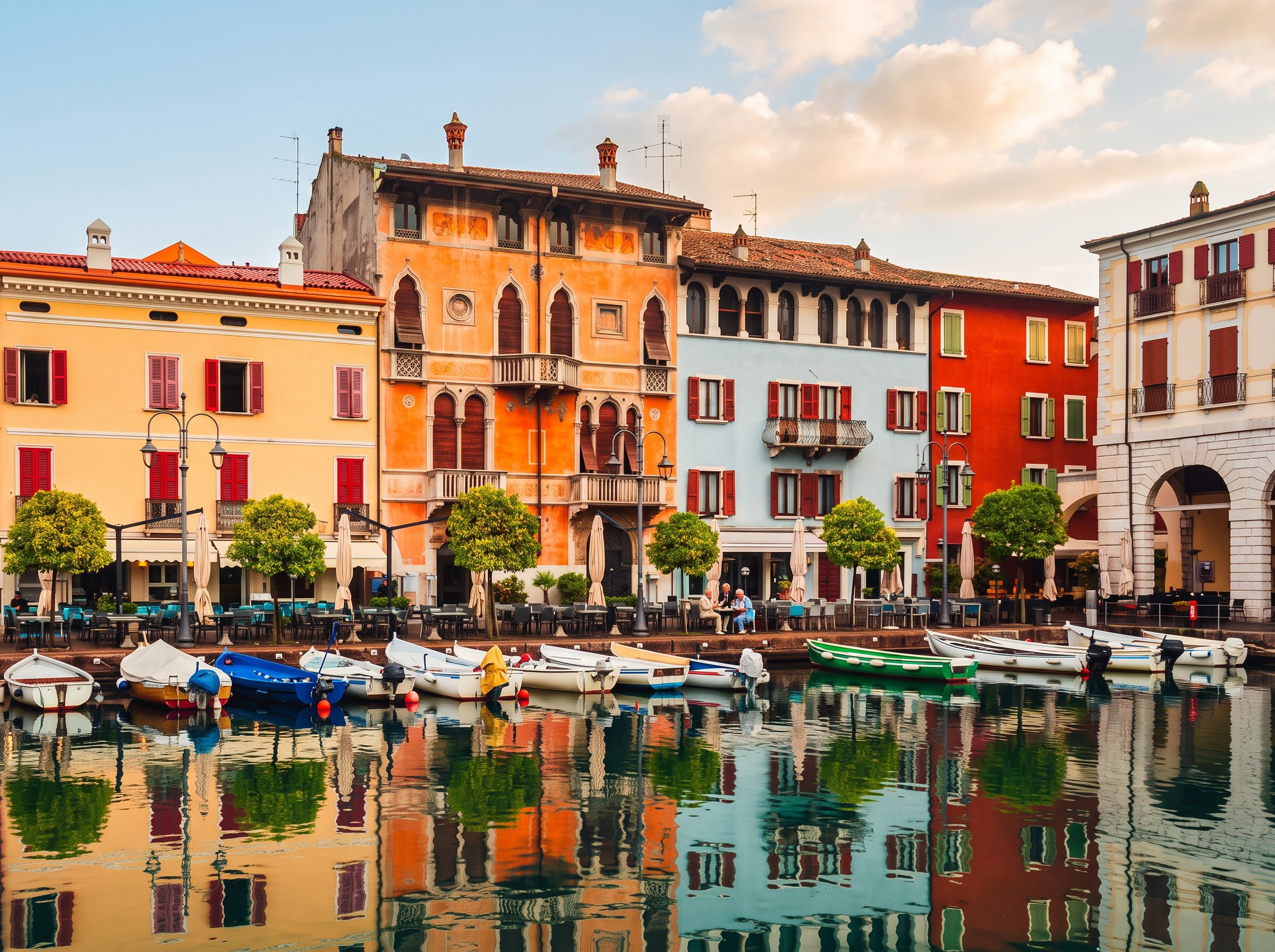 AI-edited
Which Towns Are Easiest for Limited Mobility?
Regione Lombardia describes the lakeside walks at Desenzano, Salò, Gardone Riviera and Gargnano as wide, level and well paved, and Sirmione's streets as level and free of obstacles. Malcesine holds the Bandiera Lilla accessibility award and its lakeside path is barrier-free, though its historic centre is cobbled and stepped.
The lower lake is the most manageable stretch, and the region says so in plain terms: Regione Lombardia's accessible-tourism pages call the Desenzano lakeside walk "ampio, in piano" — wide and level — with well-connected paving, and note that the boats let reduced-mobility visitors reach the centre of each town, where the lakefront and the streets beside it are usually flat. See also the Visit Brescia accessibility guidance, which lists accessible itineraries across the province of Brescia, from the lake up to Valle Camonica.
For a detailed comparison of each town's character and practical access, our town-by-town base guide breaks down the pros and cons of every lakeside resort.
| Town | Terrain | Best for |
|---|---|---|
| Desenzano del Garda | Flat lakefront, level promenade | Wheelchair users, walker users |
| Bardolino | Gentle, paved lakeside walk | Easy strolling with benches |
| Peschiera del Garda | Rail hub with PRM assistance | Car-free travellers |
| Riva del Garda | Flat waterfront, hillier edges | Barrier-free transport, Bastione lift |
| Malcesine | Barrier-free lakeside path, cobbled centre | Bandiera Lilla town, cable car |
| Limone | Stepped lanes, hillside | Bandiera Lilla town; the lakeside path, not the lanes |
Are the Ferries Step-Free and Reliable?
Yes, the lake ferry system is the single best mobility tool on Lake Garda. Navigazione Laghi assists every boarding with a non-slip gangway at least 80 cm wide, and its ships and main ports of call have carried stepless ramps since 2016. Its newest ships have lifts and accessible toilets, and six piers and nine boats hold Bandiera Lilla Approved certification.
As of August 2026, Navigazione Laghi runs this service across the lake, but the timetable is seasonal: the 2026 season runs from 29 March to 4 October, with the dense summer schedule from 16 May. Since 2018 the timetable boards carry symbols marking the sailings most suitable for wheelchair passengers. The operator also says openly that not every wharf is easy to reach, and that the captain may limit boarding for safety reasons. Guests consistently report that crew members are helpful, assisting with boarding and organising queues.
However, plan for the practicalities. Piers such as Sirmione offer little shade, so bring a hat and water for the wait. Sailings can change at short notice, so check the day's departures on the board at the dock and look for the wheelchair symbol that marks the sailings the operator recommends. If you need help boarding, say so at the ticket office rather than at the gangway.
For a full breakdown of ferry routes, ticket prices, and how to plan boat-based days, see our comfortable trip cost guide, which includes current fare information.
Is the Malcesine Cable Car Worth It?
Yes — the operator states the Malcesine–Monte Baldo cable car is barrier-free, with a lift from the underground car park up to the street-level ticket office and staff at every boarding point. It climbs in two sections to Tratto Spino at 1,760 metres, and only the upper cabin rotates. The SkyWalk lounge bar sits inside the top station.
Malcesine is better prepared than its medieval look suggests. Beyond the barrier-free shore path, the Palazzo dei Capitani, the church of Santo Stefano and the sailing club are all accessible, and a car carrying a European disabled parking card parks free in the blue bays. The historic centre is the harder part. When the comune presented the first phase of its accessibility plan in July 2026, cobble and porphyry paving was named the main obstacle by 43.4 per cent of respondents and steps at entrances by 32.1 per cent.
Plan your visit around the cable car: arrive by ferry, ride up early to avoid queues, and allow time for lunch at the top station. The views over the lake and the Dolomites are the payoff, and the walk that starts at the station is described by the operator as one of the easiest on Monte Baldo.
"The cable is a convenient means to reach Monte Baldo when you don't have too much time," one Google reviewer wrote in August 2025. "No matter where you stand in the cabin, you'll have a complete view of the landscape because the cabin rotates slowly around it's axis while moving up/down. Once up you have a great panorama over Lake Garda."
What About Sirmione and Limone's Old Towns?
Sirmione is easier than its medieval look suggests: the town states that all pedestrian routes are suitable for wheelchairs, and Regione Lombardia describes several of its streets as level, well paved and free of obstacles. Limone is the harder of the two, since it climbs a hillside, but its lakeside cycle-and-footpath runs north from Lungolago Marconi.
Sirmione is one of the lake's most historic destinations, with Roman-era ruins at the Grotte di Catullo and a medieval castle. The town is blunt about the difference between the two: the Scaligero Castle is not accessible inside, while the Grotte di Catullo, museum included, are. The road out to the Grotte rises at 10 to 18 per cent over about 1.5 kilometres, so take the little train, which has a wheelchair space at the back.
In Limone the plan is to stay low. The cycle-and-footpath along the water starts on Lungolago Marconi in the old centre and runs north to Capo Reamol, cut into the rock face above the lake, and it can be walked as well as cycled. If you want a thermal spa day in Sirmione, our spa day guide covers which facilities offer step-free access.
Are the Northern Roads Safe and Manageable?
The northern lake roads are busy, narrow, and winding — not ideal for nervous drivers. The western shore road between Limone and Riva is particularly challenging, and the famous Strada della Forra has had repeated closures. If you're not confident driving, use ferries and buses instead.
The Province of Brescia closed the road from 2 February to 13 March 2026 for the second phase of stabilisation work after a landslide in December 2023, and reopened it on 13 March at 16.30. The province's order of August 2025 still governs the traffic: one-way uphill for the full three kilometres, from Porto di Tremosine to Località Forra, at 30 km/h and with no overtaking. That same August 2025 order bans lorries, articulated vehicles, motorhomes and trailers, along with vehicles over 2.20 metres wide or 3.00 metres high apart from scheduled buses, and prohibits walking between kilometre 0.950 and 2.700.
Bardolino's limited-traffic zone (ZTL) ran from 1 April to 2 November in 2025, and the comune brought the 2026 season forward to 1 March under ordinance 39 of 24 February 2026, so plan parking and drop-offs around it. A European disabled parking card does open restricted zones: since 2021 the holder can register a number plate for free access to Italian ZTLs. Register that plate with each comune before you travel, because the ZTL cameras fine unregistered cars.
Which Attractions Offer Step-Free Access?
Beyond the cable car, the documented ones cluster in Desenzano and Sirmione: the Villa Romana is a fully accessible UNESCO site, the Rambotti archaeological museum has a side entrance with a ramp and handrail, Desenzano's castle is reached by lift and concrete ramp, and the Grotte di Catullo in Sirmione, museum included, are accessible.
The STAI project — Services for Accessible and Inclusive Tourism, run by Regione Lombardia — has surveyed four accessible routes on the Brescian shore: Desenzano del Garda, Sirmione, Bedizzole and Carzago Riviera. Two famous sights need a warning rather than a recommendation. The Vittoriale degli Italiani states that its historic character prevents the removal of all architectural barriers, so the visit route is only partly accessible: the Prioria cannot be reached by wheelchair, though the D'Annunzio Segreto museum, the car museum and the auditorium can, by the lift inside the library. Entry is free with a certified disability above 70 per cent or the European Disability Card. The MAG Museo Alto Garda in Riva says the top of its keep and the Torre Apponale cannot be made barrier-free.
For food lovers, the lakeside restaurants in Bardolino and Desenzano are easy to reach and offer excellent local cuisine. Our food guide for the over-50s highlights which dining spots have level access and which require a few steps.
What Practical Tips Make the Trip Easier?
Book accessible rooms far in advance — Rick Steves calls doing so not just cheaper but necessary. Travel in spring or early autumn to avoid July and August heat and crowds. Use ferries for scenic legs and taxis for awkward links between stations, hotels, and waterfronts. Plan for frequent rests and shorter sightseeing blocks.
Accessible-travel guidance and the regional accessibility pages point the same way:
- Base yourself on the flat lower lake rather than a scenic but hilly resort
- Use ferries for the scenic legs and reserve car or taxi transfers for awkward connections
- Choose one or two towns, not the whole lake — moving around takes longer than expected
- Check whether there are stairs between the elevator and your room, restaurant, or terrace
- Avoid assuming "lakefront" means easy walking — verify the specific path
Guest reviews frequently mention dining-room staff who go out of their way to help visitors using a wheelchair. One practical detail the brochures rarely carry: at the Malcesine cable car the ticket is free for people with a 100 per cent disability certificate and for their carer, and staff are posted at every boarding point and inside the cabins to help with getting on and off.
As of August 2026, Navigazione Lago di Garda holds a 3.6/5 rating on Tripadvisor from 383 reviews, with praise focused on helpful crew and clean boats. The cable car carries a far larger sample: 4.3 out of 4,657 Google reviews as of August 2026. Neither score measures accessibility, so read them as a general verdict on the service rather than a promise.
"A very good way to travel from towns anywhere in Lake Garda," a Google reviewer wrote of the Sirmione landing stage in August 2022. "The ferry was lovely and clean… Views are stunning!"
When Is the Best Time to Visit?
Spring (April to June) and early autumn (September to October) offer the most comfortable conditions: mild temperatures, lighter crowds, and easier movement. July and August are hot, busy, and harder to navigate — avoid them if you can.
Eurostat backs the pattern: people aged 65 and over were more likely to travel in the shoulder season — March to June and September to November — and in 2024 they accounted for 27 per cent of all EU tourism nights in June and 28 per cent in September. That fits Lake Garda, which is much busier in midsummer and easier to navigate in the morning or outside the peak months.
For those who tire easily, the cooler months also mean less physical strain on exposed promenades and ferry queues. Book your accessible room well in advance for these shoulder seasons, as they are increasingly popular with older travellers.
How Do I Get Around Without a Car?
Ferries first, then the train. RFI lists both Desenzano del Garda–Sirmione and Peschiera del Garda as stations with an assistance service for passengers with disabilities and reduced mobility, and Desenzano's station has lifts and a tactile route to the platforms. Buses are only partly accessible: on the Verona shore, 60 per cent of ATV's suburban fleet carries a wheelchair platform.
Bus access is uneven and worth checking before you build a day around it. ATV, which runs the Verona shore, states that 98 per cent of its urban Verona buses and 60 per cent of its suburban vehicles carry a wheelchair platform; the equipped ones are marked on the outside and wheelchairs board through the middle door. Arriva, on the Brescia side, states simply that wheelchair users can use its buses, and in the city of Brescia the metro stations are accessible.
For the northern lake, the Garda Trentino tourist board states that public transport across its area is entirely barrier-free — bus, train, Bus&Go and the scenic lift up to the Bastione above Riva del Garda. A car can reduce strain if you want to visit multiple towns, but factor in the ZTL restrictions and parking challenges in historic centres.


