
The Amalfi Coast rewards those who plan around its terrain rather than against it. This cliff-hugging stretch of Campania, a UNESCO World Heritage landscape, is built vertically, with stepped streets and narrow lanes that have changed little over centuries. For travellers aged 50 to 70, the secret is matching each experience to your own energy level, choosing the right time of day, and knowing which towns offer rest stops and which demand stamina. The coast's beauty is genuine, but so is its challenge. This guide picks the finest experiences and grades them by effort, so you can build a day that suits you, whether you want a gentle terrace with a view or a proper exploration of a historic centre.
 AI-edited
How physically demanding is the Amalfi Coast?
The coast is steep and stepped, with some towns requiring hundreds of stair descents to reach the water. Amalfi town itself has a mostly flat cobblestone centre and a level seafront approach, making it the most manageable base. Positano's main beach sits over 1,000 stairs below the road.
The terrain is the single most important factor in planning a visit. The coast was built on cliffs over centuries, with little thought given to accessibility in its original layout. Streets in Positano are effectively steps, and the main beach requires descending more than 1,000 stairs from the main road, a genuine challenge for anyone with limited mobility. Public buses have narrow aisles, no wheelchair spaces, and boarding steps, and summer overcrowding makes them particularly difficult for mobility-device users.
Amalfi town stands apart. Its centre is mostly flat cobblestone, and its seafront approach is flatter than most other coastal locations. The bus station sits right at water level, so arriving in town is easier than at hilltop bases. For visitors with significant mobility limitations, private transport is the essential starting point; one accessible-travel guide describes it as the only viable option for getting around this coast. The practicalities of reaching the coast are covered in our separate guide.
When should I visit to avoid the worst crowds?
September and October have become the new peak months, while July and August have grown quieter, according to the Costa d'Amalfi tourism district's 2025 data. For the most comfortable balance of weather and crowds, aim for May or the weeks either side of the main summer season.
The district's 2025-season report showed a notable shift in visitor patterns. July and August were down 8 to 10 percent against the previous year, while September and October became the busiest months. The same data showed the area is highly international, with 79.2 percent of visitors coming from abroad. This means the coast's character changes with the seasons, and the classic advice to visit in the shoulder months now needs a refinement: late spring remains your best bet for quieter streets.
One weather guide explicitly recommends April to June or September to October for pleasant temperatures and fewer people. Monthly averages run roughly 10 to 12°C from January to March, 16 to 20°C in April and May, 24 to 27°C in July and August, and 19 to 24°C in September and October. Many smaller-town hotels, restaurants, ferries and hydrofoils close between November and March, reopening after Easter. If you want warm days without the crush, May is the sweet spot.
What makes Amalfi town the best base for over-50s?
Amalfi is the coast's historic heart and its most practical day-trip base. The town centre is mostly flat cobblestone, the seafront is level, and the bus station sits at water level, so you can explore without constant climbing. It is the best-documented place for a senior-friendly visit.
Amalfi's flat centre makes it the natural anchor for a coast itinerary. The town's history as a maritime republic gives it a distinct character, with the cathedral and its piazza forming the cultural core. The seafront promenade offers an easy walk with benches and cafés, and the town's compact scale means most sights sit within a short stroll of each other.
The town also has the clearest documented health and safety infrastructure. The Guardia Medica Amalfi is listed at 089 871272, and pharmacies include Farmacia degli Arsenali and Farmacia del Cervo. Emergency numbers are standard Italian: 112 for police, 118 for medical aid, 115 for fire, and 1530 for sea rescue, with the local coast guard on 089 871366. For a fuller picture of where to rest your head, our guide to comfort-first hotels on the Amalfi Coast covers accommodation separately.
Where can I swim without a difficult descent?
Amalfi's Marina Spiaggia, on the west side of Marina Grande, operates an inclusive beach project with walkways, floating chairs, a Job chair, loungers and umbrellas. The service runs from June to October, Tuesday to Sunday, 9:30 to 17:30, and assistance is free with advance booking.
The Comune di Amalfi inaugurated the equipped beach in summer 2025 under the project name "Mare per Tutti" (Sea for Everyone). The beach has been fitted with walkways to the water, showers and toilets, plus specialist equipment: 4 floating chairs, 1 Job chair, 6 loungers, 6 umbrellas and 6 director's chairs. Each station can be occupied by one user and up to two companions.
Assistance is completely free of charge, organised by the L'Alveare Social Cooperative, which handles welcome, orientation and access management. The service ran from 20 June to 15 October 2025, with six bookable places. For information, the Comune's "Servizi alla Persona" department can be reached Monday to Friday, 9:00 to 13:00, on 089.873.6220. The official municipal announcement details the equipment and booking process.
How do I experience Ravello's famous gardens?
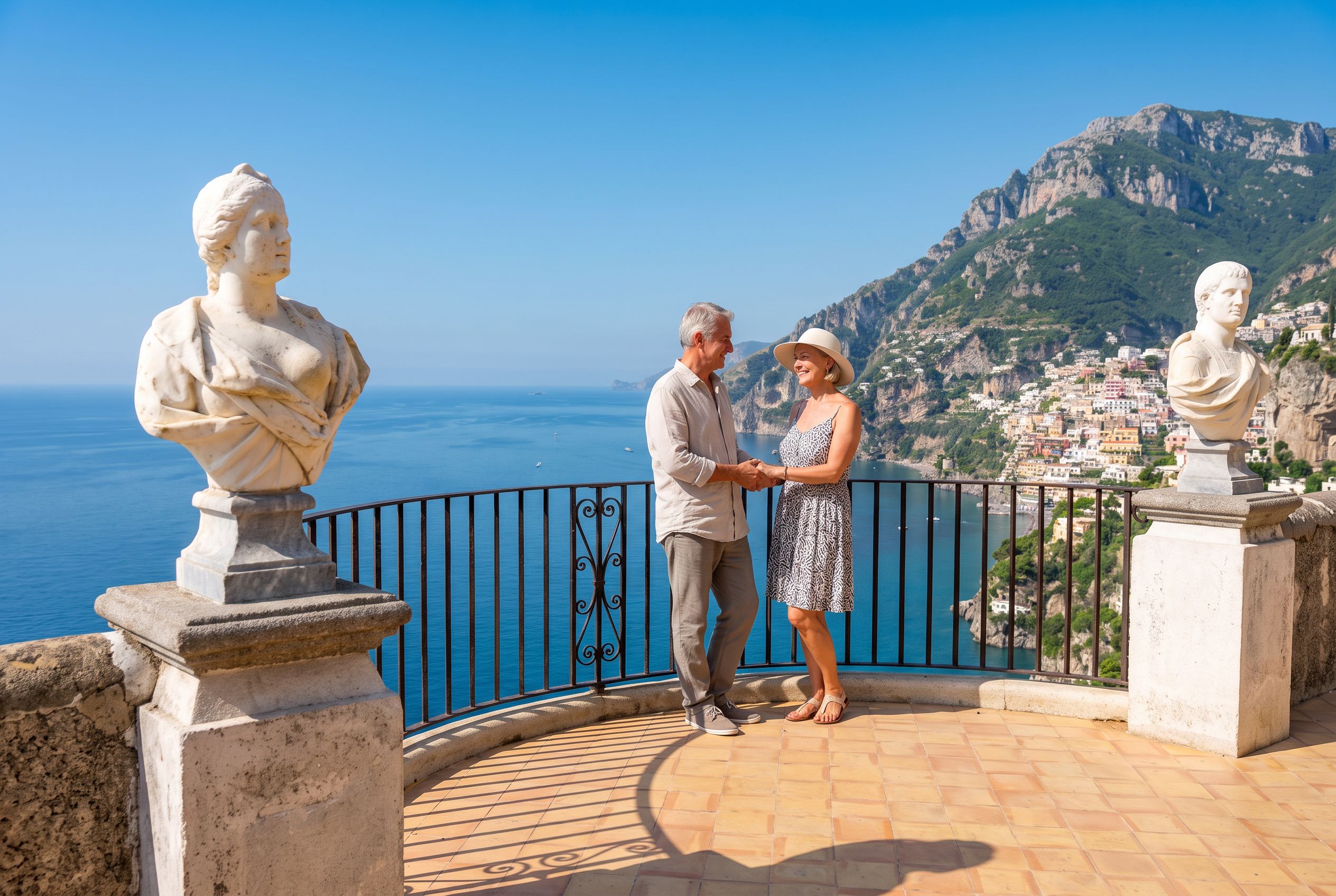
Ravello sits above the coast at 350 metres, reached by bus or taxi from Amalfi, about 6.9 kilometres by road. The town is charming and not too hilly around its main piazza, with Villa Cimbrone's gardens and the Terrace of Infinity as the principal draw.
Ravello offers a different pace from the coastal towns, with a cooler climate and a focus on culture rather than beach life. The town is reachable by bus or taxi from Amalfi, a journey of about 10 minutes with clear roads. Around the main piazza, Ravello is very flat, making it manageable for a leisurely stroll between the cathedral and the villa entrances.
Villa Cimbrone is the standout, recommended by official Italy tourism sources for its gardens and the Terrace of Infinity with panoramic views over the Tyrrhenian Sea. The villa does not publish mobility details, step counts or closure days, so confirm access when planning your visit. The gardens reward a slow pace, with shaded paths and benches that invite you to sit and take in the view. For a deeper look at the town's green spaces, our dedicated guide to Ravello's gardens and villas for senior travellers explores the options in detail.
What should I know about Amalfi's cathedral?
Amalfi's cathedral anchors the town's main piazza and is the cultural centrepiece of a visit. The piazza itself is flat and walkable, with cafés and shaded spots for resting. Specific step counts and lift access inside the cathedral are not documented.
The cathedral of Sant'Andrea sits at the top of a broad flight of steps in Piazza Duomo, the town's social heart. The piazza is the natural meeting point, with its fountain, cafés and the continuous flow of visitors. The cathedral's facade is a striking example of Arab-Sicilian Norman architecture, a reminder of Amalfi's medieval trading power.
For visitors who prefer not to climb the cathedral steps, the piazza itself offers plenty of reward. The surrounding streets are flat cobblestone, and the seafront is a short level walk away. The cathedral's interior arrangements, including any lift access, are not documented available, so ask at the tourist office or your accommodation for current details. The town's Arsenali museum pass system, regulated by the Comune, offers free entry for residents, children up to 13, disabled visitors with certification, and those over 70, with reduced rates for groups and university students.
Is a boat cruise the best way to see the coast?
Seeing the coast from the sea is the most rewarding way to appreciate its scale and drama. Ferries connect the main towns seasonally, and a boat trip reveals the cliffs, coves and pastel villages from the perspective the coast was designed to be seen from.
The coastal road clings to the cliffs, but it is the sea that gives the coast its identity. Travelmar operates ferry connections along the coast, with services running seasonally, typically from April to late October on some routes. Tickets are bought before boarding, and many ferries have wheelchair ramps. For those with limited mobility, a boat trip offers a way to see Positano's famous pastel houses without attempting the 1,000-plus stairs to its beach.
The ferry is often described as the best way to get around the coast, with buses cheaper but crowded. A private boat charter allows you to stop at coves and swim in clear water, but the scheduled ferries offer the same views at a fraction of the cost. The CMS Amalfi Coast sustainable mobility consortium coordinates local public transport connections to the main destinations, with Green, Blue and Orange line services.
How should I experience Positano without the stairs?
Positano is scenically essential but physically demanding. The main beach sits over 1,000 stairs below the road. The accessible-travel guidance suggests seeing it from the sea or from a road belvedere rather than attempting independent walking exploration.
Positano's vertical layout is part of its charm and its challenge. The town cascades down a hillside to the sea, with stepped lanes connecting the upper road to the beach. For travellers who cannot manage the descent and ascent, the best approach is to enjoy Positano from a distance. A ferry arrival gives you the classic view of the pastel houses climbing the cliff, and you can step ashore for a short visit to the waterfront area without committing to the full climb.
An evening in Positano, viewed from a terrace or a restaurant on the upper road, captures the town's magic as the lights come on across the hillside. The road belvederes offer parking and viewing points where you can take in the panorama without tackling the stairs. If you do want to reach the beach, consider the ferry, which docks at water level and avoids the descent entirely. Marina di Praia, in nearby Praiano, offers an alternative: the beach is reached by elevator from the main road followed by a short stair-free path.
Can I visit a lemon grove without a strenuous hike?
Lemon groves are woven into the coast's terraced landscape, and several producers welcome visitors for tastings. The groves are typically reached by short walks from village centres, though specific accessibility details vary by producer and are not uniformly documented.
The Amalfi Coast's lemons, particularly the large, thick-skinned sfusato variety, are central to local identity. The terraced groves climb the hillsides above the towns, their scent carrying on the sea breeze. Several producers along the coast offer tours and tastings, typically including limoncello sampling alongside fresh fruit.
The effort involved varies. Some groves sit close to village centres with gentle paths; others require climbing terraced slopes. A tasting is a sensory experience that pairs well with a morning in a flatter town like Amalfi or Maiori, where you can combine a grove visit with a seafront stroll.
What is the smartest way to move between towns?
Ferries are the most scenic and accessible option, with wheelchair ramps on many vessels. Buses are cheaper but crowded, with narrow aisles and boarding steps. Driving adds stress on narrow, congested roads. For limited-mobility travellers, private transfer is the practical default.
Distances between towns are short by road but slow in practice. Amalfi to Ravello is 6.9 kilometres, about 10 minutes with clear roads. Amalfi to Positano is 19 kilometres, about 35 minutes with clear roads. Maiori to Amalfi is 5.4 kilometres, about 10 minutes. These times assume free-flowing traffic, which is rare in summer when the coast road congests.
The road distances matter less than the transport choice. Ferries run between the main towns seasonally, offering comfortable seating and sea views. Buses connect all towns but fill quickly in summer. The coast's roads are narrow and winding, and multiple traveller forums advise against renting a car, citing traffic and parking difficulties. The CMS consortium's bus services offer a middle ground, with routes and fares published on the tourism board's website.
How do I structure a comfortable day on the coast?
Start early in Amalfi's flat centre, take a late-morning ferry to see the coast from the sea, lunch in a quieter town, and finish with a late-afternoon visit to Ravello's gardens when the light softens and crowds thin.
A well-paced day balances activity with rest. Begin with the cathedral piazza in Amalfi while the morning light is fresh and the town is waking. The flat seafront offers an easy promenade with benches. Mid-morning, take a ferry along the coast to appreciate the cliffs from the water, a journey that requires no walking at all.
For lunch, choose a town that matches your energy. Maiori, with its longer flat seafront, is a relaxed option. Ravello, reached by a short bus or taxi ride from Amalfi, offers a cooler, quieter atmosphere for the afternoon. The gardens at Villa Cimbrone reward a slow visit, and the Terrace of Infinity is at its most dramatic in late afternoon light. End the day with an early dinner in Amalfi, where the evening promenade is a gentle pleasure. The coast's rhythm rewards those who move slowly and rest often.


