
For travellers aged 50 to 70 planning a restorative break, the Amalfi Coast offers a particular kind of wellness day: one shaped by cliffside hotels, thermal seawater and the relaxed rhythm of Italian spa culture. The practical question is not whether to book a treatment, but how to plan a day that suits your pace, your knees and your idea of calm.
The coast itself is stunning but demanding, with staircases and steep lanes in almost every town. The good news is that the most documented accessible thermal experience in the region is not on the mainland at all. It sits across the water on the island of Ischia, at the Giardini Poseidon Terme in Forio, where ramps, lifts and an internal electric-cart service make a full spa day feasible for guests with limited mobility. This guide covers what to expect from a spa or thermal day, how to book, what is included and how to pace yourself, with a clear steer toward the quieter venues.
 AI-edited
Which spa or thermal venue suits a calm day best?
For a documented accessible thermal park with space to spread out, Giardini Poseidon Terme in Forio d'Ischia is the strongest choice. On the Amalfi mainland, smaller hotel spas in Minori, Vietri sul Mare and Conca dei Marini offer quieter alternatives, though their accessibility details are less documented.
The spa-hotel roundup has its own dedicated guide, so this article focuses on day visits. On the mainland, three non-resort options stand out. Otium Spa in Minori offers spa access with or without massages, a Jacuzzi, sensory showers, herbal teas, a relaxation area and the Argillarium clay ritual. Aquaboutique Wellness and Spa in Vietri sul Mare has a Finnish sauna, an aromatherapy Turkish bath, whirlpool tubs and a herbal-tea corner with coast views. Monastero Santa Rosa in Conca dei Marini, a hotel spa, includes steam rooms, thermal pools, a foot spa, hydro pools and a rock sauna with a crushed-ice fountain.
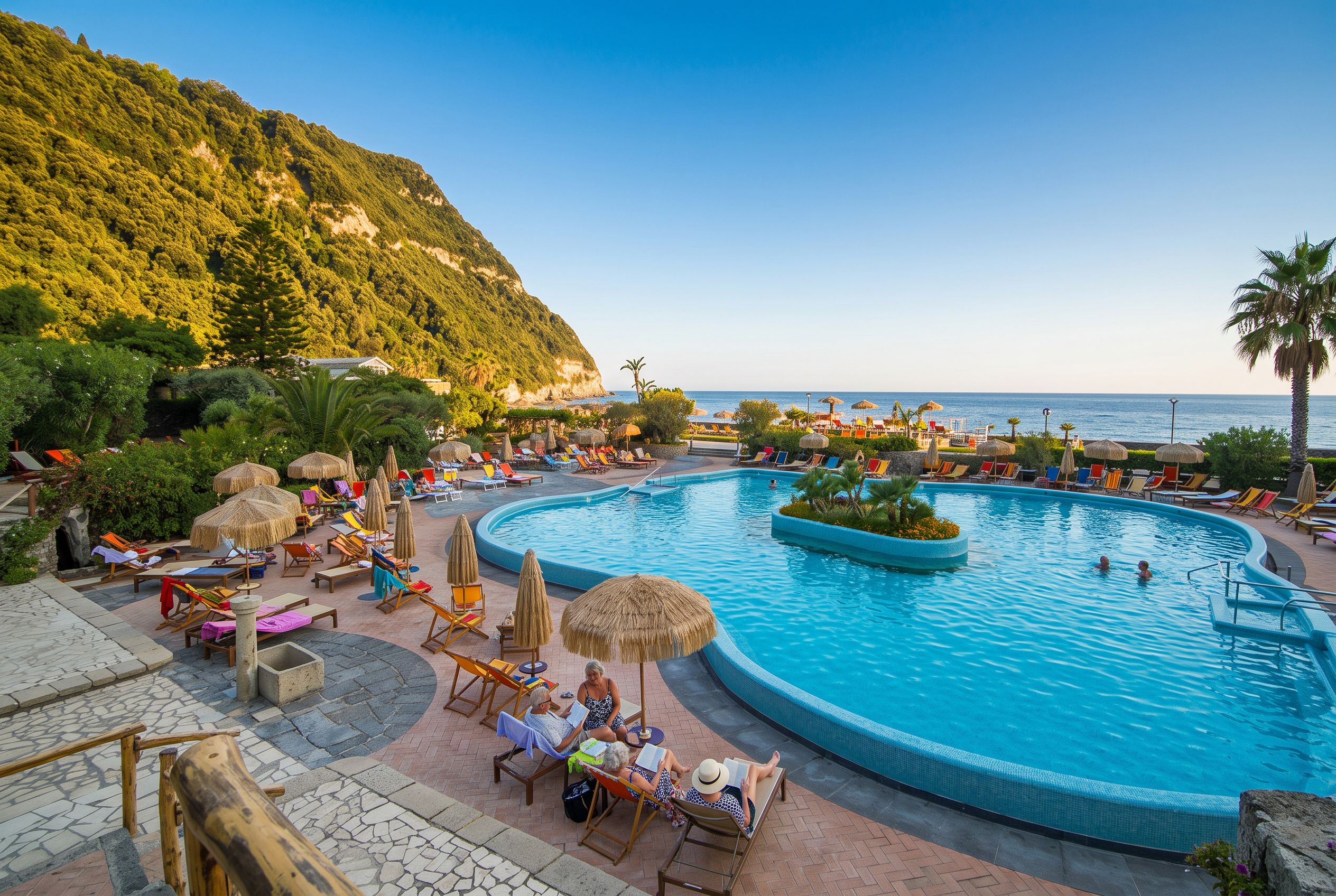
For the fullest thermal experience, however, Ischia remains the destination of choice. The island's thermal waters have drawn bathers for centuries, and Giardini Poseidon Terme, created in 1959 by German physician Gernot Walde, was designed from the outset so that patrons could devote themselves exclusively to relaxation. The park overlooks Citara Bay with direct access to a private beach, and its 20 curative thermal pools each hold a particular temperature and purpose.
How do you book a spa day, and is booking required?
At Giardini Poseidon Terme, booking ahead is not required, though tickets can be purchased online through official channels. For hotel spas on the mainland, contact the facility directly in advance, as most require reservations for day access and treatments.
The Poseidon Gardens operate seasonally, open every day from 9:00 a.m. to 7:00 p.m., from the beginning of April until the end of October, subject to change. Tickets are priced by season: in low season (April, May and October) entrance costs 41 euros, in high season (June, July and September) it rises to 43 euros per person, and in very high season (August) it reaches 48 euros. No senior or over-65 fare is documented for this park, so budget for the standard adult rate.
The reliable approach is to telephone or email each venue directly, state that you are planning a day visit, and confirm availability, pricing and any deposit requirements. Monastero Santa Rosa, as a hotel spa, typically requires advance booking for non-resident day access, and one guide describes such visits as available but subject to the hotel's schedule.
What does the ticket include, and what should you bring?
At Giardini Poseidon Terme, the ticket covers the curative thermal pools, Citara beach, Japanese bath and sauna, underwater massages, Kneipp pools, whirlpools, sun loungers, chairs and umbrellas according to availability, plus showers. You must bring your own swimwear, towel, bathrobe and slippers.
The park's own guidance is explicit about what to pack: bathing suit, towel, bathrobe and slippers. It also recommends not wearing jewellery or watches, as the mineral-rich thermal water can affect metals. A swimming cap is mandatory in the thermal pools, so pack one or purchase it at the entrance shop.
Food, drinks and wellness treatments are available separately. The park includes three restaurants, and a Health and Wellness Center offers personalised healing and relaxation paths for those who want structured treatments. The thermal water in the pools maintains high temperatures ranging from 28 to 40 degrees Celsius, and the park describes the water as endowed with healing properties, though specific medical claims for individual conditions are not documented.
For mainland spas, inclusions vary by venue. Otium Spa's day access includes the Jacuzzi, sensory showers and relaxation area, with massages and the Argillarium clay ritual available as additions. Aquaboutique includes its sauna, Turkish bath and whirlpool tubs in the day rate. Each venue should confirm exactly what its day pass covers when you book.
How accessible are clifftop spas and changing rooms?
Giardini Poseidon Terme is the best-documented accessible choice in the region, with a wheelchair-accessible path, pools reachable via lift, ramps throughout, and an internal electric-cart service for reduced-mobility guests. For mainland hotel spas, accessibility details are not documented.
The Poseidon Gardens explicitly cater to guests with reduced mobility. The park has a wheelchair-accessible path, several areas are reachable via ramps or lifts, and some pools are accessible via lift. Reduced-mobility guests can request tailored assistance at the entrance desk, and the park operates an internal electric-cart service to help move between areas. Wooden walkways help access the beach, and the park is described as easy to reach with no hike required.
Getting to the park is straightforward. From Ischia Porto, bus line 2 runs to Casamicciola Terme, Lacco Ameno and Forio, stopping at the bay of Citara about 100 metres from the entrance. A taxi from the port takes between 20 and 30 minutes to reach the Gardens. Near the entrance there is a paid parking lot, with all-day parking quoted at 5 euros for cars and 3 euros for scooters in one source.
This silence is not evidence of difficulty; it simply means the details are not published. Ask each venue directly about step counts, lift access and changing-room layouts when you book.
What is the etiquette at Italian thermal parks and spas?
Italian thermal culture values quiet, slow bathing and respect for shared spaces. At Poseidon, a swimming cap is mandatory in thermal pools, and the park advises removing jewellery. Silence in saunas and relaxation areas is expected, and mobile phone use is discouraged.
Thermal bathing in Italy follows a rhythm that rewards patience. The Kneipp pools, for example, involve alternating baths at temperatures of 40 and 15 degrees Celsius, a contrast therapy said to stimulate circulation. The Japanese bath involves walking on pebble paths, again with the aim of reactivating circulation. Neither is a race; both are slow, deliberate practices.
At Poseidon, children under 12 cannot access the thermal areas but may use the beaches and seawater pools, which makes the park a quieter adult-focused space in its thermal zone. Several mainland spas enforce adult-only policies: Relais Paradiso restricts spa access to adults over 18, with 16 to 18-year-olds admitted only when accompanied by an adult at least 25. Hotel Raito applies the same rule. These policies contribute to a calmer atmosphere suited to rest-focused travellers.
Reviews of the region's spas consistently describe staff as kind, attentive and helpful, and the atmosphere as relaxing, peaceful and serene. The most positive first-hand accounts come from travellers who used their spa day for recovery after travel, suggesting that an unhurried pace works best.
How should you pace a full spa day?
Plan for three to four hours of active bathing, broken by rest periods. Start with the warmest pools, progress through contrast therapies like the Kneipp pools, and finish with the sauna or a rest in the relaxation area. Hydrate between pools and stop before you feel tired.
A common mistake is trying to experience every pool and treatment in a single visit. The Poseidon Gardens alone hold 20 thermal pools, each with its own temperature and purpose, plus a sauna, Japanese bath and beach access. Attempting all of them in one day is exhausting, not restorative.
A sensible sequence, supported by the park's own descriptions of its therapies, begins with gentle immersion in a warm pool (around 36 to 38 degrees), followed by a contrast therapy such as the Kneipp pools, then a rest on a sun lounger with water. The sauna and Japanese bath are best attempted later, when your body has acclimatised to the heat. The park's three restaurants allow you to take a proper lunch break without losing your place.
Summer weekends can be crowded at Ischia's thermal parks, and the parks are seasonally open from mid-April to the end of October. For the calmest experience, visit on a weekday, arrive at opening time, and avoid August if you can. September and October are increasingly popular months on the coast, but they bring milder temperatures and thinner crowds than July and August.
How do you reach Ischia's thermal gardens from the Amalfi Coast?
From the Amalfi Coast, reaching Ischia requires a ferry or hydrofoil from Naples. Hydrofoils take about an hour to reach Ischia, while ferries take at least an hour and a half. Once on the island, bus line 2 or a taxi covers the final leg to Forio.
The journey is scenic but requires planning. From Amalfi town, you first travel to Naples or Sorrento by road or ferry, then cross to Ischia. The road distance from Amalfi to Sorrento is 47 kilometres, about 60 minutes with clear roads and no traffic. From Sorrento, ferries and hydrofoils connect to Ischia's ports.
Once at Ischia Porto, the Poseidon Gardens are 10 kilometres from Forio by road, about 15 minutes with clear roads. Bus line 2 from Ischia Porto runs through Casamicciola Terme, Lacco Ameno and Forio to the bay of Citara, stopping about 100 metres from the park entrance. A taxi takes between 20 and 30 minutes from the port.
For travellers who prefer to avoid the crossing, the mainland spas in Minori, Vietri sul Mare and Conca dei Marini offer closer alternatives. The road from Amalfi to Ravello, for context, is 6.9 kilometres, about 10 minutes with clear roads, giving a sense of the coast's compact scale. For full transport planning, see our guide to getting to the Amalfi Coast by air, train and ferry.
When is the best season for a spa day?
The most pleasant period for spa breaks on the Amalfi Coast runs from May to June and September to early October, when temperatures are warm but not oppressive and crowds are thinner. Giardini Poseidon Terme operates from early April to the end of October.
July and August bring average daytime highs around 30 to 31 degrees Celsius and sea temperatures peaking around 25 to 26 degrees, which can make outdoor thermal bathing uncomfortable. November is the wettest month, while June through August are the driest. The coast is less busy from November to March, but most thermal parks and many hotel spas close during this period.
Monastero Santa Rosa, for example, closes from November to mid-April, according to one hotel review source. Poseidon's season runs from the beginning of April to the end of October, with October closing earlier than peak-season hours. If you are planning a spring or autumn visit, confirm the exact opening dates with each venue, as they can shift year to year.
Tourism reporting on the coast noted that July and August were down 8 to 10 percent year on year in 2025, and that September and October have become the new peak months. This shift means the traditional shoulder seasons now carry their own crowds, but the atmosphere remains calmer than high summer.
What do spa days cost, and are there senior fares?
Giardini Poseidon Terme charges 41 euros in low season, 43 euros in high season and 48 euros in August. No senior or over-65 fare is documented for this park. Mainland spa day rates are not published, so confirm prices directly with each venue.
The Poseidon pricing structure is transparent and seasonal. Low season covers April, May and October at 41 euros per person. High season, spanning June, July and September, costs 43 euros. August, the very high season, reaches 48 euros. These rates include all the thermal pools, beach access, sauna, sun loungers and showers described earlier.
Rates are indicative and vary by season and booking channel, so telephone each venue for a current quote. No senior or over-65 fares are documented for any of these mainland spas either.
One cost-saving option exists on Ischia for those who want thermal water without a park pass. The Nitrodi spring in Buonopane offers free access for drinking the water or using outdoor shower stations, and the Baia di Sorgeto in Forio has hot thermal water flowing into the sea, forming natural pools at about 37 degrees Celsius year-round. These are rustic, undeveloped sites, not spa experiences, but they offer the island's famous waters without admission.
What should you know about safety and medical help?
Emergency numbers for the Amalfi Coast area are 112 for police and general emergencies and 118 for ambulance and medical emergency. During summer, rescue response may come by sea or helicopter, which can be faster than road ambulance for genuine emergencies.
The nearest hospital to Amalfi town is the Presidio Ospedaliero Costa d'Amalfi in Ravello at Via Civita 70, according to one source, with serious cases transferred onward. An older guide places the closest hospital in Salerno. Sources differ on this point, so confirm the current arrangement with your hotel or the municipal tourism office if you need medical care.
Amalfi's pharmacy is at Piazza dei Dogi, and another source notes there are two pharmacies in the city centre without naming exact locations. Tap water is safe to drink throughout the Amalfi Coast, so you can refill a water bottle rather than buying plastic.
For older adults and people with disabilities needing hospital, clinic or rehabilitation travel, the Comune di Amalfi offers an accompaniment by facilitated transport service, run by Pubblica Assistenza Millenium Amalfi O.N.L.U.S. This service is documented on the municipal website and is worth knowing about if you need assisted travel while staying in Amalfi town.
The coast is described as very safe in one guide, with the usual Italian risks of scams and pickpocketing present but not overly common. In thermal parks, the main risks are dehydration and overheating, so drink water regularly and step out of the pools if you feel light-headed.
Which venues offer the calmest experience?
For documented calm, arrive at Giardini Poseidon Terme by 09:30 and avoid summer weekends. On the mainland, the adult-only policies at Relais Paradiso and Hotel Raito, both in Vietri sul Mare, create quieter environments suited to rest-focused travellers.
At Poseidon, arriving at 09:30 in peak summer is comfortable, and after 11:00 the free sun beds are gone, implying that earlier visits are calmer. Summer weekends can be crowded at Ischia's thermal parks generally, so weekday visits are preferable.
On the mainland, the adult-only access policies at Relais Paradiso and Hotel Raito in Vietri sul Mare mean you will not share the spa with young children. Both restrict access to adults over 18, with 16 to 18-year-olds admitted only when accompanied by an adult at least 25. This creates a more adult atmosphere aligned with rest and wellness goals.
For travellers weighing where to base themselves, Sorrento is often recommended for older visitors because it is less hilly than Positano or Ravello, making it a more comfortable base for walking. Forum discussions consistently note that the Amalfi Coast's exertion levels vary dramatically by town, so choose your base according to your stamina. Our guide to the Amalfi Coast's highlights for the over-50s covers this in more depth, and our hotel guide for comfort-first travellers addresses accommodation choices.
Guest reviews across the region's spas and hotels repeatedly praise the service as kind, attentive and helpful, and the spa atmospheres as relaxing and serene. The most common complaint in hotel reviews concerns noise from roads, nearby rooms or church bells, with several guests noting thin walls. For a spa day, this matters less, but if you are combining your spa visit with an overnight stay, ask for a quiet room away from roads and lifts when booking.
For those who want to extend their wellness stay with gentle cultural outings, the gardens and villas of Ravello offer a complementary, low-exertion day. Ravello is reached by bus or taxi and is not too hilly, according to forum reports, making it a manageable addition to a rest-focused itinerary.


