
Located in the heart of the Salzkammergut, Hallstatt is one of Austria's most photographed destinations. But for travellers aged 50 to 70, the question isn't whether to visit—it's where to sleep. The village itself offers postcard views and immediate access to the UNESCO core, while the quieter shores of Obertraun, Bad Goisern, Bad Ischl, and the Wolfgangsee provide peace, value, and easier logistics. This guide compares each base on atmosphere, transport links, walkability, steps and hills, evening calm, and who each suits best.
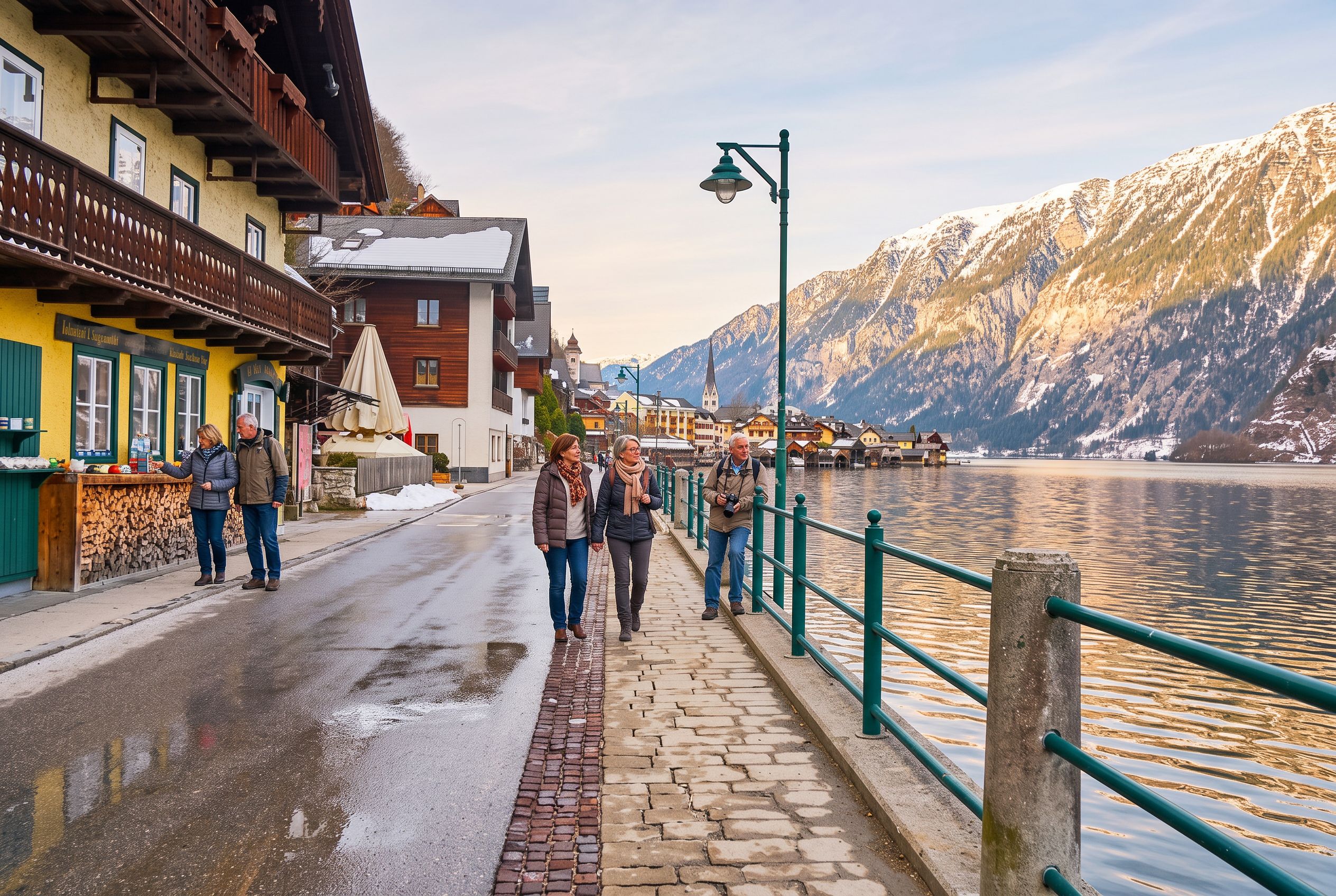 AI-edited
Should I stay in Hallstatt village or choose a quieter base?
The short answer: choose Hallstatt village only if you prioritise being steps from the iconic lakefront and can tolerate significant crowds, narrow sidewalks, and limited parking. For nearly everyone aged 50–70 seeking comfort, quiet, and value, Obertraun or Bad Goisern is the smarter choice.
Hallstatt is a market town of 760 residents with a main residence here, the figure the municipality published for April 2025, and it sits on a narrow strip of land between the lake and the rock face — which is why the lanes are tight and passing places are few. Every coach has to pre-book a slot through the town's parking operator, and the centre itself is closed to cars. If you stay in the village, the early morning is the calm part of the day, and the evening is quiet rather than lively: dinner service in the village largely ends between 20:00 and 21:00.
By contrast, Obertraun offers a genuinely restful alternative. The cable car operator puts the OÖVV bus from Hallstatt to the Obertraun valley station at ten minutes; from May to September a boat also runs, taking 25 minutes from Hallstatt Markt. Parking is easier and the village is far less busy. Obertraun also has its own railway station in the village and the Dachstein cable car valley station with a bus stop directly outside it, which makes it the easier base to manage without a car.
How does the atmosphere differ between Hallstatt village and the quieter shores?
Hallstatt village delivers an immersive, postcard-perfect atmosphere but at the cost of constant tourist traffic and limited evening calm. Obertraun offers a peaceful alpine setting with low light pollution and genuine quiet after dark. Bad Ischl and the Wolfgangsee provide a refined, spa-town ambience with more cultural amenities.
Hallstatt's old town is a UNESCO World Heritage site since 1997, and its charm is undeniable. The main street, with its pastel-coloured houses and lake views, is genuinely beautiful. However, the atmosphere shifts dramatically between morning and midday. Guests consistently report that the village becomes overwhelming from late morning onward, with bus tour groups filling every corner. Evening brings a different challenge: the village largely shuts down early, leaving little to do after dinner.
Obertraun, four and a half kilometres away at the quiet end of the lake, feels like a different world. The atmosphere is relaxed, with turquoise waters, bike rentals, and a slower pace. It has its own station on the Salzkammergut railway and the valley station of the Dachstein cable car, so arriving and getting about without a car is straightforward. The Dachstein cable car from Obertraun provides access to the 5fingers viewing platform, the Giant Ice Cave and the Mammut Cave; the operator runs the lifts and caves daily from 1 May to 1 November 2026.
Bad Ischl, about 22 kilometres away by road, offers a spa-town atmosphere built around the Kaiservilla, the imperial summer residence at Jainzen 38, and the Salzkammergut-Therme. It suits travellers who want cultural amenities alongside lake access. For a dedicated guide, see Taking the Waters at Bad Ischl: A Spa Day Near Hallstatt.
How are the transport links from each base?
Obertraun has the best transport links for seniors: its train station is directly in town, eliminating the need for a ferry. Hallstatt's train station is across the lake, so arriving by rail means a ferry crossing of about 15 minutes, timed to the trains and payable in cash only (€4 one way, €8 for the open return). Bad Ischl is a regional transport hub with frequent trains to Salzburg.
Getting to and from your base is critical for travellers aged 50–70. For a full breakdown, see Getting to Hallstatt: Airports, Trains and Transfers – A Practical Guide for Travellers Over 50.
| Base | To Hallstatt Village | Train Station | Parking |
|---|---|---|---|
| Hallstatt Village | You are there | Across lake (approx. 15-min ferry, €4 single/€8 return, cash) | Car-free centre; park at P1–P4, 15–40 min walk |
| Obertraun | 10-min OÖVV bus; boat May–Sept (25 min) | Directly in town | Easier; free at many hotels |
| Bad Goisern | 10-min train or bus | In town centre | Good availability |
| Bad Ischl | 20-min train or bus | Regional hub | Garages available |
| Wolfgangsee (St. Gilgen) | About 45-min drive; bus with change | No station; bus 150 via Bad Ischl | Moderate |
A critical detail: the ferry from Hallstatt train station to the village is timed to the trains, and the operator takes cash only — no card payment at all. The crossing takes about 15 minutes and costs €4 one way or €8 for the open return ticket. It is Austria's only year-round scheduled boat line, and the vessel used on it, the MS Stefanie, is listed by the operator as wheelchair accessible. Obertraun's train station is directly in town, meaning you do not need the ferry to reach your hotel if arriving by rail.
How walkable is each base, and what about steps and hills?
Hallstatt village sits on a narrow strip between the lake and the rock face, so its lanes are tight and often steep. Obertraun is largely flat with easy walking. Bad Goisern and Bad Ischl have flat town centres with good pedestrian infrastructure. The Wolfgangsee lakeside promenade is flat and well-maintained.
For travellers aged 50–70, physical ease matters. Hallstatt's old town is built on a steep slope between the lake and the mountain. The main promenade is flat, but the cliff path behind the village is steep and marked. The Salzbergbahn funicular up to the Salt Mine and the Skywalk is being rebuilt and is not running. Salzwelten lists both the funicular and the mine as closed for renovation work until 28 August 2026, with reopening on Saturday 29 August 2026, so anything planned before that date has to leave them out. From then the two new cabins take up to 60 passengers each, double the previous capacity, and the operator states that boarding the funicular and the bistro at the top are step-free — the mine tour itself is not.
Obertraun itself is largely flat. The mountain above it is not. The operator puts the walk from the Krippenstein mountain station to the 5fingers platform at about 20 minutes, and the Giant Ice Cave is reached from the Schönbergalm middle station by a walk of 15 to 20 minutes with 70 metres of ascent, followed by a guided route of 800 metres with 80 metres of height difference in steps. Both are optional, and neither is needed to enjoy the lake shore.
"The room (mountain view) was very clean and comfortable. The location wise, Obertraun is far better and more convenient than the Hallstatt whether you are coming from Vienna or Salzburg by train." — a guest wrote on Google about Haus Salzkammergut in Obertraun in July 2024
Which base offers the best evening calm?
Obertraun and Bad Goisern are significantly quieter at night than Hallstatt village. Obertraun has low light pollution and genuine darkness after sunset, while Hallstatt village experiences moderate noise from tourist foot traffic and buses until late evening.
The village empties rather than gets loud. The Heritage Hotel's own restaurant serves its evening menu from 17:30 to 21:00 between April and October, with hot food until 20:30, and several other kitchens in the village stop serving earlier than that. Public transport winds down at the same time: the tourist board notes that no bus runs from Bad Ischl towards Hallstatt, Obertraun, Gosau and Bad Goisern in the evening, the last departure from Bad Ischl station being at 18:16. An evening out therefore needs planning around the timetable.
Obertraun sits at the quiet end of the lake, away from the coach traffic that funnels into Hallstatt, and its guest houses are set back from the through road. One planning point matters here: there is no evening boat back. The last Rundfahrt Süd sailing from Hallstatt Markt is at 16:00 in July and August; in the other months the 15:00 departure is the last one, and the boat does not run at all outside May to September. After that the OÖVV bus is the only public link — about ten minutes, but on a timetable that thins out early.
Who should choose each base?
Choose Hallstatt village if you prioritise immediate access to the UNESCO core, can book 3–6 months ahead, and are comfortable with crowds and limited parking. Choose Obertraun if you value quiet, value, and easy transit. Choose Bad Ischl if you want spa amenities and cultural attractions. Choose the Wolfgangsee if you prefer a refined lakeside resort experience.
Hallstatt village suits first-time visitors who want the iconic "calendar view" immediately outside their door. It also suits those planning to see the Salt Mine and Skywalk, which reopen together with the rebuilt funicular on 29 August 2026. However, be prepared for crowds; visit the village before 9 AM or after 4 PM to avoid peak congestion.
Obertraun suits travellers aged 50–70 who prioritise comfort, quiet, and value. It offers easier parking, direct train access, and a relaxed atmosphere while still providing easy access to Hallstatt on the ten-minute bus. Haus Salzkammergut in Obertraun is a five-room bed and breakfast whose listing with Upper Austria Tourism gives the railway station as directly adjacent and the lake and boat landing about 400 metres away. That listing records no wheelchair-specific features, so anyone who needs step-free access should settle the details with the house before booking.
Bad Goisern suits travellers who want a balance of accessibility and local character, with good transport links and full-service pharmacies. Bad Ischl suits those who want spa days and cultural sightseeing alongside lake access. The Wolfgangsee (St. Gilgen or Strobl) suits travellers who prefer a classic lakeside resort with good walking paths and ferry connections.
For a comprehensive overview of the entire region, see Hallstatt and the Salzkammergut for Travellers Over 50: A Realistic Guide.
How do costs compare between bases?
Obertraun and Bad Goisern are the cheaper bases; Hallstatt village charges a premium for the address and has very little capacity, so summer dates need booking months ahead. Obertraun has more availability, and its guest houses usually include parking, which in Hallstatt is a separate daily cost of up to €20.
Room rates are the least reliable part of any comparison, because they move with the season and the booking channel. The costs that are fixed and worth budgeting for are the ones around the room. Parking in Hallstatt runs from 15 minutes free to €5 an hour and €20 for a full day, and cannot be booked in advance; the ferry fares are set out above. Obertraun charges a local visitor tax of €3 per person per night. As a benchmark for the quieter shore, Upper Austria Tourism's listing for Haus Salzkammergut in Obertraun quotes double rooms from €85 per person per night including breakfast.
November is the cheapest month, and it is empty for a reason. The Dachstein cable cars and caves run daily from 1 May to 1 November 2026, the boat between Hallstatt and Obertraun only from May to September, and Salzwelten Hallstatt closes again after 24 October before its winter season starts on 25 October. Late September and October keep most of that open at lower rates and are the better compromise.
What practical considerations should I know?
Neither Hallstatt nor Obertraun has a pharmacy; the two nearest are in Bad Goisern, about 12 kilometres away. Both villages are served by the same GP practice, which holds surgery hours in Hallstatt and, on two mornings and afternoons a week, in Obertraun. Bad Ischl is the regional medical hub, with the Salzkammergut Klinikum hospital.
For travellers aged 50–70, access to healthcare matters, and the picture here is easily misread. The address often quoted for Obertraun, Obertraun 180, is the municipal office; the ground floor houses the surgery of the local GP, open Monday 16:00–18:00 and Thursday 08:00–12:00. The same practice sits at Salzbergstrasse 224 in Hallstatt, open Monday, Tuesday and Friday 08:00–12:00 and Wednesday 17:00–19:00. Neither village has a pharmacy. Bad Goisern has two: Edelweiss Apotheke at Obere Marktstraße 4, open Monday to Friday 08:00–12:00 and 14:00–18:00 and Saturday morning, and Apotheke im Baumhaus at Bundesstraße 112, open Monday to Friday 08:00–18:00. Outside surgery hours, 141 reaches the Austrian GP on-call service and 144 the ambulance. Bad Ischl, about 25 kilometres from Obertraun by road, is the regional medical hub, with the Salzkammergut Klinikum at Doktor-Mayer-Straße 8/10.
Parking is another key consideration. The centre of Hallstatt is sealed off by two barriers and cannot be reached by car at all, so visitors park at P1, P2, P3 or P4. The tourist board's own walking times are 20 minutes from P1 to the centre, 15 minutes from P2 and 40 minutes from P3 and P4; the shuttle bus runs only from P1, and only for guests who have booked accommodation in the centre. Tariffs run from 15 minutes free to €5 for one hour and €20 for a full day, and spaces cannot be reserved in advance. Coaches have to book a slot through the town's parking operator before they arrive. Obertraun has free parking at many guest houses, while the Dachstein cable car valley station has a paid car park.
The rebuilt funicular to the Salt Mine and Skywalk reopens on 29 August 2026; until 28 August 2026 the operator lists both as closed for renovation work. Salzwelten states that the funicular ride and the bistro in the high valley are step-free, while the mine tour itself is not. For a dedicated guide, see Hallstatt's Salt Mine and Ancient History: A Guide for Travellers Over 50.
The operators publish the details that matter most for planning. Salzwelten Hallstatt lists the funicular and the mine as closed for renovation work until 28 August 2026, with reopening on 29 August. Hallstättersee Schifffahrt publishes the ferry timetable and fares and states plainly that no card payment is possible.


