
Cape Town is a city of distinct quarters, and where you sleep shapes your days more than any other single decision. The V&A Waterfront puts restaurants, shops and harbour attractions within a short, concentrated walk. The City Bowl places museums, heritage sites and the central transport network on your doorstep. Camps Bay trades convenience for sea views and a beachfront strip. Constantia and the Winelands towns offer gardens, wine estates and space, at the cost of a car journey into the city. Each suits a different kind of traveller, and the differences matter most for visitors in their fifties and sixties who want to plan around comfort rather than compromise.
The city rewards a base chosen for the way you actually want to spend your time. A first visit built around Table Mountain, Robben Island and the Castle benefits from central access. A slower stay built around long lunches and garden walks suits the southern suburbs. The sections below compare the main bases on atmosphere, walkability, safety, views, transport and the traveller each one fits, with the practical detail that planning for this age group requires. Individual hotel reviews sit in a separate guide.
Which Cape Town base suits which traveller?
The V&A Waterfront is the easiest first visit, the City Bowl the most central, Camps Bay the most scenic, and Constantia and the Winelands the quietest. Cape Town Tourism describes the Waterfront as walkable, with restaurants, hotels and visible security, while Fodor's contributors call Camps Bay scenic but too far to walk to the city.
The table below sets out the trade-offs at a glance. It draws on Cape Town Tourism's neighbourhood guidance, Fodor's forum discussions and the City of Cape Town's transport information.
| Base | Best for | Walkability | Transport |
|---|---|---|---|
| V&A Waterfront | Easiest first visit; restaurants, shops, harbour attractions | Described as relatively level and concentrated | MyCiTi serves the Waterfront; airport route via the city centre |
| City Bowl | Culture, heritage, central connections | Compact, but street character changes block by block | Best-connected area; Civic Centre station |
| Camps Bay | Beach atmosphere and sea views | Beachfront strip walkable; hills require transport | MyCiTi links to central Cape Town; car or taxi useful |
| Constantia and Winelands towns | Gardens, wine estates, space, repeat visits | Not documented for the area as a whole | Arranged transport or a hire car |
Sea Point and Green Point sit between the Waterfront and Camps Bay on the Atlantic Seaboard. Cape Town Tourism's neighbourhood guidance treats Sea Point and Green Point as a best compromise, with promenade access, restaurants and proximity to the Waterfront. Green Point in particular gives you a more residential feel while keeping the Waterfront within easy reach.
Is the V&A Waterfront the easiest base for older travellers?
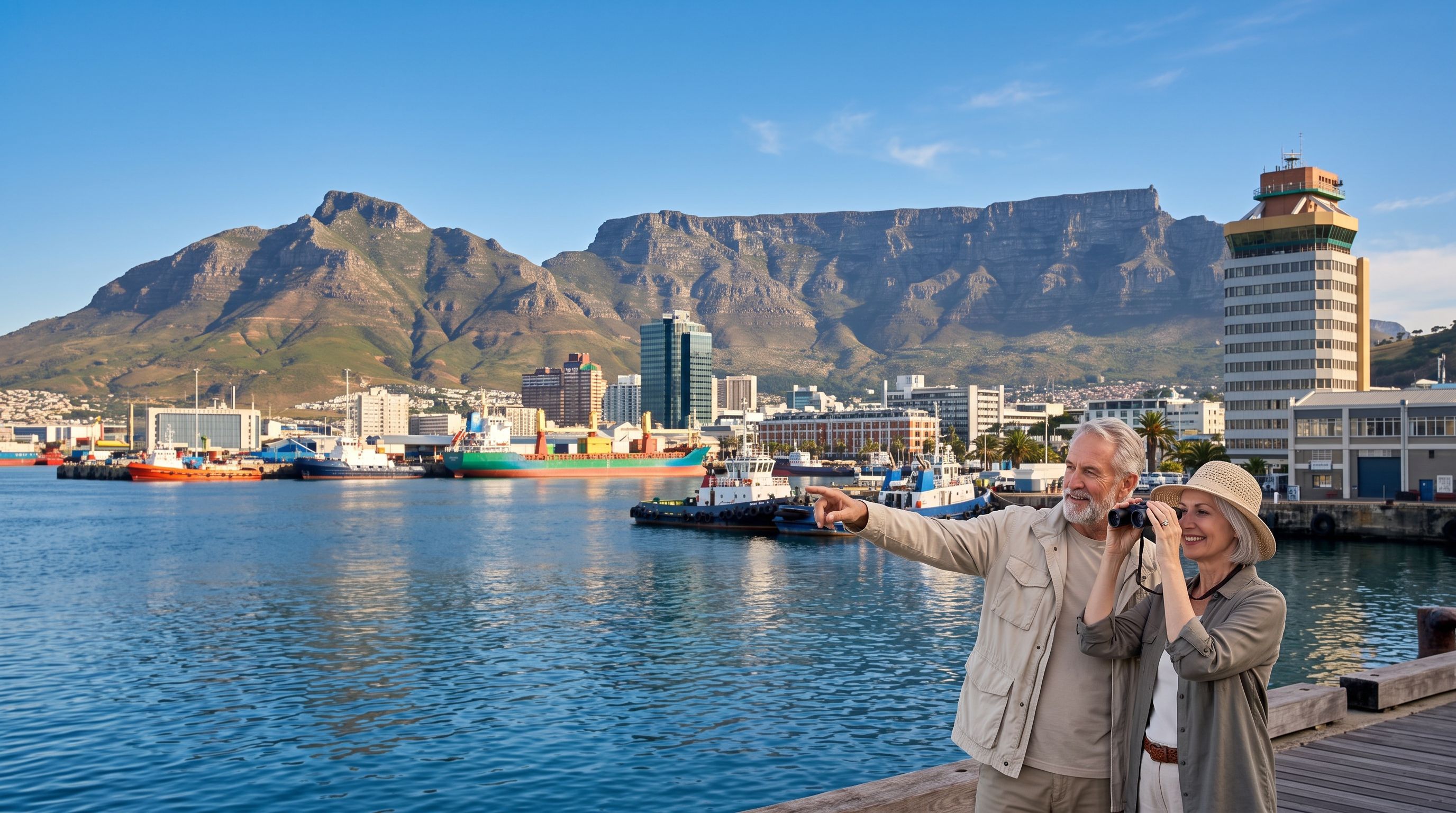
For many visitors aged 50-70, yes. The Waterfront concentrates hotels, restaurants, shops and harbour attractions in one secure, relatively level area, and MyCiTi serves it directly. Cape Town Tourism describes it as the easiest first visit, with walkable attractions and visible security.
The Waterfront works because everything sits close together. An accommodation guide describes it as a secure, relatively level area where hotels, restaurants, shops and evening walking are concentrated. That concentration matters if you prefer not to drive at night, or if you want a base with plenty of indoor options during the wet winter months.
Fodor's contributors report that restaurants and attractions in Green Point and the Waterfront can be reached safely on foot at night. They advise against walking around the City Bowl after dark, which makes the Waterfront the more comfortable evening base of the two. The area is heavily visited and well populated, so normal urban precautions still apply.
On transport, the city's MyCiTi bus rapid-transit system serves the Waterfront and connects with Cape Town International Airport through the city network. The airport is 22 km by road from the Waterfront, about 15 minutes with clear roads. The City of Cape Town describes MyCiTi as currently the city's only universally accessible public-transport service, designed for wheelchair users, visually impaired passengers and older passengers, with level boarding that makes boarding with luggage easier.
The trade-off is character. A Fodor's trip report describes the Waterfront as a strong shopping and dining setting, though the writer found the shops less distinctive than the waterside location. If you want streets with a sense of history, the City Bowl delivers more.
 AI-edited
What does the City Bowl offer that the Waterfront does not?
The City Bowl puts you closest to Cape Town's cultural and heritage attractions and gives the best access to the MyCiTi network and the central Civic Centre station. It is the most versatile base for a first itinerary, but street character changes significantly from block to block.
This is the district for travellers who want the Castle, District Six and the museums within reach, and who value a central position over a waterside one. Cape Town's history, from the Castle to District Six and Robben Island, sits largely in and around this area, which makes the City Bowl a natural base for a history-led visit.
Walkability is good in the sense that the district is compact, but the experience varies street by street. Hotel location and the ease of returning by reputable taxi or ride service matter more than choosing the district name alone. Fodor's contributors advise against walking around the City Bowl at night, so plan evening returns by taxi or e-hailing service.
The City of Cape Town has set out plans for a new bridge and neighbourhood on the Foreshore. The City's announcement of the Foreshore plans is worth checking before booking a property close to major road corridors, since construction can affect noise and access.
Cape Town Tourism reports that visible safety officers have been deployed in central Cape Town, and that the Cape Town Central City Improvement District provides security support in the city area. This is a central-city measure and should not be assumed to apply equally to Camps Bay, Sea Point or the Waterfront.
Is Camps Bay a practical base, or just a pretty one?
Camps Bay is practical if you want beach atmosphere and sea views and are content to drive or take a taxi to the city's cultural attractions. Fodor's contributors describe it as scenic and laid-back, but too far to walk to the Waterfront or City Bowl.
The setting is the draw. Fodor's contributors repeatedly describe Camps Bay as scenic and laid-back, with the beach in front and the Twelve Apostles behind. One poster found it "quite a bit more laid back" than busier resort areas, and another described it as especially quiet in the off-season and convenient for excursions.
Distances are the practical consideration. The Waterfront is 9.5 km from Camps Bay by road, about 10 minutes with clear roads. Fodor's forum estimates put the drive at roughly 15 to 20 minutes, and a Reddit trip report from 27 December 2019 describes the drive to downtown or the Waterfront as about 30 minutes, illustrating how traffic and the precise destination affect the journey. A Fodor's neighbourhood discussion calls Camps Bay safe but "too far to walk" to the Waterfront or City Bowl.
Where you stay within Camps Bay matters. Several forum posts recommend staying near the beachfront strip rather than in the hills. Fodor's specifically names Camps Bay Terrace as a preferred location, while another contributor notes that hill locations may make taxis or a car more useful. A Fodor's post describes a visitor who used the City Sightseeing red route after a hotel concierge's suggestion and found it connected Camps Bay with central attractions, including Table Mountain.
The coastal position brings wind, especially in summer. Forum reports warn of heat, crowds and heavier traffic in Camps Bay in summer, while Fodor's posters describe July as too cold for beach use and recommend Green Point or the Waterfront then.
How does the Atlantic Seaboard fit in?
Sea Point and Green Point form the practical middle ground between the Waterfront and Camps Bay. Cape Town Tourism treats them as a best compromise, with promenade access, restaurants and proximity to the Waterfront, and Green Point in particular supports evening walks.
Green Point is 3.8 km from the Waterfront by road, about 5 minutes with clear roads. That proximity makes it a useful base for travellers who want the Waterfront's restaurants and attractions without sleeping in the middle of them. Fodor's contributors report that restaurants and attractions in Green Point and the Waterfront can be reached safely on foot at night.
Sea Point is served by MyCiTi routes linking central Cape Town and surrounding tourism areas. The City of Cape Town advises using lit routes and accredited transport at night in Sea Point.
A Fodor's trip report gives a sense of scale: a bus journey from the Bantry Bay area took about 15 minutes, while walking to the Waterfront took about one hour. That contrast is worth keeping in mind when you choose between the promenade and the Waterfront for an evening out.
When do Constantia and the Winelands towns make sense?
Constantia and the Winelands towns suit repeat visitors and travellers who prefer space, gardens and a less tourist-intensive setting. They are less convenient for daily Waterfront or City Bowl sightseeing and usually work better with arranged transport or a hire car.
The southern suburbs can suit repeat visitors and travellers who prefer space and a less tourist-intensive setting. They are less convenient for daily Waterfront or City Bowl sightseeing and usually work better with arranged transport or a hire car. The same logic applies to the Winelands towns beyond the city, which reward a slower stay built around estates and gardens rather than daily city excursions.
For travellers planning a gentler day between city excursions, a spa day in Cape Town can be arranged from any of these bases, though the southern suburbs and Winelands put more of that kind of experience within easy reach.
No official neighbourhood-level visitor statistics, senior fares, closing-day schedule or accreditation list was found for the southern suburbs as a collective area. The available official statistics do not publish separate tourism counts for these areas either. Treat any specific claim about the area's visitor numbers with caution.
How do you get around Cape Town without a car?
MyCiTi is the backbone. The City of Cape Town describes it as currently the city's only universally accessible public-transport service, with level boarding. It serves the Waterfront, the City Bowl, Sea Point and Camps Bay, and connects with the airport through the city centre.
The airport service runs between the MyCiTi airport bus station immediately outside the main airport terminal and the city centre. Passengers can transfer in the city to another MyCiTi route for destinations such as the Waterfront, Sea Point or Camps Bay. The operator identifies the A01 Airport to Civic Centre route. Its published information says buses depart every 20 minutes on that service, while another operator notice describes airport departures from Civic Centre every 30 minutes. Check the live timetable before travelling, because airport frequency and service status can change.
Every passenger needs an individual myconnect card, with tap-on and tap-off validation. The operator says airport passengers can buy a single-trip card at the airport or Civic Centre and do not necessarily need a reloadable myconnect card. The operator publishes a free 24/7 number, 0800 65 64 63.
The municipality also operates Dial-a-Ride, a dedicated kerb-to-kerb service for people with disabilities who cannot use mainstream public transport. Applications and information are available through the Transport Information Centre on 0800 65 64 63. The City of Cape Town's universal access and public transport page sets out the system's design for wheelchair users, visually impaired passengers and older passengers.
Cape Town Tourism lists Uber, metered taxis and other accredited taxi services as alternatives, while the City advises visitors to use accredited public transport, taxis, cabs or e-hailing services. For the journey from the airport, getting to Cape Town, the long-haul flight and airport transfers covers the options in more detail.
What should travellers with mobility needs check before booking?
Confirm the specifics with each property, because the published record is uneven. The City of Cape Town states that MyCiTi is currently the city's only universally accessible public-transport service. For hotels, lift access, step-free routes and walk-in showers are documented for some properties and not for others.
At the V&A Waterfront, several properties publish accessibility detail. The Cape Town EDITION documents elevators, mobility-accessible rooms, roll-in showers, adjustable-height handheld shower wands, non-slip bathroom grab rails, accessible vanities and wheelchair-height toilets. Cape Grace documents disabled access, a lift, upper floors accessible by lift, a shower chair, toilet grab rails and a walk-in shower, though the listing does not specify whether every room has one. The AC Hotel Cape Town Waterfront and the ONOMO Hotel Cape Town Waterfront both appear in Tripadvisor's accessible-hotel and walk-in-shower listings, but the available extracts do not establish the exact room configuration, lift dimensions or a complete step-free route.
In Camps Bay, South Beach Camps Bay Boutique Hotel appears in Tripadvisor's accessible-hotel and walk-in-shower listings, but the exact room type and shower design are not stated. POD Camps Bay Boutique Hotel appears in the walk-in-shower listing, though the exact room category and accessibility specification are not stated. For both, the available results do not establish a level-access route, and exact steps, gradients and distances to transport are not documented.
Some Camps Bay properties carry explicit warnings. A Tripadvisor review describes 3 On Camps Bay Boutique Hotel as not suitable for limited mobility, citing extensive climbing and many stairs. At Camps Bay Retreat, rooms are reached by a suspension bridge; one Tripadvisor review complained that it was unlit at night and exposed in strong winds, while another considered it safe and easy to cross. Camps Bay Village reviews mention narrow stairs, and the Clifton Room is reached only by a narrow steel spiral staircase, described as challenging for people with mobility limitations.
For a specific hotel, confirm lift access, entrance thresholds, bathroom configuration and the route between the property and the nearest MyCiTi stop.
How safe are these neighbourhoods, and what should you plan for?
Cape Town Tourism characterises Cape Town as a major modern city and advises the same vigilance visitors would use in any large international city. Fodor's contributors consistently distinguish busy, well-lit tourist zones from deserted streets, describing the Waterfront, Camps Bay's seafront restaurant strip and central tourist areas as generally comfortable.
The City of Cape Town advises visitors not to walk in deserted or dark areas, to stay in groups and on lit paths or roads, and to use accredited transport. Practical advice repeated in the forums includes carrying only what is needed, keeping valuables concealed, using a hotel safe for passports and avoiding quiet streets at night.
A Fodor's contributor living in Camps Bay said walking along the beachfront strip of shops and restaurants at night was generally comfortable, but avoided unlit areas and places without other people. More recent Reddit discussion about Camps Bay stresses that the neighbourhood is safer than many Cape Town areas but not completely safe; the thread includes an account of a daylight robbery near the Engen garage.
No official "safest Cape Town neighbourhood" ranking was found for the Waterfront, so normal urban precautions remain appropriate, particularly outside busy pedestrian areas and after dark. Cape Town Tourism's safety guidance sets out the city's advice for visitors. Cape Town Tourism's visitor-support Band-Aid service can assist distressed visitors on 021 487 6552, according to the City's visitor-safety guidance.
For emergencies, the Western Cape Government lists 112 from a mobile phone and 107 from a landline for fire, rescue, medical, ambulance and law-enforcement emergencies. Commonly used local contacts are Police 10111, Ambulance and fire 10177, and Cellphone emergency 112. Hotel reception or a local accommodation manager should be used first where practical, particularly for non-life-threatening incidents.
When should you go, and does the season change the base?
The season changes both the weather and the atmosphere of each base. December to February offers the strongest likelihood of warm, dry weather but also the greatest demand. May to September is quieter and often better value, with shorter days and more rain.
Cape Town's climate is Mediterranean: warm, relatively dry summers and wetter winters. February is the warmest month, with a typical daytime high of 25°C, a night low of 15°C and 31 mm of rain over 4 rainy days. June is the wettest month in this climate series, with a typical high of 17°C, a night low of 8°C and 189 mm over 13 rainy days. The monthly averages come from a Cape Town climate series using long-term data supplied by the CRU, the UK Met Office and the Netherlands Meteorological Institute.
The City of Cape Town identifies a pronounced peak season from October to April, driven by international tourism and strong domestic leisure and business demand. Winter is the off-peak period, when both international and local demand fall substantially. The City's tourism framework says approximately 32.5% of visitors currently arrive between May and September, and notes that June arrivals average 35 to 40% below December arrivals.
Fodor's posters describe July as too cold for beach use and recommend Green Point or the Waterfront then. The same discussion calls winter in Camps Bay uncrowded, with attractive sunsets, while summer was described as hot and crowded. For lower prices and fewer visitors, April to May or September to October are suggested.
No official neighbourhood-level visitor-safety ranking or tourism-seasonality series was found for Camps Bay, the Waterfront or the City Bowl. The available official statistics do not publish separate tourism counts or occupancy figures for the V&A Waterfront. Cape Town is a year-round destination, and individual restaurants, attractions and boat operators may alter hours or suspend operations for weather, maintenance or private events.
What else should you know before you book?
Rates are indicative and vary by season and booking channel. No source documents a municipality-wide Cape Town senior or over-65 fare, reduced tourism tariff or universal visitor pass applying across the Waterfront, Camps Bay and the City Bowl.
Reduced fares and age concessions in Cape Town are generally attraction-specific. Visitors aged 65 or over should ask each museum, cableway, garden, cruise operator and transport provider for its current policy. A neighbourhood-wide senior tariff was not documented.
On health, the available official results do not identify a single nearest pharmacy or hospital to Cape Town as a whole, because the city is a large metropolitan municipality rather than one small site. Distances depend on whether the base is the Waterfront, City Bowl, Sea Point or Camps Bay. A hotel or accommodation provider should confirm the nearest open pharmacy and the appropriate emergency department before arrival.
On booking, no dedicated senior booking line is documented for the properties named, and cancellation terms are not stated for most. Ask the property directly about cancellation terms, assistance services and any accessible-room specification before you commit.
For a wider look at what the city offers this age group, Cape Town's finest experiences, chosen for the over-50s covers the highlights beyond the base decision.
How should you make the final choice?
Choose the V&A Waterfront if you want level, concentrated convenience and evening walks. Choose the City Bowl if culture and connections matter most. Choose Camps Bay if sea views outweigh a car journey. Choose Constantia or the Winelands if you want space and quiet, with a car.
The decision usually comes down to two questions. How much do you want to walk, and how much do you want to drive? The Waterfront and the City Bowl answer the first well, though the City Bowl asks you to take a taxi after dark. Camps Bay and the southern suburbs answer the second, provided you are comfortable with arranged transport or a hire car.
For travellers in their fifties and sixties, the Waterfront's concentration of restaurants, shops and attractions in a relatively level area makes it the lowest-friction choice for a first visit. The City Bowl rewards those who want history and central connections and who are content to plan evening returns. Camps Bay rewards those who want the sea in front of them and are happy to travel for everything else. Constantia and the Winelands reward those who have been before and want a slower rhythm.
Whichever you choose, confirm the specifics that matter to you with the property before booking. The published record covers some details and not others, and a short email settles what a brochure cannot.


