
Cape Town rewards a slower itinerary. After the flights, the transfers and the time-zone shift, a day given over to warm water, quiet rooms and unhurried treatment makes practical sense before the sightseeing begins. The city's spas sit mostly within hotels, which shapes what a day costs and how it is booked. The detail that matters most for older travellers (changing facilities, pool access, treatment-room layouts) is rarely published, so a little preparation before you commit is worth more than any brochure.
What follows is a planning guide rather than a review. It covers how Cape Town spa days are structured, what the published rates include, how to pace the day around jet lag, and which questions to put in writing before you pay a deposit. The separate guide to Cape Town hotels where comfort comes first covers where to sleep; this one covers the day itself.
What does a spa day in Cape Town actually involve?
Most Cape Town spa days are built around a treatment rather than a standalone facility pass. At the Fairmont Spa at Cape Grace on the V&A Waterfront, guests booking a treatment of 60 minutes or longer receive access to the facilities, which include a salt room, sauna, steam room, heated outdoor pool and relaxation areas. Standalone facility access is listed at R1,200 per hour.
That model is worth understanding before you compare options. In many European cities you buy a day pass and add treatments; in Cape Town the treatment is usually the entry ticket. The Fairmont's published structure is the clearest example, and it is open daily from 08:00 to 20:00 according to the property's own spa page.
Rates are indicative and vary by season and booking channel, so treat any figure as a starting point rather than a fixed price. The property recommends booking in advance, particularly at weekends, holidays and peak periods, and asks guests to arrive 20 minutes before a treatment.
How should I book, and what should I ask first?
Book directly with the spa, in writing, and ask your access questions before paying a deposit. The Fairmont accepts bookings through its spa page or by telephone and recommends advance booking at weekends, holidays and peak periods. Cancellation terms are not published in the property material available, so request them in writing.
Email or a written booking confirmation gives you a record of what was promised. The questions below are the ones the published material does not answer for Cape Town spas generally, and they are the ones that most affect a comfortable day.
- Is there a lift to the changing rooms and treatment floor, and how many steps are involved?
- How do guests enter the pool: steps, a ladder or a graded entry?
- Are there handrails in the changing rooms and showers?
- Is there seating in the relaxation area, and can a companion wait there without booking a treatment?
- What are the cancellation terms, and what happens if a flight is delayed?
- Are there any pool, sauna or steam-room closures during your dates?
No Cape Town-wide senior tariff, over-65 discount or spa pass is documented. Any reduction is normally property-specific and may apply only to residents, hotel guests, weekday bookings or particular packages. Ask the spa directly rather than assuming.
How accessible are Cape Town spas, really?
For Cape Town spas as a whole, the detail is not documented. No reliable source records step-free entrances, accessible treatment rooms, pool access, changing rooms or toilet facilities for a specific Cape Town spa. The City of Cape Town states that universal-access features are built into transport, signage, roads and bridges, but that says nothing about any individual spa interior.
This is the single most important gap in planning a spa day in the city, and it is a gap in published information rather than a statement about any property. Silence is not evidence of access, and it is not evidence of difficulty either. The practical answer is to choose your spa first and then ask.
One documented example from the wider region shows why the question is worth asking precisely. Santé Wellness Retreat & Spa, which lies in the Paarl municipality rather than in Cape Town, is listed with no lift and with a grab bar near the toilet, a low-height counter and a sink. That is the level of detail to request: not "is it accessible" but "is there a lift, and where".
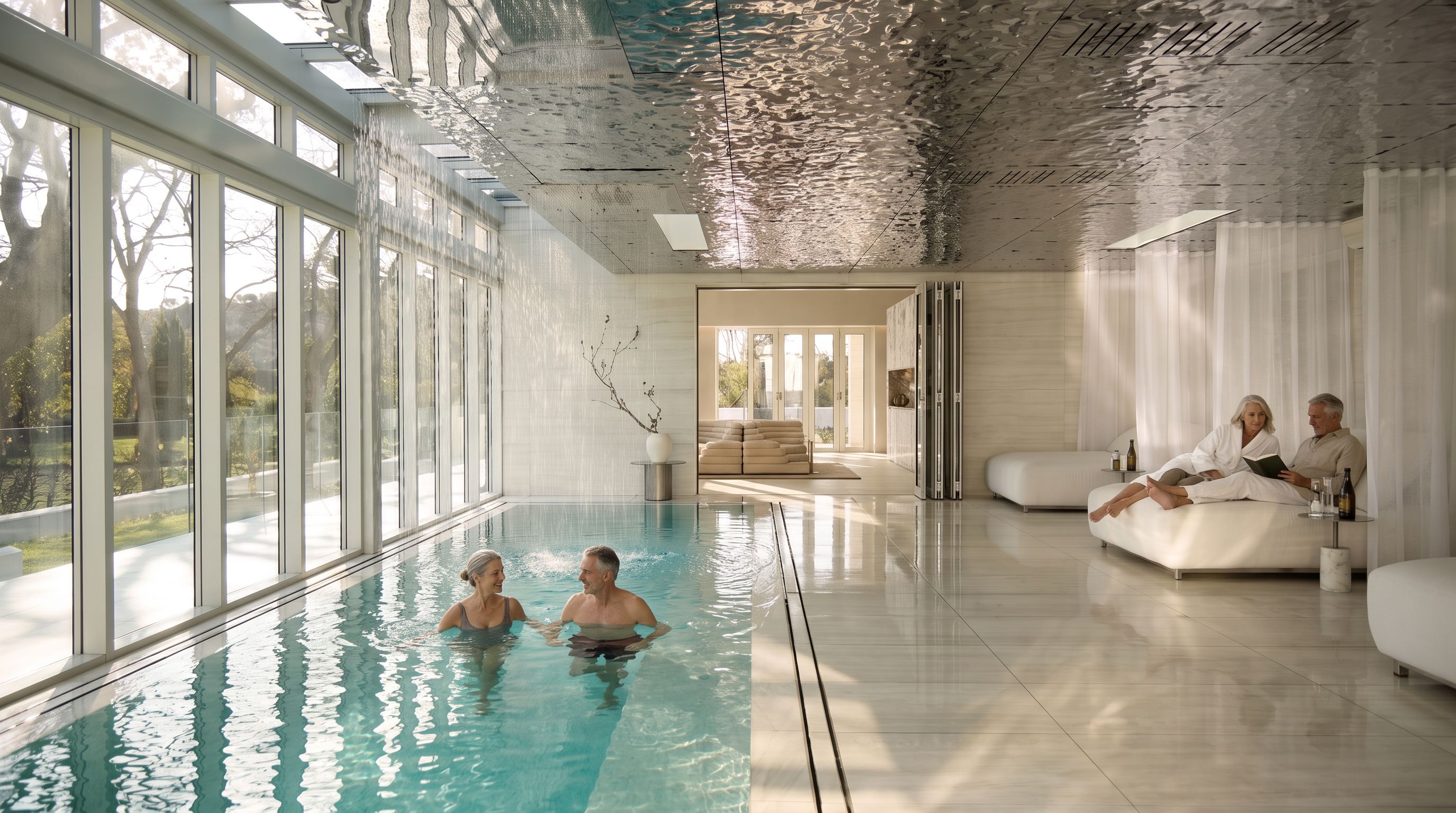 AI-edited
Transport is the other half of the picture. The City of Cape Town operates Dial-a-Ride for people with special needs, but the source does not set out booking requirements, coverage for a particular spa or same-day availability. Confirm with the operator before you rely on it.
How do I pace a spa day to ease jet lag?
Book your treatment for the middle of the day, not the morning, and keep the day short. A long-haul arrival leaves most travellers 50-70 waking early and fading by mid-afternoon. A midday slot at a spa open from 08:00 to 20:00 lets you arrive rested, take one treatment, use the warm pool briefly and leave before the dip.
Daylight is your ally. Cape Town's summer months (December to February) bring average highs of 25 to 26°C and average lows of 15 to 16°C, so an outdoor pool and a walk afterwards are comfortable. Winter, from June to August, brings average highs of 17°C and lows of 7 to 8°C, with rainfall concentrated in those months. In winter, plan around indoor facilities and a long lunch rather than the outdoor pool.
If you are arriving from Europe or North America, the guide to the long-haul flight and airport transfers covers the journey itself. For the spa day, three habits help:
- Take the treatment on your second day, after one full night's sleep.
- Choose one substantial treatment rather than three short ones.
- Leave the afternoon free, with no dinner booking before 19:30.
The Fairmont's own guidance is to arrive 20 minutes before a treatment. Build that into the plan rather than treating it as an afterthought.
When is the calmest time to go?
No Cape Town spa publishes occupancy figures or guaranteed quiet hours. The Fairmont describes its spa as tranquil and recommends advance booking at weekends, holidays and peak periods, which points to weekdays outside school holidays as the sensible choice. March is described by Cape tourism sources as warm, less windy and less crowded than midsummer.
That is a planning inference from published booking advice, not a measured quiet period. The most defensible approach is to book outside weekends, holidays and peak seasons, and to ask the spa whether any group bookings or events coincide with your date.
Seasonal context helps. December and January combine festive demand, school holidays and summer weather. February generally becomes less crowded after mid-month. March is described as a sweet spot with warm days, lower wind frequency and fewer crowds. April and May stay comfortable but become progressively wetter.
| Month | Average high | Average low | Pattern |
|---|---|---|---|
| January | 26°C | 16°C | Dry, strong south-easterly winds |
| February | 26°C | 16°C | Dry and warm, winds continue |
| March | 25°C | 14°C | Dry, warm, generally less windy |
| April | 22°C | 12°C | Autumn, rainfall increasing |
| May | 19°C | 9°C | Cooler, rain more frequent |
| June | 17°C | 8°C | Wet winter period |
| July | 17°C | 7°C | Wet, generally the coldest month |
| August | 17°C | 8°C | Wet winter period |
| September | 19°C | 9°C | Rain easing, spring returns |
| October | 21°C | 11°C | Drier and warmer |
| November | 23°C | 13°C | Generally dry, winds return |
| December | 25°C | 15°C | Dry, warm, busy festive season |
Cape Town's annual rainfall is described as approximately 515 mm, concentrated mainly from June through August. Winter is well suited to indoor treatments, hydrotherapy and a long lunch, provided you keep outdoor plans flexible.
What is the etiquette in a Cape Town spa?
Arrive 20 minutes before your treatment, as the Fairmont asks, and keep your voice low in relaxation areas. Silence in shared spaces is the near-universal convention, though individual spas publish their own rules. Ask about phone policy, robe and slipper provision, and whether a companion may wait in the relaxation room.
Beyond that, published etiquette for Cape Town spas is thin. The material does not document dress codes, tipping conventions or gratuity policies for specific properties. Ask at booking rather than guessing.
Two practical points are worth carrying with you. First, if you are combining a spa visit with other Cape Town sightseeing, the selection of Cape Town experiences chosen for the over-50s sets out what fits comfortably into a day. Second, the city's history is close by: the guide to the Castle, District Six and Robben Island is worth reading before you plan a spa day alongside a museum visit, so the two do not collide.
How do I get to the spa safely?
Use pre-booked transfers or accredited transport, and keep valuables out of sight. The City of Cape Town advises visitors to use accredited public transport, including recognised taxis, e-hailing services and buses. Cape Town Tourism recommends arranging a fixed-price airport transfer in advance through a reputable provider or using the airport transfer kiosk.
From the airport, the V&A Waterfront is 22 km by road, about 15 minutes with clear roads. Allow considerably more on the day itself, since that figure assumes free-flowing traffic and no stops. The MyCiTi Airport service links the airport to Civic Centre station every 30 minutes, with level boarding that helps passengers with luggage and may assist some wheelchair users. The airport's public-transport area is the Transport Plaza, opposite the Central Terminal Building and reached via a subway under the main road, as set out in the airport's own transfer information.
At the airport, use only authorised taxi or shuttle operators and refuse unsolicited offers. The City's general safety guidance for visitors adds that you should keep possessions close on public transport, avoid leaving items unattended, travel with someone where possible and not take trains late at night.
What if something goes wrong on the day?
Cape Town's emergency numbers are published by the City. The general emergency centre is 021 480 7700, described by the City as the single entry point for life- or property-threatening emergencies. The toll-free cellphone number is 112, the landline emergency number is 107, and the ambulance number is 10177.
Sea and mountain rescue can be reached on 021 449 3500. The Police Flying Squad is on 10111, and the Disaster Risk Management Centre on 080 911 4357. Cape Town Tourism runs a 24-hour Band-Aid visitor-support service on 021 487 6552, which can help with lost documents, victim-support counselling, emergency accommodation and transfers, itinerary changes, and reporting incidents to the South African Police Service.
For non-emergencies, the nearest pharmacy and the nearest hospital cannot be identified reliably without a precise spa address. Ask the spa which pharmacy and medical facility it recommends for its address, and note the answer with your booking confirmation.
If a treatment or facility is not as described, raise it at the desk before you leave. Cancellation terms are not documented for the Cape Town spas, so the remedy is easier to negotiate on the day than afterwards.
Can I find thermal water in Cape Town itself?
No natural thermal spring within Cape Town is documented. The hot-spring properties of the Western Cape lie outside the city and require separate transport planning. Caledon, Goudini, Montagu, The Baths at Citrusdal and Warmwaterberg are all day trips rather than city spa visits.
For readers who want mineral water rather than a hotel spa, Caledon Hotel & Spa in the Overberg is described by Cape Town Tourism as fed by mineral-rich warm springs from geothermally heated groundwater, with a Victorian bathhouse dating from 1902. One source lists day visits there Tuesday to Sunday, 09:00 to 17:00, with advance booking and guests bringing their own towel and robe.
Warmwaterberg Spa, near Barrydale, is described with spring water reaching 44°C at the source and high in iron. One source lists day passes at R80 per person, with visitor numbers limited and access from 08:00 to 17:00. Montagu Springs Resort lists daily hours of 08:00 to 20:00 in summer and 08:00 to 18:00 in winter, with day visitors capped at 300. ATKV Goudini Spa restricts day visits to ATKV members, booked and paid at least 48 hours in advance.
Accessibility at all five is not documented. Rock pools at The Baths imply uneven natural terrain, but no formal accessibility statement is published. Confirm step-free routes, pool entry and walking distances directly with each property before booking transport.
Putting the day together
A Cape Town spa day works best as a single, unhurried appointment in the middle of the day, booked in writing, with your access questions answered before you pay. Choose the spa first, then ask about lifts, pool entry, changing facilities and treatment-room access. Confirm cancellation terms and any facility closures for your dates.
Build the day around the season. Summer months suit the outdoor pool and a walk afterwards; winter suits indoor treatments and a long lunch. March sits between the two, with warm days and fewer crowds than midsummer. Where the published material is silent, the spa itself is the only reliable source, and a written reply is worth more than a brochure.
Finally, keep the day small. One treatment, one pool, one meal. The point of a spa day after a long flight is not to see everything the city offers, but to arrive at the rest of your trip rested.


