
Cape Town sits at the end of a long flight, and the last two hours of the journey, from the aircraft door to the hotel lobby, decide how the first two days feel. Cape Town International Airport is about 20 km from the city centre, according to Cape Town Tourism's official airport guide, and it handles more than 10 million passengers a year, the City of Cape Town reported for 2024. The airport is well organised for older arrivals, but the onward transfer needs a decision made before departure, not in the arrivals hall at midnight.
This guide covers the flight itself, the airport, and the transfer to your hotel. Getting around the city afterwards is a separate subject with its own dedicated guide.
How long is the flight, and where do you change planes?
There is no non-stop flight from North America to Cape Town, and European routes usually involve one change. The journey is long enough that the connection, not the flying time, is what most travellers should plan around. Allow at least three hours for any connection, and avoid tight transfers at the end of a long first leg.
Cape Town International Airport has two terminals, one for international flights and one for domestic, connected through a central building. That layout matters if you fly via Johannesburg or another South African hub and continue to Cape Town on a domestic flight: you clear immigration once, then walk to the domestic side.
The airport's own accessibility page advises allowing at least 2.5 hours for international-to-domestic connections. A Fodor's forum trip report, posted in 2012 and updated in March 2025, describes a routing through Paris where the connection was missed and the wait for the next flight ran to 12 hours; the poster advised allowing at least three hours and avoiding Paris for the change if possible. That is one traveller's account, not a rule, but the arithmetic is sound.
Which route and seat suit a traveller in their sixties?
Choose the route with the fewest changes and the longest connection, not the shortest total time. On board, an aisle seat near a galley or lavatory reduces the two things that make long flights hard after 60: sitting still for hours and queueing when you cannot.
For the November to March peak international season, the City of Cape Town reported that the city was connected by 24 airlines to 30 destinations across 35 routes, with 228 weekly flights. That is a wide choice, and it means the connection city is genuinely a decision rather than something dictated by price alone.
Seat choice is personal, but the planning points are consistent. An aisle seat lets you stand and move without disturbing a neighbour. A seat away from the bulkhead avoids foot traffic and light from the galley. If you use a wheelchair or mobility scooter, the airport states that these are accepted as checked baggage at no extra charge on all airlines at CPT, so the chair travels with the luggage rather than in the cabin.
Ask the airline about seat selection fees at the time of booking. The airport does not publish airline seating policies, and they vary by carrier and fare class.
How do you minimise jet lag on arrival?
South Africa runs two hours ahead of Central European Time and one hour ahead of British Summer Time, so the clock shift from Europe is modest. From North America the shift is larger. The reliable strategy is to sleep on the overnight leg, then stay awake and outdoors until a normal local bedtime.
Cape Town has a Mediterranean climate, with warm, dry summers and cooler, wetter winters, and daylight is the strongest signal your body has. Arriving in the morning and spending the first afternoon outside, even gently, does more than any supplement.
The airport itself helps here. Passengers can access up to 4 hours of free Wi-Fi or 1GB/500MB of data at no charge, according to Cape Town Tourism's airport guide, which makes it easy to message home and confirm your transfer while you wait for luggage.
Practical points for the flight:
- Book the overnight leg where you can, so the long sleep happens in the air.
- Set your watch to Cape Town time when you board, and eat and sleep accordingly.
- Drink water steadily; cabin air is dry and the flight is long.
- Plan nothing demanding for the first afternoon. A short walk and an early dinner are enough.
 AI-edited
What is Cape Town International Airport like on arrival?
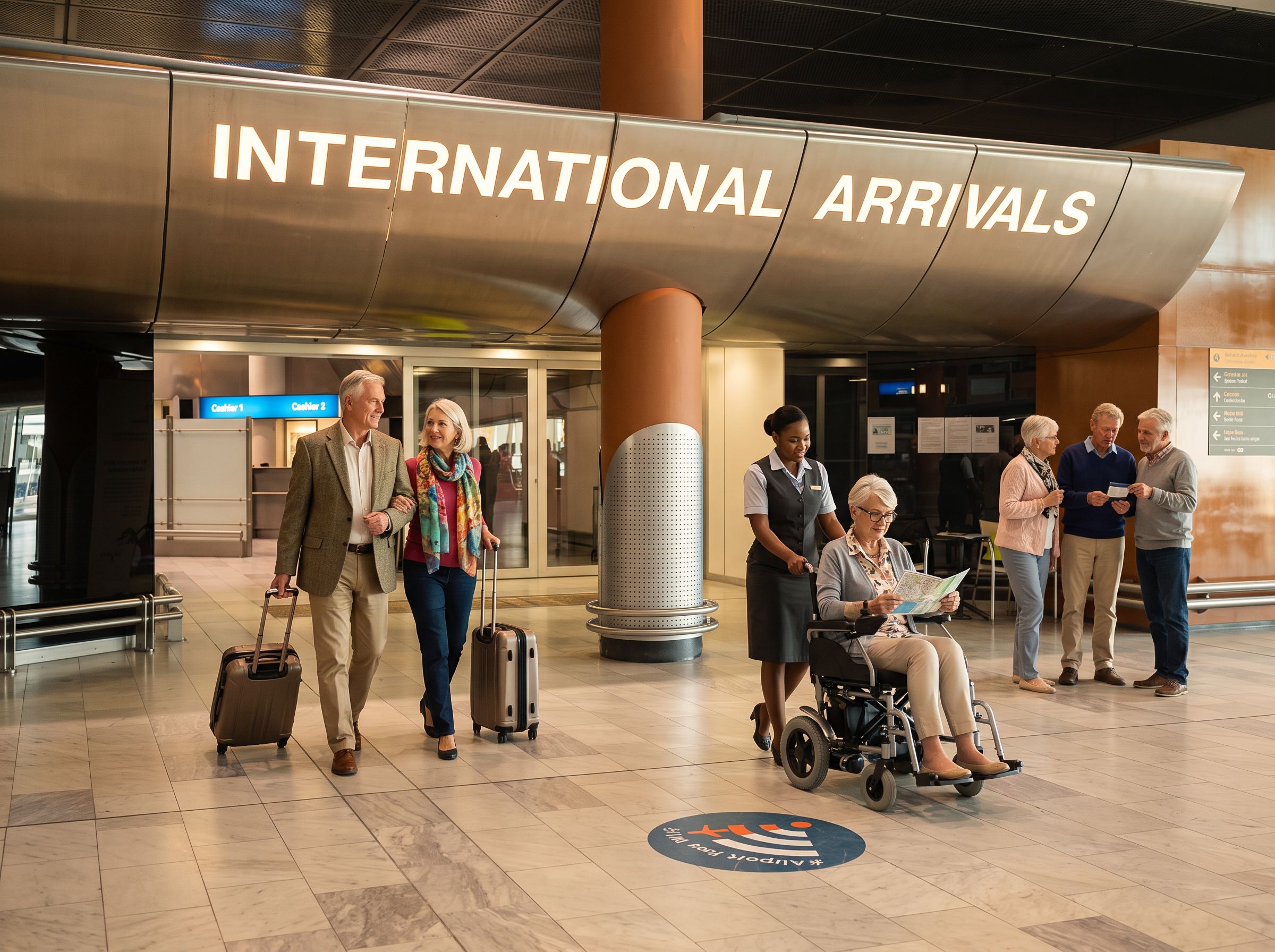
The airport is compact and step-free in its central building, with lifts at every level change, moving walkways, gently sloped ramps and accessible toilets on every floor in both terminals. A Visitor Information Centre sits on the ground floor of the central terminal, and free Wi-Fi covers the wait for bags.
The airport operator, Airports Company South Africa, describes the Central Terminal Building as fully step-free, with lifts at all level changes, dedicated check-in and security lanes for passengers with reduced mobility, ambulift services for aircraft parked on a remote apron, and accessible toilet facilities on every floor in both domestic and international areas. The ground-floor accessible toilet near the arrivals hall also has a full changing bench for passengers requiring personal care assistance.
Cape Town Tourism's airport guide lists moving walkways and ramps with gentle slopes, passenger elevators serving all levels, and wheelchair-friendly access to shops, restaurants and viewing decks.
Allow time at the other end of the trip too. Cape Town Tourism advises arriving two hours before departure for domestic flights and three hours for international flights to complete check-in.
How do you get from the airport to your hotel?
Pre-book a private transfer or use an authorised taxi from the official desk. The airport advises arriving passengers to use only authorised taxis and not to accept unsolicited offers from drivers inside the terminal or outside it. Authorised operators work from transport kiosks and the domestic-arrivals desk in the central terminal building.
The airport's transfer information page sets out taxis, shuttles, car hire and app-based rides. Uber and Bolt are listed as authorised services, and the designated pick-up point for both is on the ground floor of Parkade 1. The airport names Citi Hopper and Centurion Tours among its authorised shuttle operators, and shuttles run from the international inner lane, with representatives meeting passengers from the arrivals terminals.
Cape Town Tourism recommends pre-booking a transfer with a reputable company or through a travel agent, specifically to avoid negotiating transport after a long flight, and advises confirming the driver's name, vehicle, destination and price before departure. It lists Kingdom Tours and Transfers (info@kingdomtt.co.za, +27 21 705 6177) and Sunset Cape Transport, which meets passengers at the airport and also runs private chauffeured city and scenic tours. Neither listing documents a senior discount or a published vehicle-accessibility policy, so ask directly if either matters to you.
What do airport transfers cost, and what is included?
Fixed-rate transfers depend on the distance between the airport and your destination. Cape Town Tourism notes that firms may charge extra for luggage, waiting time or after-hours travel, which it defines as 18:00 to 06:00. Ask what is included before you pay.
No general senior or over-65 fare for airport transfers is documented in the official sources. The concessions reported for Cape Town attractions, such as the Table Mountain Aerial Cableway's R130 return fare for South African citizens aged 60 and above, are tied to South African identification and do not extend to foreign visitors.
Distances give a sense of the journey:
| Destination | Distance by road | Driving time with clear roads |
|---|---|---|
| V&A Waterfront | 22 km | About 15 minutes |
| Blackheath Lodge | 23 km | About 20 minutes |
Those times assume free-flowing traffic with no stops. Congestion can make the journey substantially longer, so do not book a tight onward appointment on arrival day.
Is the MyCiTi airport bus running?
Not according to the operator. MyCiTi's own airport page currently states that the airport service is temporarily suspended, and the A01 bus to the Civic Centre was suspended on 1 December 2022. There is no rail link to the airport. Check the current position before relying on the bus.
Sources differ on the service. Cape Town Tourism's 2026 fact sheet says the airport service is currently suspended, while the same fact sheet also describes MyCiTi buses leaving the airport roughly every 20 minutes between 05:10 and 22:00. Treat the operator's suspension notice as the current position and confirm before you travel.
For the rest of the network, MyCiTi requires a personal myconnect card, with passengers tapping in and out. The published fare material describes cards, distance bands, airport supplements and passes, but no senior concession. MyCiTi runs a 24-hour information line on 0800 65 64 63.
The Public Transport Plaza sits directly opposite the Central Terminal Building entrance and is reached by a subway under the main road. The airport's official public transport page does not confirm that every onward vehicle or route is independently accessible, so ask about the specific service you intend to use.
What should you know about luggage and safety on the transfer?
Keep luggage with you until it is loaded, use the authorised desk rather than a driver who approaches you, and confirm the fare and vehicle before setting off. For app-based rides, check the registration and driver details in the app before boarding, and wait in the designated collection area rather than in the road.
Airports Company South Africa's advice is specific to the airport and its transfer arrangements. It does not extend to every part of the City of Cape Town municipality, and general safety conditions for a particular suburb, hotel or walking route are not documented in the official airport sources.
GetFromAirport's guidance adds a road-level point: stay on the N2 and the M3 rather than the R300, use the Airport Approach Road (exit 16 on the N2) rather than Borcherd's Quarry Road towards Nyanga, and do not follow satnav routes that leave the main roads. A pre-arranged hotel car or authorised taxi follows a known route, which is one reason to book ahead.
ACSA introduced a baggage-tracking feature in its mobile application in November 2025, which is worth installing before you fly.
Where should you stay if you land late or leave early?
An airport hotel removes the transfer question entirely for a late arrival or an early departure. Guest feedback on Hotel Verde Cape Town Airport repeatedly describes the complimentary shuttle as quick and frequent, and particularly useful for late-night arrivals and early-morning departures, according to Tripadvisor reviews.
Hotel Verde's guests also report that the hotel prepared a breakfast package for an early flight, and several reviews say they heard little or no aircraft noise and found the beds comfortable. a Tripadvisor restaurant review from March 2017 noted the room was quiet internally but exposed to aircraft and road noise outside, and the wider review summary notes occasional soundproofing concerns. Ask for a room away from the road when booking.
Road Lodge Cape Town International Airport draws more mixed reports. A Tripadvisor review from April 2026 described comfortable beds but called the hotel "all in all very noisy," with doors banging and luggage moving through corridors at night. Guest reports also conflict over whether a shuttle is available and whether it is complimentary, with one 2026 review citing a 160 rand charge and others describing difficulty arranging a transfer at all. Confirm the shuttle and its cost in writing before booking.
If you would rather stay in the city from the first night, our guide to Cape Town hotels where comfort comes first covers properties chosen for quiet and ease rather than proximity to the runway.
What should you pack, and what help is nearby on arrival?
Pack layers, a windproof outer layer, supportive shoes and sun protection. Cape Town's weather varies between the city, coast and mountains, and the mountain wind is a real feature of the summer months. Carry prescriptions in your hand luggage with copies of the paperwork.
The official climate normals describe warm, dry summers from December to February and cooler, wetter winters from June to August, with changeable, windy conditions in spring. The airport publishes these as 24-hour means and monthly rainfall, not daytime maximums, so pack for a range rather than a single figure.
For reference, Webb & Savoy Pharmacy at 34, corner of Main and Durban Roads, Mowbray, lists opening hours of Monday to Saturday 08:00 to 21:00 and Sunday 09:00 to 21:00. Groote Schuur Hospital on Main Road, Observatory, has a switchboard on 021 404 9111.
Emergency numbers to save before you fly:
- Police: 10111
- Ambulance: 10177
- From a mobile phone: 112
- From a landline: 107
- City emergency services: 021 480 7700
- Cape Town Tourism visitor support, 24/7: 021 487 6552
Once you are settled, the city itself opens up. Our complete guide to Cape Town for travellers over 50 covers the wider trip, and Cape Town's history at the Castle, District Six and Robben Island is the place to start on the sightseeing.
What is changing at the airport?
Airports Company South Africa has outlined a phased upgrade within a broader R21.7 billion network investment. The principal project is a new, realigned 3,500-metre main runway budgeted at about R6.39 billion, with contractor appointment planned for December 2026.
Domestic terminal expansion is scheduled to begin in April 2027, subject to approvals and procurement, with reported elements including a larger arrivals facility, a departures extension and additional gates. International terminal improvements are planned in phases with an estimated budget of R863 million. ACSA's 2024/25 annual report records progress on a R388 million domestic departure lounge and gate extension and a roughly R1 billion domestic arrivals project.
The reporting reviewed does not document a new airport rail link, a new express bus, or a specific transfer closure. The planned works could eventually alter roads, forecourts or walking routes, but no precise passenger-transfer disruption schedule has been published. For a trip in the next two or three years, the practical advice stands: pre-book the transfer, confirm the meeting point, and check the MyCiTi airport page before you rely on the bus.


